
Johnston’s Mangabey
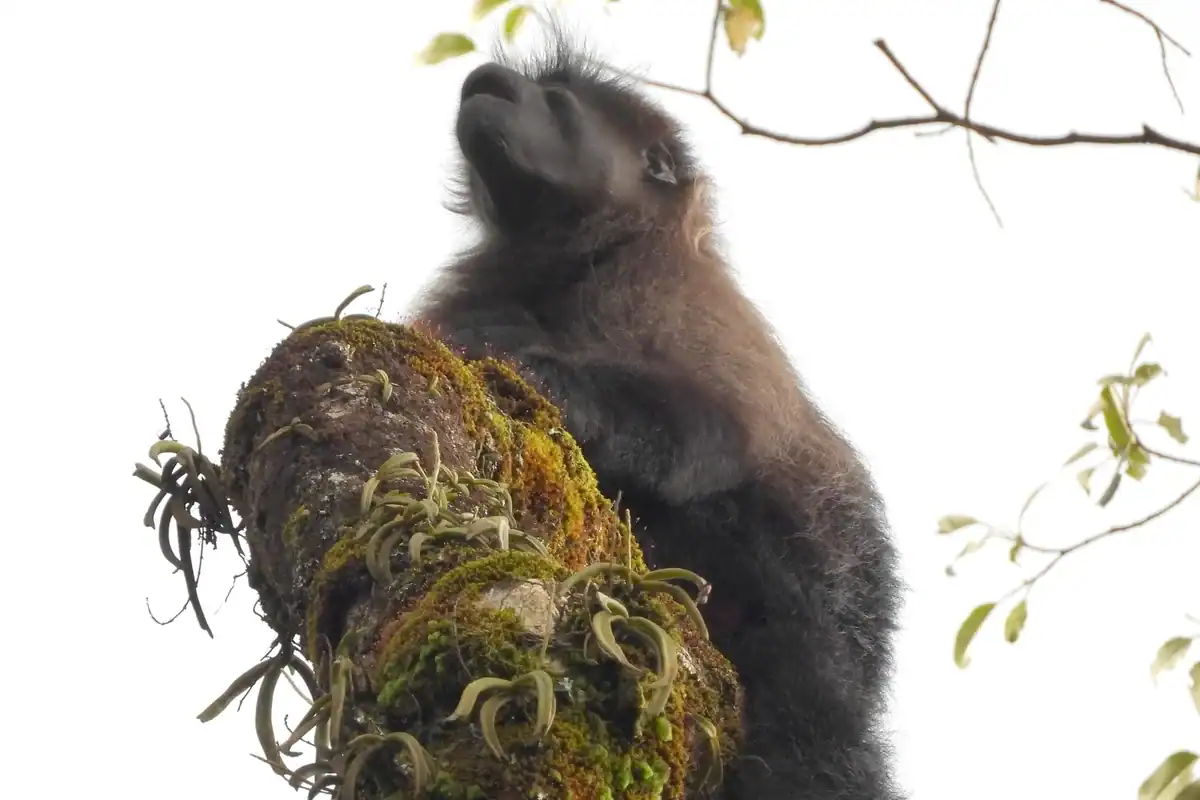
Johnston’s mangabey (Lophocebus johnstoni) lives in the eastern Congo Basin.[1] Rwanda and Burundi hold it along the Albertine Rift. It is the crested mangabey east of the Ubangi River.[2]
Richard Lydekker named it in 1900, as a subspecies.[2] Colin Groves raised it to a full species in 2007.[3] He also carved a second species out of it.
That second species is the Ugandan crested mangabey.[2] Whether the two intergrade is not known. Nobody has looked at the boundary between them.
It belongs to the crested mangabeys, genus Lophocebus. The genus sits inside the Old World monkeys.
Forests of the eastern Congo Basin, western Rwanda and western Burundi. Several of its strongholds have been occupied by armed groups.
- Common NameJohnston’s Mangabey
- Taxonomy Classification Year1900
- Monkey SizeHead-body 45 to 73 cm (18 to 29 in); tail 67 to 100 cm (26 to 39 in)
- Skin Color(s)Darkish brown to black, slightly lighter gray-brown mantle, thin pale cheeks
- HabitatPrimary and secondary tropical semi-deciduous forest
- DietOmnivorous; probably seeds, fruit, young leaves, bark, flowers and animal prey
- Native CountriesBurundi, Democratic Republic of the Congo, Rwanda
- Holds the Congo Basin east and south of the Ubangi River.[2] It stops at the Congo River to the south.
- Western Rwanda and western Burundi carry the Albertine Rift population.[2]
- It may reach northwestern Uganda and South Sudan.[1] Neither is confirmed.
- Groups run 6 to 14 animals in the Ituri Forest.[2] At Kahuzi-Biega they average about 21.
- Albinism is common in this species.[2]
Johnston’s Mangabey Distribution
 )
) )
) )
)Johnston's Mangabey Guide:
Mangabey Identification
The fur is darkish brown to black, above and below.[2] The mantle across the shoulders is only slightly lighter. It is a gray-brown rather than a strong contrast.
Crown hairs are swept back.[2] Long eyebrow tufts stand up as horns. The gray-cheeked mangabey carries those too.
The cheeks are light gray-brown, turning white lower down.[2] They are very thinly haired, which is a useful mark. The animal is slender, with long limbs and a long tail.
Albinism is common in this species.[2] In the gray-cheeked mangabey it is merely known to occur.[8] That is an unusual thing to record as a difference.
One caution on size. The Handbook prints the same measurements for three species.[2][8] Head-body 45 to 73 cm in males, tail 73 to 100 cm. Treat them as a guide to the genus, not to this animal.
Range And Habitat
Rivers set the edges of this species.[2] It holds the Congo Basin east and south of the Ubangi River. The Congo River stops it to the south.
That makes it the middle piece of a three-part puzzle. The gray-cheeked mangabey holds the forest west of the Ubangi.[8] The black crested mangabey holds the forest south of the Congo.
Western Rwanda and western Burundi carry the eastern population.[2] Nyungwe Forest National Park in Rwanda is one stronghold.
Two more countries are possible but unconfirmed.[1] One is northwestern Uganda, west of the Albert Nile. The other is South Sudan.
Habitat is primary and secondary tropical semi-deciduous forest.[2] Across most of its range it overlaps the agile mangabey. It also joins mixed parties with colobus monkeys and guenons.
Groups And Numbers
Two sites give almost all the published numbers.[2]
In the Ituri Forest groups run 6 to 14 animals.[2]
Lowland Kahuzi-Biega National Park is richer.[2] Groups there average about 21 animals. Density is markedly higher than in the Ituri.
Beyond that the record thins out fast. There is no published information on its breeding.[2] Its diet has never been studied in the wild either.
What the Handbook gives for diet is read across from the genus.[2] Seeds are probably the major component. Fruit, young leaves, bark, flowers and animal prey fill it out.
A Split Species
Lydekker described it in 1900 as Semnocebus albigena johnstoni.[2] The type came from near Lake Tanganyika.
The type locality has been moved twice since.[2] Schwarz fixed it in 1910 to present-day Burundi. Lorenz von Liburnau restricted it in 1917 to Semliki or Ituri.
Those two restrictions do not agree with each other. Burundi and the Ituri Forest are some 700 km apart.
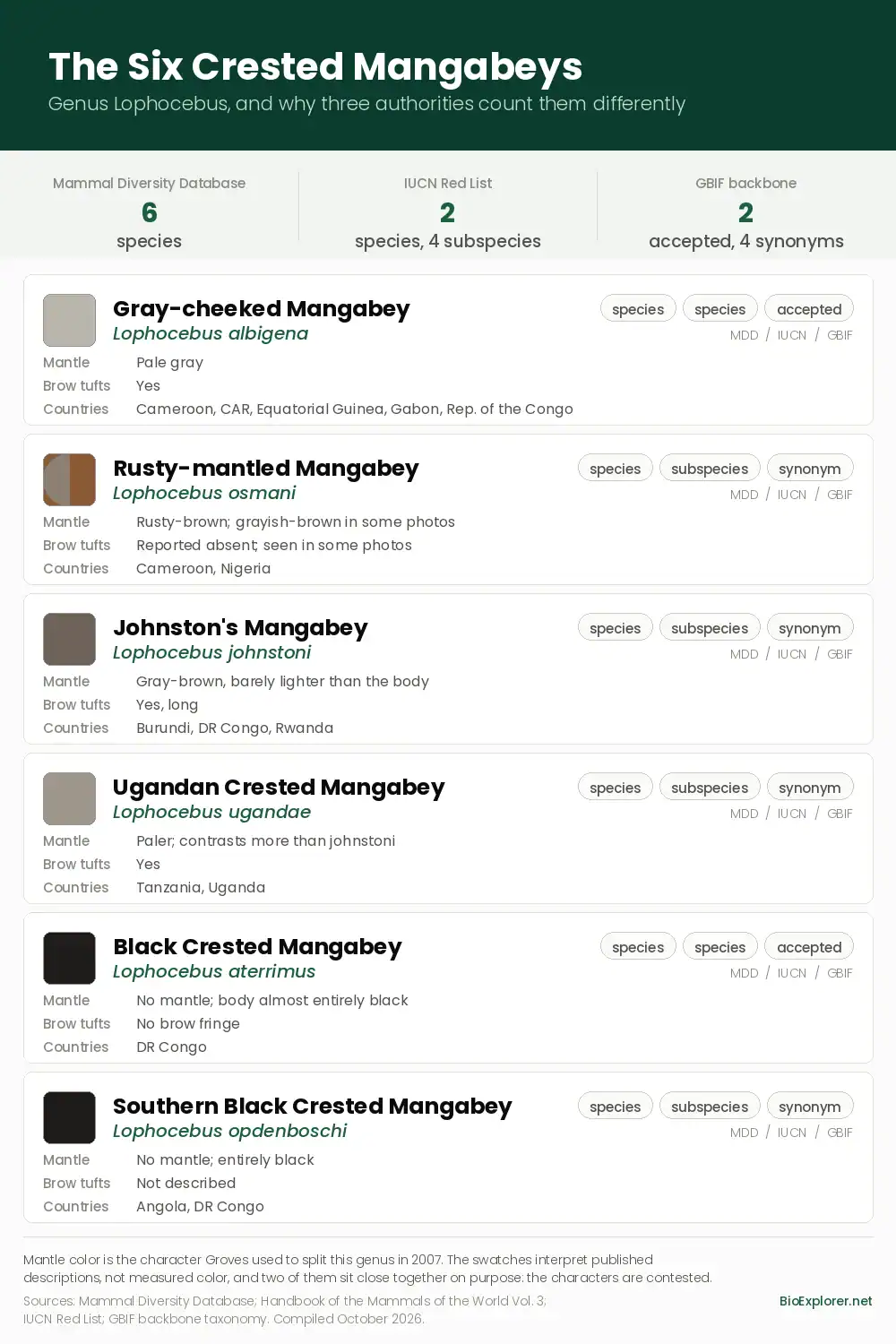
Groves reviewed the genus in 2007 and raised it.[3] He also split part of its population off as a separate species.[2]
Authorities still disagree about all of this.
- The Mammal Diversity Database accepts it as a species.[1] It calls the arrangement tentative.
- The IUCN assesses it as a subspecies of L. albigena.[4]
- The GBIF backbone lists the name as a synonym.[6]
- Mammals of Africa covers it inside the gray-cheeked mangabey account.[5]
This page follows the Mammal Diversity Database.[1] That is the authority the rest of this site uses.
The pattern repeats across the genus.[1]
Conservation Status
The IUCN has not assessed Lophocebus johnstoni as a species.[1] The badge above therefore reads Not Evaluated.
It is assessed as a subspecies instead.[4] Fiona Maisels made that assessment in 2019. It was published in 2020.
War is the pressure that sets this species apart.[2] It has become scarce in several protected areas. The reason given is civil war and armed occupation of its forests.
That is not a background threat. It names specific places where the animal used to be commoner.
Hunting for food is a pressure in some areas.[2] It is occasionally shot as a crop pest.
The protected area list is long for a poorly known monkey.[2] Kibira National Park covers it in Burundi. Nyungwe Forest National Park covers it in Rwanda.
The Democratic Republic of the Congo holds most of the rest.[2] Maiko, Kahuzi-Biega and Virunga National Parks are on the list. So are the Okapi Faunal Reserve, the Ituri Forest, Bomu and Yangambi.
Trade is regulated under CITES Appendix II.[2] The 1968 African Convention listed it in Class B.
The Handbook ends with a demand.[2] A reassessment of its distribution and conservation status is urgently needed.
Common Questions
In the eastern Congo Basin, east and south of the Ubangi River and north of the Congo River, plus western Rwanda and western Burundi along the Albertine Rift. It may also reach northwestern Uganda, west of the Albert Nile, and South Sudan, but neither is confirmed.
Mostly by where you are, because their ranges are divided by the Ubangi River. On the animal itself the mantle is the character: Johnston's mangabey has a gray-brown mantle only slightly lighter than the body, while the gray-cheeked mangabey's is a clearer pale gray. Both carry the upright eyebrow horns, so those do not separate them.
Authorities disagree. The Mammal Diversity Database accepts it as a species while calling the arrangement tentative. The IUCN treats it as a subspecies of Lophocebus albigena. The GBIF backbone lists the name as a synonym. Mammals of Africa covers it inside the gray-cheeked mangabey account. This page follows the Mammal Diversity Database.
In the Ituri Forest in the Democratic Republic of the Congo, groups run 6 to 14 animals. In lowland parts of Kahuzi-Biega National Park they are larger, averaging about 21, and density is markedly higher there. Those two sites supply almost all the published numbers for the species.
The IUCN has never assessed it as a species, so the badge reads Not Evaluated. It is assessed as a subspecies of L. albigena, by Fiona Maisels in 2019 and published in 2020. The Handbook of the Mammals of the World records that it has become scarce in several protected areas because of civil war and armed occupation of its forests, and calls for an urgent reassessment.
Because the Handbook of the Mammals of the World records albinism as common in Johnston's mangabey, while for the gray-cheeked mangabey it says only that albinism is known to occur. A difference in how often a pigment condition appears is an unusual thing to find recorded between two closely related monkeys.
The rusty-mantled mangabey is the fourth species Groves separated out, away west in Cameroon and Nigeria.
Cite this page
BioExplorer. (2026, October 8). Johnston’s Mangabey. https://www.bioexplorer.net/animals/mammals/monkeys/johnstons-mangabey/
About the author