
Rusty-Mantled Mangabey
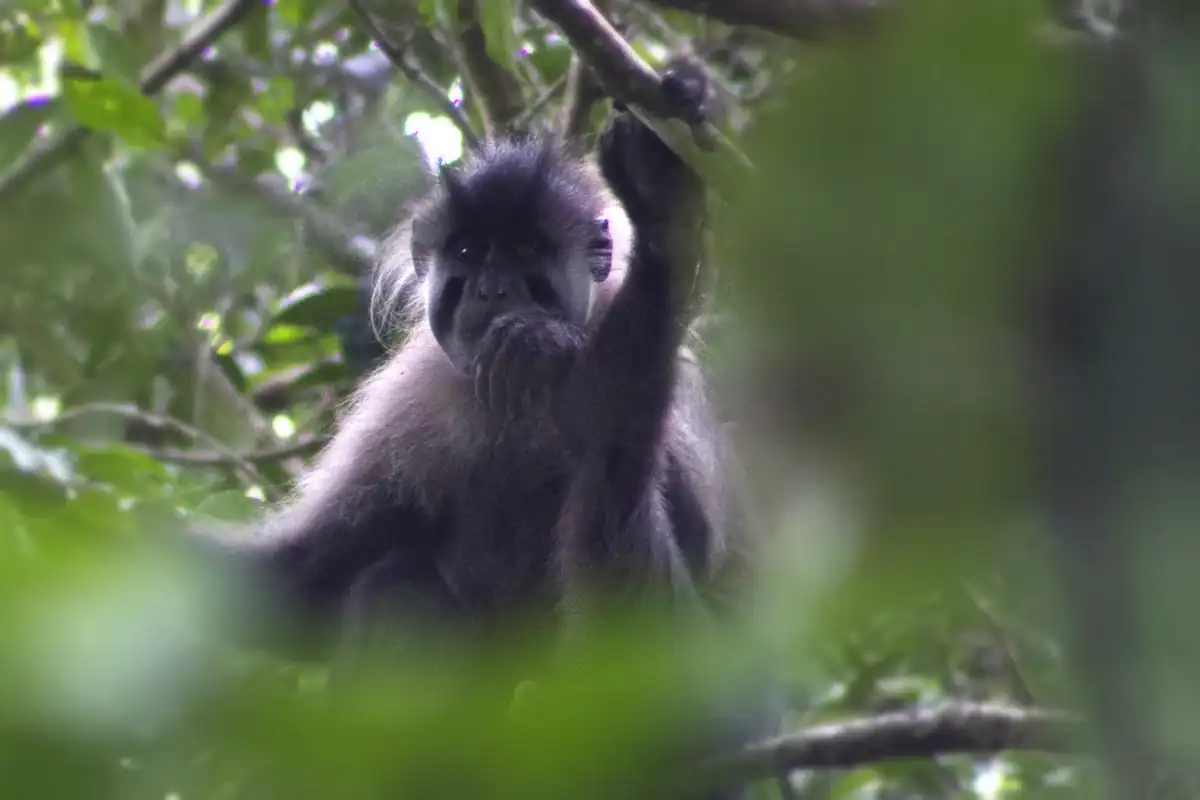
The rusty-mantled mangabey (Lophocebus osmani) is known from Cameroon.[1][4] It has also been recorded in Nigeria. Its current status there is uncertain. It is named for its reported rust-colored shoulder mantle.[2]
Colin Groves described it in 1978 as a subspecies.[2] He raised it to a full species in 2007.[3] Not every authority has followed him.
The 2013 Handbook called this the least-known crested mangabey.[2] Field data come mostly from populations whose taxonomic identity is uncertain. Breeding, home range, and social organization remain poorly documented.
It belongs to the crested mangabeys, genus Lophocebus. See where it sits among the mangabey monkeys. The genus falls inside the Old World monkeys.
The Mammal Diversity Database tentatively accepts this taxon as a species. IUCN treats it as a Data Deficient subspecies.
- Common NameRusty-mantled Mangabey
- Taxonomy Classification Year1978
- Monkey SizeNo verified taxon-specific measurements. Genus-level estimate: head-body 45 to 73 cm (18 to 29 in); tail 67 to 100 cm (26 to 39 in)
- Skin Color(s)Dark coat and pale cheeks; the shoulder mantle varies from rusty-brown to grayish-brown
- HabitatMostly lowland rainforest, plus riverine and swamp forest
- DietFruit, seeds, invertebrates, and other plant and animal foods; evidence comes from the taxonomically uncertain Dja population
- Native CountriesCameroon, Nigeria
- Known from west-central Cameroon.[1][4] Records also come from eastern Nigeria. Whether it persists there is uncertain.
- Confirmed or reported sites include Mbam-et-Djerem National Park in Cameroon.[4] A tiny population may survive in Nigeria’s Gashaka-Gumti National Park.
- Groves described a rusty-brown mantle.[3] IUCN notes that some photographed animals have a grayish-brown mantle.[4]
- Groves reported no upright brow tufts.[3] IUCN notes that some photographed animals do show them.[4]
- It may be locally extinct in Takamanda, Cameroon, and Okwangwo, Nigeria.[4]
Rusty-Mantled Mangabey Distribution
 )
) )
)Rusty-Mantled Mangabey Guide:
Mangabey Identification
The upper body is black with a brownish tinge.[2] Groves described the shoulder mantle as rusty-brown or tobacco-brown. IUCN notes that some photographed animals have a grayish-brown mantle.[4]
The underside is yellowish-gray.[2] The yellow is stronger toward the front. The arms are pale and the hands are black.
Cheeks are bright grayish-white or golden-white.[2] The crown is black, with a somewhat swept-back tuft.
Groves reported that its crown hair never forms upright brow tufts.[3] The gray-cheeked mangabey and Johnston’s mangabey often carry those tufts. IUCN notes visible tufts in photographs from Mbam-et-Djerem.[4]
It is a slender animal, with long limbs and a long tail.[2]
One caution on size. The Handbook gives this taxon the gray-cheeked mangabey’s measurements.[2][8] Treat its figures as a genus-level guide, not verified measurements for L. osmani.
Range And Habitat
The confirmed range is in west-central Cameroon.[1][4] Records also exist from eastern Nigeria. IUCN lists the taxon as possibly extinct there.
Cameroonian records extend from coastal Douala-Edéa to the Cameroon Plateau.[3][4] Other records come from Dja and Mbam-et-Djerem. Historic records also exist near Mamfe.
Nigerian records come from the border region and Gashaka-Gumti National Park.[4] The Gashaka-Gumti record involved one male seen from 2004 to 2008.
IUCN describes the recorded localities as mostly lowland rainforest.[4] The taxon also uses riverine and swamp forest.
Some authors called the Dja population a possible hybrid. The other parent would be the gray-cheeked mangabey.[4][8] Genetic evidence has not confirmed that interpretation.
Diet And Feeding
A 2001 study followed mangabeys in the Dja Biosphere Reserve. It ran for 11 months.[9] Fruit made up 33% of feeding records, seeds 29%, and invertebrates 27%. Other foods included leaves, flowers, and occasional vertebrate prey.[4]
The study identified the animals as L. albigena.[9] Later sources described the Dja population as intermediate or possibly hybrid.[4] Its results may not represent other L. osmani populations.
A Split Species
Groves described it in 1978 as Lophocebus albigena osmani.[2] The type specimen came from Edea in Cameroon. He put the locality at 3 degrees 30 north.
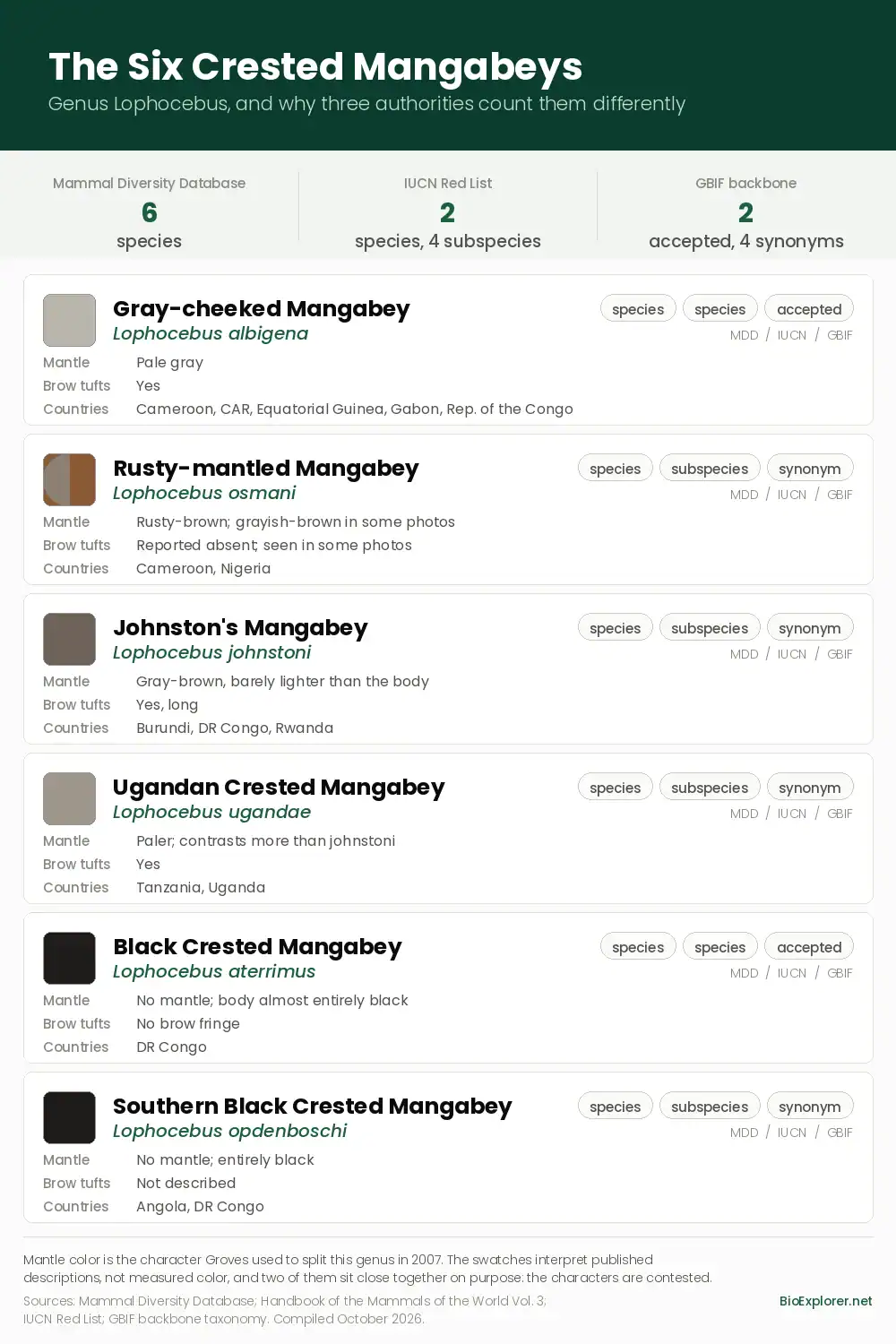
The Mammal Diversity Database lists two scientific names for the taxon.[1] They reflect its treatment as either a species or a subspecies.
In 2007, Groves reviewed the group and raised L. osmani to species rank.[3] He cited consistent coat differences and skull measurements. The review also recognized the Ugandan crested mangabey as a distinct species.
Authorities have not settled on one answer.
- The Mammal Diversity Database tentatively accepts it as a species.[1]
- The IUCN assesses it as a subspecies of L. albigena.[4]
- The GBIF backbone lists the name as a synonym.[6]
- Mammals of Africa covers it inside the gray-cheeked mangabey account.[5]
This page follows the Mammal Diversity Database.[1] That is the authority the rest of this site uses.
The disagreement changes how records are labeled. Under the Mammal Diversity Database treatment, Nigerian records belong to L. osmani, not L. albigena.[1]
The same disagreement runs across the whole genus.[1]
What Is Unknown
The 2013 Handbook called this the least-known crested mangabey.[2] Important gaps remain.
- The only detailed feeding study involved the taxonomically uncertain Dja population.[4][9]
- It reported no taxon-specific information on breeding.[2]
- It also reported no taxon-specific data on home range or social organization.[2]
- Its distribution and population status still need reassessment.[2][4]
- One free-licensed photograph of a wild animal is online.[7]
The Handbook described it as diurnal and arboreal.[2] It provided no further taxon-specific activity data.
Data from better-studied Lophocebus species is not fact for this taxon. Field surveys and ecological studies are still needed.
Under the Mammal Diversity Database, Nigerian records belong to this species.[1] Those animals remain exceptionally poorly documented.
Conservation Status
The IUCN has not assessed Lophocebus osmani at species rank.[1] The badge above therefore reads Not Evaluated.
IUCN instead assessed L. albigena osmani as a subspecies in 2021.[4] That assessment classifies the subspecies as Data Deficient.
IUCN lists its occurrence in Nigeria as possibly extinct.[4] A very small population may survive in Gashaka-Gumti National Park.
Hunting for bushmeat is a likely major threat.[2] Habitat loss to farming is the other.
Two local extinctions are suspected.[4] One is in Takamanda National Park, Cameroon. The other is the Okwangwo Division of Cross River National Park.
Trade is regulated under CITES Appendix II.[2] The 1968 African Convention listed it in Class B.
The 2013 Handbook called for an urgent assessment. It named distribution, ecology and conservation status.[2]
Common Questions
Confirmed populations are in west-central Cameroon. Records also come from eastern Nigeria. IUCN lists the taxon as possibly extinct there, though a very small Gashaka-Gumti population may survive. Its full range needs reassessment.
Groves described a rusty-brown mantle and no upright brow tufts. IUCN notes grayish-brown mantles and visible tufts in some photographs. These traits are useful clues, but they are not infallible.
Authorities disagree. The Mammal Diversity Database tentatively accepts it as a species. IUCN assesses it as the subspecies Lophocebus albigena osmani. GBIF treats the species name as a synonym of that subspecies. Mammals of Africa includes it in the gray-cheeked mangabey account. This page follows the Mammal Diversity Database.
A study of the Dja population recorded fruit, seeds, invertebrates, leaves, flowers, and occasional vertebrate prey. However, that population may be intermediate or hybrid. Its diet may not represent other rusty-mantled mangabey populations.
IUCN has not assessed it at species rank, so its species-level status is Not Evaluated. IUCN does assess the subspecies Lophocebus albigena osmani as Data Deficient. Hunting and forest clearance are the main suspected threats. The taxon may be extirpated from Takamanda and Okwangwo.
It has received little taxon-specific field research. The 2013 Handbook called it the least-known crested mangabey. It reported no taxon-specific data on breeding, home range, or social organization. Its distribution and population status also need reassessment.
The black crested mangabey is the southern member of this genus, across the Congo River.
Cite this page
BioExplorer. (2026, October 8). Rusty-Mantled Mangabey. https://www.bioexplorer.net/animals/mammals/monkeys/rusty-mantled-mangabey/
About the author