
Red-bellied Monkey
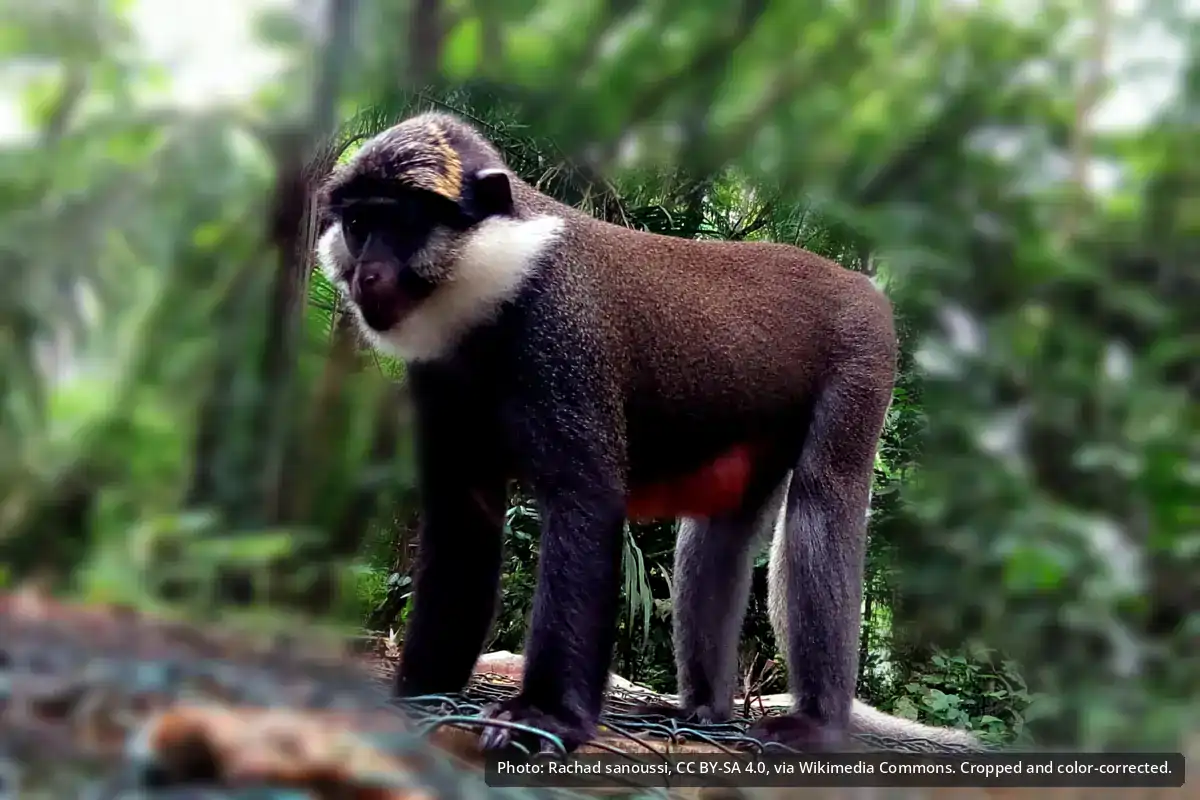
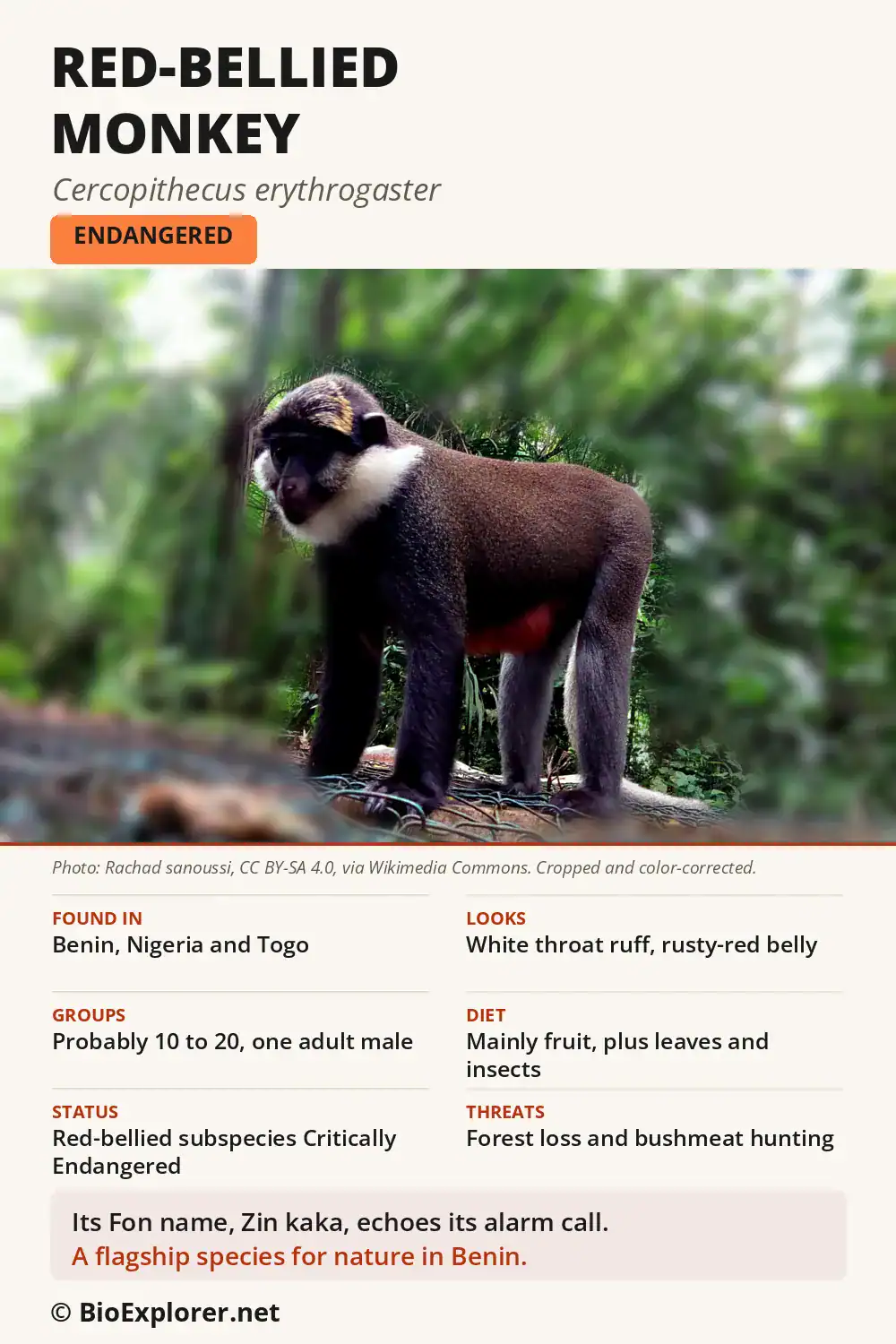
The red-bellied monkey is a small guenon of West Africa. Its scientific name is Cercopithecus erythrogaster.[1] It lives only in Benin, Nigeria and a corner of Togo. It is one of the Old World monkeys. The IUCN lists it as Endangered.[2]
This Endangered guenon lives in the forests of Benin, Nigeria and Togo.
- Common NamesRed-bellied monkey, red-bellied guenon, white-throated monkey, white-throated guenon
- Taxonomy Classification Year1866
- Monkey Size40 to 50 cm (16 to 20 in), head and body
- Skin Color(s)Red-brown back, dark arms, gray legs, white throat ruff, red or gray belly
- HabitatLowland moist, semi-deciduous, gallery and swamp forest, up to 400 m
- DietProbably mostly fruit, plus leaves, insects and crops
- Native CountriesBenin, Nigeria, Togo
- A thick ruff of white hair covers its throat and neck.
- The red-bellied guenon subspecies has a bright rusty-red belly.
- The Nigerian subspecies has a brownish-gray belly instead.
- It is thought to eat mostly fruit, plus leaves and insects.
- It lives low in dense, tangled forest near water.
Red-bellied Monkey Distribution
 )
 )
 )
Red-bellied Monkey Guide:
Name and Classification
John Edward Gray named this monkey in 1866. He described a live animal at the London Zoo. Its wild origin was recorded only as West Africa. In 1999, scientists fixed its type locality as Benin's Lama Forest.[3]
It belongs to the cephus group of guenons. That group also holds the moustached guenon and the red-eared guenon. Sclater's guenon and the lesser spotted-nosed monkey are members too.
Two subspecies are recognized by the IUCN and the handbook. The red-bellied guenon, C. e. erythrogaster, lives in Benin and Togo. It also reaches southwesternmost Nigeria. The Nigeria white-throated monkey, C. e. pococki, lives in Nigeria. The Mammal Diversity Database treats both subspecies names as synonyms.
Physical Description
Its most striking feature is a ruff of white hair. It sits under the lower jaw and spreads onto the neck. That is why some people call it the white-throated monkey.
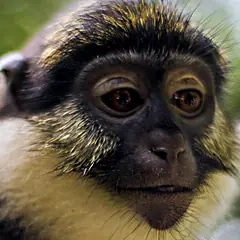
A band of gold-flecked black hair crosses the front of the crown. Its cheek tufts are light yellow and black, with white whiskers. The nose patch may be white, black or dark brown.
The back and flanks are a dark agouti red-brown. Those warm tones place it among the brown monkeys. The arms are almost black. The legs are a lighter gray.
In the red-bellied guenon, the chest and belly are bright rusty red. That makes it one of the true red monkeys. The groin and inner thighs stay white.
The Nigerian subspecies has a brownish-gray chest and belly. Some show a slight reddish tinge. With their gray legs, they also count among the gray monkeys.
The tail is grayish white below, with a dark tip. It often holds the tail in a question-mark curve.
Size and Weight
The handbook gives these ranges. It does not give sample sizes.
Male head-body length is 45 to 50 cm (18 to 20 in). Female head-body length is 40 to 45 cm (16 to 18 in). The male tail runs 65 to 70 cm (26 to 28 in). The female tail runs 55 to 60 cm (22 to 24 in).
Males weigh 3.5 to 4.5 kg (7.7 to 9.9 lb). Reported male ranges are generally higher than female ranges.
Similar Species Compared
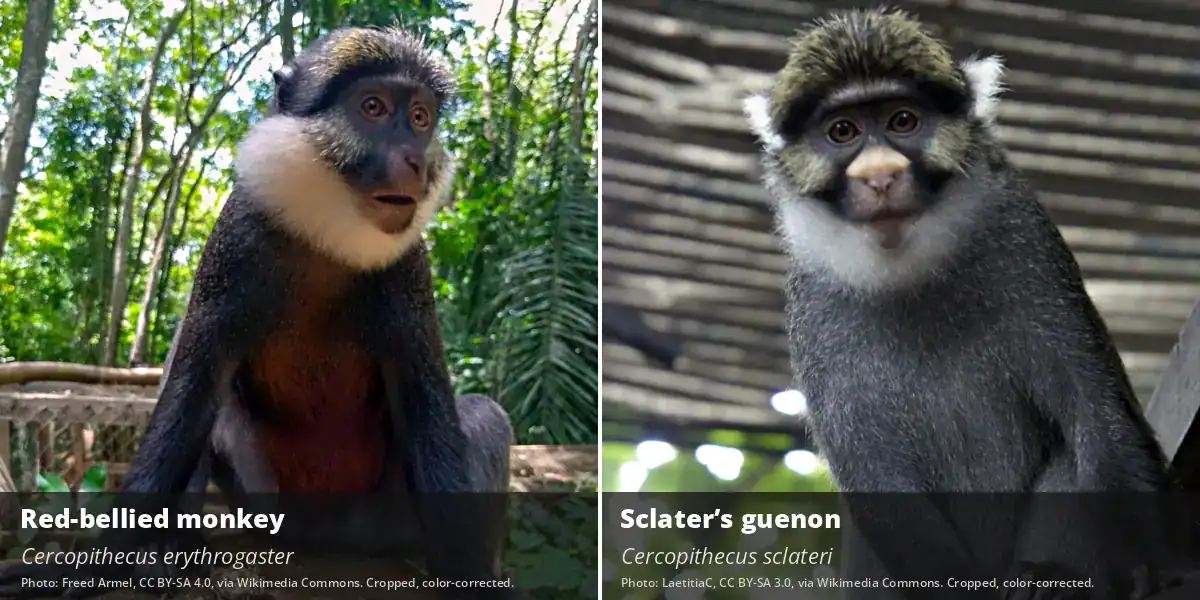
Sclater's guenon overlaps its range in the Niger Delta.[4] It lives in southeastern Nigeria, between the lower Niger and Cross rivers. Its throat is white, but it lacks a full ruff. Its nose is pale and pinkish. The red-bellied monkey reaches east of the Orashi River. There, it meets and hybridizes with Sclater's guenon in a narrow zone. Sclater's guenon is listed as Endangered.[5]
The red-eared guenon lives farther east.[6] It is found on Bioko and near the Nigeria-Cameroon border. It has a rusty-red tail and red ear fringes. Its nose spot is red. The IUCN lists it as Vulnerable.[7]
The lesser spotted-nosed monkey lives farther west.[8] It ranges from Senegal to western Togo. It has a bright white nose spot and a white belly. It is listed as Near Threatened.[9]
| Trait | Red-bellied monkey | Sclater's guenon | Red-eared guenon | Lesser spotted-nosed monkey |
|---|---|---|---|---|
| Scientific name | Cercopithecus erythrogaster | Cercopithecus sclateri | Cercopithecus erythrotis | Cercopithecus petaurista |
| Range | Southern Benin, southeastern Togo, southwestern Nigeria | Southeastern Nigeria, between the lower Niger and Cross rivers | Bioko, southeastern Nigeria and western Cameroon | Senegal to western Togo |
| Habitat | Lowland moist, gallery and swamp forest, up to 400 m | Secondary, gallery and swamp forest and village groves, below 130 m | Lowland and submontane moist forest, up to 3,100 m | Forest, gallery forest, savanna woodland and farmbush |
| Coat and key marks | White throat ruff, red or gray belly, variable nose patch | White throat without a ruff, pale pinkish nose | Rusty-red tail and ear fringes, red nose spot | White nose spot, white throat ruff, white belly |
| Head and body | Males 45 to 50 cm | Males 45 to 55 cm | Males 45 to 55 cm | Males 44 to 53 cm |
| Tail | Males 65 to 70 cm | Males 60 to 75 cm | Males 56 to 77 cm | Males 57 to 79 cm |
| Weight | Males 3.5 to 4.5 kg | Males 3 to 4.5 kg | Males 3.5 to 4.5 kg | Males 2.5 to 4.5 kg |
| Diet | Fruit probably dominates, plus leaves and insects | Mainly fruit, plus leaves and animal prey | Fruit, leaves, shoots and arthropods | Taï: foliage 40%, fruit 34% of feeding time |
| Group size | Probably 10 to 20, observed up to 30 | 3 to 30 | 4 to 30 | 4 to 24, average 11 |
| IUCN status | Endangered (assessed 2016) | Endangered (assessed 2019) | Vulnerable (assessed 2020) | Near Threatened (assessed 2017) |
Range and Distribution
It is found in three West African countries. These are Benin, Nigeria and Togo. Its populations are scattered across isolated forest patches.
The red-bellied guenon lives in southern Benin and southeastern Togo. It also reaches the far southwestern corner of Nigeria. In Benin, it once ranged from the Couffo River to Nigeria.[10] Today it survives in the Lama Forest and in wet sacred groves.
In Togo, it lives in Togodo and the Godjin-Godjè sacred forest. A national checklist calls it one of Togo's rare primates.[11]
The Nigeria white-throated monkey lives in southwestern Nigeria and the Niger Delta. It occurs in Okomu National Park and Omo Forest Reserve. The line between the two subspecies is unclear.
Habitat Needs
It lives in lowland moist and semi-deciduous forest. It also uses riverine gallery forest and swamp forest. It lives from sea level up to 400 m (1,300 ft). These forests make it one of the rainforest monkeys of West Africa.
It rarely strays far from water. A 2022 habitat model studied southern Benin.[12] Distance to water mattered most. Only 3.62% of the study area was suitable. Most suitable patches were tiny.
It survives in forests too flooded to farm. Sacred groves, where hunting is taboo, also shelter it.
Diet and Feeding
Its diet is poorly known. Fruit is thought to be its main food. It also eats leaves and insects. In Lama, it favors ripe fruit. In the dry season, it eats more unripe fruit. That fruit-heavy diet places it among the frugivorous monkeys.
Insects and leaves round out its meals. That mix also makes it one of the omnivorous monkeys. It raids crops where forest has shrunk.
At a Benin sanctuary, monkeys stripped and ate neem bark.[13] They also caught and ate grasshoppers. They were never seen eating vertebrate prey.
Behavior and Groups
The red-bellied monkey is active by day. It prefers dense, tangled vegetation. It spends much of its time low in the canopy. It walks, runs and climbs on small and medium branches.
It is very hard to watch. Its sharp eyes spot people first.
Most groups probably hold 10 to 20 animals. Groups of up to 30 have been seen. Each group likely has one adult male. Census groups in Lama averaged 9.6 animals.
It often joins mixed groups with the mona monkey. In Okomu, the greater spot-nosed monkey joins them too.
Its alarm call is a loud, explosive ka-ka call. Its Fon name in the Ouémé Valley is Zin kaka.
Population and Status
The 2016 assessment gave no total population estimate. The IUCN listed the species as Endangered in its 2016 assessment. It estimates a decline of at least 50% over 27 years.
Encounter rates in the Lama Forest fell by 55.5%. They dropped from 0.09 to 0.04 groups per km. That change came between 1995 to 1997 and 2014 to 2015. In Okomu National Park, encounter rates fell 26.7% from 1982 to 2010.
The two subspecies are assessed separately. The red-bellied guenon is Critically Endangered.[14] The Nigeria white-throated monkey is Endangered.[15]
Major Threats
Most of its forest has been cut or degraded. Much of it is now farmland. Nigeria lost 98.7% of its primary forest from 1990 to 2015. In the Niger Delta, logging degrades the remaining forest.
Hunting for bushmeat is rising. Larger monkeys are disappearing from its forests. One is the Niger Delta red colobus. So this smaller monkey is now hunted more for meat.
The 2016 assessment called the Adjarala dam a threat to Togodo. It projected flooding of about 2,315 ha of forest.
Conservation Efforts
It is listed on CITES Appendix II. It is also in Class A of the African Convention. Benin lists the red-bellied guenon as fully protected.[16]
It lives in a handful of protected areas. These include Okomu National Park and several Nigerian forest reserves. Others are the Lama Forest in Benin and Togodo in Togo.
The Red List calls for stronger anti-poaching patrols in all three countries. It also urges national park status for the Lama Forest.
The Sanctuaire des Singes began near Cotonou in 1995. It started on 2.5 ha. It grew to 14 ha of regrown forest. Fourteen monkeys founded the group. All but one came from the Ouémé floodplain. By the end of 2023, 42 monkeys lived in two groups. From 1999 to May 2024, 66 infants were born there. The species is now a flagship for nature protection in Benin.
Explore more monkeys starting with R. Or browse all types of monkeys.
Common Questions
The red-bellied monkey lives in southern Benin, southwestern Nigeria and southeastern Togo. It needs forest near water.
Its nominate subspecies has a bright rusty-red belly. The Nigerian subspecies has a grayish belly.
The red-bellied monkey probably eats mostly fruit. It also eats leaves, insects and crops.
Yes. The IUCN lists the red-bellied monkey as Endangered. Its red-bellied guenon subspecies is Critically Endangered.
A male red-bellied monkey measures 45 to 50 cm, head and body. Males weigh 3.5 to 4.5 kg.
The red-bellied monkey has a full white throat ruff. Sclater's guenon has a pale pinkish nose instead.
Cite this page
BioExplorer. (2026, November 2). Red-bellied Monkey. https://www.bioexplorer.net/animals/mammals/monkeys/red-bellied-monkey/
About the author

Wildlife Writer and Photographer, BioExplorer.net
Arjun is a science writer and wildlife photographer at BioExplorer.net. He turns new research on animals into clear, accurate reads for curious readers. His work covers animal behavior, ecology, and newly described species. He holds a Cornell Lab of Ornithology certificate in bird biology. He is pursuing an HBSc at the University of Toronto Mississauga.