
Aquino’s Titi
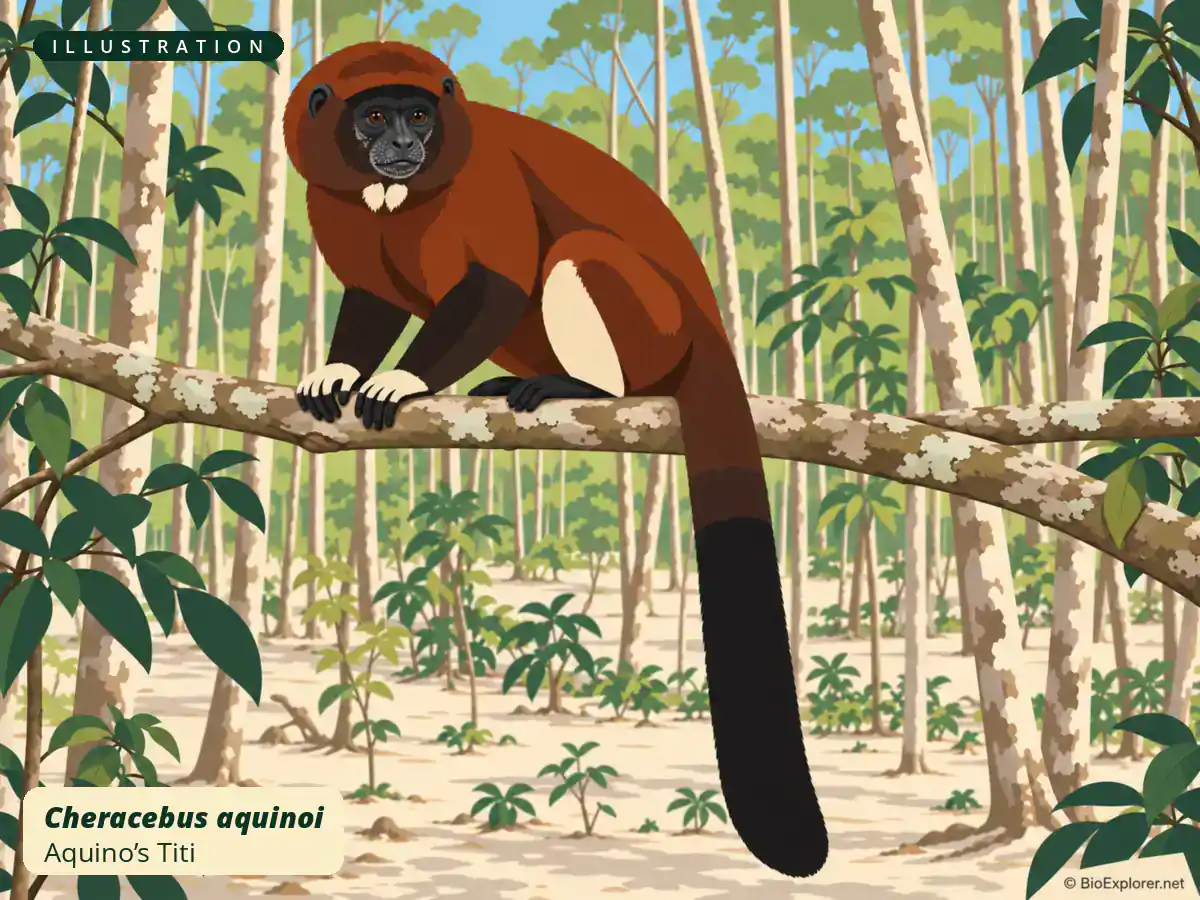
Aquino's titi (Cheracebus aquinoi) is a reddish-brown monkey from Peru. Scientists described it in October 2022.[1] Until then it was filed as another species.[1]
It lives in one strip of Amazonia, between the Nanay and Tigre rivers.[1] The whole known range sits in Loreto.[1]
One feature separates it from every relative. The cream collar at its throat is shaped like a bow tie.[1]
See where it sits among the New World monkey group. It is one of many types of monkeys in Peruvian Amazonia.
A reddish-brown titi with a cream bow tie at the throat. Described in 2022 from a single corner of Peru.

- Common NameAquino's Titi
- Taxonomy Classification Year2022
- Monkey SizeExternal measurements not reported; skull length 68.9 to 69.9 mm in three specimens
- Skin Color(s)Blackish facial skin with sparse white hairs; reddish-brown coat; creamy-white bow-tie throat collar
- HabitatVarillal forest on white sand, plus gallery, flooded and palm forest
- DietBuds, flowers, fruit pulp, insects, leaves, and seeds
- Native CountriesPeru
- Described in October 2022 from the Nanay-Tigre interfluvium.[1] Until then it was called Cheracebus lucifer.[1]
- The holotype is an adult female, MUSM 50736.[1] Researchers recovered it from local subsistence hunters in June 2019.[1]
- The bow-tie collar is unique within Cheracebus.[1] It stops at the center of the neck.[1]
- Known from 15 localities, all in Loreto, Peru.[1]
- The IUCN has not assessed it.[2] ITIS recognizes it as valid.[3]
Aquino's Titi Distribution
 )
The country is home to many other Peru monkeys.
Aquino's Titi Guide:
A New Species
This monkey was hiding in plain sight.
Specimens from the Nanay-Tigre interfluvium were filed as Cheracebus lucifer.[1] A 2022 study took another look. The authors compared skulls, pelage and mitochondrial DNA.[1] The Nanay-Tigre animals came out as a separate lineage.[1]
Two museum skins made the point. Hershkovitz had used them to extend the range of C. lucifer west.[1] The 2022 team reexamined them and moved them to this species.[1]
Their known ranges do not overlap.[1] Neither species is recorded between the Nanay and Napo.[1] A 2007 survey of that gap found no Cheracebus at all.[1] The likely reason is that the gap lacks varillal forest.[1]
Compare it with the Lucifer titi, the species it was taken for.
Aquino's Titi Identification
The bow-tie collar is unique within Cheracebus.[1]
Every other member of the genus wears a collar that runs ear to ear.[1] This one wears a small cream bow tie.[1] It stops at the center of the throat.[1] It does not spread sideways.[1]
The coat is an intense reddish brown.[1] The crown is a deeper reddish brown still.[1] Back and flanks are reddish brown.[1] Upper arms and upper legs match them.[1] The belly is reddish chestnut.[1] The thigh is whitish.[1]
Hands and feet break the pattern. The backs of the hands are creamy white.[1] Some carry a yellow-orange cast.[1] The feet are black.[1] The forearms are dark brown.[1]
The face is almost bare. The skin is blackish, with a scatter of short white hairs.[1] A narrow black band separates the face from the crown.[1] That band is sharply defined here.[1] In the black titi it is barely visible.[1] The collared titi shows a distinct band too.[1]
The tail is dark. The first third is blackish chestnut, the rest is black.[1]

Range And Habitat
Its known range lies between the Nanay and Tigre rivers.[1] All of it lies in Loreto, Peru.[1] The paper lists 15 known localities.[1]
The northwestern limit is not settled. It may end where the Quebrada Aleman meets the Pucacuro River.[1] That is a right bank tributary of the Tigre.[1]
Varillal forest is one important habitat.[1] Varillales are forests of thin-stemmed trees on white sand.[1] One survey found the species restricted to them.[1] Earlier work also found it elsewhere.[1] Gallery forest, flooded forest and palm forest all count.[1]
It keeps to the upper canopy, between 15 and 25 meters.[1]
The range falls inside the Napo moist forest ecoregion.[1] The Lucifer titi sits in a different one, the Solimoes-Japura.[1]
Diet And Groups
This is a diurnal monkey that lives in small families.[1] Group size averages 2.9 to 3.5 animals.[1] One set of studies put the home range at 20 hectares.[1]
Density varies widely across sites. Reported figures run from 0.3 to 4.8 animals per square kilometer.[1]
Recorded foods are buds, flowers, fruit pulp, insects, leaves and seeds.[1]
It is not always alone in the canopy. Temporary associations are recorded with three other monkeys.[1] Those are the white-tailed titi, the equatorial saki, and a saddle-back tamarin.[1]
The sympatric white-tailed titi provides a useful comparison.[1] It has a whitish band across the forehead, which this species lacks.[1] Its tail is brownish and agouti, often with a buff tip.[1] Aquino's titi has a mostly black tail.[1]
Named For Aquino
The name honors Rolando Aquino, a Peruvian primatologist.[1]
The authors cite his work on Peru's primates.[1] It spans distribution, ecology and conservation.[1] They also credit him with training a generation of Peruvian mammalogists.[1] The epithet is a patronym in the genitive singular.[1]
The holotype number is printed two ways in the description. The formal account gives MUSM 59736.[1] The appendix of specimens examined gives MUSM 50736.[1] It is flagged there as the holotype, with the same type locality.[1] The ethical note gives 50736 as well.[1] Two mentions against one, so this page uses MUSM 50736.
There is an irony in the holotype. It came from subsistence hunters, not from a research collection.[1] The authors defend that route.[1] They argue such specimens are still badly needed to understand primate diversity.[1] They also argue the knowledge helps fight illegal trafficking.[1]
Conservation Status
The IUCN has not assessed this species.[2] Its status is Not Evaluated.
That is expected for a monkey described in 2022. Other databases have caught up. ITIS now recognizes the species as valid, under TSN 1283119.[3] It was added in July 2026.[3]
The description calls the known range small.[1] Several localities lie along the Iquitos-Nauta road.[1] Others occur in the Alto Itaya basin.[1]
Genus placement is not settled either. Some authors treat Cheracebus as a subgenus of Callicebus.[2] MDD follows the genus arrangement but calls it tentative.[2]
Common Questions
A titi monkey from northeastern Peru, described in 2022. It was previously filed as the Lucifer titi. Its known range lies between the Nanay and Tigre rivers.
By the throat collar. Every other Cheracebus has a collar running ear to ear. Aquino's titi has a small cream bow tie. It stops at the center of the neck.
It is known only from Loreto, Peru. Its known range lies between the Nanay and Tigre rivers. Varillal forest is one important habitat.
Rolando Aquino, a Peruvian primatologist. The authors credit his research on Peru's primates. They also credit his training of Peruvian mammalogists.
The IUCN has not assessed it. Its status is Not Evaluated. The description calls its known range small.
Buds, flowers, fruit pulp, insects, leaves and seeds. It feeds in the upper canopy, 15 to 25 meters up.
Cite this page
BioExplorer. (2026, October 13). Aquino’s Titi. https://www.bioexplorer.net/animals/mammals/monkeys/aquinos-titi/
About the author