
Types of Crows
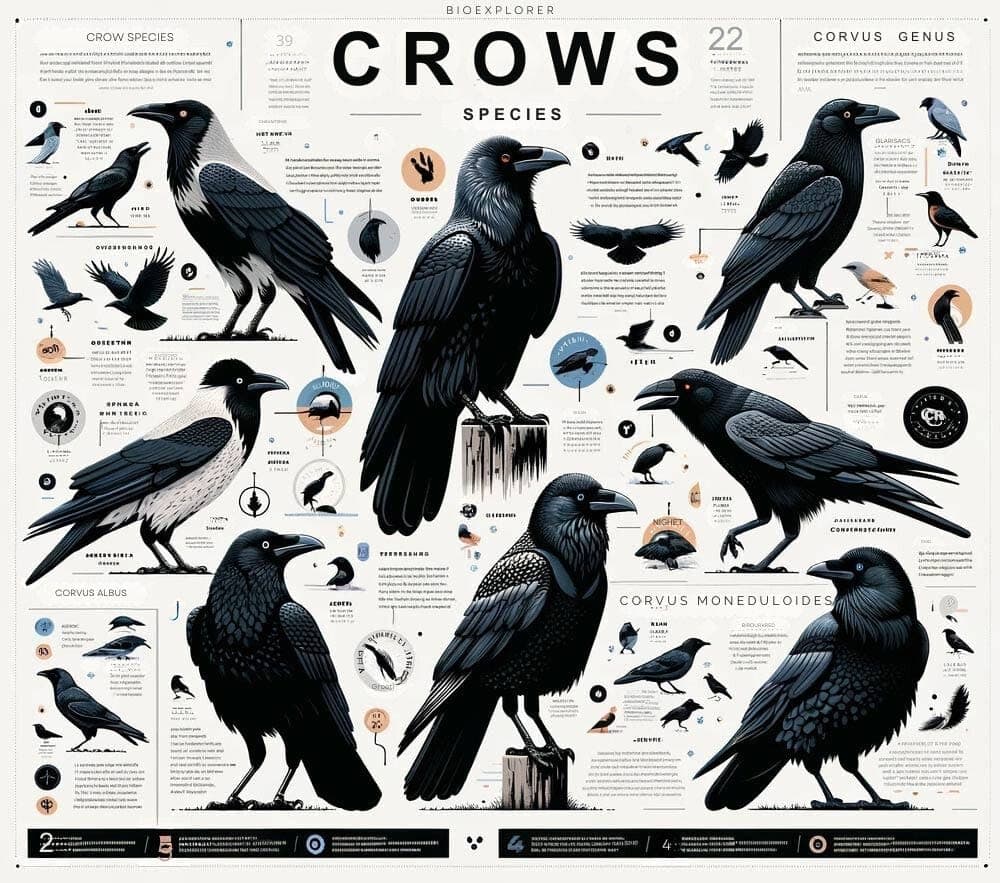
Types of Crows: Crows are one of the most widespread and recognizable birds, found across diverse habitats all over the world. Belonging to the genus Corvus, there are approximately 43 different crow species worldwide.
Crows inhabit regions in North America, Europe, Asia, Africa, Australia, and across islands in the Pacific. However, they are not naturally found in the Arctic or Antarctic continents due to the frigid climates and lack of vegetation.
Crows are highly adaptable and intelligent birds that demonstrate complex social behaviors and even tool use. They have adapted to thrive in various environments, from tropical forests to deserts to city streets.
This page provides an overview of the most common types of crows in regions worldwide, except the Arctic and Antarctic. We will explore crows from different habitats worldwide and what makes each species unique.
Jump to:
Types of Crows
Pied Crow
| Kingdom | Order | Family | Genus | Species |
|---|---|---|---|---|
| Animalia | Passeriformes | Corvidae | Corvus | Corvus albus |
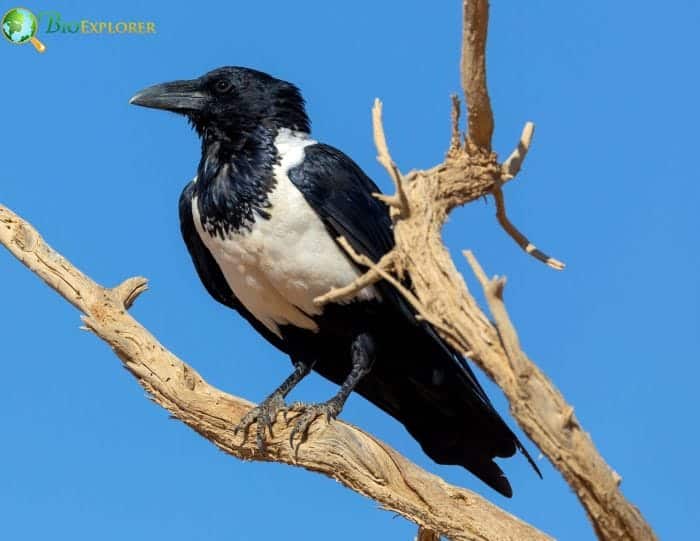
The pied crow is a bird that grabs attention in Africa. With a slick black head and neck paired with a crisp white chest, this bird has a natural tuxedo look that gives it serious style points. It may reach just 46-50 cm in height, but the pied crow struts with oodles of confidence.
Often found chilling near villages and towns across much of Africa, the fun-loving pied crow digs human company. It has no qualms about getting up close with people. Avoid looking for it in deep rainforests though – too muggy for the pied crow’s taste!
When it’s time to eat, the pied crow keeps an open mind – feasting on insects, small reptiles, discarded scraps and grains. It’s an opportunistic eater, snacking on whatever tasty morsels can be found.
With its adaptable nature and outgoing personality, the pint-sized pied crow shows that size doesn’t determine splash. The next time a dark bird prances around an African village, take a second look – it just might be the playful pied crow showing off its signature style!

Common Raven
| Kingdom | Order | Family | Genus | Species |
|---|---|---|---|---|
| Animalia | Passeriformes | Corvidae | Corvus | Corvus corax |
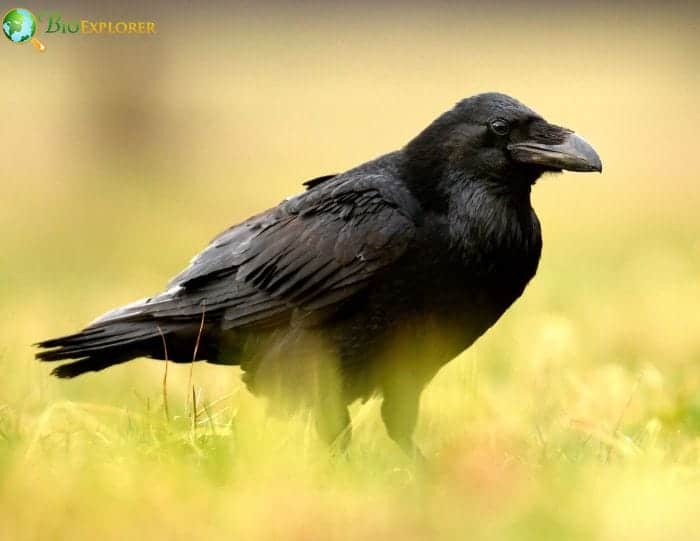
The common raven is one clever bird. This big, all-black corvid has mastered the art of thriving across the Northern Hemisphere, from frigid tundras to barren deserts. Don’t let its gothic look fool you – this adaptable bird is now making itself right at home in busy cities too.
Ravens gorge on a diverse diet; they’ll snack on everything from juicy fruits to small mammals to creeping insects. And they aren’t quiet about mealtime either, with complex vocalizations mimicking sounds from their environment.
These brainy birds have been captivating humans for centuries with their aerial stunts, problem-solving skills, and even tool use. From folk tales to poetry, the common raven has long symbolized a mix of magic, creation, and mischief.
RAvens form close-knit relationships, choosing one partner for life. Together, the pair perfects gravity-defying spins and rolls high in the skies. When perched on branches, they work together to solve puzzles – a true testament to their intelligence.
So, the next time you hear a raspy “caw” look skyward. It may well be the common raven, performing its aerial artistry and reminding us that brains and beauty can go beak-in-beak. This masterful bird continues to entrance us with its adaptability and craft[1].
Rook
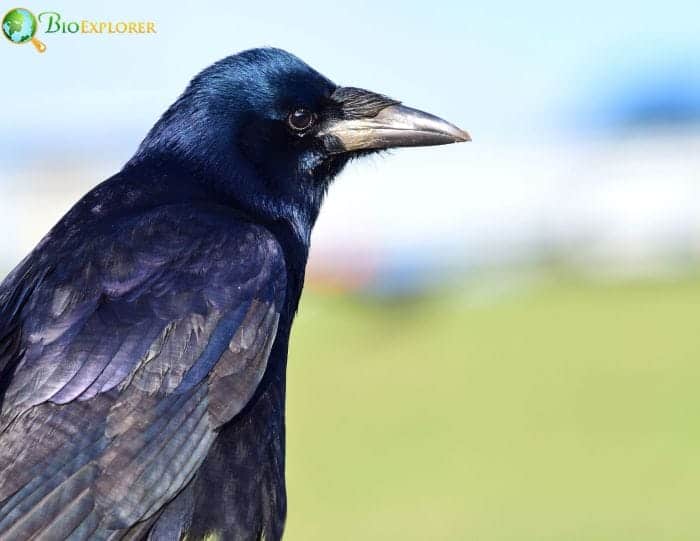
| Kingdom | Order | Family | Genus | Species |
|---|---|---|---|---|
| Animalia | Passeriformes | Corvidae | Corvus | Corvus frugilegus |
With its jet-black feathers and distinctive bare white face, the Rook is a remarkable bird hailing from Europe and Asia. These highly social corvids gather in large colonies called rookeries, nesting high in the trees.
Though primarily residents, northern rooks may flock south when winter bites too cold. On chilly days, you can spot these black birds mingling in mixed flocks with their Corvus cousins, warming up together.
Rooks forage on the ground for invertebrates, cereals and other plant materials. Historically seen as crop pests, we now know rooks play an important role in ecosystems.
Beyond their social nature, rooks display some serious brainpower. Captive rooks exhibit complex problem-solving skills, tool use and even teamwork. Their intelligence is matched by their intricate courtship behaviors, with pairs bonding for life.
Next time you spot a flock of black birds congregating in a tree, look for a flash of white face – it’s likely to be the brainy, social rook. Clever and communicative, this bird continues to captivate us with its tight-knit communities and cognitive abilities[2].
American Crow
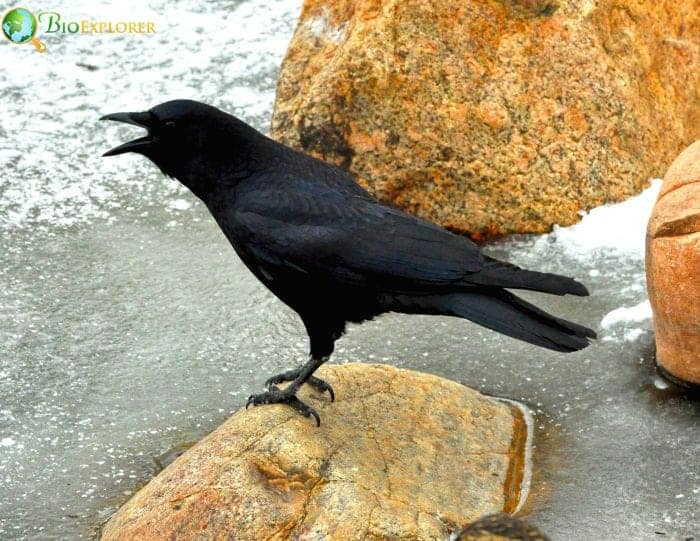
| Kingdom | Order | Family | Genus | Species |
|---|---|---|---|---|
| Animalia | Passeriformes | Corvidae | Corvus | Corvus brachyrhynchos |
With its jet-black plumage and signature “CaaW!” call, the American crow is a familiar sight across North America. As the New World counterpart to the Carrion Crow, this brainy Corvid shares similar habitats and behaviors with its Eurasian cousins.
American crows measure around 40-50 cm long, with nearly half that length coming from their long, graduated tails. Weighing 300-600 grams, males tend to be larger than females. But both sport slick, iridescent black feathers.
A highly adaptable generalist, the American crow thrives equally well in wild forests and bustling cities. Their intelligence is renowned, allowing them to solve problems, use tools, and communicate in complex social groups[3].
Crows are vulnerable to West Nile virus, making them an important bioindicator for monitoring the disease’s spread. While crows can’t directly transmit the virus to humans, their susceptibility provides an early warning.
Clever, vocal, and opportunistic, American crows have adapted readily to human presence, despite being viewed as pests by some. But behind those black feathers lies an impressive intelligence we are still striving to fully understand.
Fish Crow
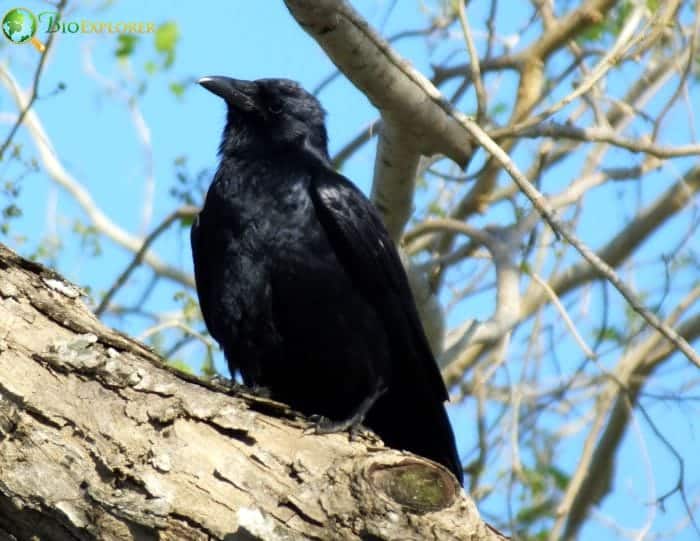
| Kingdom | Order | Family | Genus | Species |
|---|---|---|---|---|
| Animalia | Passeriformes | Corvidae | Corvus | Corvus ossifragus |
Along the eastern and southeastern US coasts, a petite black bird with a distinctive nasal call makes its home. Meet the fish crow, named by Alexander Wilson in 1812 for its fish-heavy diet. Weighing just 247-320 grams, the fish crow is smaller than its familiar cousin, the American crow[4].
At first glance, the two appear nearly identical with dark, iridescent plumage. But the fish crow’s signature “waw-waw” or “ark-ark-ark” call gives it away. This savvy corvid sticks close to wetlands and coastal areas, unlike the more adaptable American crow.
True to its name, the fish crow enjoys snacking on aquatic fare like crustaceans, fish and eggs. It also feasts on fruits, reptiles, nestlings and even human leftovers. Its diverse, opportunistic diet allows it to thrive near humans.
Interestingly, the fish crow seems more resilient against the West Nile virus compared to other crow species. This resilience, paired with its inquisitive nature, make the pint-sized fish crow a compelling species to study.
Next time you’re near the eastern US coast and hear nasal crow cries, listen closer – it may be the small but savvy fish crow, foraging for its next meal.
Grey Crow
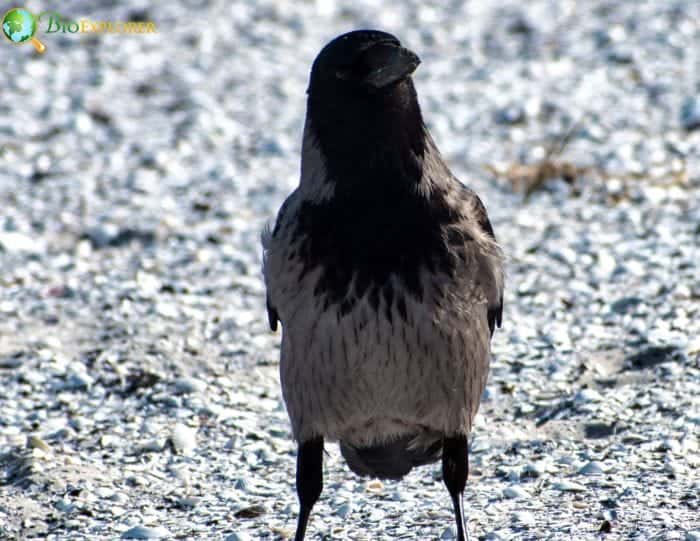
| Kingdom | Order | Family | Genus | Species |
|---|---|---|---|---|
| Animalia | Passeriformes | Corvidae | Corvus | Corvus tristis |
The grey crow, previously known as the bare-faced crow, is about the same 42-45 cm length as its Eurasian relative, the carrion crow. This tropical bird is distinguished by its unique juvenile feather patterns and the large bald patch of pinkish-white facial skin in adults.
The adult grey crow sports an all-black appearance with graduated tail feathers randomly bleached to an ombre effect. But the most distinctive feature is the bare facial skin around the eyes, lacking any feathers[5].
Juvenile grey crows display pale brown to cream-colored plumage before acquiring the adult pigment. Their eyes shine a bluish-white hue. The bill also varies from partially pinkish-white to completely pinkish-white with a darker tip.
Endemic to New Guinea and nearby islands, the grey crow inhabits lowland and hill forests up to 1350 meters in elevation. Its diverse diet includes small animals and fruits.
With its eccentric mix of black plumage and bare pinkish face, the grey crow exhibits unique adaptations to its tropical island ecosystem.
Hooded Crow
| Kingdom | Order | Family | Genus | Species |
|---|---|---|---|---|
| Animalia | Passeriformes | Corvidae | Corvus | Corvus cornix |
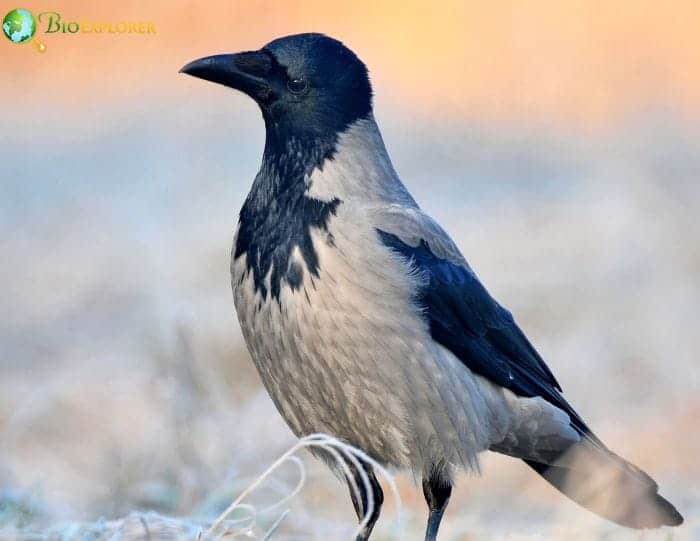
With its dashing grey and black look, the Hooded Crow is a sharp-dressed corvid. This medium-sized bird reaches 48-52 cm tall and inhabits regions from Western Europe to East Asia. It sticks out from its all-black cousin, the Carrion Crow, thanks to its stylish hood[6].
Beyond looks, the Hooded Crow boasts some serious skills. It thrives in forests, cities, farms – you name it! With a varied diet and top-notch problem-solving intellect, this savvy bird can adapt to any habitat it encounters.
Some populations migrate south for winter, but many tough it out year-round in their home territories. Nesting in trees or on cliffs, both mom and dad Hooded Crow take turns feeding their hungry hatchlings.
While not considered endangered, these clever crows get a bad rap as pests on farms sometimes. But their intelligence and resilience let them succeed across three continents!
So next time you’re traveling in Europe or Asia, keep an eye out for the dashing Hooded Crow putting its resourcefulness on display. With brains, beauty and ambition, this is one bird destined to flourish.
New Caledonian Crow
| Kingdom | Order | Family | Genus | Species |
|---|---|---|---|---|
| Animalia | Passeriformes | Corvidae | Corvus | Corvus moneduloides |
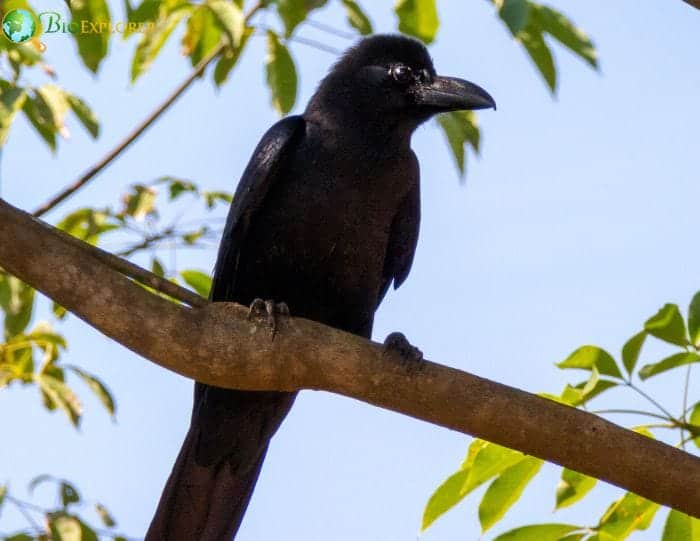
The New Caledonian crow’s one clever bird. Endemic to the islands of New Caledonia, this tropical corvid is often called the ‘qua-qua’ thanks to its unique vocalization. With its impressive intelligence, the qua-qua continues to captivate researchers worldwide.
The qua-qua’s got a varied diet – it’ll snack on everything from snails to seeds. But it’s the crow’s advanced tool use that really wows scientists. By carefully shaping sticks into hooked tools, the qua-qua can wiggle out tasty grubs from logs[7]. Now that takes some serious creativity!
Researchers have found the qua-qua can ace complex cognitive tests, even outperforming Chimpanzees at certain problem-solving tasks. Due to its outstanding skills, the New Caledonian crow has become a model species for studying how tool use and intelligence evolve in tandem.
So, if you’re ever in New Caledonia and hear a distinctive “qua-qua” call, look up. You might spot one of the planet’s most ingenious birds hard at work. The qua-qua crow continues to impress with its crafty intellect.
Carrion Crow
| Kingdom | Order | Family | Genus | Species |
|---|---|---|---|---|
| Animalia | Passeriformes | Corvidae | Corvus | Corvus corone |
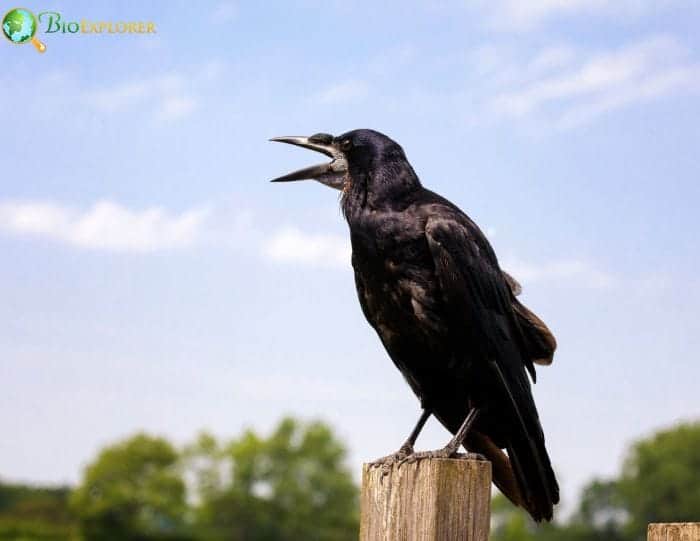
The carrion crow is a passerine bird in the Corvidae family and Corvus genus, first described scientifically by Carl Linnaeus in 1758. Native to western Europe and the eastern Palearctic, this glossy black bird has a length of 48-52 cm, 84-100 cm wingspan, and weighs 400-600 grams.
Distinguished by its sheen and stouter beak with bristle-like nostril feathers, the carrion crow can be differentiated from its relative the rook. Juvenile crows display brownish plumage with blue eyes before acquiring adult coloration[8].
With a diverse diet including carrion, insects, grains, fruits, fish and more, the carrion crow exhibits behavioral adaptability. Their intelligence manifests in abilities like facial recognition, number discrimination, and rule switching.
For nesting, these crows prefer tall trees, cliffs, buildings or pylons. The female incubates 3-4 blue or greenish eggs speckled with brown for 18-20 days.
Known for mobbing predators in groups and aggressively defending resources, the carrion crow continues to thrive across Europe and Asia due to its adaptability, intellect and resourcefulness.
Hawaiian Crow
| Kingdom | Order | Family | Genus | Species |
|---|---|---|---|---|
| Animalia | Passeriformes | Corvidae | Corvus | Corvus hawaiiensis |
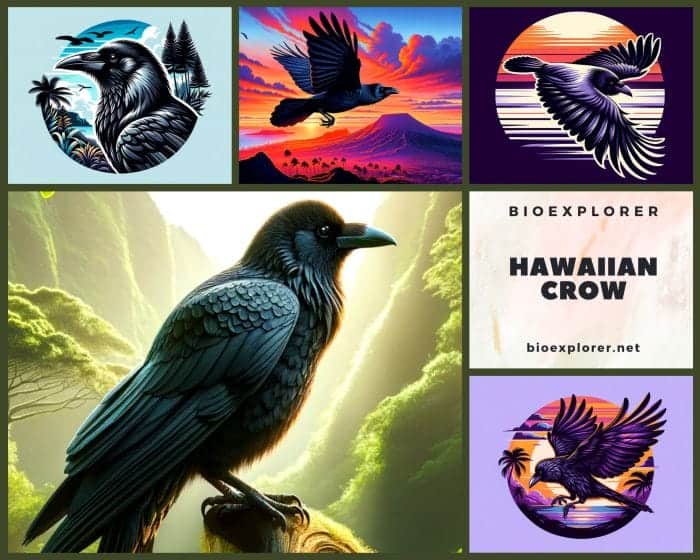
The Alalā, Hawaii’s endemic crow, once flourished across the islands before vanishing from the wild. With soft, brownish-black plumage and bristly throat feathers, these agile birds resemble carrion crows but boast rounded wings and thicker bills[9].
Capable of living nearly 30 years, ʻAlalā were right at home in dry, mesic forests on Mauna Loa and Hualālai’s slopes. But after humans introduced diseases like malaria and fowlpox, the crows’ numbers plummeted. These resilient birds played a key ecological role too, dispersing seeds of native plants.
In Hawaiian lore, the Alalā led souls to their final resting place atop the cliffs of Ka Lae. While extinct in the wild now, efforts are underway to reintroduce the culturally vital ʻAlalā to its former island habitats.
Bringing back Hawaii’s endemic crow won’t be easy, but if any bird can make a comeback, it’s the resourceful ʻAlalā. Restoring these vanishing birds would help preserve both ecological balance and cultural heritage.
White-necked Raven
| Kingdom | Order | Family | Genus | Species |
|---|---|---|---|---|
| Animalia | Passeriformes | Corvidae | Corvus | Corvus albicollis |
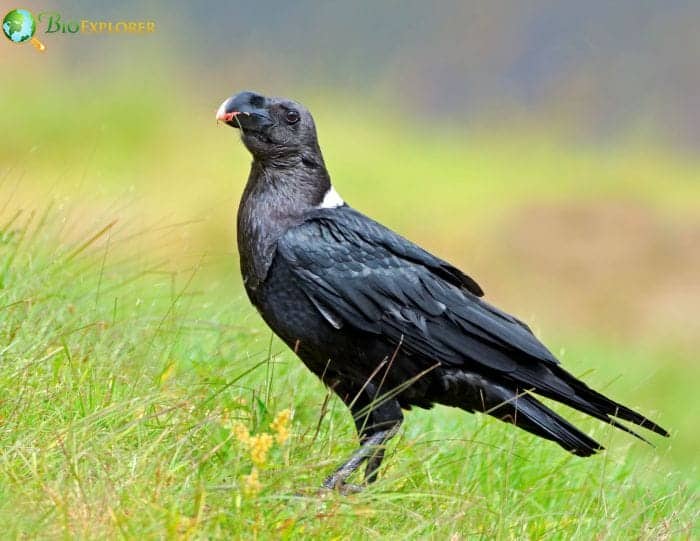
Found in eastern and southern Africa, the white-necked raven exhibits unique traits and behaviors setting it apart from corvid cousins. A touch smaller than the common raven, it boasts a shorter tail and deep bill tipped white. As the name indicates, sharp white neck feathers contrast otherwise black plumage[10].
Right at home in mountainous regions, the white-necked raven displays resourcefulness using tools. Observations show them dropping tortoises from heights, cracking shells to access the meat inside. In captivity especially, these vocal mimics imitate sounds and voices.
With a varied diet of fruit, grains, insects and carrion, the agile white-necked raven thrives from rocky cliffs to villages near mountain terrain. Females lay 3-5 eggs per clutch, nesting on ledges or trees.
Clever, adaptive and equipped with tool skills, the white-necked raven flourishes across its African range. Studying its abilities provides insights into corvid intelligence.
Australian Raven
| Kingdom | Order | Family | Genus | Species |
|---|---|---|---|---|
| Animalia | Passeriformes | Corvidae | Corvus | Corvus coronoides |
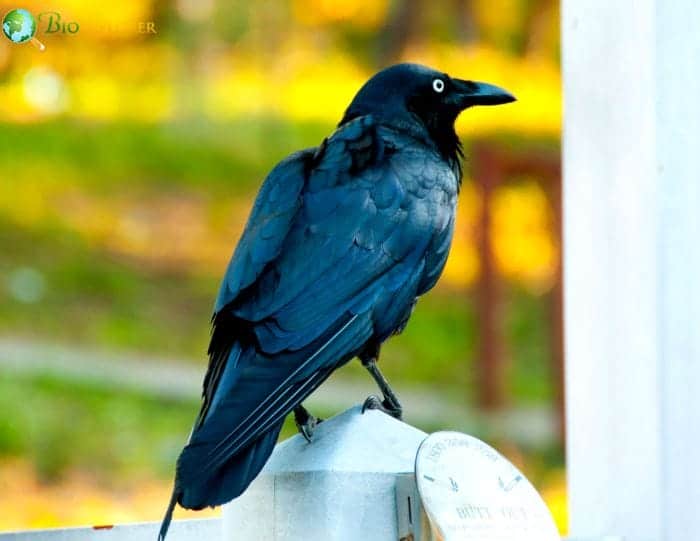
The clever Australian raven, reaching 46-53 cm long, inhabits much of southern and northeastern Australia. With its glossy black plumage reflecting striking purple, blue and green iridescence, this corvid certainly stands out. Prominent throat hackles distinguish it from other Australian crows.
Equally at home in open woodlands, transitional zones and urban areas, the adaptable Australian raven thrives in cities like Sydney and Canberra. Omnivorous, it associates with sheep in eastern Australia[11].
Territorial birds typically bond lifelong with a mate. Breeding July through September, pairs build bowl-shaped nests high in trees.
With its vibrant plumage and resourcefulness in diverse environments, the Australian raven continues flourishing across its native range. Its adaptability and intellect make this iconic Aussie corvid one to admire.
Chihuahuan Raven
| Kingdom | Order | Family | Genus | Species |
|---|---|---|---|---|
| Animalia | Passeriformes | Corvidae | Corvus | Corvus cryptoleucus |
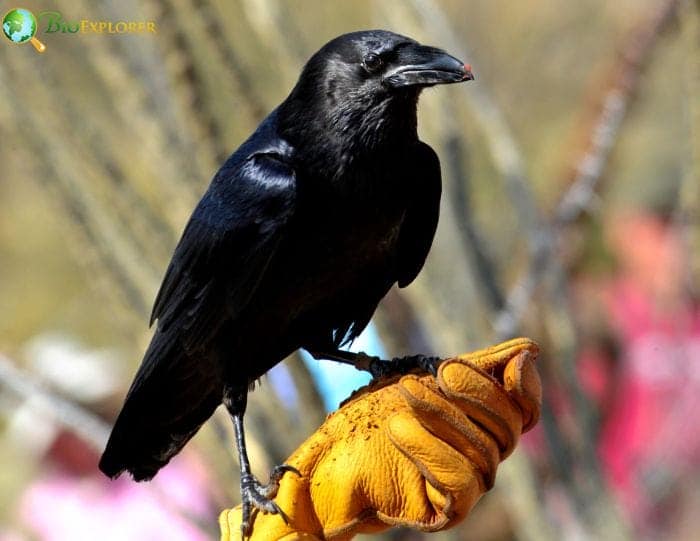
The Chihuahuan raven is a savvy corvid species residing in the southwestern United States and Mexico. About the size of a carrion crow at 44-51 cm long, this all-black bird sports a glossy purple-blue sheen when the light hits just right.
Look closely and you’ll notice the Chihuahuan raven’s dark brown eyes and white feather bases, distinguishing features among raven species. It also boasts nasal bristles extending farther down its bill than others in the Corvus genus[12].
This clever raven inhabits a range spanning Arizona, Texas and northern Mexico. With an varied diet of grains, insects, reptiles and carrion, it flourishes across diverse landsapes.
Nesting in trees, shrubs or old buildings, male and female Chihuahuan ravens share brooding duties. Their vocalizations resemble the common raven’s but at slightly higher pitches. These birds even mimic sounds they hear!
With its resourcefulness across the Southwest, the Chihuahuan raven continues to impress with its adaptability and intellect. This iconic corvid is one savvy bird.
Little Crow
| Kingdom | Order | Family | Genus | Species |
|---|---|---|---|---|
| Animalia | Passeriformes | Corvidae | Corvus | Corvus bennetti |
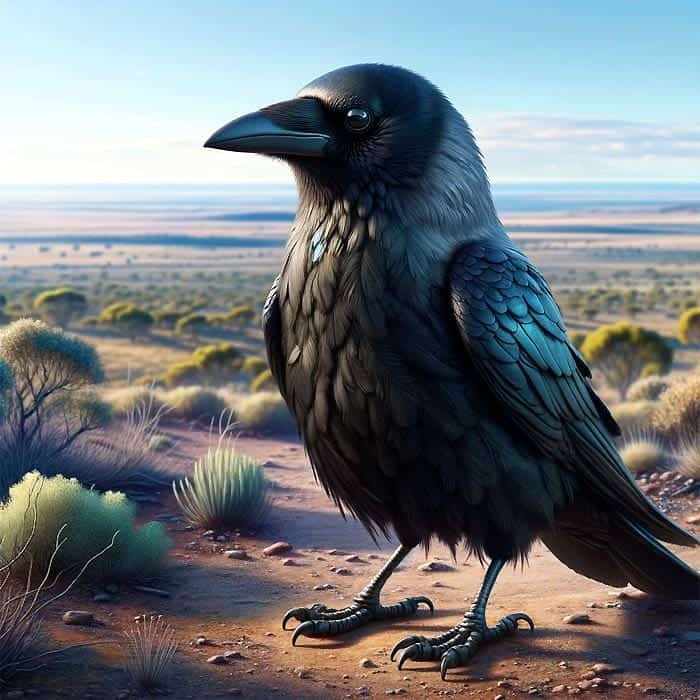
The little crow, scientifically Corvus bennetti, makes its home across western and central Australia. A touch smaller than the Torresian crow at 38-45 cm long, this species reveals white neck and head feathers when winds ruffle its plumage. Like other Aussie crows, its eyes shine white.
Right at home in arid, near-desert habitats, the little crow also frequents small towns and cultivated areas. With an appetite for insects, cereal grains, and seeds, it scavenges less than its Torresian cousin.
Unique among Australia’s corvids, the little crow often nests in loose colonies, building mud-lined stick nests. Its vocalizations range from harsh, raven-like caws to a barking “hark-hark-hark”.
While pint-sized, the savvy little crow exhibits adaptations suiting the dry Australian interior. This plucky corvid continues to thrive, proving you don’t have to be big to be clever[13].
Thick-billed Raven
| Kingdom | Order | Family | Genus | Species |
|---|---|---|---|---|
| Animalia | Passeriformes | Corvidae | Corvus | Corvus crassirostris |
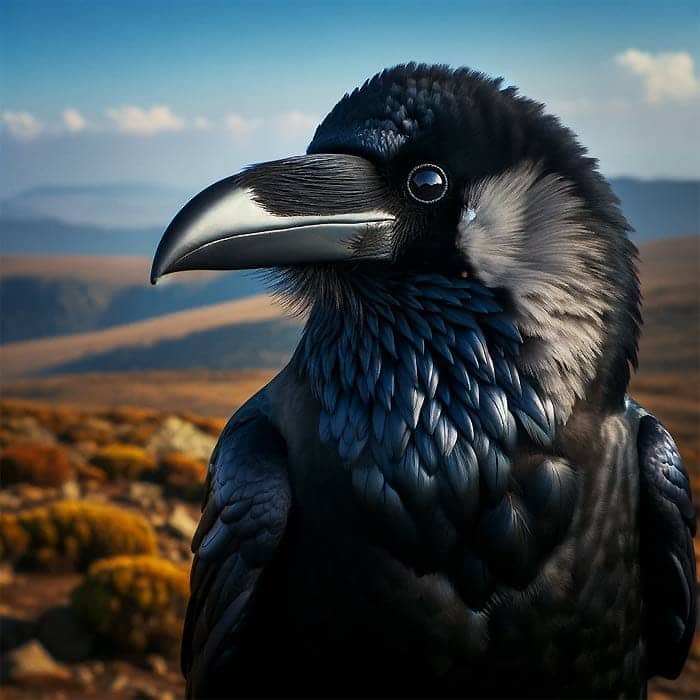
Swooping over the Horn of Africa dwells the thick-billed raven, a giant among corvids. Rivaling even the common raven’s size at 64 cm long, this hefty bird weighs over 1 kg, potentially making it the world’s heaviest living passerine[14].
As the name suggests, the thick-billed raven sports a massive bill – laterally compressed, deeply curved, and 8-9 cm long. The black bill ends in a pale tip. Short neck feathers gleam with an oily brown sheen.
This resourceful corvid inhabits mountains and plateaus of Eritrea, Ethiopia and Somalia from 1, 500 to 3, 400 meters up. With an appetite for grubs, beetles, carrion and more, the thick-billed raven makes the most of its lofty habitat.
Nesting on cliffs or trees, the thick-billed raven protects its domain with an array of vocalizations, even mimicking sounds it hears.
From its titanic bill to booming voice, the thick-billed raven astonishes with its adaptations to Africa’s highlands. This heavyweight corvid is quite the standout.
Large-billed Crow
| Kingdom | Order | Family | Genus | Species |
|---|---|---|---|---|
| Animalia | Passeriformes | Corvidae | Corvus | Corvus macrorhynchos |
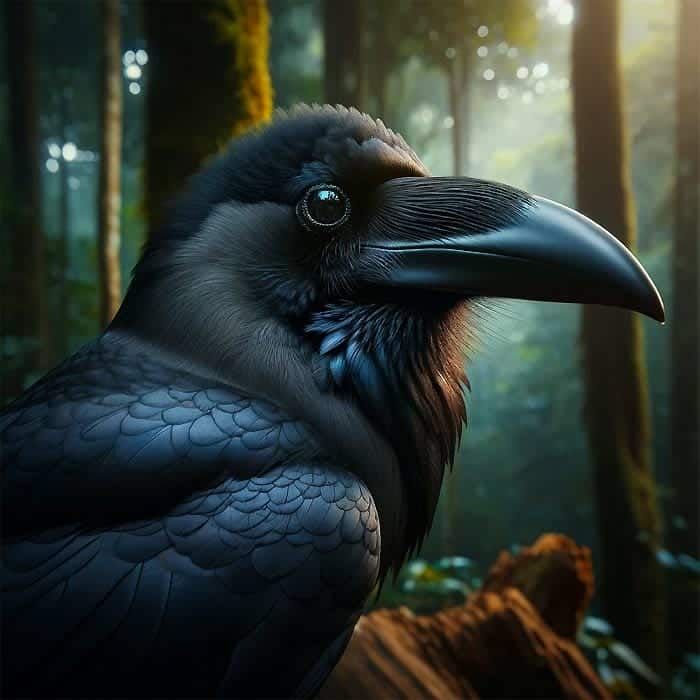
The Large-billed Crow is a fascinating bird native to Asia. With its sizable bill, don’t mix it up with a raven. This savvy corvid survives across northeast Asia to Afghanistan, thriving in woodlands, cities, anywhere. The crow’s secret? An adaptable appetite – it eats almost anything, from plants to critters. In towns it brazenly tears into trash and steals wire coat hangers for nest material.
Get this – the species has nine subspecies, each with unique vocal, physical and genetic traits. For nesting, Large-billed Crows like tall conifers like firs or pines. Here they lay 3-5 eggs, incubated around 17-19 days before hatching[15].
But not all people are fans. Despite its resilience, the Large-billed Crow irks some as a nuisance, disrupting island ecosystems with its varied diet and bold behavior. Its conservation status doesn’t reflect the range of interactions, from admiration to annoyance.
Clever and contentious, the Large-billed Crow continues thriving, flexing survival skills across Asia. This iconic corvid elicits diverse reactions but never fails to fascinate.
Little Raven
| Kingdom | Order | Family | Genus | Species |
|---|---|---|---|---|
| Animalia | Passeriformes | Corvidae | Corvus | Corvus mellori |
The Little Raven, scientifically named Corvus mellori, inhabits southeastern Australia and stands out for its social tendencies. With jet black plumage from beak to tail feathers, this corvid reaches around 48-50 cm in length. Its eyes change color, starting blue-grey in nestlings and becoming white in adults. First identified in 1912, the Little Raven gained distinction as a separate species from the Australian Raven in 1967[16].
Adapting to various habitats from scrublands to urban areas like Melbourne, these birds often nest in loose colonies, building their stick, bark, grass and wool nests close together. While insects dominate their diet, Little Ravens stay opportunistic, eating anything readily available. They have even been observed utilizing tools during foraging. Despite their resilience across a widespread range, the IUCN Red List classifies them as “Least Concern. ” The Little Raven exemplifies remarkable adaptability and survival skills.
Forest Raven
| Kingdom | Order | Family | Genus | Species |
|---|---|---|---|---|
| Animalia | Passeriformes | Corvidae | Corvus | Corvus tasmanicus |
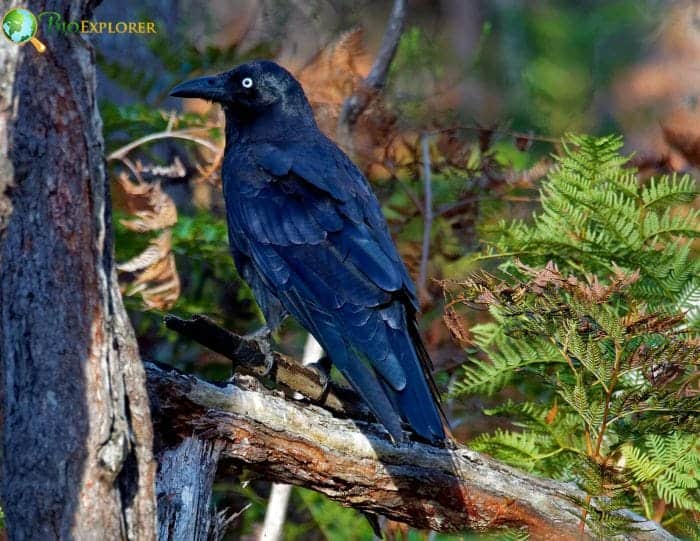
With its glossy black feathers, the Forest Raven is a breathtaking sight. This clever bird lives mainly in Tasmania and Victoria, making it Australia’s largest raven species[17].
Don’t let the beauty of this bird fool you though. The Forest Raven has some amazing skills! It can solve problems and even copy sounds it hears, like car alarms or other birds. These abilities show how smart this raven truly is.
Forest Ravens are also very social. You’ll often see them hanging out in pairs or small flocks. They aren’t picky at all about what they eat either. This opportunistic bird will munch on anything from bugs to small mammals to leftover animal carcasses.
In the tall trees, Forest Raven’s parents work together to care for their young. The moms and dads both pitch in to gather food for the babies.
Life isn’t perfect for these birds though. Their habitats are disappearing, and humans sometimes disturb their nesting areas. People are trying to help through conservation, but more efforts are needed.
Next time you’re exploring the woods in Australia and hear a mysterious “caw, ” look up! You might spot one of these awesome Forest Ravens showing off its intelligence and ability to adapt.
Brown-necked Raven
| Kingdom | Order | Family | Genus | Species |
|---|---|---|---|---|
| Animalia | Passeriformes | Corvidae | Corvus | Corvus ruficollis |
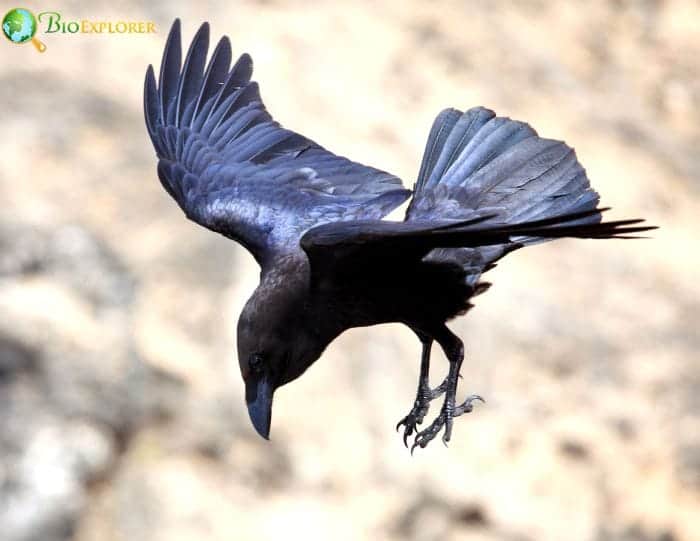
With its distinctive brownish-black head and throat, the brown-necked raven earned its name fair and square. This bird measures around 52-56 cm long, making it larger than some raven species but smaller than the common raven. The rest of its feathers are a slick black with glossy hints of purple, blue, or purple-blue.
This opportunistic bird is right at home in desert environments across North Africa, the Arabian Peninsula, the Middle East, and parts of southern Iran. But it will also hang out at oases or palm groves when it gets the chance.
When it comes to food, the brown-necked raven isn’t picky. It will munch on carrion, snakes, locusts, and even stranded fish near coastlines. These savvy birds are great at working together to hunt lizards too[18].
For nesting, they build nests like their common raven cousins, typically in trees, cliffs, or old buildings. The moms lay 4-5 eggs that are cared for by both parents. In about 20-22 days the eggs hatch, and by 42-45 days, the babies are ready to fly off on their own.
The brown-necked raven’s vocalizations sound similar to the common raven but higher pitched. In captivity, these clever birds can even mimic speech, though it’s not seen as often in the wild.
Despite its ability to thrive across deserts, the brown-necked raven is still considered a species of “Least Concern“. This desert survivor continues to adapt thanks to its opportunistic nature.
Northwestern Crow
| Kingdom | Order | Family | Genus | Species |
|---|---|---|---|---|
| Animalia | Passeriformes | Corvidae | Corvus | Corvus caurinus |
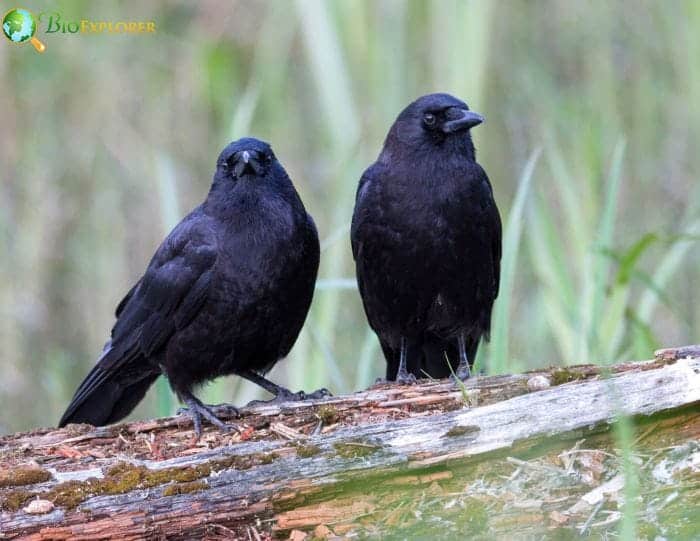
Along the Pacific coasts of Alaska, British Columbia, and Washington lives a clever bird – the Northwestern crow. Smaller than its close cousin the American crow, this savvy corvid sticks to the coastal habitats it knows best, from beaches to city streets[19].
What really sets this bird apart is its taste for seafood. The Northwestern crow is a total marine invertebrate aficionado! It will dig up clams, snap up crabs, and even nab fish right out of the water. But don’t worry, it also chows down on fruits, grains, and our leftovers too.
These resourceful birds are also smart enough to use tools. They’ll grab sticks to poke out food and have even been seen dropping shellfish from up high to crack open the shells. Talk about creativity!
But sadly, the Northwestern crow faces threats from habitat destruction and pollution. Their numbers are declining, causing debate among scientists about their classification as a unique species.
Either way, the Northwestern crow shows amazing intelligence and adaptability. This seafaring, tool-using bird is a true marvel of the avian world along the Pacific Northwest coast.
Cape Crow
| Kingdom | Order | Family | Genus | Species |
|---|---|---|---|---|
| Animalia | Passeriformes | Corvidae | Corvus | Corvus capensis |
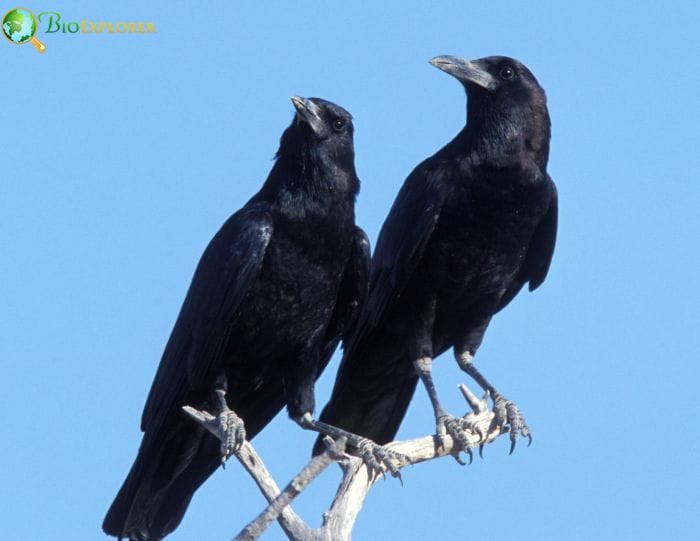
Spanning two large regions of Africa lives the unique Cape Crow, also called the Black Crow. One population spread from southern Africa up to Angola and Mozambique, while the other inhabits East Africa from South Sudan to Kenya.
Reaching 48-50 cm long, the Cape Crow sports all black plumage with a subtle glossy purple sheen. Its slender bill is specialized for poking around on the ground and digging up tasty insects.
This crow’s diverse diet includes grains, seeds, bugs, and even small reptiles. It’s known for flipping over mammal poop to find insects and takes down birds up to a pound! For nesting, it picks high tree branches, laying 3-4 eggs that hatch after 18-19 days[20]. The babies fledge by 38 days old.
Vocally talented, the Cape Crow makes “krrah krrah” and “kah-kah-kah” calls. It also creates bubbling sounds and can mimic noises it hears.
Despite its broad range and ability to thrive, the Cape Crow is still rated “Least Concern. ” This clever bird continues to adapt thanks to its opportunistic insect-hunting skills across Africa.
Collared Crow
| Kingdom | Order | Family | Genus | Species |
|---|---|---|---|---|
| Animalia | Passeriformes | Corvidae | Corvus | Corvus torquatus |
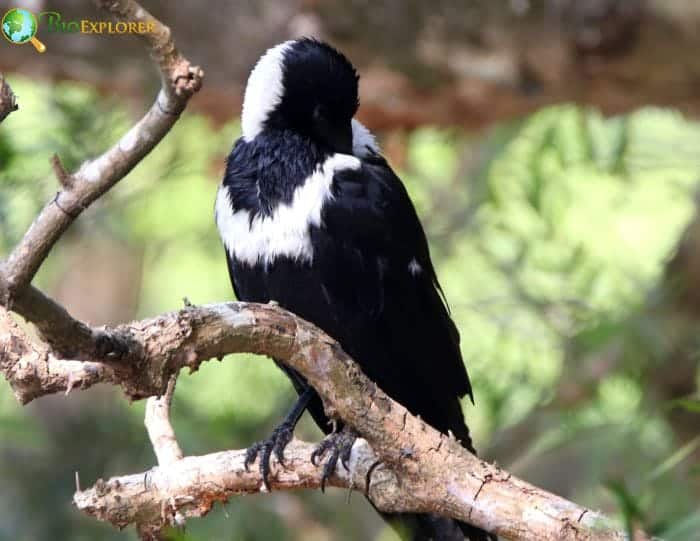
In China and northern Vietnam lives a distinctive black crow with striking white markings on its neck, back, and chest – the Collared Crow. About the size of a carrion crow at 52-55 cm long, this crow really stands out with its flashy neckwear. Its vocalizations like loud “kaaar” calls are equally attention-grabbing.
Unlike many crows, this species avoids cities and sticks to rural areas with plains, rivers, and farmland, especially rice paddies. It has an opportunistic appetite, gobbling up bugs, mollusks, grains, and anything else appetizing in its path[21].
For nesting, the Collared Crow chooses tree branches and uses mud to plaster its home together. The moms lay 3-4 eggs which are cared for until hatching.
But sadly, this unique bird was uplisted to “Vulnerable” status in 2018 after researchers found its population was smaller than expected. The Collared Crow now faces a high risk of extinction in the wild.
With its limited range and declining numbers, more action is needed to protect this creatively-collared crow and its specialized wetland home.
Brown-headed Crow
| Kingdom | Order | Family | Genus | Species |
|---|---|---|---|---|
| Animalia | Passeriformes | Corvidae | Corvus | Corvus fuscicapillus |
<https://youtu.be/q5bGUJ_MgQc?si=fFvnGbh8pN-4d5Pr>
In the lush forests of Indonesia lives the unique Brown-headed Crow. With its brownish-black head and neck contrasting against glossy black feathers, this crow really lives up to its name. Growing to around 22 inches long with a 7-inch tail, it sports a massive arched beak that comes in different colors for males and females[22].
This fruit-loving crow hangs out in the treetop canopy, moving through in pairs or small flocks. It uses its strong beak to pluck tasty fruits straight from the foliage.
Unfortunately, logging, mining, and a planned dam threaten the tropical forests this crow calls home. Despite some protected areas, the Brown-headed Crow faces an uncertain future and is rated “Near Threatened” by conservation groups.
With its specialized diet and shrinking habitat, the stunning Brown-headed Crow needs support. Saving Indonesia’s forests could help ensure this canopy corvid continues foraging for fruit among the treetops.
Torresian Crow
| Kingdom | Order | Family | Genus | Species |
|---|---|---|---|---|
| Animalia | Passeriformes | Corvidae | Corvus | Corvus orru |
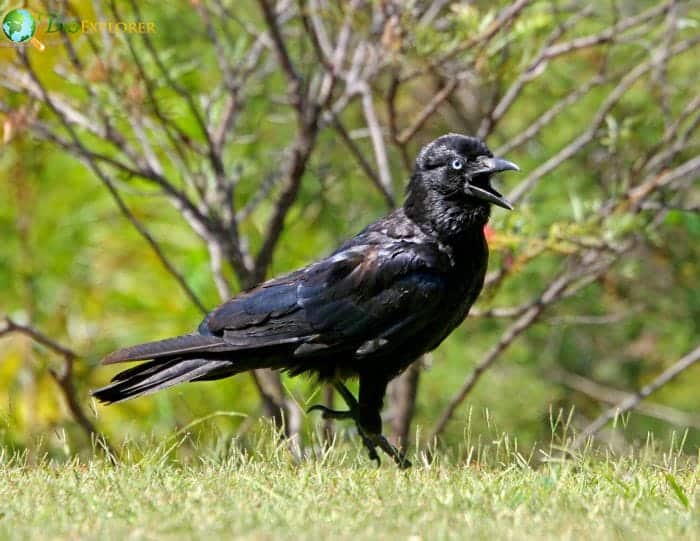
Across northern and western Australia, plus nearby islands, flies a savvy black bird – the Torresian Crow. With its white eyes and white-tipped neck feathers, this bird rocks a stylish look. Slightly bigger than its cousin the Little Crow, the Torresian Crow sports a sturdier beak too.
This clever corvid thrives anywhere with water, from tropical forests to cities. In urban areas though, it’s considered a pest for nibbling on crops. Thanks to more farmland and cities, its numbers are rising[23].
The Torresian Crow will eat just about anything – bugs, carrion, you name it. Remarkably, it’s even learned how to eat toxic cane toads safely! These birds are great at teaming up to swipe food from larger birds too. Their intelligence and adaptability serve them well.
Equally at home in the wilderness or big cities, the Torresian Crow continues to flourish. With its resourceful nature, this savvy bird will likely keep finding food and outwitting threats for generations to come.
Mariana Crow
| Kingdom | Order | Family | Genus | Species |
|---|---|---|---|---|
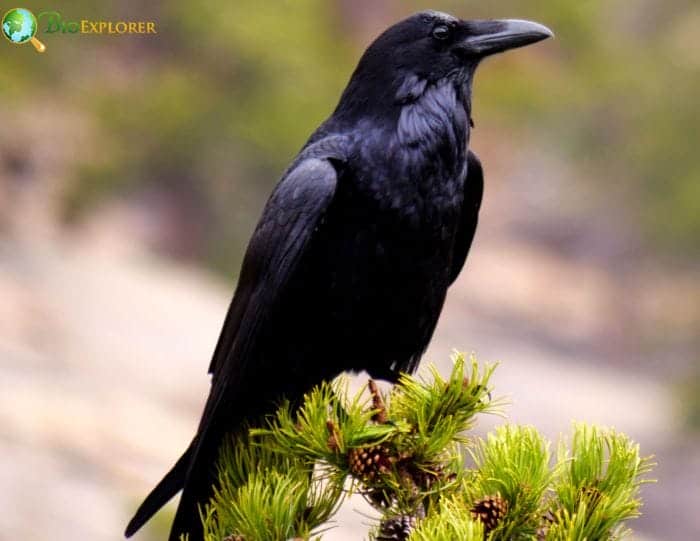
| Animalia | Passeriformes | Corvidae | Corvus | Corvus kubaryi |
With its glossy black feathers, the Mariana crow, called “åga” in Chamorro, is a striking bird. But sadly, this Western Pacific species is in real trouble. Since the 1960s, its numbers have been dropping fast.
On Guam, Mariana crows have been completely wiped out by invasive brown tree snakes. And on Rota, less than 200 of these crows remain, threatened by habitat destruction and predators[24].
This opportunistic bird will eat just about anything – fruits, seeds, bugs, lizards – you name it. It makes unique vocalizations too, from high-pitched caws to guttural sounds. For nesting, Mariana crows prefer native limestone forests and yoga trees.
Conservation efforts are underway, like habitat protection and captive breeding and release programs. But with under 200 birds left on one small island, this species remains critically endangered.
The Mariana crow is on the brink. More action is urgently needed to ensure this tropical corvid continues gracing Guam and Rota with its presence. With dedicated conservation, its unique calls and adaptability have a chance of recovery.
Piping Crow
| Kingdom | Order | Family | Genus | Species |
|---|---|---|---|---|
| Animalia | Passeriformes | Corvidae | Corvus | Corvus typicus |
On the Indonesian island of Sulawesi lives a little-known corvid called the Piping Crow. As a bird only found in this one region, it has adapted uniquely to its tropical island home.
Belonging to the crow family Corvidae, the Piping Crow sticks to the lowland forests it knows best. Despite the limited information available on this species, it is currently labeled “Least Concern” by conservation groups[25].
This suggests the Piping Crow isn’t facing major threats right now. But does its status really paint the full picture? More research is needed to study this island endemic and ensure adequate habitat protections are in place.
The Piping Crow highlights Sulawesi’s incredible biodiversity. It also serves as a reminder that lesser-known species have an important place in local ecosystems too. Though it may not be endangered, there’s still much to learn about this forest-dwelling corvid.
With further study, the Piping Crow can teach us more about the ecology and evolution of island birds. For now, it remains a mysterious resident of Sulawesi’s tropical forests, playing its part in an intricate web of island life.
Violet Crow
| Kingdom | Order | Family | Genus | Species |
|---|---|---|---|---|
| Animalia | Passeriformes | Corvidae | Corvus | Corvus violaceus |
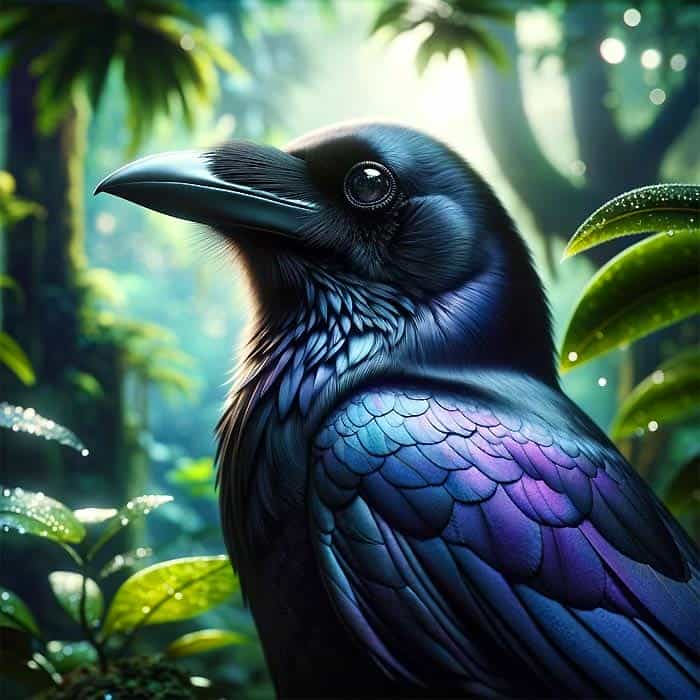
Meet the Violet Crow, a one-of-a-kind corvid native to the Indonesian island of Seram. With its dark black head and bluish-black feathers, this crow really lives up to its name. It also sports a shorter bill than other crows.
For a while, scientists thought the Violet Crow was just a subtype of the slender-billed crow. But genetic studies revealed it’s totally unique!
This rare bird is currently labeled “Least Concern, ” meaning its population seems stable for now. However, there’s still tons we don’t know about the Violet Crow and its home in the Seram rainforests.
As a genetically distinct island species, further research could help uncover fascinating facts about how the Violet Crow evolved. It adds to Indonesia’s incredible biodiversity too.
The Violet Crow is proof that even within bird families, species can take their own evolutionary path[26]. We’ve only scratched the surface when it comes to understanding Seram Island’s dazzling Violet Crow. More study will help ensure this one-of-a-kind corvid continues wowing us with its uniqueness.
White-billed Crow
| Kingdom | Order | Family | Genus | Species |
|---|---|---|---|---|
| Animalia | Passeriformes | Corvidae | Corvus | Corvus woodfordi |
White-billed Crow Meet the Elusive White-billed Crow – The Solomon Islands’ Mysterious Ivory-Billed Corvid
In the lush forests of the Solomon Islands lives one very sneaky bird – the White-billed Crow. This short, stocky corvid reaches about 40-41 cm long and rocks a totally unique look. Its deep, curved ivory-colored bill is hard to miss against its glossy black plumage.
This bird blends in well thanks to greenish-purple tones on its head and purple glossy feathers on its body. You’ll also spot pale grey or white eyes and black legs on this elusive crow.
The White-billed Crow hangs out only on a few central Solomon Islands, moving through the canopy in family groups and feasting on insects and fruit. It makes distinctive “ao-ao-ao” calls but stays hidden high above the forest floor most of the time.
Little is known about how this rare bird breeds or its total population. For now, it’s listed as “Least Concern” by conservation groups. But with so many unanswered questions, more research is needed to unravel the mysteries of the Solomon Islands’ camouflaged White-billed Crow[27].
Long-billed Crow
| Kingdom | Order | Family | Genus | Species |
|---|---|---|---|---|
| Animalia | Passeriformes | Corvidae | Corvus | Corvus validus |
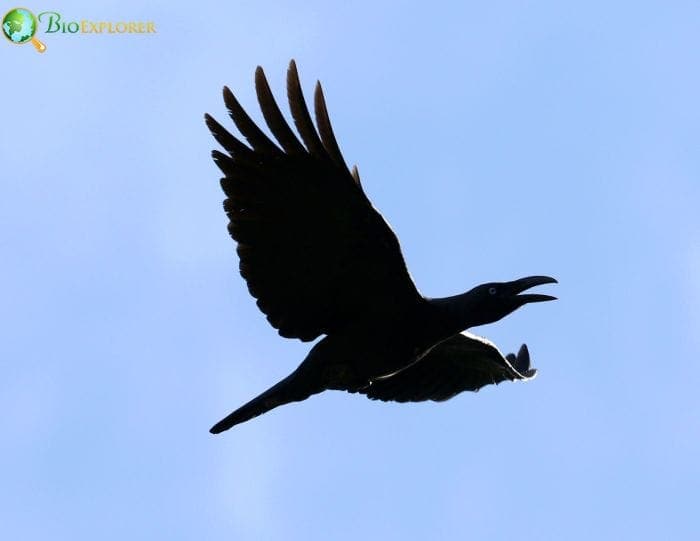
In the forests of Indonesia’s Northern Maluku Islands lives a one-of-a-kind corvid – the Long-billed Crow. With its glossy black plumage, piercing white eyes, and extra long bill, this crow really stands out from the flock. At 45-53 cm tall, it’s a large bird too.
The Long-billed Crow’s calls sound like a puppy yapping: “cruk\. ..cruk\. ..cruk. ” You’ll find these vocal corvids only in certain Maluku Islands like Morotai, Obira, and Halmahera. They prefer forest habitats, but will venture into farms and secondary growth when needed[28].
Unfortunately, deforestation threatens this bird’s tropical island home. And with a limited island range of about 25,700 km2, losing forest means losing Long-billed Crows. Due to declining numbers, it was just uplisted to “Near Threatened” status.
The Long-billed Crow is a Maluku Islands specialty, found nowhere else on Earth. Saving its island forests is crucial for protecting Indonesia’s unique yapping corvid. With dedicated conservation, we can ensure future generations get to see this glossy-feathered, ivory-eyed bird thriving in its island home.
Slender-billed Crow
| Kingdom | Order | Family | Genus | Species |
|---|---|---|---|---|
| Animalia | Passeriformes | Corvidae | Corvus | Corvus enca |
<https://www.youtube.com/watch?v=RJM8yF0fTlY>
Lurking in the lush forests of Southeast Asia dwells the elusive Slender-billed Crow. This striking black bird blends into the shadows of its tropical habitat. But its evolutionary history tells a complex tale full of twists and revisions[29]. This crow species is also called Sunda Crow.
Once, scientists thought these crows closely related to the majestic Violet and Palawan Crows. Genetic sleuthing shattered assumptions. Analysis reclassified the Palawan as distinct, while the petite Samar Split-Crow splintered off from the Slender-billed branch.
Taxonomy shaken; relationships realigned.
While human understanding shifts, the crows’ lives stay steady. For now, their populations appear stable, rated “Least Concern” by the IUCN Red List. But the ax of deforestation swings closer each day. Their haven of mangroves and rainforests diminishes.
How many more secrets do these birds hold? What clues to adaptation and survival might unlock should we take the time to observe their mysteries before the forests fall silent? The Slender-billed Crow’s future, like its past, promises further revelations should we care to listen.
Jamaican Crow
| Kingdom | Order | Family | Genus | Species |
|---|---|---|---|---|
| Animalia | Passeriformes | Corvidae | Corvus | Corvus jamaicensis |
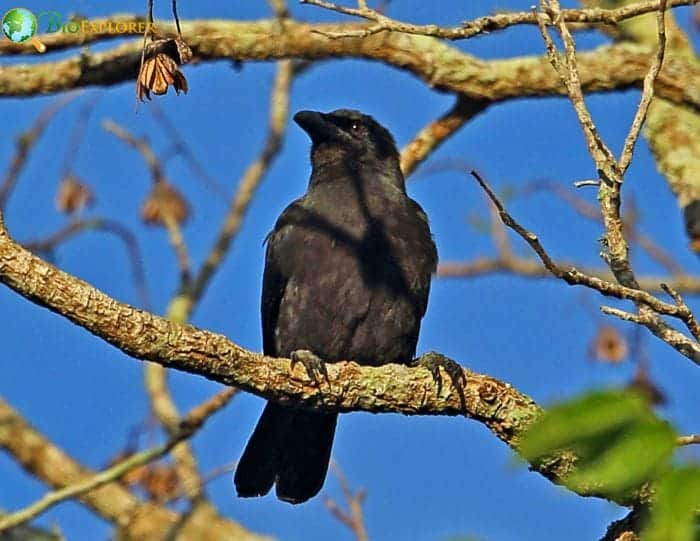
A flash of slate-grey darts through Jamaican woodlands, letting out a distinctive jabbering call. This bubbly bird is the Jamaican Crow, chattering away in its island home.
Though small, barely reaching 38 cm long, the Jamaican Crow makes its presence known. Its loud voice earned it the Patois nickname “Jabbering Crow”. When not jabbering, musical burbling flows from its throat[30].
The Jamaican Crow shares kinship with the Cuban and White-necked Crows, fellow West Indian corvids. Sooty-grey plumage blended with dark grey facial patches give the birds a distinguished look.
Sharp slate-grey beaks taper into points ideal for omnivorous appetites. Fruit, small invertebrates, even juvenile lizards all whet their palates. A sneaky snack of eggs or nestlings pilfered from other birds’ nests tops off feasts.
But amongst the laughter of its calls, an uncertain future loom. Deforestation shrinks its woodland home. As habitat withers, so too do Jamaican Crow numbers. The IUCN Red List labels them “Near Threatened”.
What other secrets do these birds hold? Let us pause and observe their mysteries before their voices fade from Jamaica’s forests.
Cuban Crow
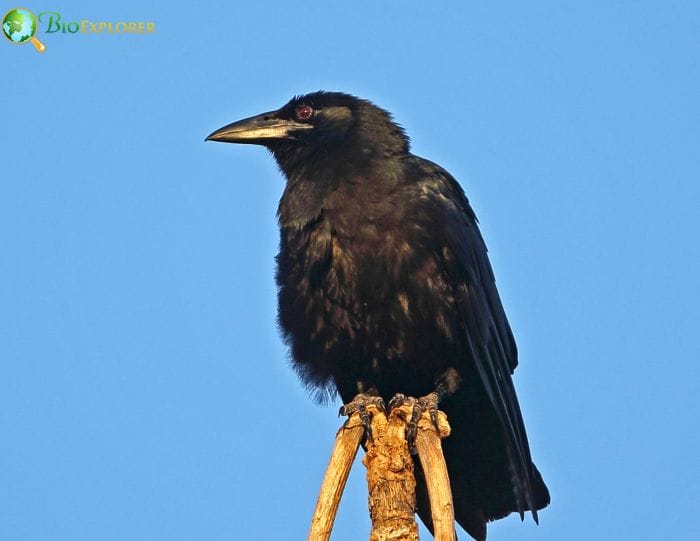
| Kingdom | Order | Family | Genus | Species |
|---|---|---|---|---|
| Animalia | Passeriformes | Corvidae | Corvus | Corvus nasicus |
The islands of the Caribbean are home to a sharp-looking corvid – the Cuban Crow. About 40-42 cm tall, this medium-sized bird rocks a totally unique style. It sports a long, curved bill and slick black feathers with a bluish-purple sheen in bright light. You can’t miss the patch of grey bare skin behind its reddish-brown eyes either[31].
From Cuba to the Turks and Caicos, this adaptable bird hangs out in forests but also frequents farms and villages. It will snack on just about anything – fruits, bugs, our leftovers – you name it! The Cuban Crow has a vocal range too, making bubbling, ringing, and screeching notes.
Nesting habits are still a mystery since it hides nests high up in trees. For now, this Caribbean endemic is rated “Least Concern” by conservation groups.
With its stylish look and varied diet, the Cuban Crow continues thriving across its island range. But more study is needed to unravel the mysteries of this tropical corvid’s life in the Caribbean treetops. One thing’s for sure – it adds plenty of color, inside and out!
Sinaloa Crow
| Kingdom | Order | Family | Genus | Species |
|---|---|---|---|---|
| Animalia | Passeriformes | Corvidae | Corvus | Corvus sinaloae |
Along Mexico’s Pacific coastline lives the savvy Sinaloa Crow. Looks-wise, this 34-38 cm corvid is identical to its cousin the Tamaulipas Crow, both sporting slick black plumage. But don’t be fooled – the Sinaloa Crow’s jay-like voice sets it apart!
From Sonora to Manzanillo, you’ll find this opportunistic bird hanging out along riverbanks, coastlines, open woodlands, and semi-desert areas. It especially loves chilling in coastal towns and villages[32].
The Sinaloa Crow isn’t picky when it comes to food. It uses its opportunity-seeking nature to munch on shellfish, crabs, fruits, eggs – you name it! Even other birds’ nestlings aren’t safe from this crafty corvid.
For its own nests, the Sinaloa Crow picks prickly trees or tall palms. Its nest resembles its American Crow cousin’s, just smaller.
For now, conservation groups list this Pacific coast crow as “Least Concern. ” But its impressive mimicking skills and adaptability suggest the Sinaloa Crow will continue flourishing along Mexico’s Pacific shores.
Bismarck Crow
| Kingdom | Order | Family | Genus | Species |
|---|---|---|---|---|
| Animalia | Passeriformes | Corvidae | Corvus | Corvus insularis |
Among the islands of Papua New Guinea lives a specialized corvid called the Bismarck Crow. This bird was originally thought to be a sub-type of the Torresian Crow but turns out to be totally unique!
Found only in the Bismarck Archipelago, the Bismarck Crow is rated “Least Concern” for now by conservation groups. But there’s still tons more to learn about this island endemic and its evolutionary story[33].
As a genetically distinct island species, further research on the Bismarck Crow could reveal fascinating details about how it adapted to its tropical home over time. This lesser-known corvid highlights the rich biodiversity of New Guinea.
The Bismarck Crow shows that even within bird families, species can take their own separate path. More study of this island crow will help uncover mysteries about its life in the Bismarck Archipelago. For now, it remains an intriguing example of nature’s creativity when it comes to speciation.
Bougainville Crow
| Kingdom | Order | Family | Genus | Species |
|---|---|---|---|---|
| Animalia | Passeriformes | Corvidae | Corvus | Corvus meeki |
On the tropical island of Bougainville, one crow rules them all – the Bougainville Crow. At 41 cm tall, this heavyset bird is the only corvid in town. With its all-black plumage and massive ebony-colored bill, this crow cuts an imposing figure.
Right at home in the rainforests, the Bougainville Crow roams both the lowland forests and higher mountain forests up to 1600 meters in elevation. For now, it remains a common sight across its island range.
But logging threatens this bird’s specialized forest habitat. While still rated “Least Concern, ” if deforestation continues, the Bougainville Crow’s future could be at risk.
As Bougainville’s sole corvid, preserving its ancestral rainforests is key. With safe forests, the Bougainville Crow can continue thriving – a heavyweight forest champion in both size and spirit!
Flores Crow
| Kingdom | Order | Family | Genus | Species |
|---|---|---|---|---|
| Animalia | Passeriformes | Corvidae | Corvus | Corvus florensis |
On the Indonesian island of Flores lives a severely threatened bird – the Flores Crow. As a corvid found only on this one island, it has adapted uniquely to its dry and moist forest home.
But extensive habitat loss now puts the Flores Crow at risk of extinction. With its forests disappearing, this island endemic is classified as “Endangered”.
As a genetically distinct island species, the Flores Crow highlights the incredible biodiversity of Indonesia. But its uncertain future raises urgent questions. Are current conservation efforts enough? More must be done to protect this rare bird and its dwindling island forests.
The Flores Crow reminds us that localized island species play vital ecological roles. If we lose them, we lose irreplaceable pieces of nature’s intricate puzzle. With the Flores Crow’s time running out, increased habitat protections offer hope that this island corvid can bounce back from the brink.
Somali Crow
| Kingdom | Order | Family | Genus | Species |
|---|---|---|---|---|
| Animalia | Passeriformes | Corvidae | Corvus | Corvus edithae |
In the arid Horn of Africa lives a petite corvid called the Somali Crow. About the size of the carrion crow but with a longer bill, this bird sports slightly brownish black feathers. It was originally considered a type of brown-necked raven but turns out to be its own unique species[34].
You’ll find the Somali Crow building bulky nests in lone trees or poles across Somalia, Djibouti, and Northern Kenya and Ethiopia. The moms lay 3-5 eggs in springtime. This bird’s harsh “caw” calls resemble its Eurasian rook cousin.
For now, the Somali Crow is rated “Least Concern” by conservation groups. But there’s still much to uncover about this slender-billed desert corvid. Further research can reveal fascinating facts about how it has adapted to the arid Horn of Africa.
The Somali Crow highlights the biodiversity of this unique region where few birds can survive. It serves as a reminder that even lesser-known species play important ecological roles.
Eastern Jungle Crow
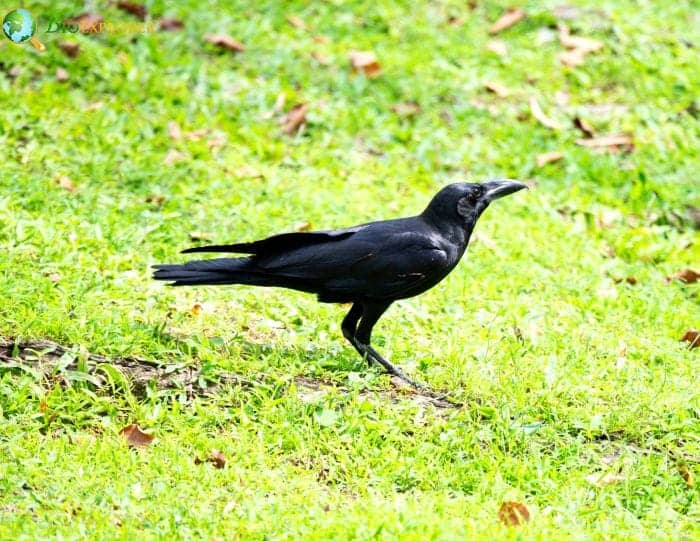
| Kingdom | Order | Family | Genus | Species |
|---|---|---|---|---|
| Animalia | Passeriformes | Corvidae | Corvus | Corvus levaillantii |
Somewhere in the forests of Asia flies a mysterious corvid – the Eastern Jungle Crow. This little-known bird spans a wide range, inhabiting countries from China to Thailand. But details about the elusive Eastern Jungle Crow remain scarce[35].
Its adaptability points to a varied habitat, likely including both wet and dry forests across its range. However, without dedicated research, the Eastern Jungle Crow’s specific ecology and population status stay shrouded in mystery.
This lack of knowledge is a missed opportunity to understand a unique Asian species. Targeted studies could uncover fascinating facts about how the Eastern Jungle Crow has evolved across its widespread home.
For now, the Eastern Jungle Crow remains an enigma, reminding us of the work still needed to document Asia’s rich biodiversity. By shedding light on this evasive bird, we better comprehend nature’s intricate web of life. The time has come to reveal the secrets of the Eastern Jungle Crow.
Indian Jungle Crow
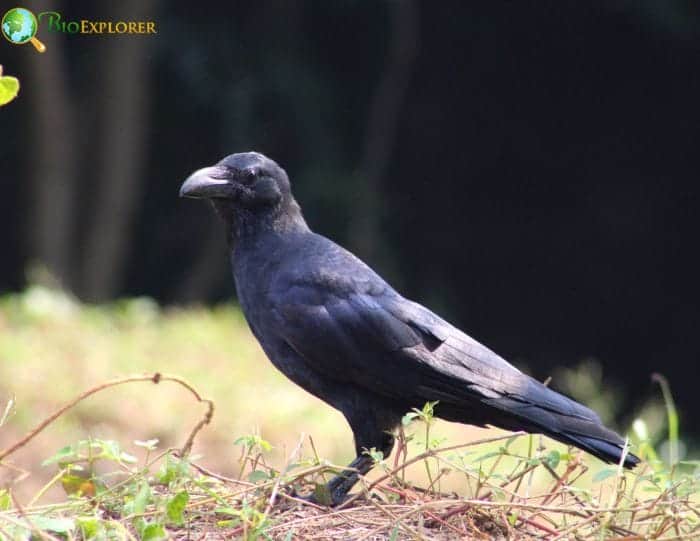
| Kingdom | Order | Family | Genus | Species |
|---|---|---|---|---|
| Animalia | Passeriformes | Corvidae | Corvus | Corvus culminatus |
Across India’s forests lives a slick all-black bird known as the Indian Jungle Crow. Unlike its cousin the house crow, this corvid lacks any grey neck feathers. Its rounded tail and heavy bill without a curved upper edge are other giveaways.
Once considered just a type of other crows, the Indian Jungle Crow is now recognized as its own unique species due to its distinct vocalizations and features.
This savvy bird roams the subcontinent south of the Himalayas solo, in pairs, or in small flocks. An opportunistic eater, it’ll get creative in finding food, like softening tough morsels in water.
Come breeding season, you can spot their nests built high up in large trees, containing 3-5 pale blue-green eggs. The Asian koel bird sometimes sneaks in to lay eggs of its own too!
From its adaptability to its all-black look, the Indian Jungle Crow is a true jewel that adds to India’s incredible biodiversity.
Banga Crow/Banggai Crow
| Kingdom | Order | Family | Genus | Species |
|---|---|---|---|---|
| Animalia | Passeriformes | Corvidae | Corvus | Corvus unicolor |
Never heard of the Banggai Crow? You’re not alone. This critically endangered bird is little known outside its remote island home in Indonesia. But the fate of the Banggai Crow highlights the wider challenges endangered species face worldwide.
These unique crows dwell solely on the Banggai Archipelago, east of Sulawesi. Discovered in 1991, only around 500 remain, mostly in the mountains of Peleng island. Their specialty? Montane forests. Yet habitat destruction threatens the Banggai Crow’s survival[36].
Logging and potential mining have damaged the crows’ home. Though mining threats have been temporarily averted, they could return. Already the forests shrink.
And locals wrongly believe the crows steal poultry eggs, leading to persecution. With few options, the crows persist on the brink. Now, conservation efforts led by residents aim to establish protected forests where Banggai Crows can finally thrive free of threats.
But time is running short for this rare species. The Banggai Crow highlights a common plight – human activity pushing island species to extinction. Still, dedicated conservation work offers hope of averting the Banggai Crow’s demise. With quick action, this little-known bird can still have a fighting chance.
Cuban Palm Crow
| Kingdom | Order | Family | Genus | Species |
|---|---|---|---|---|
| Animalia | Passeriformes | Corvidae | Corvus | Corvus palmarum |
In the pine forests and around Lake Enriquillo of Cuba and the Dominican Republic dwells a small vocal corvid – the Cuban Palm Crow. Though once abundant in Cuba, this bird’s numbers have sadly dropped[37].
Slightly smaller than its Hispaniolan relatives, the Cuban Palm Crow sports the Caribbean name “cao”, mimicking its repetitive call. Despite living alongside the white-necked crow, this bird is actually more closely related to the fish crow of the eastern US.
For now, the Cuban Palm Crow is still rated “Least Concern”. But its declining Cuban population hints that this island corvid faces growing threats.
Without more study and protection, we risk losing the distinctive voice and ecology of Cuba’s Palm Crow. Sustained efforts are needed to ensure this tropical bird continues flourishing throughout its Caribbean Island habitat.
The Cuban Palm Crow reminds us that even localized subspecies play important roles. With care, its call can continue sounding through Cuba’s forests for generations to come.
Philippine Jungle Crow
Swooping through the lush forests of the Philippines is one clever corvid – the Philippine Jungle Crow. This tropical bird reaches 40-43 cm long and sports dark black plumage with subtle glossy hints of purple or blue when the light hits just right[38].
True to its jungle crow family, this bird is a true brainiac. It can adapt to various foods and environments thanks to its omnivorous diet. Though these opportunistic behaviors may bother farmers at times, the Philippine Jungle Crow plays an important role as both predator and scavenger.
Traveling in talkative flocks, the Philippine Jungle Crow has a complex array of calls used to communicate. And with top-notch problem-solving skills, this tropical corvid can hold its own against even the most intelligent crow species.
While not currently threatened, habitat loss is a growing issue. But with conservation support, this adaptable jungle crow can continue thriving.
So next time you’re in the Philippines’ forests, listen for the calls of the Philippine Jungle Crow. It’s sure to be plotting its next clever move! This crafty bird is a reminder of the biodiversity worth protecting in these vanishing tropical forests.
Albino Crow
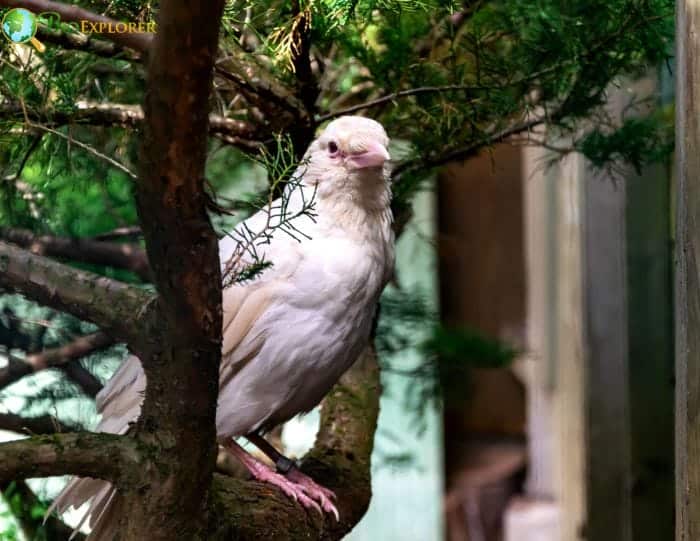
Although Albino Crows are not a specific species of Crows but any aforementioned crow species could get into this rare genetic condition called Albinism.
Extremely rare albino crows lack the jet black plumage that typically camouflages crows. Instead, albino crows appear snow white with bright reddish eyes. Their beaks and feet also lack melanin pigments and appear pinkish. Albino crows' vision is impaired, and they have little chance of thriving in the wild.
Yet through random mutation, albino crows sporadically occur demonstrating that recessive albinism genes persist in crow populations at low levels. Albino crows provoke fascination and fear due to associations with supernatural spirits and mystical forces.
Former Corvus Species
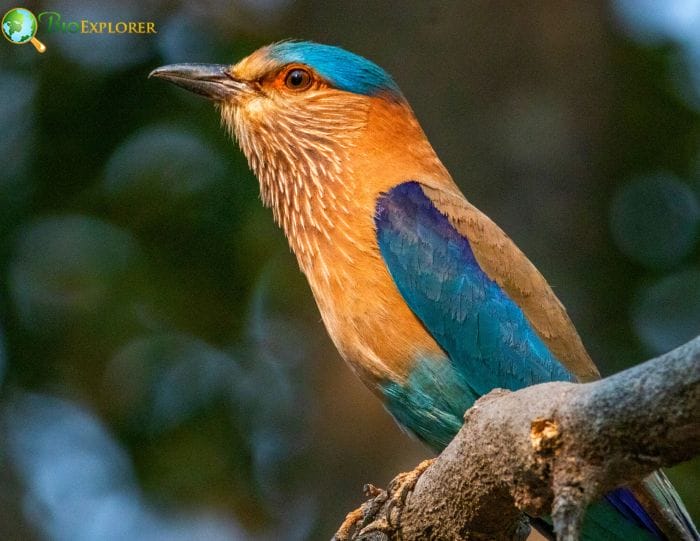
-
- The Indian roller was previously classified as Corvus benghalensis, but genetic analysis has shown it is not closely related to true crows and now places it in its own genus Coracias.
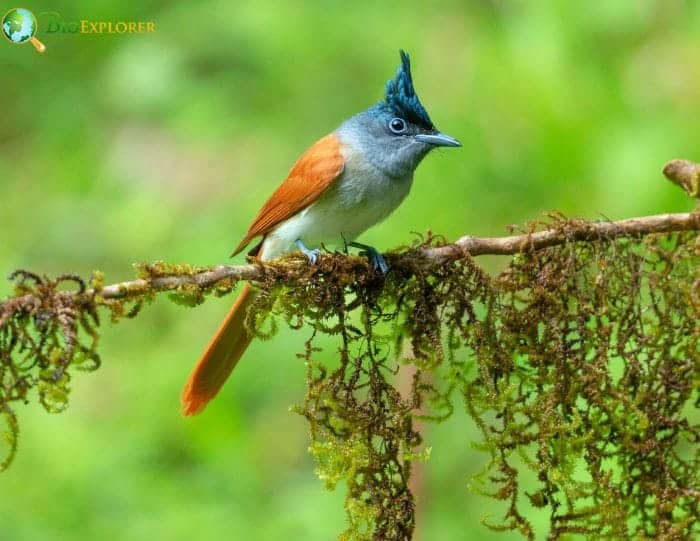
-
- The paradise flycatcher was formerly named as Corvus paradisi by Linnaeus in 1758, but this colorful Indian bird is not a corvid and its current accepted scientific name is Terpsiphone paradisi.
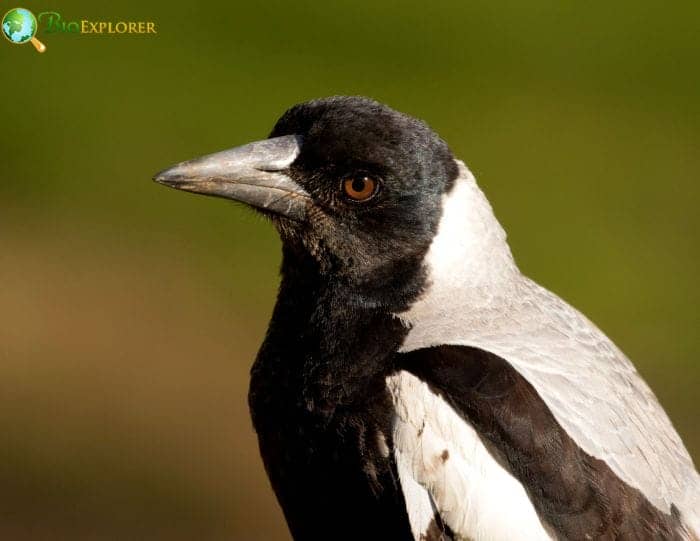
-
- The Australian magpie-lark was initially described as Corvus cyanoleucus by John Latham in 1801, but further study revealed it is not a crow and it was reclassified into the genus Grallina.
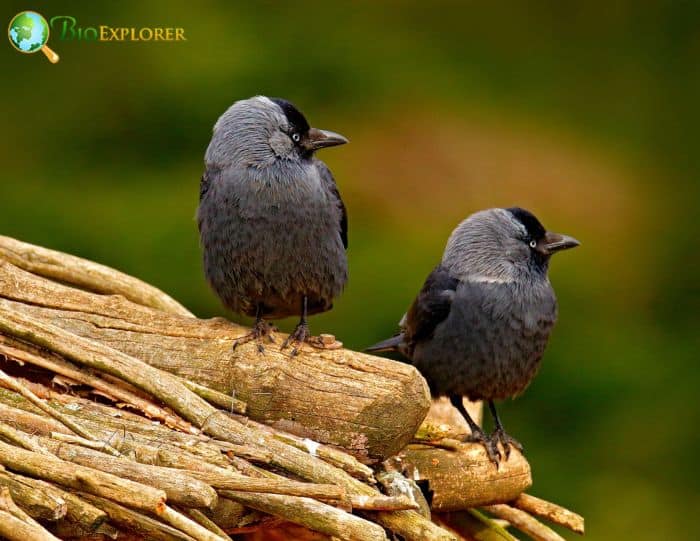
-
- The western jackdaw and the similar daurian jackdaw were both previously considered part of the widespread Corvus monedula and Corvus dauuricus species, but they are now placed in their own genus Coloeus as Coloeus monedula and Coloeus dauuricus.
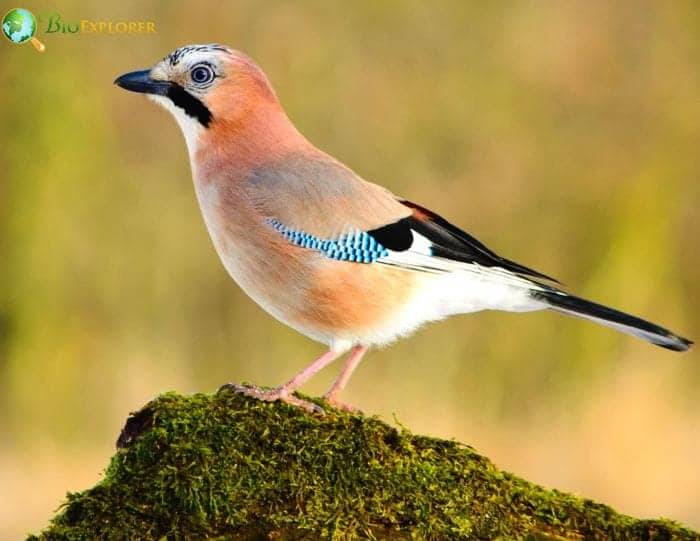
- The Eurasian jay was formerly known as Corvus glandarius by Carl Linnaeus in 1758 in the tenth edition of his Systema Naturae, but research showed it is distinct enough to be classified as a separate genus, Garrulus glandarius.
In summary, while these birds were initially grouped under the Corvus genus with crows, advances in ornithology have led to reclassifications into more accurate genera based on updated genetic analysis.
Crows by Year of Taxonomy Classification
From a taxonomy classification perspective, American Crow, Hooded Crow and Carrion Crow were the first set of crow species to be added to the Passeriformes order by Carl Linnaeus in 1758. The last crow species to be added was the Mexican Crow by James Lee Peters in 1929.
| White-necked Raven | Corvus albicollis | 1790 | John Latham | England |
| Pied Crow | Corvus albus | 1776 | Statius Müller | Germany |
| Little Crow | Corvus bennetti | 1901 | Alfred John North | Australia |
| American Crow | Corvus brachyrhynchos | 1758 | Carl Linnaeus | Sweden |
| Cape Crow | Corvus capensis | 1822 | Coenraad Jacob Temminck | Netherlands |
| Hooded Crow | Corvus cornix | 1758 | Carl Linnaeus | Sweden |
| Carrion Crow | Corvus corone | 1758 | Carl Linnaeus | Sweden |
| Australian Raven | Corvus coronoides | 1827 | Nicholas Aylward Vigors & Thomas Horsfield | UK |
| Thick-billed Raven | Corvus crassirostris | 1836 | Eduard Rüppell | Germany |
| Chihuahuan Raven | Corvus cryptoleucus | 1854 | Johann Friedrich Gmelin | Germany |
| Cuban Crow | Corvus nasicus | 1826 | Thomas Nuttall | UK |
| Slender-billed Crow | Corvus enca | 1821 | Thomas Horsfield | UK |
| Flores Crow | Corvus florensis | 1894 | Otto Finsch | Germany |
| Hawaiian Crow | Corvus hawaiiensis | 1848 | Adolphe Simon Neboux | France |
| Brown-headed Crow | Corvus fuscicapillus | 1859 | George Robert Gray | UK |
| Mexican Crow | Corvus imparatus | 1929 | James Lee Peters | USA |
| Jamaican Crow | Corvus jamaicensis | 1788 | Johann Friedrich Gmelin | Germany |
| Mariana Crow | Corvus kubaryi | 1885 | Otto Finsch | Germany |
| Jungle Crow | Corvus levaillantii | 1831 | René Primevère Lesson | France |
| Large-billed Crow | Corvus macrorhynchos | 1827 | Johann Georg Wagler | Germany |
| House Crow | Corvus splendens | 1817 | Louis Jean Pierre Vieillot | France |
| Grey Crow | Corvus tristis | 1827 | René Primevère Lesson | France |
| Banggai Crow | Corvus unicolor | 1900 | Ernst Hartert | Germany |
| Cuban Palm Crow | Corvus palmarum | 1835 | Johann Georg Wagler | Germany |
| White-billed Crow | Corvus woodfordi | 1880 | Richard Bowdler Sharpe | UK |
| Brown-necked Raven | Corvus ruficollis | 1831 | René Primevère Lesson | France |
| Chihuahuan Raven | Corvus cryptoleucus | 1854 | Johann Friedrich Gmelin | Germany |
| Fan-tailed Raven | Corvus rhipidurus | 1826 | René Primevère Lesson | France |
| Sinaloa Crow | Corvus sinaloae | 1885 | George Newbold Lawrence | USA |
| Palm Crow | Corvus palmarum | 1835 | Johann Georg Wagler | Germany |
| Brown-necked Raven | Corvus ruficollis | 1831 | René Primevère Lesson | France |
| Bismarck Crow | Corvus insularis | 1903 | Walter Rothschild | UK |
| Bougainville Crow | Corvus meeki | 1904 | Walter Rothschild | UK |
| Little Raven | Corvus mellori | 1912 | Gregory Mathews | Australia |
| New Caledonian Crow | Corvus moneduloides | 1851 | Jules Verreaux | France |
| Fish Crow | Corvus ossifragus | 1817 | Louis Jean Pierre Vieillot | France |
| Hispaniolan Palm Crow | Corvus palmarum | 1835 | Johann Georg Wagler | Germany |
| Fan-tailed Raven | Corvus rhipidurus | 1826 | René Primevère Lesson | France |
| Brown-necked Raven | Corvus ruficollis | 1831 | René Primevère Lesson | France |
| Sinaloa Crow | Corvus sinaloae | 1885 | George Newbold Lawrence | USA |
| House Crow | Corvus splendens | 1817 | Louis Jean Pierre Vieillot | France |
| Forest Raven | Corvus tasmanicus | 1804 | John Latham | England |
| Grey Crow | Corvus tristis | 1827 | René Primevère Lesson | France |
| Banggai Crow | Corvus unicolor | 1900 | Ernst Hartert | Germany |
| Bougainville Crow | Corvus woodfordi | 1880 | Richard Bowdler Sharpe | UK |
Frequently Asked Questions
What is the difference between the American crow and raven?
While they are both part of the Corvidae family, known as crows, the American Crow (Corvus Brachyrhynchos) and the Common Raven (Corvus corax) are different species of birds. They have a few distinct physical and behavioral differences. Ravens are larger, have a thicker beak, and a more pronounced ruffle of feathers around their throat. Ravens are also often solitary, while crows may live in larger groups or pairs.
Where can I find the habitat of the common raven?
Common Ravens are widespread and can be found in a variety of habitats, ranging from forests, mountains, and grasslands to deserts and coastal lines. They can adapt to live almost everywhere except the deep interiors of large forests.
Who is part of the crow species?
There are many species that are part of the crow family (Corvidae), including not only the American Crow (Corvus Brachyrhynchos) and the Common Raven but also many other species, such as the Hawaiian Crow, the Mariana Crow, the Northwestern Crow, and smaller species like the Jackdaw.
How to distinguish different types of crows?
Different types of crows can be distinguished by their size, the shape and size of their beak, their habitat, their vocalizations, and their behavior. For example, the Northwestern Crow (Corvus Caurinus) is slightly smaller than the American Crow and can chiefly be found in coastal regions.
What thematic behaviors have crow species been observed to do?
Crows are known to be highly intelligent species of birds with observed behaviors including problem-solving and using tools. For example, a crow places pebbles into a water container to raise the water level and get to food. They also work in groups to accomplish tasks or feed effectively.
Are crows broadly mischievous in nature?
Yes, due to their high IQ, crows can sometimes be characterized as mischievous. They are known to play tricks on other birds and mammals, and they have a reputation for stealing shiny objects. They are also known to gather in huge numbers in places called “crows courts” where they appear to judge the behavior of a group member.
What are the different threats to crows and ravens?
How do crows reach sexual maturity?
Crows reach sexual maturity around two to four years of age. They tend to mate for life, and both parents help to raise their young. Mated pairs of crows will often accompany their offspring from previous years, who help raise the new chicks.
Can ravens and jackdaws communicate?
Yes, like other Corvus species, Ravens and Jackdaws have complex communication systems and are believed to be able to communicate not only amongst their own species but also with other Corvus species.
Is there any unusual behavior recorded among Crows?
Yes, crows have been observed engaging in what appears to be playful behavior, such as aerial acrobatics and sliding down steep snowy roofs or hillsides. Additionally, they are known to work in groups to accomplish tasks or feed effectively.
What types of habitats are suitable for different crow species?
Crows are versatile creatures and can adapt to a variety of habitats. Common birds like crows are found throughout various parts of the world, including dense forests, suburbs, and even agricultural areas. They are known to roost in large flocks, mainly in tall trees made of twig nests. Hawaiian crow and the Mariana crow, for example, are found in Pacific islands. An Australian species might live in outback areas, while other species of crows are found in parts of Europe, Asia or North America.
What are the most common species of crows?
While there are many different types of crow species, the most common ones include the American crow, the Hawaiian crow, and the Mariana crow. Each of these species exhibits slightly different behaviors, diets, and sounds. Some species, like the Hawaiian crow and the Mariana crow, are under the protection of the U. S. Fish and Wildlife Service due to their endangered status.
How would you describe the physical features of crows?
Crows generally have strong bodies with long, sturdy legs, and wedge-shaped tails. The tail is rounded in some species. They’re often entirely black, with some species having a slight gloss to their feathers on the neck or torso. The size varies from medium to large, depending on the species.
What is the lifespan of crows in their natural habitat?
While the lifespan can differ among species, most crows live for about 7-8 years in the wild. However, some crows have been known to live up to 20 years or more, particularly in areas where food supply is consistently available and there is little predation.
How does the communication system of crows work?
Crows have a complex communication system including a variety of vocalizations. A common one is a long caw followed by a series of short caws, often made when a bird is separated from its mate or offspring. The meanings of these caws are still largely unknown but they rank highly on the avian IQ scale.
How would you describe the behaviour of crows?
Crows exhibit a range of behaviors. They tend to be solitary or travel in large family groups. They’re known to use tools, recognize themselves in mirrors, and hold ‘funerals’ for their dead. During the late summer and fall, crows gather in large, communal roosts.
Do crows interact with humans?
Yes, crows are known to live in close proximity to humans and are very adaptable. They seem to recognize individual humans and remember their faces. In urban areas, they are often seen scavenging for food while in countryside areas they may protect their territory or young from human interference.
What does a crow’s diet consist of?
Crows are omnivorous which means they eat a variety of foods. Their diet includes small animals such as earthworms and small reptiles, grains, fruits, and even carrion when food gets scarce. They’re also known to eat human leftovers, making them common visitors to urban trash bins.
Can crows be considered dangerous?
Generally, crows aren’t a danger to humans and tend to avoid people. However, during nesting season they can be protective of their young and may swoop if they feel threatened. Also, some people may associate crows with diseases as they consume carrions, but they pose less health risk than Pigeons or seagulls.
How to tell the difference between a crow and a vulture?
While both are birds, crows and Vultures are different species with distinct characteristics. Crows are generally smaller and are covered with black feathers, while vultures are larger and often have a bald neck or torso. Crows have a wider, fan-shaped tail and a sharp, straight beak, while vultures have a long, broad wings and a hooked beak.
Cite this page
Bio Explorer. (2026, January 28). Types of Crows. https://www.bioexplorer.net/animals/birds/crows/
Your photo for the Australian magpie-lark shows a different bird, which I think is the pied crow Corvus albus from Africa (the first entry in this article). The magpie-larks are Australian and smaller. Magpie-lark is Grallina cyanleuka.
I lived in Australia for 5 years. The birds are spectacular!
The magpies in Australia have a large white patch on the upper back and nape,but the breast is black. They are distantly related to the corvids, and resemble them is shape, size, and behavior. Terrific memories, great problem solvers. Other related families in Australia include the butcher birds and currawongs (larger than crows). Magpie refers to black-and-white coloration (pied). The American magpies (black-billed and yellow-billed) have very long tails. They are a big larger than jays. Magpies, jays, and crows are all classed in the corvid family.
The Australian magpies are distantly related to the corvids (different family) but resemble them in shape, size, and behavior. Terrific memories, great problem solvers. Other sort-of related families in Australia include the butcher birds and currawongs (larger than crows). Butcher birds and magpies there sing two notes at once–magical sounds! Magpie refers to black-and-white coloration (pied).
The American magpies have black and white bodies, very long tails, iridescent green. They are a big larger than jays. Magpies, jays, and crows are all classed in the corvid family.