
Y-Linked Inheritance Calculator
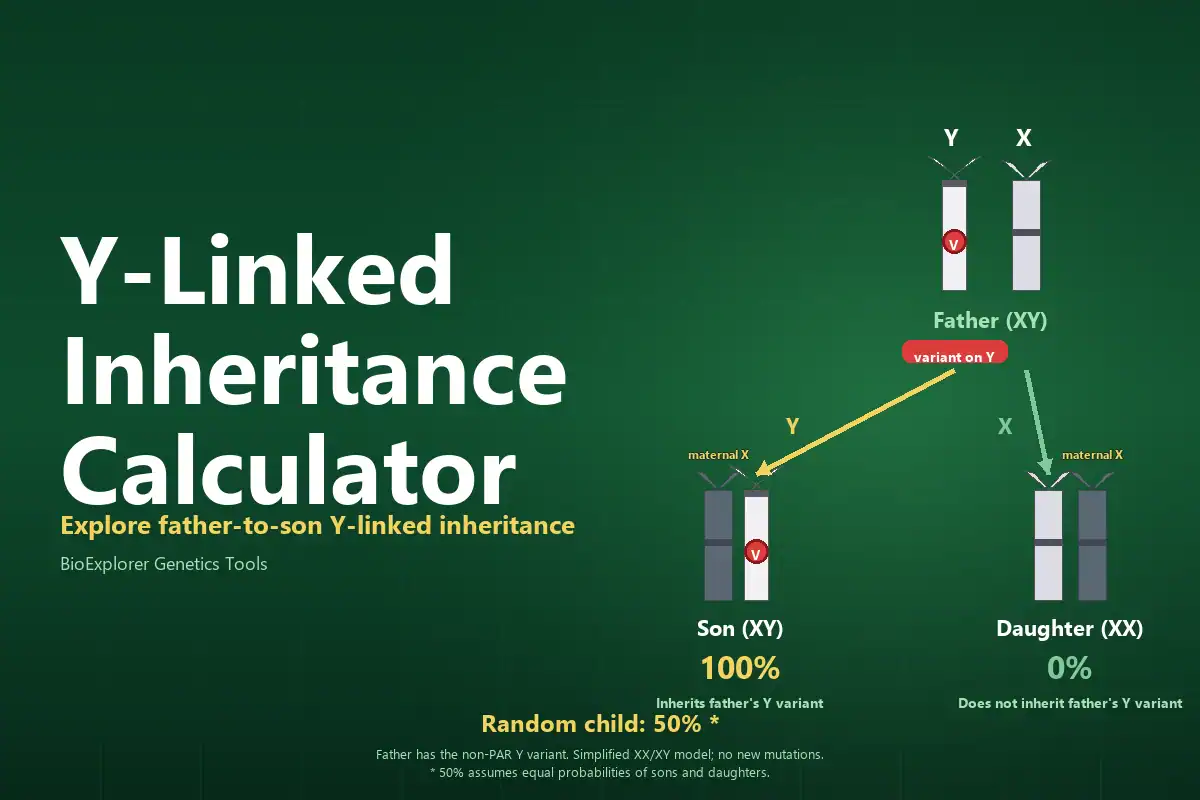
The Y-Linked Inheritance Calculator predicts the probability that offspring of a single couple inherit a Y-chromosome variant (a holandric trait) from the child’s genetic father.
The tool has two surfaces: a quick-answer panel that summarizes the paternal-path result in one line, and a main calculator that produces sex-stratified per-child probabilities, a cumulative distribution for random-sex mode, or a deterministic count for specified-sex mode. The calculator runs entirely in the browser.
Y-Linked Inheritance Calculator
Predict the probability of a Y-linked (holandric) trait in offspring. Pick the child’s genetic father’s variant status, choose the number and sex of children, and get sex-stratified probabilities.
How to use the Y-Linked Inheritance Calculator
- Pick the child’s genetic father’s variant status: Present, Absent, or Unknown. The default is Unknown; the main calculator is disabled until you choose Present or Absent.
- Select a scenario. Generic is the default for any non-PAR Y variant. AZF microdeletion adds the clinical de-novo info block but does not change the inheritance math.
- Optionally enter a trait name (for example, “AZF microdeletion”). The trait name appears in the output as a label only; it does not change the math.
- Enter the number of children (1 to 20).
- Pick the sex mode. Random uses the binomial distribution (P(son) = 0.5 per child). Specified lets you set each child’s sex, which makes the result deterministic (number inheriting = v × m, where m is the count of specified sons).
- If the relationship between the child and a relative is relevant, click “Show family-history helper” to display the table that defines which relatives share the child’s genetic father’s paternal Y lineage under the v1 no-mutation model.
- Click Calculate to see the per-child probabilities, the cumulative distribution (random-sex mode) or the deterministic number inheriting (specified-sex mode), and the quick-answer panel.
What is Y-linked inheritance?
Y-linked inheritance, also called holandric inheritance, refers to traits determined by genetic variants on the Y chromosome. Because the Y chromosome is passed essentially intact from father to son, a Y-linked variant in the child’s genetic father will be present in every son and absent from every daughter. Daughters do not inherit the father’s Y. The Y chromosome’s pseudoautosomal regions (PAR1 and PAR2) recombine with the X chromosome and are excluded from this calculator’s model; the calculator covers the non-PAR portion of the Y.
The Y-Linked Inheritance Calculator answers two related questions: “what does my father’s variant status imply for me (the child) and for any future children?“, and “given a couple’s N planned children, what is the probability that at least one inherits?“.
The first is the quick-answer panel; the second is the main calculator. The two share a single canonical field, fatherVariantStatus, so the two surfaces cannot disagree.
The math: per-child and cumulative probabilities
Let v = 1 if the genetic father has the Y-linked variant, v = 0 if he does not. The probability that a given son inherits the variant is v; the probability that a given daughter inherits is 0 (daughters do not receive a Y).
For a random child (each child is a son with probability 0.5 and a daughter with probability 0.5), the probability of inheriting is v × 0.5. For N random children, the number of children who inherit follows a binomial distribution K ~ Binomial(N, 0.5 × v), and the probability that at least one child inherits is 1 − (1 − 0.5 × v)^N.
For specified-sex mode, the result is deterministic: if the user lists m sons among N children, the number inheriting is exactly v × m, and P(at least one inherits) is 1 if v = 1 and m > 0, else 0. The binomial distribution does not apply when sex is fixed because there is no remaining randomness in the inheritance outcome.
Unknown status: conditional scenarios
If the child’s genetic father’s variant status is unknown, the calculator does not produce a case-specific probability. Instead, it surfaces two conditional scenarios labeled “If present” and “If absent” so the user can see what each branch implies.
The main calculator is disabled when the status is unknown; only the quick-answer panel runs. The reason is that without a confirmed status there is no prior probability to combine with the conditional probabilities, and the calculator does not invent one.
The two conditional scenarios are: “If present” (v = 1): 100% of sons inherit, 0% of daughters, 50% of random children; for N random children, P(at least one inherits) = 1 − 0.5^N. “If absent” (v = 0): 0% of sons, 0% of daughters, 0% of random children. Confirm the genetic father’s status with a Y-chromosome test before using the result for clinical or family-planning decisions.
The family-history helper
The family-history helper is a separate sub-tool. It answers the question “does this relative share the child’s genetic father’s paternal Y lineage?“. The lineage is defined on the genetic father (not on the selected child) so that the table does not give a false implication when the child is a daughter.
A relative shares the lineage if the relative and the genetic father have a male-line common ancestor under the v1 no-mutation model. The table covers: the genetic father himself; the father’s father; full brothers or paternal half-brothers of the father; the father’s sons (the child’s brothers); the father’s paternal great-grandfather; the father’s mother and sister (no Y); maternal-line relatives (no Y); the mother herself (no Y).
AZF microdeletion: the clinical scenario
AZF (Azoospermia Factor) microdeletions are the principal clinical example used in this calculator. They are well-characterized Y-linked variants with established deletion-type stratification (AZFa, AZFb, AZFc; complete vs partial). Approximately 80% of AZF deletions identified in individuals with Y-chromosome infertility arose de novo (per GeneReviews and PMC9933971).
This does not change the inheritance math: if the child’s genetic father has the deletion, every son inherits it. Phenotype effects vary by deletion type and may include increased risk of impaired spermatogenesis or infertility. The calculator displays this info block when the scenario is set to AZF microdeletion, regardless of the variant status selection, so the clinical context is always visible.
Worked examples
The calculator ships with six hand-verified worked examples that exercise every combination of variant status, scenario, number of children, and sex mode. Each example can be loaded by clicking its chip in the calculator widget. The expected output for each example is documented in PHASE-1-2-DISCOVERY-AND-MATH.md, and the unit tests verify the calculator reproduces the documented numbers exactly.
Example 1: variant-present father, N=1, random sex
Inputs: fatherVariantStatus = present, scenario = generic, N = 1, sexMode = random.
Quick answer: 100% of sons, 0% of daughters, 50% of random children.
Main calculator: P(inherits | son) = 100.00%, P(inherits | daughter) = 0%, P(random child is a son who inherits) = 50.00%. P(at least one of 1 random child inherits) = 50.00%.
Example 2: quick-answer with status = present
Inputs: fatherVariantStatus = present, scenario = generic, N = 1, sexMode = random.
Quick answer returns the result code “transmission_path_verified” with the message “100% of sons inherit. 0% of daughters. 50% of random children inherit.”
The result code is exposed as a CSS class on the quick-answer card so test automation can verify which branch fired.
Example 3: variant-present father, N=3, random sex
Inputs: fatherVariantStatus = present, scenario = generic, N = 3, sexMode = random.
The number of inheriting children K follows Binomial(3, 0.5). P(K = 0) = 12.5000%, P(K = 1) = 37.5000%, P(K = 2) = 37.5000%, P(K = 3) = 12.5000%. P(at least one inherits) = 87.5000%. The cumulative table shows all four k-rows.
Example 4: AZF scenario, variant-present father, N=1
Inputs: fatherVariantStatus = present, scenario = azf_microdeletion, N = 1, sexMode = random.
The math is the same as Example 1, but the AZF info block fires and the de novo figure (~80%) and the variable-phenotype caveat are displayed. The info block is informational, not a warning, and is shown with role=status.
Example 5: variant-present father, N=3 specified sons
Inputs: fatherVariantStatus = present, scenario = generic, N = 3, sexMode = specified, sexSpecified = [M, M, M].
The result is deterministic: number inheriting = 3 (100%), P(at least one inherits) = 100%. The binomial distribution does not apply because sex is fixed. The calculator displays the “Specified-sex mode (deterministic)” card with the count and the percentage.
Example 6: variant-present father, N=1 specified daughter
Inputs: fatherVariantStatus = present, scenario = generic, N = 1, sexMode = specified, sexSpecified = [F]. The number inheriting is 0.
The calculator displays a neutral explanation: “0 of 1 specified daughters inherit this Y-linked variant in the calculator’s simplified model.” There is no hard warning.
The act of specifying a daughter in the offspring list is not an input for “an affected daughter”; the calculator has no such input. Clinical interpretation of an observed affected daughter is out of scope and is for a clinician, not for the calculator.
Y-Linked Inheritance vs X-Linked Punnett Calculator
The X-Linked Punnett Square Calculator covers X-linked patterns, where the relevant genotypes for an offspring are the mother’s X for sons and either parent’s X for daughters (the father contributes his single X to daughters and his Y to sons).
The Y-Linked Inheritance Calculator covers father-to-son Y-linked patterns, where the relevant genotype is the father’s Y. The two calculators cover complementary inheritance modes: X-linked for X-chromosome traits, Y-linked for Y-chromosome traits.
For autosomal dominant, autosomal recessive, and rare digenic patterns, see BioExplorer’s broader Punnett Square Calculator family.
Reporting Y-linked results
For reproducibility, report the Y-chromosome variant or region tested, the assay used (Y-STR, Y-STS, microdeletion PCR, NGS panel), the genetic father whose status was used as input, the number of children considered, the sex mode (random or specified), and the per-child and cumulative probabilities produced.
Preserve the quick-answer result code (transmission_path_verified, no_transmission, indeterminate) so a reader can confirm which branch fired. If the family-history helper was used, record the relationship of each relative checked.
Troubleshooting
- Main calculator does not run when the father’s status is unknown. This is the v0.3-corrected behavior. The main calculator requires an explicit Present or Absent status; the quick-answer panel handles the indeterminate case with two conditional scenarios. If the status is unknown, the calculator cannot produce a case-specific probability.
- Random-sex and specified-sex mode give different results for the same N. Specified-sex mode is deterministic (no binomial), so 3 specified sons with a variant-present father give 3 inheriting every time, whereas 3 random children give a binomial distribution. The two modes answer different questions: random mode gives the distribution over possible family compositions, specified mode gives the result for the actual composition the user listed.
- Sex-specified radios do not appear. Click “Specified” in the sex-mode dropdown. The radios are rendered dynamically based on the number of children field. If the number field is changed after switching to specified mode, the radios re-render.
- AZF info block is informational, not a warning. The block is shown with role=status (not role=alert) and uses the .be-yli-info class. It is always shown when the scenario is AZF, regardless of variant status, because the de novo figure (~80%) is a population statistic that does not depend on this family’s variant status.
- Family-history helper shows “No” for the father himself. This would be a bug; the table’s first row is the genetic father himself, which is always “Yes” by definition. If you see “No” for the father, report it.
- Number of children rejected. The v1 product range is 1 to 20. Values outside this range are rejected with a validation error. Lifting the cap is a v1.1 forward-note.
Limits
- The calculator models a single couple with a single Y-linked variant. Multi-generation pedigree chains and compound-heterozygote modeling are out of scope (deferred to v1.1+).
- De novo mutation rates, mosaicism, and incomplete penetrance are not modeled. The v1 model assumes the genetic father’s variant status is fixed and the transmission is deterministic conditional on sex.
- Pseudoautosomal region (PAR1, PAR2) variants recombine between X and Y during meiosis and behave autosomally, not Y-linked. They are not covered by this calculator’s model. PAR-region variants are out of scope for the X-Linked Punnett Square Calculator as well; they are usually analyzed with autosomal or pseudoautosomal inheritance models.
- Y-STR haplotype analysis, Y-chromosome phylogeny, and forensic genealogy are out of scope.
- Prior probabilities for the genetic father’s status (population prevalence, Bayesian updating from family history) are not combined. The unknown-status path shows two conditional scenarios and leaves the prior to the user.
- The number of children is capped at 20 in v1; v1.1 can lift the cap.
Y-linked and mitochondrial inheritance provide a useful contrast. A confirmed non-PAR Y variant follows the paternal line from father to son, while mtDNA is transmitted through the maternal line. Use the Mitochondrial Inheritance Calculator to explore maternal heteroplasmy and one possible modeled offspring outcome under simplified bottleneck sampling.
Sources and further reading
- Deng, C.-Y., et al. (2023). Microdeletions and vertical transmission of the Y-chromosome azoospermia factor region. pmc.ncbi.nlm.nih.gov/PMC9933971. Primary source for the ~80% de novo figure for AZF microdeletions in Y-chromosome infertility. The article supports the population-level de novo rate but does not by itself establish that AZF is the most common or most clinically relevant Y-linked condition.
- GeneReviews. Y Chromosome Infertility. ncbi.nlm.nih.gov/books/NBK1339. Authoritative clinical reference for AZF microdeletions, including deletion-type stratification (AZFa, AZFb, AZFc) and the standard PCR screening protocol.
- Jobling, M. A., & Tyler-Smith, C. (2017). Human Y-chromosome variation in the genome-sequencing era. doi:10.1038/nrg.2017.36. Review of Y-chromosome structure, non-recombining region, and PAR boundaries.
- Skaletsky, H., et al. (2003). The male-specific region of the human Y chromosome is a mosaic of discrete sequence classes. doi:10.1038/nature01722. The reference sequence and structural map of the human Y chromosome, including the non-recombining region definitions used in this calculator.
Related resources
- X-Linked Punnett Square Calculator: mother-to-son and father-to-daughter X-linked patterns.
- Punnett Square Calculator: autosomal dominant, autosomal recessive, X-linked, and rare digenic patterns.
- Genetics Tools hub: the parent sub-hub for all genetics calculators.
- Genetics Glossary: definitions of inheritance-mode and population-genetics terminology.
- Biology Tools hub: the parent hub for all BioExplorer tools.
Frequently Asked Questions
Y-linked inheritance, also called holandric inheritance, refers to traits determined by genetic variants on the Y chromosome. Because the Y is passed essentially intact from father to son, a Y-linked variant in the genetic father is present in every son and absent from every daughter.
Daughters do not inherit the father’s Y. The Y-Linked Inheritance Calculator models this for any non-PAR Y variant and adds the AZF microdeletion scenario as the principal clinical example used here.
Without a confirmed variant status for the genetic father, there is no prior probability to combine with the conditional probabilities, and the calculator does not invent one.
Instead, the unknown-status path shows two conditional scenarios labeled ‘If present’ and ‘If absent’ so the user can see what each branch implies. Confirm the genetic father’s status with a Y-chromosome test before using the result for clinical or family-planning decisions.
P(inherits | son) is the conditional probability that a son inherits the Y-linked variant, given that the genetic father has it. This is 100% if the father has the variant and 0% if he does not.
P(inherits | daughter) is 0% in both cases because daughters do not receive a Y chromosome. P(random child is a son who inherits) is the unconditional probability that a random child (each child is a son with probability 0.5) inherits the variant, which is v × 0.5.
Specified-sex mode is for users who already know the sex of each planned child (for example, via prenatal testing or IVF sex selection). With the sex fixed, the result is deterministic: if the genetic father has the variant, every specified son inherits it, and the number inheriting is exactly m (the count of specified sons).
P(at least one inherits) is 100% if there is at least one specified son and the father has the variant, else 0%. The binomial distribution does not apply in specified mode because there is no remaining randomness.
AZF (Azoospermia Factor) microdeletions are the principal clinical example used in this calculator. They are well-characterized Y-linked variants with established deletion-type stratification (AZFa, AZFb, AZFc; complete vs partial).
Approximately 80% of AZF deletions identified in individuals with Y-chromosome infertility arose de novo (per GeneReviews and PMC9933971). This does not change the inheritance math: if the genetic father has the deletion, every son inherits it.
Phenotype effects vary by deletion type and may include increased risk of impaired spermatogenesis or infertility. The calculator displays the AZF info block when this scenario is selected, regardless of the variant status, so the clinical context is always visible.
The family-history helper is a separate sub-tool. It answers the question ‘does this relative share the child’s genetic father’s paternal Y lineage?’. The lineage is defined on the genetic father (not on the selected child) so the table does not give a false implication when the child is a daughter.
The table covers the genetic father himself, the father’s father, full brothers or paternal half-brothers of the father, the father’s sons (the child’s brothers), the father’s paternal great-grandfather, the father’s mother and sister, maternal-line relatives, and the mother herself.
The v1 product range is 1 to 20 children. The cap is a v1 scope decision; v1.1 can lift it. Most family-planning questions fall within this range, and the cap keeps the cumulative table legible and the computation within the v1 numerical range. Values outside the range are rejected with a validation error.
No. The calculator runs entirely in the browser. The form values, the variant status, the number of children, and the optional trait name never leave the page. There is no server-side computation and no telemetry.
This calculator implements the canonical Y-linked (holandric) inheritance model: a Y-linked variant in the genetic father is passed to every son and to no daughter, under the v1 no-mutation, no-mosaicism model. The quick-answer panel surfaces a one-line paternal-path summary.
The main calculator produces sex-stratified per-child probabilities, a binomial cumulative distribution for random-sex mode, or a deterministic count for specified-sex mode. The unknown-status path shows two conditional scenarios and does not produce a case-specific probability. Six hand-verified worked examples exercise every combination of variant status, scenario, number of children, and sex mode.
The tool runs entirely in the browser. No data leaves the page. The unit tests reproduce the documented numbers exactly.
Cite this page
BioExplorer. (2026, September 4). Y-Linked Inheritance Calculator. https://www.bioexplorer.net/y-linked-inheritance-calculator/