
Prosimians
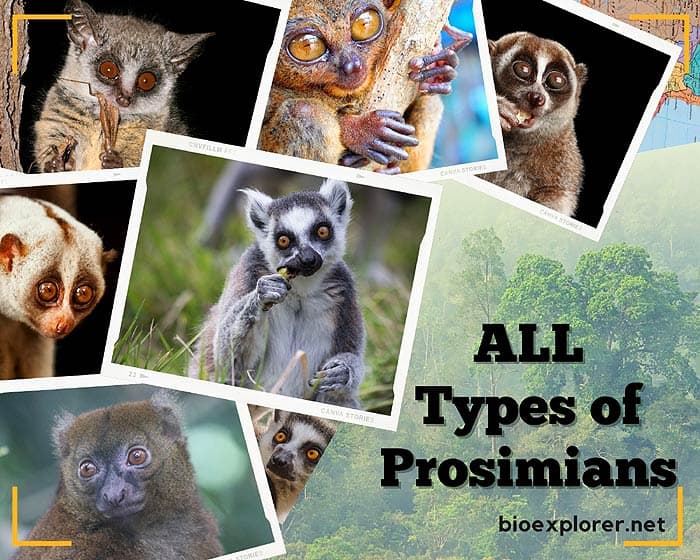
Types of Prosimians: Prosimians are a grouping of primates that is currently made up of the species (both living and extinct) of two main taxonomic categories: the Strepsirrhini suborder (which includes galagos, lemurs, loris, and more) and the Tarsiiformes infraorder (which is made up of tarsiers).
Prosimians’ counterpart is Simians, a group that includes all other primate species (e.g., monkeys, apes, humans). The term “Prosimian” means “pre-monkey” in Latin, which refers to the fact that the species of this grouping are generally more primitive than the Simians.
It is important to note that traditionally, the Prosimians and Simians were separated into two suborders within the Primates order: Prosimian species made up the Prosimii suborder, while Simian species made up the Anthropoidea suborder.
Jump to:
- Characteristics of Prosimians
- Active Times
- Brain
- Biological Risk to Humans
- Eyes & Sight
- Habitat/Distribution
- Limbs
- Snout & Smell
- Teeth
- Prosimian Families
- Extinct Prosimian Families
- Living Prosimian Families
- Types of Prosimians
- Ahmanson’s Sportive Lemur
- Allen’s Galago
- Berthe’s Mouse Lemur
- Blue-Eyed Black Lemur
- Crowned Lemur
- Eastern Lesser Bamboo Lemur
- Golden Angwantibo
- Golden Bamboo Lemur
- Goodman’s Mouse Lemur
- Mongoose Lemur
However, upon further research, biologists found that tarsiers, considered Prosimians, are more closely related to Simians; many taxonomists believed that the taxonomic classification of the two suborders had to be revamped entirely to account for this discovery.
As a result, under the more modern classification, tarsiers are put under the Haplorhini suborder (as are Simians), while the other Prosimians are put under the Strepsirrhini suborder.
Due to these taxonomic changes, the term “Prosimian” is not in circulation as often as before; regardless, it can still be used to describe all the “non-Simian” primates collectively.
Characteristics of Prosimians
Although the grouping known as “Prosimians” is vast and contains many different kinds of species, they do share common characteristics. Below is a concise list that details some of these characteristics:
Active Times
Brain
Biological Risk to Humans
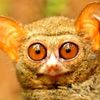
Eyes & Sight

Habitat/Distribution
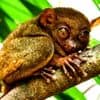
Limbs
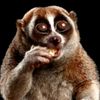
Snout & Smell
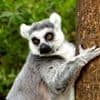
Teeth
Prosimian Families
As mentioned earlier, the taxonomy of Prosimians has changed over time; this list of families will pertain to the newer classification system as it is more relevant in the modern day.
Note that a few extinct primate species classified as Prosimians do not fall under any taxonomic family. Due to these factors, the list below ultimately cannot be seen as exhaustive coverage of every type of Prosimian.
Extinct Prosimian Families
Sivaladapidae
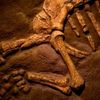 Sivaladapidae is an ancient family of extinct primates; their fossils suggest they lived during the Eocene–Miocene epochs (56 to 5.3 million years ago). Additionally, scientists believe that based on the found remains, certain species of this family were relatively large, potentially reaching a weight of around 8 pounds. It should also be noted that Sivaladapidae fossils have only ever been found in Asia (within countries such as China, India, Pakistan, and more).
Adapidae
Adapidae is an extinct family of early primates living mainly during the Eocene (55.8 to 33.9 million years ago). Many scientists believe that the species of the Adapidae family were anatomically similar to the loris and lemurs of the modern day. The remains of these species (many of which are teeth fragments) were primarily found throughout North America and Europe.Archaeolemuridae
Archaeolemuridae is a family of extinct primates currently composed of 2 genera and 3 species; collectively, these animals are often referred to as "monkey lemurs". Like most modern-day lemurs, the species of Archaeolemuridae were endemic to the island of Madagascar. Interestingly, analyses of monkey lemur show that while they had skulls that are relatively similar to those of the species of the living Indriidate family, their dentition is entirely different.Archicebidae
Archicebidae is an extinct primate family of just 1 genus and 1 species, known as "Archicebus achilles". At the time of its discovery, it was the oldest primate fossil ever to be uncovered, dating back to about 55 million years ago (during the Eocene epoch). Found in what is now the Hubei province of China, this primate is believed to have had good vision (based on its large eye sockets) and a diet primarily consisting of insects (due to its small, sharp teeth).Notharctidae
Notharctidae is an extinct family of primates that roamed the Earth during the Eocene epoch (about 55 to 34 million years ago). Scientists believe that the primates of this family were medium-sized (around 1 to 2 kilograms) near the beginning of the epoch; however, as time passed, they evolved to become much larger (around 8 kilograms). Some of the species of this family were among the first euprimates to come to North America.Palaeopropithecidae
Palaeopropithecidae is a family of extinct primates comprised of 4 genera and around 8 distinct species; collectively, these animals are often called "sloth lemurs". The closest living relative to this family is Indriidae; the two species are alike in their dental patterns, cranial bone structure, and other anatomical features. It should also be noted that scientists believe the species of Palaeopropithecidae lived on a mixed diet (e.g., fruits, seeds, leaves, etc.) similar to the diet of Indriidae species.Megaladapidae
Megaladapidae is an extinct family of lemurs that consists of 1 genus and 3 species; collectively, they are sometimes referred to as "koala lemurs". Endemic to the island of Madagascar, the remains of these primates indicate that they were pretty large—about the size of an average gorilla—and that they only went extinct a few hundred years ago (which means that they coexisted with humans for a particular point in time). All of the species of this family were herbivores; their diets were primarily made up of leaves and seeds.Ekgmowechashalidae
Ekgmowechashalidae is a family of extinct primates comprising 4 genera and 4 species. The remains of these ancient animals have been found in the United States, Thailand, China, as well as other countries across the globe; they date back to 33.6 to 26.3 million years ago. It should also be noted that the species of this family were adept at climbing and that their diets were mainly made up of insects.Azibiidae
Azibiidae is a small family of extinct primates of just 2 genera and 2 species. These forest-dwelling Prosimians lived in northern Africa during the Eocene (56 to 33.9 million years ago). It is also worth mentioning that the remains of the species of this family suggest that they were all omnivorous.Omomyidae
Omomyidae is a sizeable taxonomic family of tiny, tarsier-like primates roaming the Earth during the Eocene epoch. Due to these species' many dental and cranial similarities to the tarsiers of the modern day, many experts classify Omomyidae under the Haplorhini suborder. Interestingly, the remains of this family show that they were one of the first groups to possess a grooming claw.Djebelemuridae
Djebelemuridae is an extinct family of primates that lived in North Africa during the Eocene epoch. Traditionally, this family only has 1 genus and 1 species within it; however, many experts believe that the 'Anchomomys' milleri species should also fall under this family since it is no longer thought to be a part of the Anchomomys genus. Nevertheless, this species has not been given an official new name, which is why the first term of its binomial name is in single quotes.Living Prosimian Families
Cheirogaleidae
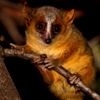
Cheirogaleidae is a family of primates with 5 genera and 21 species of dwarf and mouse lemurs. These species are known to be the world’s smallest primates, usually only 12–27 centimeters long. Like many other lemurs, the Cheirogaleidae family’s species are endemic to the island of Madagascar; they typically can only be found in forested regions of the country.
Indriidae
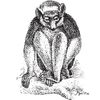
Indriidae is a family of primates that includes 3 genera and 18 species of lemurs. Known to be herbivorous, these species reside in the tropical forests of Madagascar exclusively. Unfortunately, all of the Indriidae primates are threatened by the IUCN, with an overwhelming majority of them put under the categories of “Endangered” or “Critically Endangered”.
Lemuridae
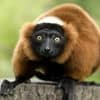
Lemuridae is a primate family comprising 5 genera and 21 species; they can only be found in the forests of Madagascar and the Comoros Islands. Anatomically, these species possess relatively long limbs and soft tufts of fur on their ears. It should also be noted that the ring-tailed lemur, possibly the most easily recognizable lemur species, is taxonomically classified under Lemuridae (the only member of the Lemur genus).
Lepilemuridae
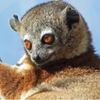
Lepilemuridae is a family of sportive lemurs with just 1 genus of 24 species; they are all endemic to Madagascar. These nocturnal primates are herbivores, with their diets primarily consisting of leaves, flowers, and fruit. Unfortunately, many of the species of Lepilemuridae are facing endangerment due to excessive hunting and habitat loss.
Daubentoniidae
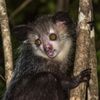
Daubentoniidae is a primate family of just 1 genus and 1 living species: the aye-aye. This species is known to be an omnivore, with its diet typically consisting of insect larvae, eggs, and fruits. It is worth noting that there is an extinct species known as the “giant aye-aye” that is also classified under the Daubentoniidae family; its fossils suggest that its weight was about 2.5 to 5 times greater than the weight of an average aye aye.
Galagidae
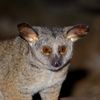
Galagidae is a family of primates that is comprised of 6 genera and 19 living species; collectively, these animals are commonly referred to as “galagos“, “bushbabies” or “nagapies“. Compared to other species within the Lorisoidea superfamily, the Galagos are unique in that their hindlegs are much longer than their forelegs and are much lighter in average body weight. It is also worth noting that the species of Galagidae are known to rapidly jump from tree to tree, making leaps almost 40 feet in length.
Lorisidae
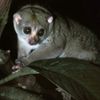
Lorisidae is a primate family comprising 4 genera and 15 species divided into three main types: loris, pottos, and angwantibos. Loris is typically found in the forests of Southeast Asia (in countries such as Thailand, India, Sri Lanka, and more). On the other hand, pottos and angwantibos are spread across West Africa, primarily residing in the forests of Nigeria, the the Democratic Republic of Congo, Uganda, and other neighboring nations.
Tarsiidae
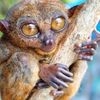
Tarsiidae is a family of primates known as “tarsiers“; it has 3 genera and 14 species. Despite being relatively tiny in terms of size (typically only weighing about 2.8 to 5.3 ounces), analyses of the tarsier genome found that from an evolutionary standpoint, these species are more closely related to monkeys, humans, and apes (the Simians) than they are to other Prosimians. It is also interesting to note that tarsiers are the only carnivorous primates; they feed on birds, lizards, insects, and other relatively small animals.
Types of Prosimians
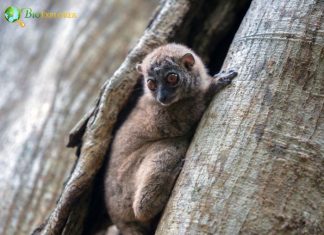
Ahmanson's Sportive Lemur
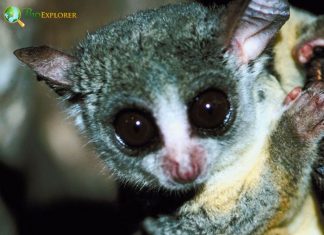
Allen's Galago
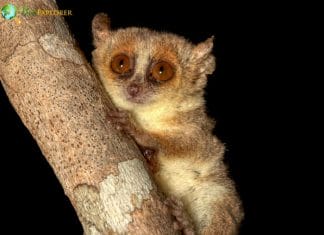
Berthe's Mouse Lemur
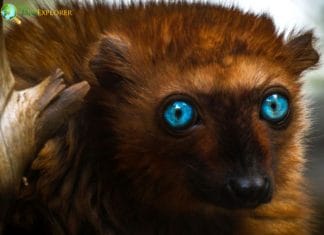
Blue-Eyed Black Lemur
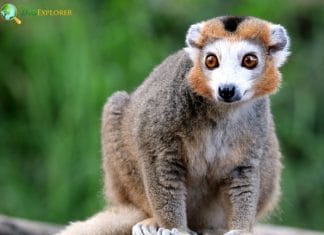
Crowned Lemur
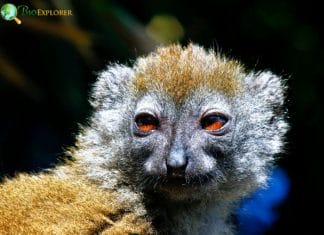
Eastern Lesser Bamboo Lemur

Golden Angwantibo
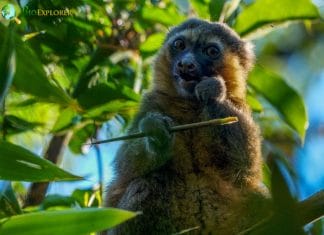
Golden Bamboo Lemur
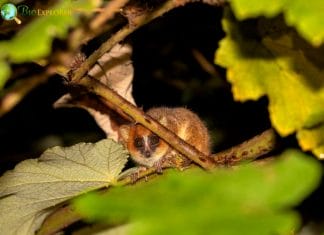
Goodman's Mouse Lemur
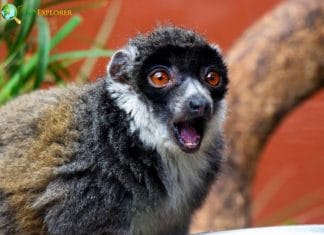
Mongoose Lemur
Cite this page
Bio Explorer. (2026, January 28). Prosimians. https://www.bioexplorer.net/animals/mammals/prosimians/