
Saban Grizzled Langur
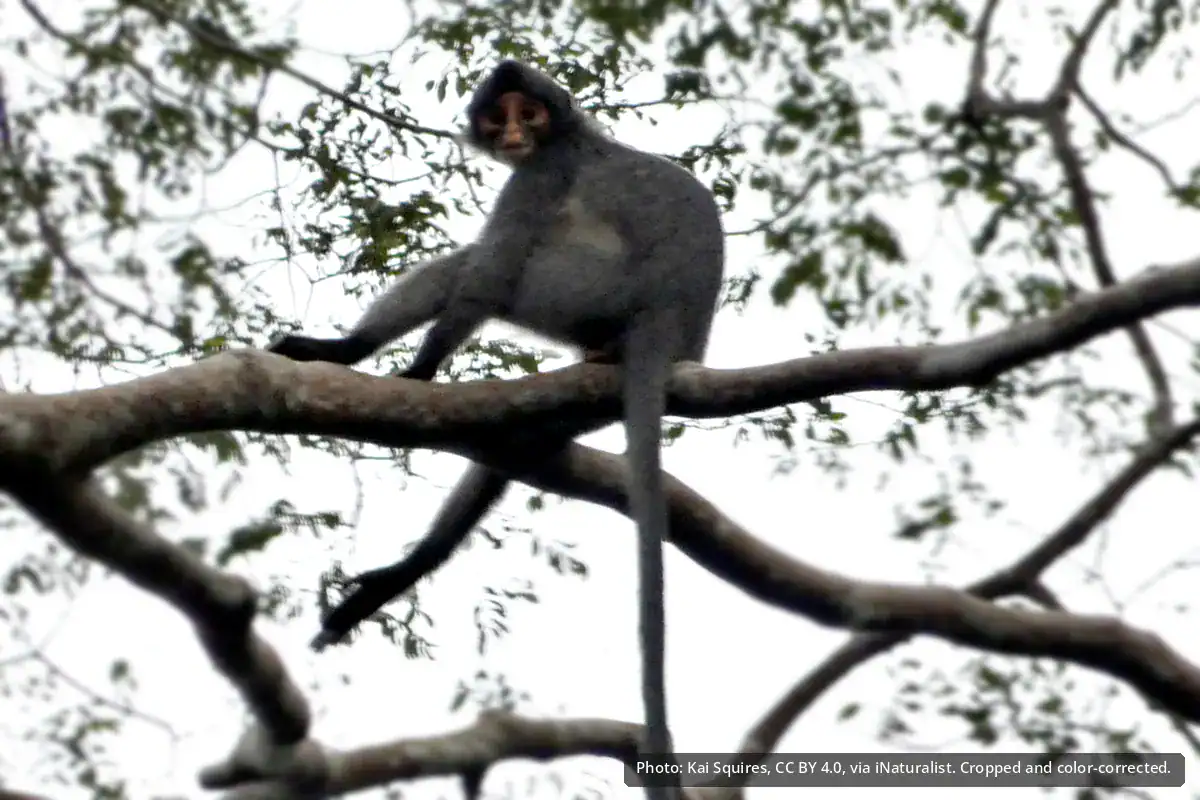
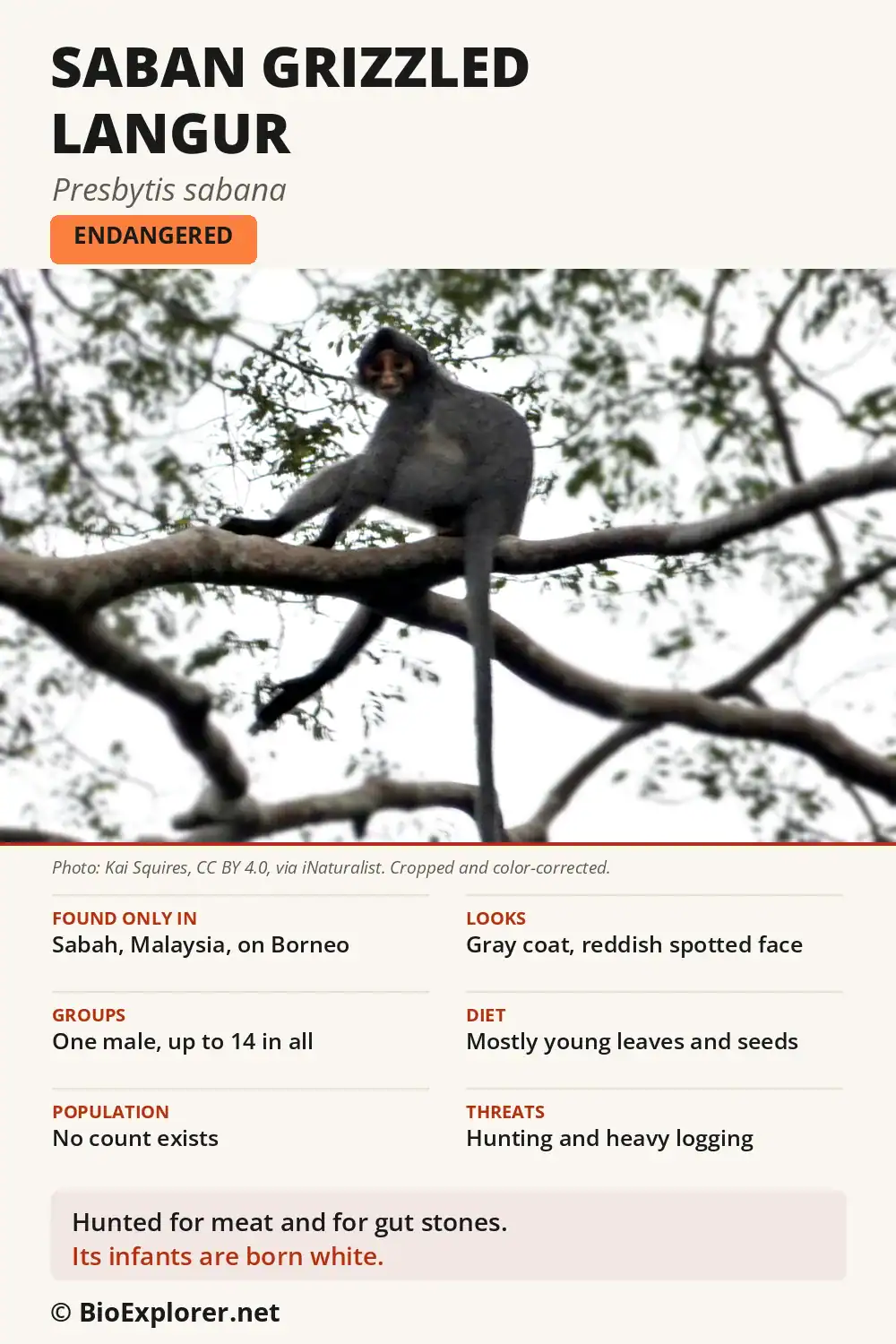
The Saban grizzled langur is a gray leaf monkey of northern Borneo. Its scientific name is Presbytis sabana.[1] It lives only in Sabah, a Malaysian state. It is one of the Old World monkeys. The IUCN lists it as Endangered.[2]
This Endangered langur lives only in the forests of Sabah, Malaysia.
- Common NamesSaban grizzled langur, Sabah grizzled langur, crested grizzled langur
- Taxonomy Classification Year1893
- Monkey Size48 to 56 cm (19 to 22 in), head and body; repeated handbook figure
- Skin Color(s)Reddish face with bluish lips and black face spots; gray coat, white belly
- HabitatEvergreen lowland, riparian and montane rainforest, 50 to 2,000 m
- DietMostly young leaves and seeds, plus fruit and flowers
- Native CountriesMalaysia (Sabah)
- Black spots mark each side of its reddish face.
- A tall black crest rises from the back of its head.
- Young leaves make up 42 to 45% of its diet.
- Each group has one adult male and up to 14 members.
- Hunters kill it for meat and for gut stones called bezoars.
Saban Grizzled Langur Distribution
 )
Saban Grizzled Langur Guide:
Name and Classification
Oldfield Thomas described this langur in 1893. He named it Semnopithecus sabanus. His type specimen came from Paitan, in northern Sabah. It is also called the Sabah grizzled langur or crested grizzled langur.
Until recently, it was treated as a subspecies of Hose's langur. Its old name was Presbytis hosei sabana. A major 2013 handbook raised it to a full species.[3] The handbook says it differs in appearance. The Mammal Diversity Database follows the split.
A 2024 action plan lists the later works that agree.[4] It counts 20 species in the genus Presbytis. These leaf monkeys are among the types of langurs.
It was once grouped with two other grizzled langurs. These are Hose's langur and the Miller's langur. All three were once one species.
Physical Description
Its coat is gray above and below. The belly and inner limbs are white. Its hands and feet are black. The coat places it among the gray monkeys.
The crown is gray, with two whorls at the front. A tall black crest sits on the back of the head.
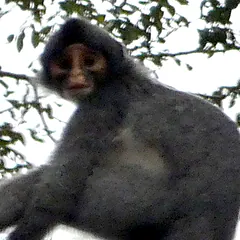
The face is the best clue. Its facial skin is reddish, and its lips are bluish. Distinct black spots sit on each side of the face. They lie between the eyes and the mouth.
Some Kinabatangan animals look a little different. Their white belly is less clear. Yet their faces show the usual Saban pattern.
Infants look nothing like adults. They are white, with a black cross-shaped mark. It runs across the back and shoulders.
Size and Weight
The handbook gives a head and body of 48 to 56 cm. That is about 19 to 22 in. Its tail runs 65 to 84 cm (26 to 33 in).
Males weigh 6 to 7 kg (13 to 15 lb). Females weigh 5.5 to 6 kg (12 to 13 lb). No sample sizes are given. The handbook repeats these figures for all three grizzled langurs. Treat them as handbook figures, not measured species ranges.
Similar Species Compared
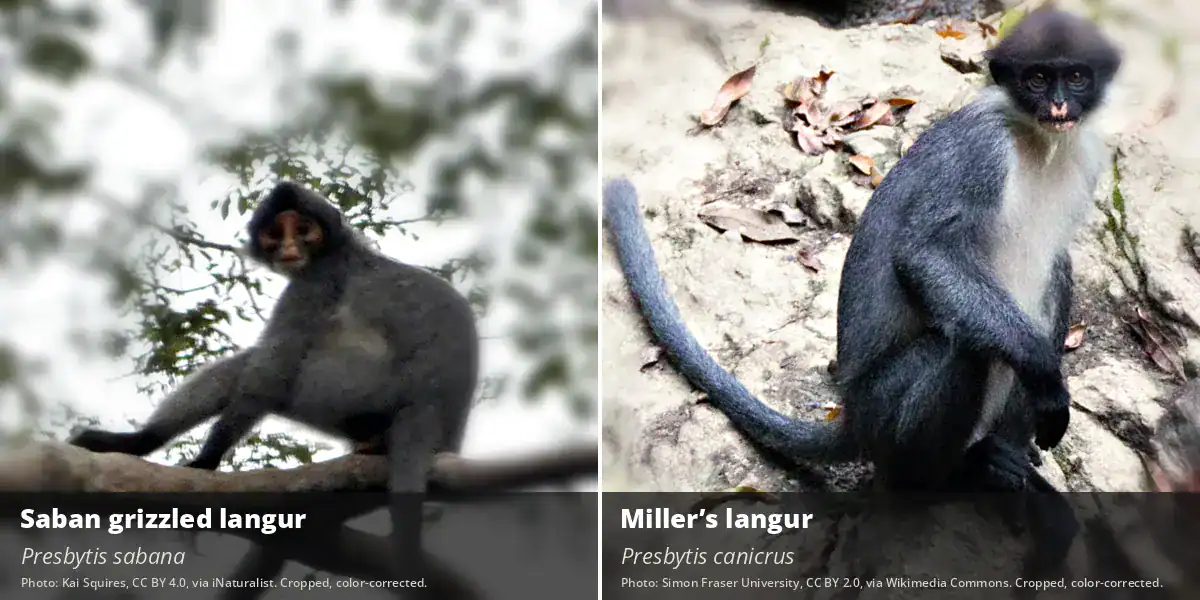
Hose's langur lives in western Sabah, Brunei, Sarawak and North Kalimantan.[5] Its males have a white head with a black crown. Some contrasting Hose's langurs show the same black face spots. Where the two ranges meet is still unclear. The IUCN lists Hose's langur as Vulnerable.[8]
The Miller's langur lives far to the south, in East Kalimantan.[6] Its crown is brownish, and its face is blackish above. It is listed as Endangered.[9]
The maroon langur shares many Sabah forests with it.[7] Its wine-red to orange coat is easy to spot. The two sometimes travel in mixed groups. Yet where one is common, the other tends to be scarce. It is listed as Vulnerable.[10]
| Trait | Saban grizzled langur | Hose's langur | Miller's langur | Maroon langur |
|---|---|---|---|---|
| Scientific name | Presbytis sabana | Presbytis hosei | Presbytis canicrus | Presbytis rubicunda |
| Range | Sabah, Malaysia | Western Sabah, Brunei, northern Sarawak and North Kalimantan | East Kalimantan, Indonesia | Borneo and Karimata Island |
| Habitat | Lowland, riparian and montane rainforest, 50 to 2,000 m | Lowland and hill dipterocarp rainforest, mostly below 1,000 m, rarely 1,600 m | Lowland and hill dipterocarp rainforest, 50 to 1,600 m | Lowland, swamp and riverine rainforest, up to 2,000 m |
| Coat and key marks | Gray, white belly, reddish face with black spots, tall black crest | Grizzled iron-gray, males white-headed with black crown | Grizzled iron-gray, buffy-white below, black hands and feet | Wine-red to orange, black brow fringe |
| Head and body | 48 to 56 cm (repeated handbook figure) | 48 to 56 cm (repeated handbook figure) | 48 to 56 cm (repeated handbook figure) | Males 44 to 58 cm |
| Tail | 65 to 84 cm (repeated handbook figure) | 65 to 84 cm (repeated handbook figure) | 65 to 84 cm (repeated handbook figure) | Males 63 to 80 cm |
| Weight | Males 6 to 7 kg (repeated handbook figure) | Males 6 to 7 kg (repeated handbook figure) | Males 6 to 7 kg (repeated handbook figure) | Males 6 to 7 kg (repeated handbook figure) |
| Diet | Young leaves 42 to 45%, seeds 17 to 21% | Mainly young leaves, some fruit and seeds | 66% young leaves, 28% unripe fruit (Kutai) | Young leaves 36.5%, seeds 30% |
| Group size | One male, 2 to 6 females; maximum 14 | One male, 2 to 6 females; mean 6 in Brunei | One male, 2 to 4 females; mean 8 | Range 2 to 12 |
| IUCN status | Endangered (assessed 2015) | Vulnerable (assessed 2015) | Endangered (assessed 2015) | Vulnerable (assessed 2015) |
Range and Distribution
It is found only in Sabah, on Borneo. That makes it one of the Borneo monkeys. It is also among the Malaysian monkeys.
It lives across most of Sabah. Its range reaches southwest to Kalabakan. There is no proof that it lives in Indonesia's North Kalimantan.
The action plan confirms it along the lower Kinabatangan River. It is found from Batu Puteh to Sukau. Many sightings there are in farm and forest mosaics.
Its western limit is unclear, where it meets Hose's langur. Surveys are needed in Crocker Range Park. If it lives there, the park may be a stronghold.
Habitat Needs
It lives in evergreen lowland, riparian and montane rainforest. The Red List gives an elevation range of 50 to 2,000 m. That is about 160 to 6,560 ft. It is one of the rainforest monkeys of Borneo.
It also enters tree plantations. The Red List rates plantations as marginal habitat.
Diet and Feeding
It eats mainly young leaves, unripe fruit, seeds and flowers. Young leaves make up 42 to 45% of the diet. Seeds add 17 to 21%. Fruit ranges from 3 to 25%. That leafy diet makes it one of the herbivorous monkeys.
Mature leaves are only 1 to 5% of the diet. Flowers are 3% or less. It also eats buds, bark, insects, bird eggs and nestlings.
Logging changes what it eats. In unlogged forest, leaves are 78% of the diet. Many are liana leaves. In logged forest, leaves drop to 60%. There it eats more fruit and seeds.
Behavior and Groups
The Saban grizzled langur is active by day and lives in trees. Resting fills 45 to 49% of its day. That rest helps it digest leaves. Travel takes 30 to 32%. Feeding takes 14 to 17%.
It moves mostly in the middle and upper canopy. That is about 10 to 30 m up. It sleeps high in tall emergent trees. It mostly walks on all fours and climbs. It leaps only now and then.
Each group holds one adult male. It also has two to six females and their young. Groups reach up to 14 animals. Home ranges cover about 35 to 125 ha. A group travels about 700 to 800 m a day.
Groups defend territories. Males give loud spacing calls, described as gargling growls. When groups meet, males run and leap while calling. Predators trigger staccato grunts instead.
Females leave their birth group. The Red List notes this differs from other Presbytis species.
Breeding and Young
Females first give birth at about three years old. Births usually fall between July and October.
Infants are weaned at about 300 days. They count as juveniles at about 11 months. They are subadults at 21 to 36 months.
Population and Status
No total population count exists. The handbook gives about 2.1 groups per square km. That is about 16 animals per square km.
The IUCN listed it as Vulnerable in 2000. It moved to Endangered in 2008. Both listings used the name Presbytis hosei sabana. The 2015 assessment kept it Endangered.
The IUCN estimates a decline of at least 50%. That decline spans 36 years, or three generations. It is still going on. The IUCN marks the assessment as needing an update.
A white, leucistic form has been seen in Tabin Wildlife Reserve. It was photographed there in 2018. White langurs were also seen with Saban and maroon langurs at Danum. Their identity is still unknown.
Major Threats
Hunting is believed to be its main threat. People kill it for meat and for bezoar stones. These stones form in the gut. Some people believe they have medicinal power.
Logging is another major threat. The langur copes fairly well with light, selective logging. Clear-cutting and canopy loss are far worse. They destroy its paths and its sleeping trees.
A 2014 study modeled forest loss across Borneo's Presbytis.[11] It found the worst loss in two ranges. One was this langur's. The other was the range of the cross-marked langur. Their forest losses ranged from 22 to 50% from 2000 to 2010.
Conservation Efforts
It is listed on CITES Appendix II. The 2013 handbook reported none in captivity.
It lives in several protected areas. These include Danum Valley, Tabin, Sepilok and the Lower Kinabatangan. Its presence in Maliau Basin is uncertain.
Sabah's 1997 wildlife law names it only as Presbytis hosei.[12] That name sits on its list of Protected Animals. Licensed hunting of that list is allowed. The action plan urges full protection as a separate species.
The plan also sets other priorities. It calls for surveys of size and range. It asks which langur lives in Crocker Range Park. It suggests langur tourism at Danum Valley and Tabin. It also calls for teaching tools that tell langurs apart.
Explore more monkeys starting with S. Or browse all types of monkeys.
Common Questions
The Saban grizzled langur lives only in Sabah, Malaysia, on Borneo. It is not confirmed in Indonesia.
The Saban grizzled langur eats mostly young leaves and seeds. It also eats fruit, flowers, insects and bird eggs.
The Saban grizzled langur has a gray coat and white belly. Its reddish face carries black spots on each side.
Yes. The Saban grizzled langur was once a subspecies of Hose's langur. A 2013 handbook raised it to a species.
The Saban grizzled langur is hunted for meat and bezoar stones. Heavy logging also destroys its forest.
Nobody knows. No population count exists for the Saban grizzled langur.
Cite this page
BioExplorer. (2026, October 29). Saban Grizzled Langur. https://www.bioexplorer.net/animals/mammals/monkeys/saban-grizzled-langur/
About the author