
Buffy-headed Marmoset
| Kingdom | Order | Family | Genus | Species |
|---|---|---|---|---|
| Animalia | Primates | Callitrichidae | Callithrix | Callithrix flaviceps |

- Common Name: Buffy-headed Marmoset
- Taxonomy Classification Year: 1903
- Monkey Size: 18 to 30 cm (7.09 to 11.81 in)
- Skin Color(s): Gray-brown
- Habitat: Rainforest
- Diet: Omnivorous
- Native Countries: Brazil

Buffy-headed Marmoset Distribution
Countries
Brazil ( )
)
)Buffy-Headed Marmoset Characteristics
The buffy-headed marmoset[1] is a rare species of marmoset native to the Tropical Rainforests of southeastern Brazil.
- It is found in southern Espírito Santo and probably northern Rio de Janeiro, and its distribution extends to Minas Gerais.
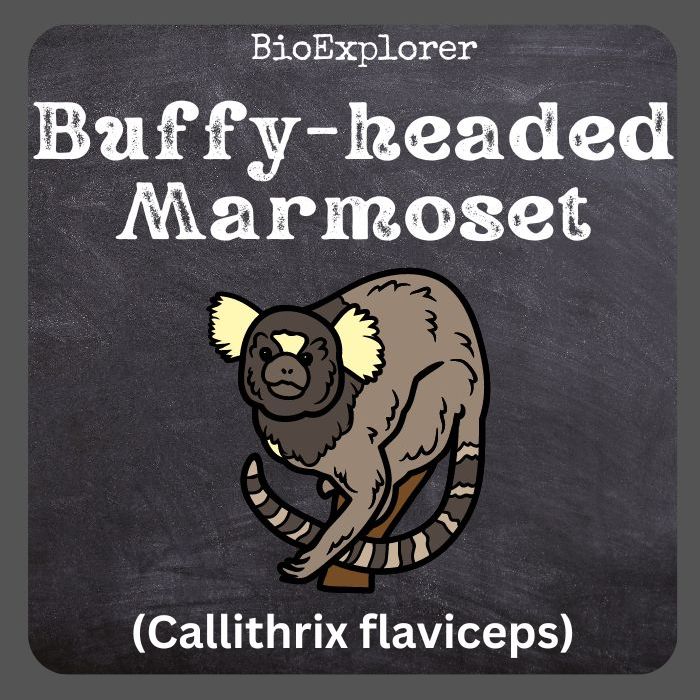
- The buffy-headed marmoset has perhaps one of the most charming faces in the primate world. Cream fur drapes its forehead, chin, and cheeks.
- In contrast, darker fur surrounds its amber eyes before brushing a flattened nose accented by flared, downward-pointing nostrils.
- The mask-like appearance has led to comparisons to a sad clown’s face. But in reality, the long strands of yellowish hair blow wildly from his temples, reminiscent of the goofy hairstyle of a specific childhood prankster: Bozo the Clown.
- A dense, beige mane drapes the head and buries the ears of this monkey. The delicate frame is covered with a coat of greyish-brown fur, with the underside covered in lighter fur.
- Alternating black and white fur stripes accent the long tail. Unlike many New World Monkeys, the buffy-headed marmoset’s tail is not prehensile.
- Claws on each of their fingers, except for the big toes, which have nails, help these marmosets hold on to trees while feeding. They have non-opposable thumbs.
What Do Buffy-headed Marmosets Eat?
The Buffy-headed Marmoset diet includes Laceleaf (Anthurium)[¶] and other plant matters.
Buffy-Headed Marmoset Facts
- These miniature and shy monkeys are mostly tree dwellers, crawling on 4 legs (quadrupeds) from tree to tree with jerky, squirrel-like movements.
- While most marmosets are mainly gomivorous (feed on tree gums), these species are mainly mycophagous-insectivorous, a fancy way of saying that they consume a lot of insects and fungi (mushrooms).
- Thanks to their adaptive primate anatomy (called “tegulae” in scientific language), they can vertically hang from a branch by digging their claws into the bark.
- At night, buffy-headed marmosets sleep in thick, vine-filled tangles in trees, where they hopefully stay undetected.
- They live in family groups (or “troops“) of three to twenty individuals. A larger group may include up to 4 breeding females, although only one is the primary breeder.
Suggested Reading: Different Types of Small Monkeys
Cite this page
BioExplorer. (2026, August 26). Buffy-headed Marmoset. https://www.bioexplorer.net/animals/mammals/monkeys/buffy-headed-marmoset/