
Types of Eagles

This guide covers 71 birds commonly described as types of eagles: 69 living species recognized under the taxonomy used here and 2 species that became extinct within the last thousand years.
Eagles belong to the order Accipitriformes, one branch of the broader types of birds. They occur on every continent except Antarctica, although only 2 species breed regularly in North America and 3 in Australia. Most eagle diversity is concentrated in Africa, Eurasia, and the Neotropics.
The 71 species are organized by taxonomic relationship where possible and by established ecological group where necessary, rather than strictly by size or geography. The principal groups include sea and fish eagles, booted eagles and hawk-eagles, snake and serpent eagles, harpy and forest eagles, and buzzard-eagles. Names and species limits follow the IOC World Bird List v15.2, cited by its editors as a 2026 publication.
Types of Eagles Guide:
At a glance
- 71 species covered (69 living and 2 extinct)
- 8 taxonomic or ecological groupings for living eagles
- 2 species breed in North America (Bald Eagle and Golden Eagle)
- Widest reported wingspans: about 8 feet among the largest sea eagle
- Heaviest eagles: up to about 20 pounds in Harpy and Steller’s Sea Eagles
- Smallest eagle: probably the Great Nicobar Serpent Eagle, at about 450 grams.
Sources: Lerner & Mindell, Mol Phylogenet Evol 2005 · IOC World Bird List v15.2
How Eagles Are Grouped
Every eagle covered here belongs to Accipitriformes, the order that also includes hawks, kites, and Old World vultures. The evolution of Accipitriformes also explains why not every traditional eagle group corresponds exactly to a clade.
The categories below combine evolutionary relationships with long-established ecological names. Sea and fish eagles and the booted eagles form well-supported clades; other categories require qualification.
- Sea and fish eagles (Haliaeetus, Icthyophaga) make up Haliaeetinae, a genuine natural group. They take fish, and their toes carry spicules, little rough projections that grip wet scales.
- Booted eagles (Aquila, Hieraaetus, Nisaetus, Spizaetus) are Aquilinae, also monophyletic. Feathering runs all the way down the leg to the toes, which is where the name comes from.
- Snake and serpent eagles include Circaetus, Spilornis, and Terathopius, which are generally placed within the circaetine lineage. The Madagascar Serpent Eagle (Eutriorchis) has a different or uncertain placement, so the ecological category is broader than a single unqualified clade.
- Harpy and forest eagles have heavy bodies, powerful feet, and short, broad wings suited to maneuvering within forest. Harpia, Morphnus, and Harpyopsis are related; the Philippine Eagle (Pithecophaga) evolved a similar form within the circaetine lineage.
- Buzzard-eagles in Geranoaetus and Buteogallus belong to the buteonine lineage. Their common names reflect their large size rather than close relationship to sea or booted eagles.
Sea and Fish Eagles
The ten sea and fish eagles form the clade Haliaeetinae. Four of these species were recently moved from Haliaeetus to Icthyophaga, so many otherwise reliable sources retain the former combinations.
Bald Eagle
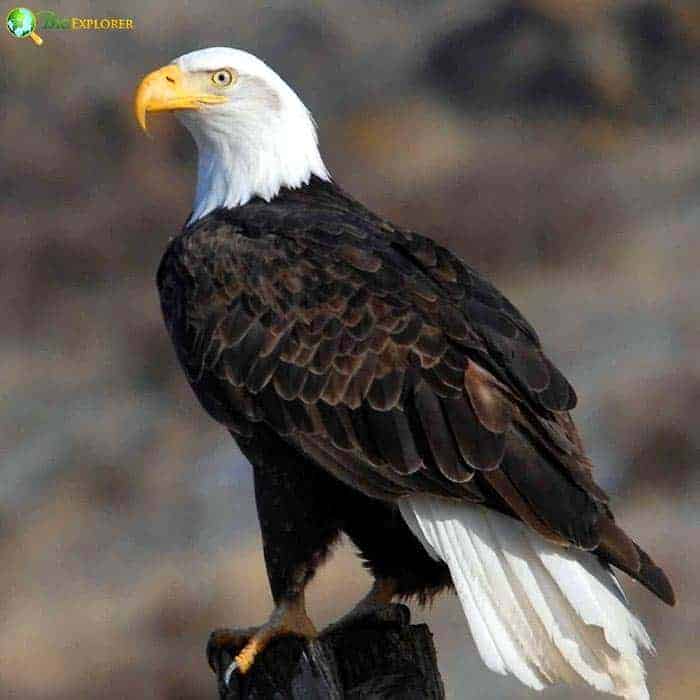
| Kingdom | Order | Family | Genus | Species |
|---|---|---|---|---|
| Animalia | Accipitriformes | Accipitridae | Haliaeetus | Haliaeetus leucocephalus |
The Bald Eagle only became the legal national bird of the United States in December 2024. It had sat on the Great Seal since 1782 without ever formally holding the title.
Females are generally larger than males. A large female may approach an 8-foot wingspan and weigh 14 pounds, whereas a male may span about 6 feet and weigh around 10 pounds. Because measurements overlap, however, size alone does not always identify sex in the field. Bald Eagle nests are the largest built by any North American bird and can reach 10 feet across and weigh thousands of pounds after years of reuse.
The species has undergone a major recovery. In 1963, surveys documented only 417 nesting pairs in the lower 48 states. Surveys conducted in 2018 and 2019 estimated more than 71,400 nesting pairs and approximately 316,700 individuals. The species was removed from the U.S. endangered species list in 2007.
Fish form the core of the diet, supplemented by waterfowl, turtles, rabbits, and carrion. Bald Eagles also obtain fish through kleptoparasitism, especially from Ospreys.
White-tailed Eagle

| Kingdom | Order | Family | Genus | Species |
|---|---|---|---|---|
| Animalia | Accipitriformes | Accipitridae | Haliaeetus | Haliaeetus albicilla |
The White-tailed Eagle is among the widest living eagles, with a reported wingspan of 76 to 96 inches. The white adult tail develops gradually and may not be complete until the bird is about eight years old.
Its flight often appears slow and heavy, and the species spends substantial time perched. It takes fish, ducks, gulls, coots, hares, muskrats, and carrion, and it may pursue waterbirds until they tire.
Pairs may return to the same stick nest for many years, adding material each season. The species was extirpated from much of western Europe by the early twentieth century but has since recovered in several areas and is currently assessed as Least Concern globally.
Steller’s Sea Eagle
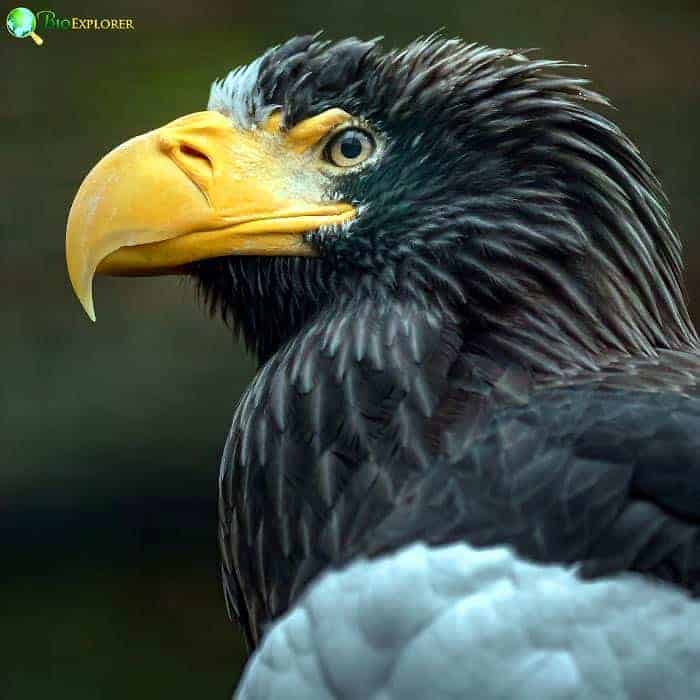
| Kingdom | Order | Family | Genus | Species |
|---|---|---|---|---|
| Animalia | Accipitriformes | Accipitridae | Haliaeetus | Haliaeetus pelagicus |
Steller’s Sea Eagle has one of the largest bills of any eagle, conspicuous at a distance because of its depth and yellow color. At 11 to 20 pounds, it is among the heaviest living eagles and overlaps the upper range reported for female Harpy Eagles.
Breeding is confined to the coast of eastern Siberia, with birds wintering south into Japan, Korea and China. Satellite tags fitted to 24 juveniles clocked migrations averaging 47.8 km a day, one bird covering 1,839 km on its second autumn flight.
The species is listed as Vulnerable. Lead poisoning from remains of animals shot by hunters is a persistent source of mortality on the Japanese wintering grounds. In one Japanese survey, lead poisoning accounted for 26.5 percent of recorded Steller’s Sea Eagle deaths, and isotope analysis linked the metal to ammunition used in Hokkaido after a 2004 restriction.
Pallas’s Fish Eagle
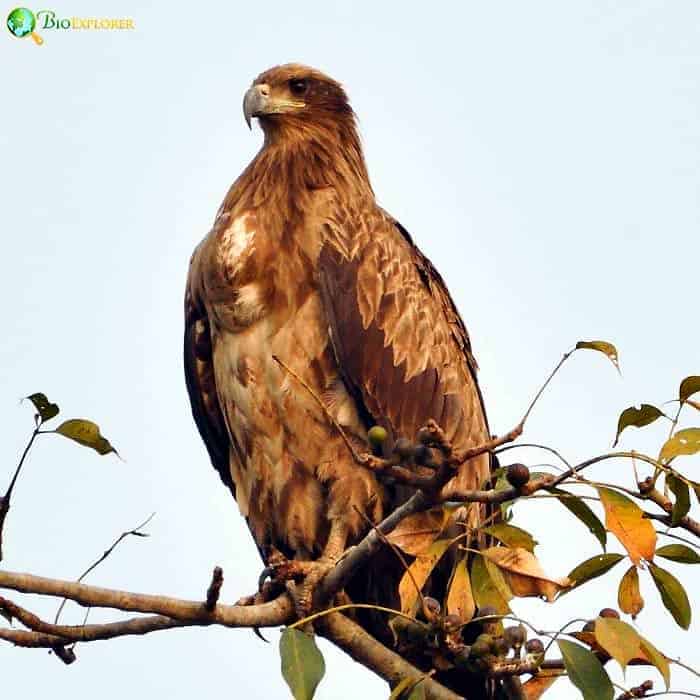
| Kingdom | Order | Family | Genus | Species |
|---|---|---|---|---|
| Animalia | Accipitriformes | Accipitridae | Haliaeetus | Haliaeetus leucoryphus |
Almost no part of Pallas’s Fish Eagle’s range touches the sea. It breeds inland across central Asia, from Kazakhstan and Mongolia through Nepal and Bhutan, on lakes, rivers and high steppe wetlands, and central Asian birds drop south in winter to northern India and the Persian Gulf.
Wetland drainage, dam construction, and the loss of mature nest trees threaten a global population estimated at fewer than 2,500 mature individuals. The species is assessed as Endangered. A Mongolian survey covering 77 wetland sites recorded it at only eight.
African Fish Eagle
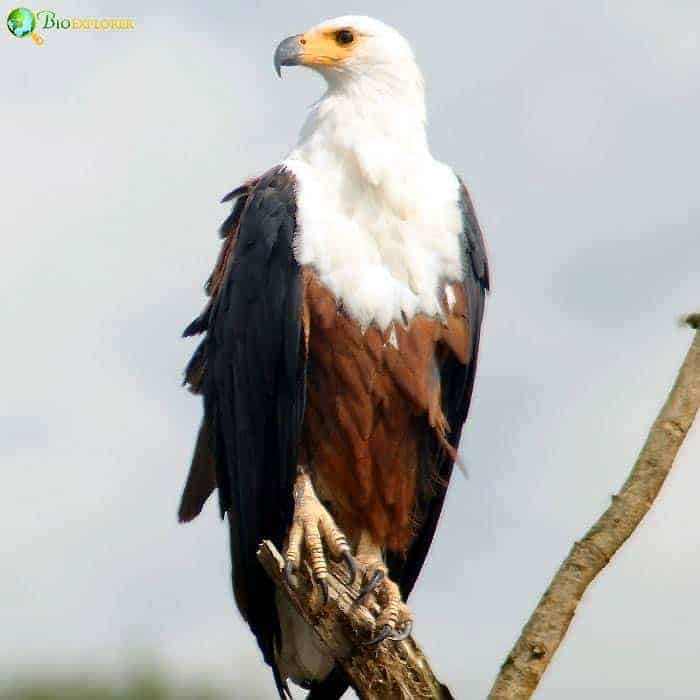
| Kingdom | Order | Family | Genus | Species |
|---|---|---|---|---|
| Animalia | Accipitriformes | Accipitridae | Icthyophaga | Icthyophaga vocifer |
The African Fish Eagle is known for a ringing, yelping call that carries across lakes and rivers. Pairs often call in duet while throwing their heads backward.
Adults span 6 to 8 feet and weigh 4 to 8 pounds. Fish are the core of the diet, and it robs freely. In the Malagarasi wetlands of western Tanzania, fish eagles were recorded stealing catches from Shoebills, and all 138 attempts succeeded. Along the Okavango, Linyanti, Chobe and Boteti rivers, one survey averaged a bird every 1.9 km of river frontage.
The African Fish Eagle is widespread across sub-Saharan Africa and is assessed as Least Concern. IOC moved it from Haliaeetus to Icthyophaga, so many sources still use the former combination.
Madagascar Fish Eagle
| Kingdom | Order | Family | Genus | Species |
|---|---|---|---|---|
| Animalia | Accipitriformes | Accipitridae | Icthyophaga | Icthyophaga vociferoides |
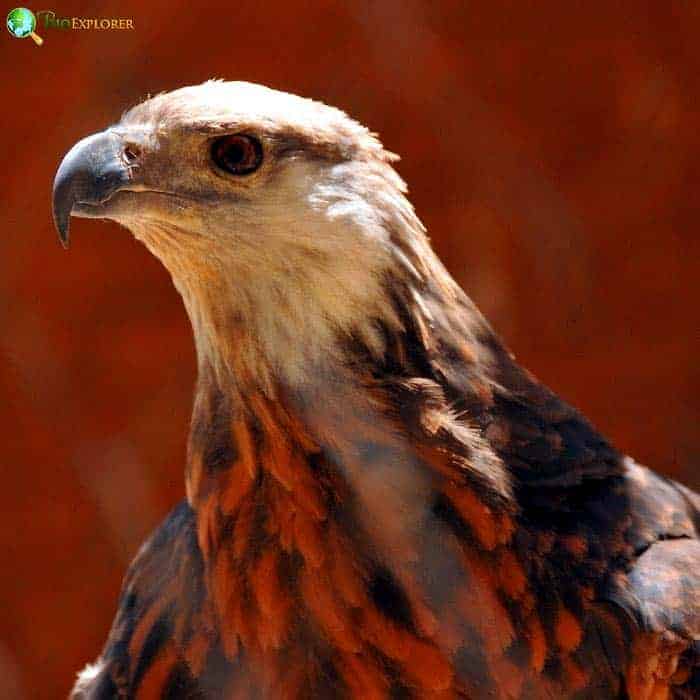
Fewer than 300 Madagascar Fish Eagles are estimated to remain, all in western and northwestern Madagascar. A range-wide survey recorded 222 adults and estimated no more than 100 to 120 breeding pairs. The species is assessed as Critically Endangered.
Some breeding groups exhibit cooperative polyandry, with a third and sometimes a fourth adult attending the nest. DNA fingerprinting of four such groups found that, in every nest containing young, a subordinate male rather than the dominant male had sired the chicks.
Adults measure 24 to 26 inches long, with a wingspan of 65 to 71 inches. They take fish, crabs, and turtles and sometimes obtain food by robbing other birds.
Deforestation and overfishing account for most of the decline, but some birds are still trapped for body parts used in local ritual.
White-bellied Sea Eagle
| Kingdom | Order | Family | Genus | Species |
|---|---|---|---|---|
| Animalia | Accipitriformes | Accipitridae | Icthyophaga | Icthyophaga leucogaster |
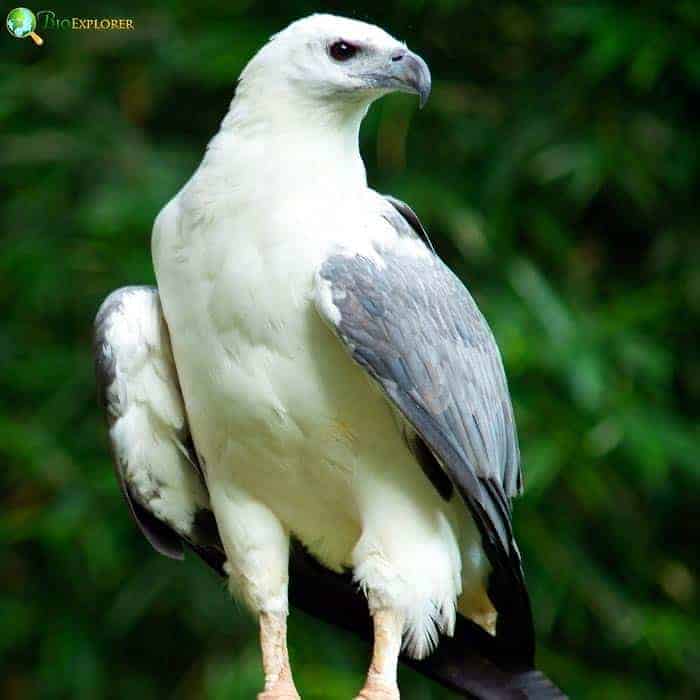
Female White-bellied Sea Eagles weigh approximately 2.8 to 4.2 kg, compared with 2.5 to 3.7 kg for males. The ranges overlap, so body mass alone does not always identify sex.
The species takes sea snakes from the surface, along with fish, turtles, fruit bats, and waterbirds. It also steals prey from kites and Ospreys.
Repeatedly reused nests can exceed 1.5 meters across and reach 2 meters deep. Clutches usually contain one or two eggs, and siblicide by the older chick is common when both hatch.
The species occurs from western India through Southeast Asia and New Guinea to Australia and Tasmania. It is assessed as Least Concern globally but is declining in parts of Australia. Tasmania supports an estimated 800 to 850 adults across roughly 280 breeding territories.
Sanford’s Sea Eagle
| Kingdom | Order | Family | Genus | Species |
|---|---|---|---|---|
| Animalia | Accipitriformes | Accipitridae | Icthyophaga | Icthyophaga sanfordi |
Sanford’s Sea Eagle lives only in the Solomon Islands, and was described from Choiseul Island in 1935.
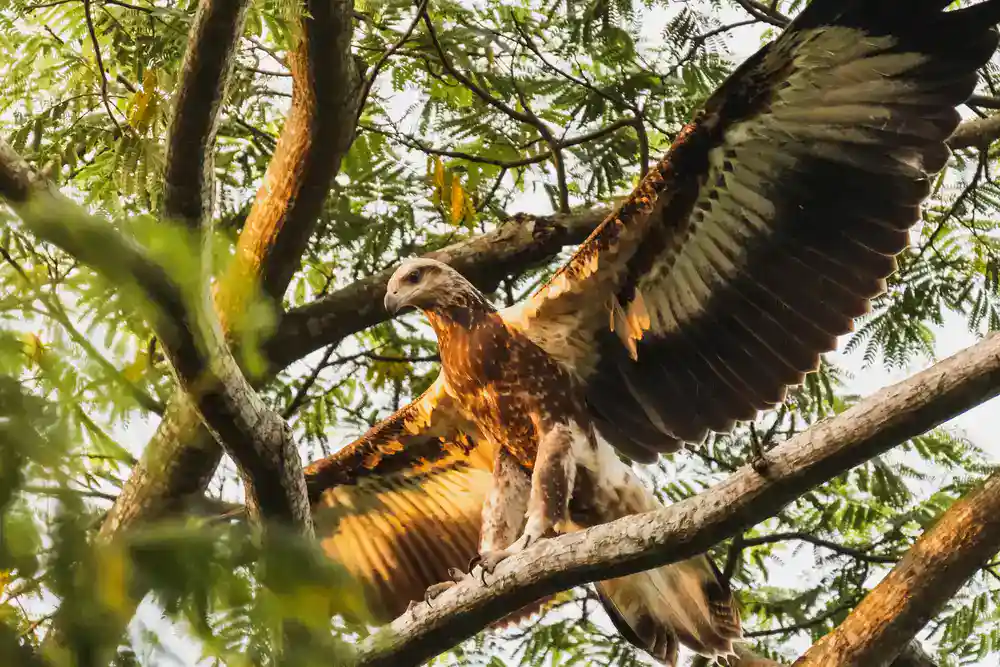
Unlike several other sea eagles, Sanford’s Sea Eagle does not develop a white head or tail. Adults retain dark brown upperparts and rufous underparts, giving them a superficial resemblance to some forest eagles.
It is one of four sea eagles moved out of Haliaeetus into Icthyophaga, a reshuffle most published sources have not caught up with.
The species is listed as Vulnerable and remains one of the least-studied large raptors. Even near the coast, it hunts primarily in forest. Very little has been published about its breeding biology, in part because the Solomon Islands are remote, the bird is scarce, and no long-term field study has been completed.
Grey-headed Fish Eagle
| Kingdom | Order | Family | Genus | Species |
|---|---|---|---|---|
| Animalia | Accipitriformes | Accipitridae | Icthyophaga | Icthyophaga ichthyaetus |
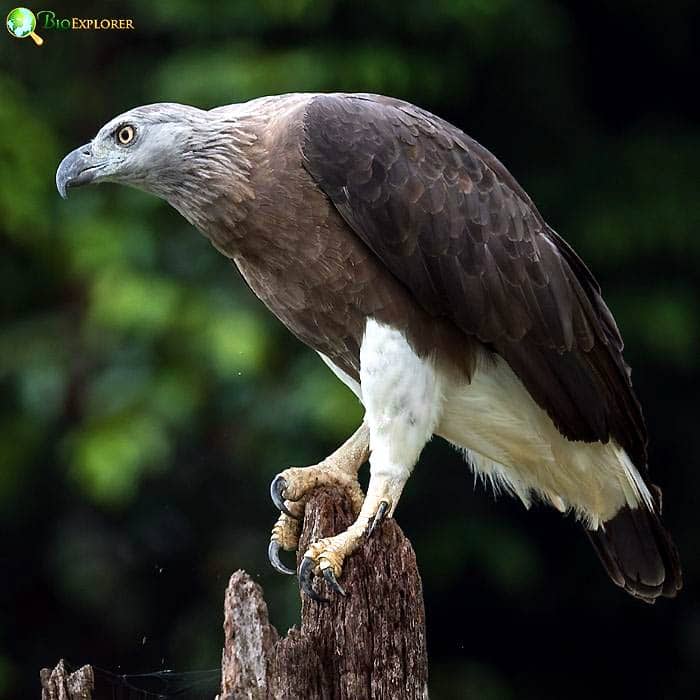
The Grey-headed Fish Eagle has changed genus twice in eight years. Horsfield placed it in Icthyophaga in 1821, the major checklists moved it to Haliaeetus between 2017 and 2022, and they have since moved it back. Almost every source online still prints the intermediate name.
The species uses lowland rivers, lakes, and reservoirs from India through Southeast Asia to Borneo, Java, and the Philippines, hunting from low perches rather than primarily on the wing. It is assessed as Near Threatened and is declining as lowland wetlands are drained.
Lesser Fish Eagle
| Kingdom | Order | Family | Genus | Species |
|---|---|---|---|---|
| Animalia | Accipitriformes | Accipitridae | Icthyophaga | Icthyophaga humilis |
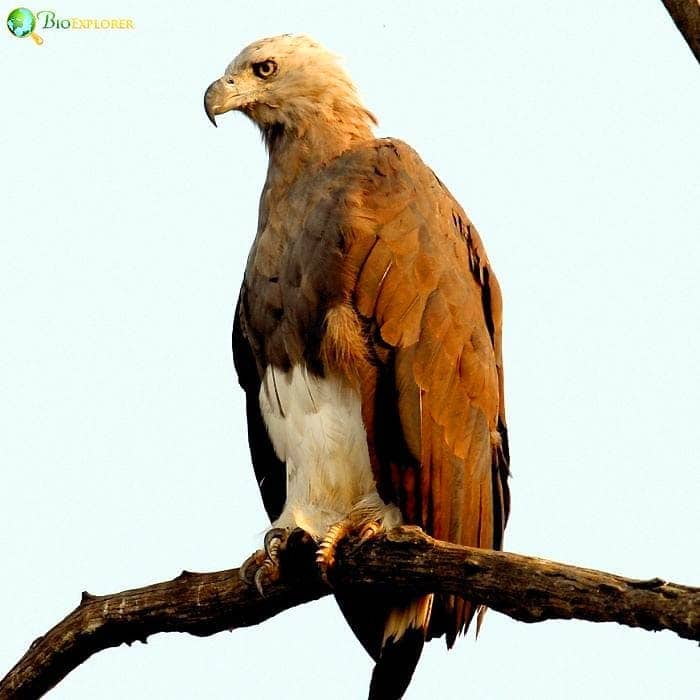
Where its larger relative often uses open water, the Lesser Fish Eagle favors clear, fast-flowing rivers within forest. Logging and dam construction can degrade this habitat, and the species already has a patchy distribution through lowlands and foothills, including an isolated population in southern India.
Like other fish eagles, it has spicules on its toes, rough projections that help grip live fish. The species is assessed as Near Threatened and is declining.
Hawk-Eagles
Fourteen species across two genera: Spizaetus in the Americas and Nisaetus in Asia. They were treated as a single genus until around 2009, when the Asian birds were separated out. Several of the species below were themselves split off from wider-ranging relatives in the same period, which is why the group looks unfamiliar next to older lists.
Ornate Hawk-Eagle
| Kingdom | Order | Family | Genus | Species |
|---|---|---|---|---|
| Animalia | Accipitriformes | Accipitridae | Spizaetus | Spizaetus ornatus |
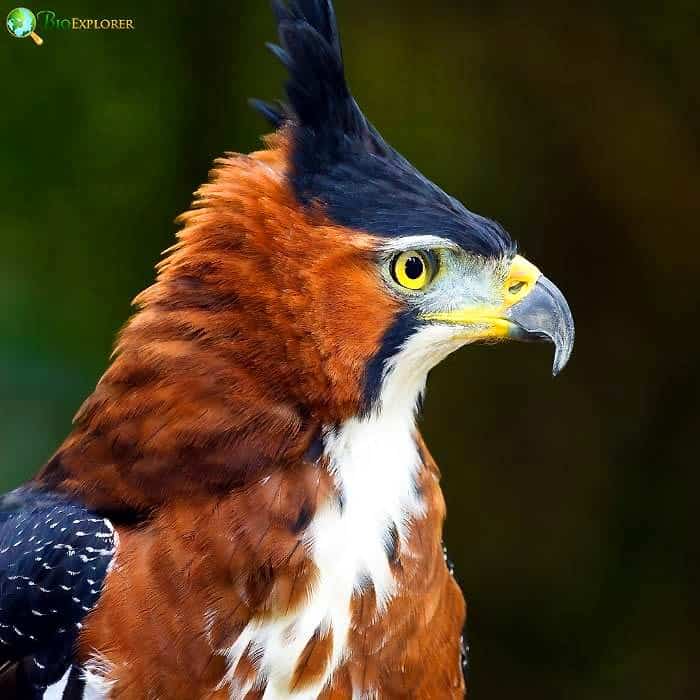
The Ornate Hawk-Eagle takes unusually large avian prey, including curassows and guans weighing up to 10 pounds, or roughly three times the eagle’s own weight.
The extended breeding cycle means that many pairs nest only every other year. Incubation lasts 44 to 46 days, fledging occurs after 70 to 84 days, and the juvenile may remain with its parents for a further 12 months. In one Belize study, the female performed 96.6 percent of observed incubation, while the male provisioned the female and chick.
The species can raise and lower its black crest. It usually hunts from concealed forest perches rather than by prolonged soaring and has occasionally been observed entering shallow water after prey.
The species ranges from southern Mexico to northern Argentina and is assessed as Near Threatened.
Black Hawk-Eagle
| Kingdom | Order | Family | Genus | Species |
|---|---|---|---|---|
| Animalia | Accipitriformes | Accipitridae | Spizaetus | Spizaetus tyrannus |
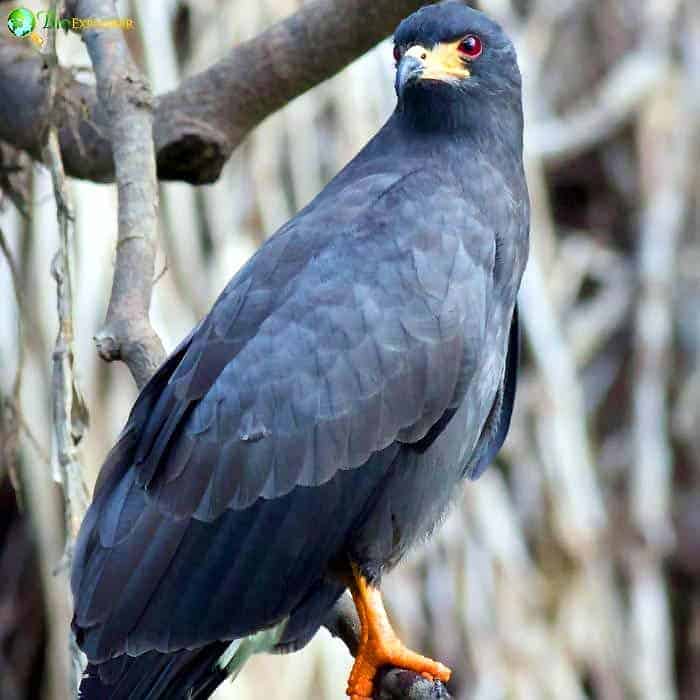
The Black Hawk-Eagle has a slight facial disk, a ring of stiff feathers more strongly developed in types of owls. The structure may help direct sound toward the ears while the eagle hunts within shaded forest.
Prey is mostly arboreal and mostly small: marmosets, squirrels, bats, plus macaws, toucans and the occasional snake.
At 58 to 71 cm long, it is relatively small for an eagle and normally breeds every other year unless a nesting attempt fails. It can serve as an umbrella species because conserving its large forest territory also protects habitat used by many other organisms. The global population is estimated at fewer than 50,000 birds; the species is assessed as Least Concern but is declining.
Black-and-white Hawk-Eagle
| Kingdom | Order | Family | Genus | Species |
|---|---|---|---|---|
| Animalia | Accipitriformes | Accipitridae | Spizaetus | Spizaetus melanoleucus |
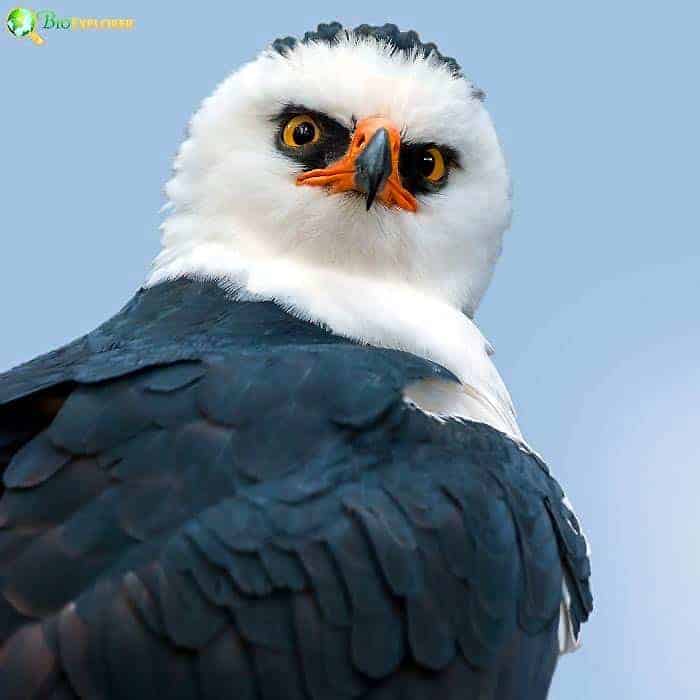
Unlike many hawk-eagles that hunt primarily from perches, the Black-and-white Hawk-Eagle often soars high and stoops into the canopy. Its silhouette and flight can be mistaken for those of a kite.
Its range runs from southern Mexico to northern Argentina, yet it is rare throughout and barely studied. Even the clutch size is uncertain, with most records showing one egg and a single report of two.
Medium-sized birds make up most of the diet, including toucans, wood-quails, oropendolas, and caciques. At about 850 g, it is among the lightest eagles in the Americas. The species is assessed as Least Concern, although the population appears to be declining.
Black-and-chestnut Eagle
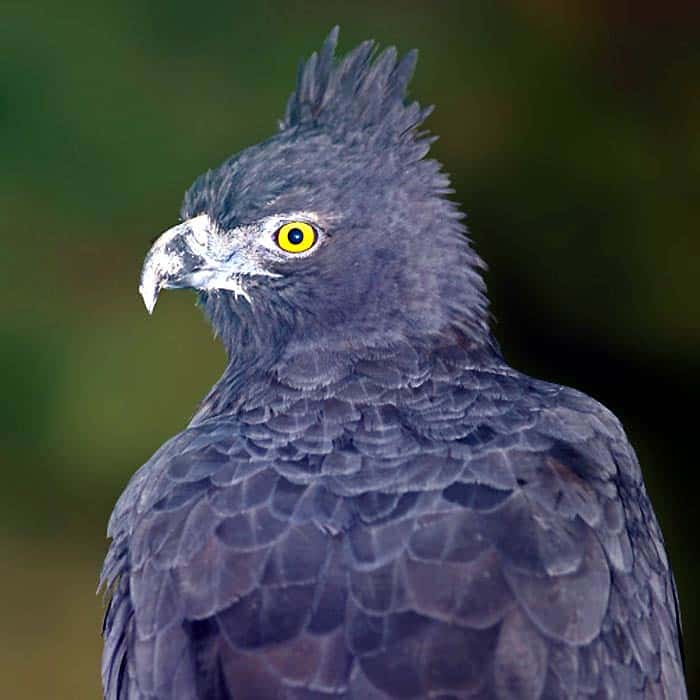
| Kingdom | Order | Family | Genus | Species |
|---|---|---|---|---|
| Animalia | Accipitriformes | Accipitridae | Spizaetus | Spizaetus isidori |
The Black-and-chestnut Eagle is the largest member of Spizaetus, with a wingspan of 58 to 65 inches and a mass of up to 8.8 pounds. Its ecology remains poorly studied.
The species inhabits Andean cloud forest, mainly between 1,500 and 2,800 meters. Agriculture and mining are clearing forest within this elevation band, and the species is assessed as Endangered.
Large arboreal prey includes guans, squirrels, coatis, porcupines, and monkeys. As forest habitat contracts, the eagles may also take poultry and are consequently vulnerable to retaliatory killing.
One egg per nest, with the female doing nearly all the incubation while the male brings food.
Changeable Hawk-Eagle
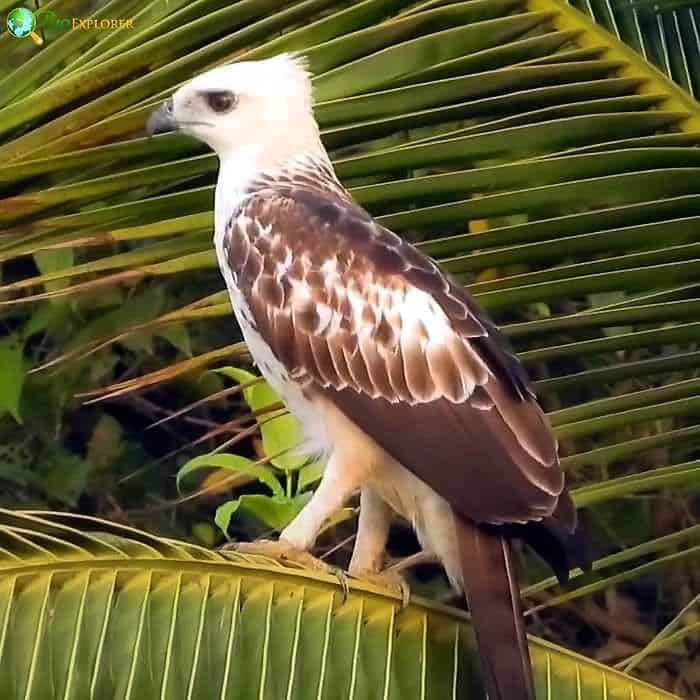
| Kingdom | Order | Family | Genus | Species |
|---|---|---|---|---|
| Animalia | Accipitriformes | Accipitridae | Nisaetus | Nisaetus cirrhatus |
The Changeable Hawk-Eagle is highly variable. Some individuals have a tall crest and others have none, while plumage ranges from pale to almost black. These variations can make members of the same species appear markedly different.
Body size also varies: adults measure 20 to 32 inches long, span 39 to 63 inches, and weigh 45 to 67 ounces. A typical clutch contains one egg, which is incubated for about 50 days; fledging follows after another 9 or 10 weeks.
The species tolerates logged forest and plantation edges better than many specialist forest eagles, contributing to its current assessment as Least Concern. Its range extends from India and Sri Lanka through mainland Southeast Asia to Indonesia and the Philippines.
Mountain Hawk-Eagle
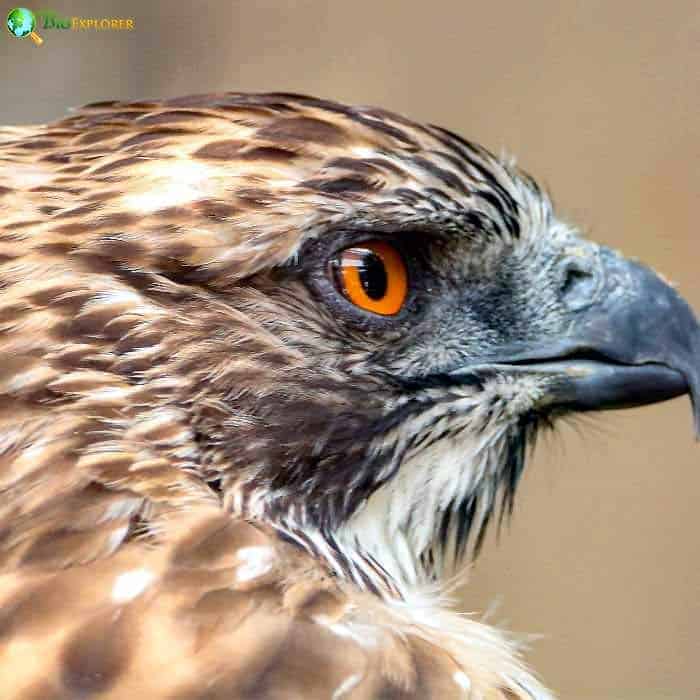
| Kingdom | Order | Family | Genus | Species |
|---|---|---|---|---|
| Animalia | Accipitriformes | Accipitridae | Nisaetus | Nisaetus nipalensis |
Hodgson described the Mountain Hawk-Eagle in 1836, and it still carries his name informally as Hodgson’s hawk-eagle. A second nickname, the feather-toed eagle, comes from leg feathering that runs right down to the toes.
Its range is the widest of any Asian hawk-eagle, extending from northeastern Pakistan along the Himalayas through southern China, Taiwan, and Hainan to Japan and Korea; Japanese birds are classified as the subspecies orientalis. The species is currently assessed as Least Concern, although it is scarce across much of its range and is affected by forest loss. A 19-year study in northern Japan found significantly greater nesting success in the year after a heavy beech mast, probably through changes in prey availability.
Legge’s Hawk-Eagle
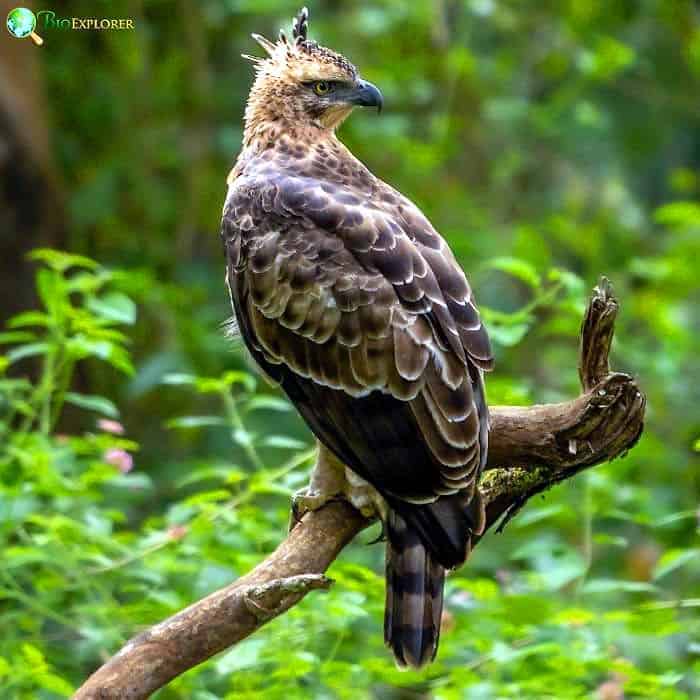
| Kingdom | Order | Family | Genus | Species |
|---|---|---|---|---|
| Animalia | Accipitriformes | Accipitridae | Nisaetus | Nisaetus kelaarti |
The taxonomic rank of Legge’s Hawk-Eagle differs among major checklists. IOC and Clements recognize it as a full species, whereas HBW and BirdLife treat it as Nisaetus nipalensis kelaarti, a subspecies of the Mountain Hawk-Eagle.
Evidence for species status includes a larger bill and claws, a shorter primary projection, consistent plumage differences, distinct calls, and genetic divergence of 4.4 percent in cytochrome b and 3.1 percent in the control region. These traits were documented when Gjershaug and colleagues re-examined the taxon in 2008, 77 years after Peters had classified it as a subspecies.
The taxon is confined to the Western Ghats of southwestern India and to Sri Lanka, a disjunct distribution shared by several South Asian forest birds. Legge described it in 1878.
Its breeding biology was not described in detail until 2023. Observers in Wayanad, Kerala, used a blind 20 meters up a neighboring tree and recorded about 150 hours of activity at a single nest. The chick fledged roughly four months after hatching and remained near the nesting area for another seven months. The female performed nearly all feeding and guarding, while the male delivered prey.
The same study recorded no feeding during daylight observations on 14 and 15 April, yet the chick had a full crop early the following morning. Repeated remains of the nocturnal Indian Giant Flying Squirrel led the authors to suggest possible crepuscular or nocturnal hunting, although the observations did not establish it directly.
Blyth’s Hawk-Eagle
| Kingdom | Order | Family | Genus | Species |
|---|---|---|---|---|
| Animalia | Accipitriformes | Accipitridae | Nisaetus | Nisaetus alboniger |
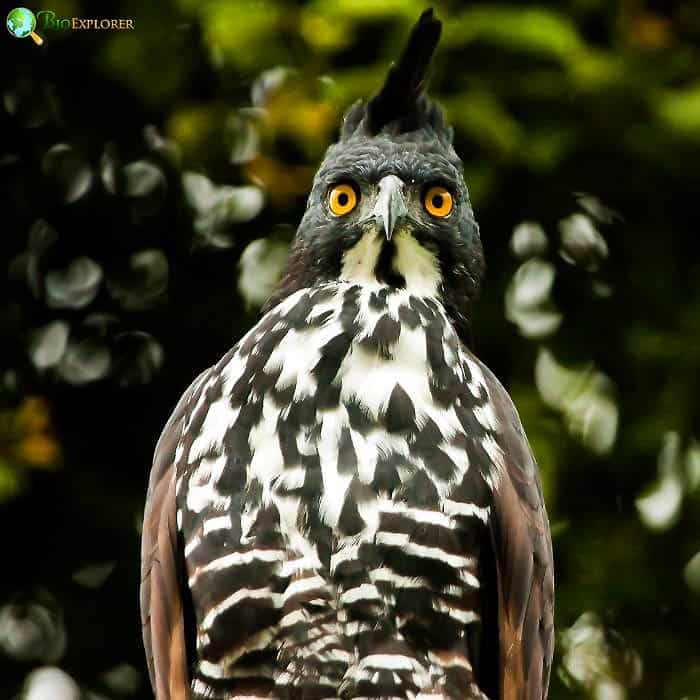
Blyth’s Hawk-Eagle is named for Edward Blyth, who described it in 1845 from a specimen collected at Malacca. It is small and sharply marked, blackish above, with a prominent crest and a broad white tail band visible from below. Its range extends from southern Myanmar down the Malay Peninsula to Sumatra and Borneo, where lowland and foothill forest continues to decline.
Javan Hawk-Eagle
| Kingdom | Order | Family | Genus | Species |
|---|---|---|---|---|
| Animalia | Accipitriformes | Accipitridae | Nisaetus | Nisaetus bartelsi |
Indonesia designated the Javan Hawk-Eagle as a national rare animal in 1993. The species is also widely associated with Garuda, the mythological bird represented on Indonesia’s national emblem, although the emblem is not a zoological depiction of the eagle.
The bird is endemic to the wooded hills of densely populated Java. It is assessed as Endangered, with a population of roughly 1,000 individuals, about half of them paired adults. Researchers found that national recognition may also have increased demand among collectors, with young birds recorded in markets at prices of about US$40.
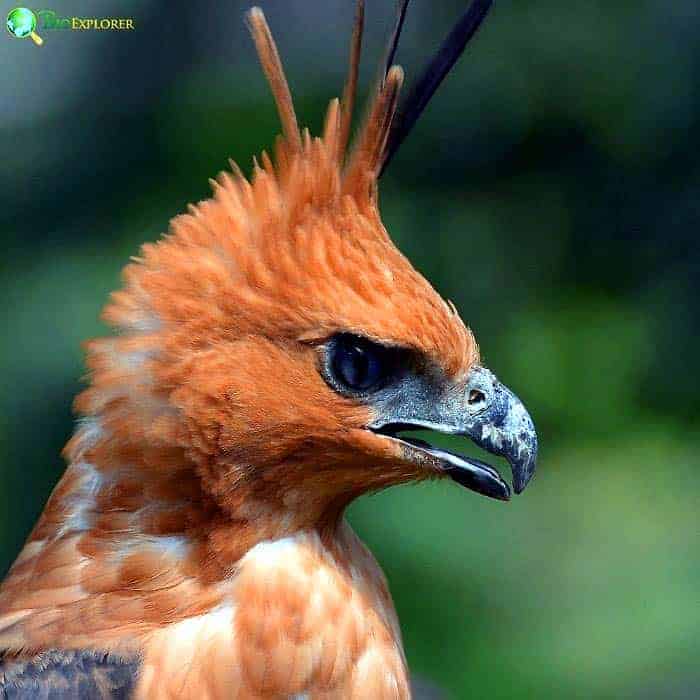
Adults are about 60 cm long, with a rufous head and neck, a tall black crest tipped with white, and heavily barred underparts. Stresemann described the bird in 1924, and it was treated for decades as a subspecies of the Mountain Hawk-Eagle.
Flores Hawk-Eagle
| Kingdom | Order | Family | Genus | Species |
|---|---|---|---|---|
| Animalia | Accipitriformes | Accipitridae | Nisaetus | Nisaetus floris |
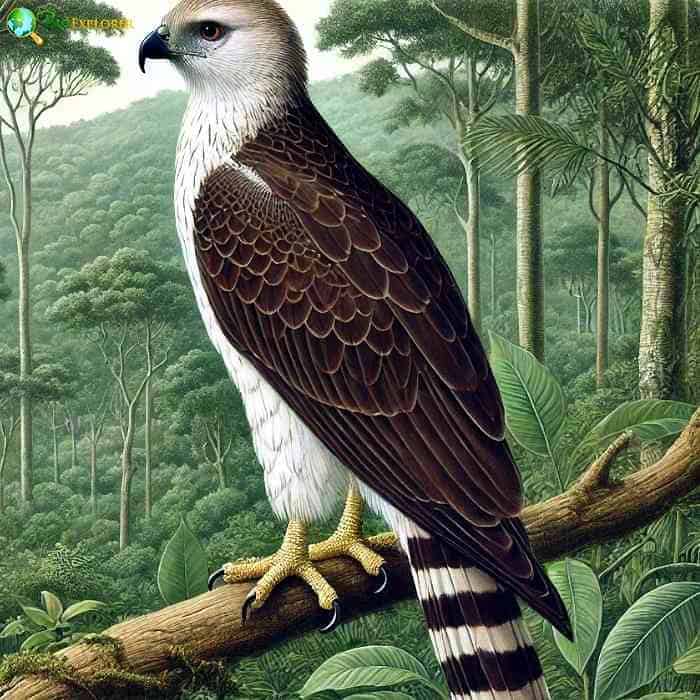
The Flores Hawk-Eagle was formerly classified as a subspecies of the more widespread Changeable Hawk-Eagle. Genetic and morphological evidence supported its recognition as a distinct species confined to the Lesser Sundas from Lombok east to Alor, revealing a much smaller range and a more serious conservation situation.
The species is now assessed as Critically Endangered. Its principal threats are habitat clearance and direct persecution, and no large population exists outside its small-island range. Nests recorded in customary forest on Flores were 15 to 18 meters above ground in trees 17 to 21 meters tall, illustrating its dependence on mature forest structure.
Sulawesi Hawk-Eagle
| Kingdom | Order | Family | Genus | Species |
|---|---|---|---|---|
| Animalia | Accipitriformes | Accipitridae | Nisaetus | Nisaetus lanceolatus |
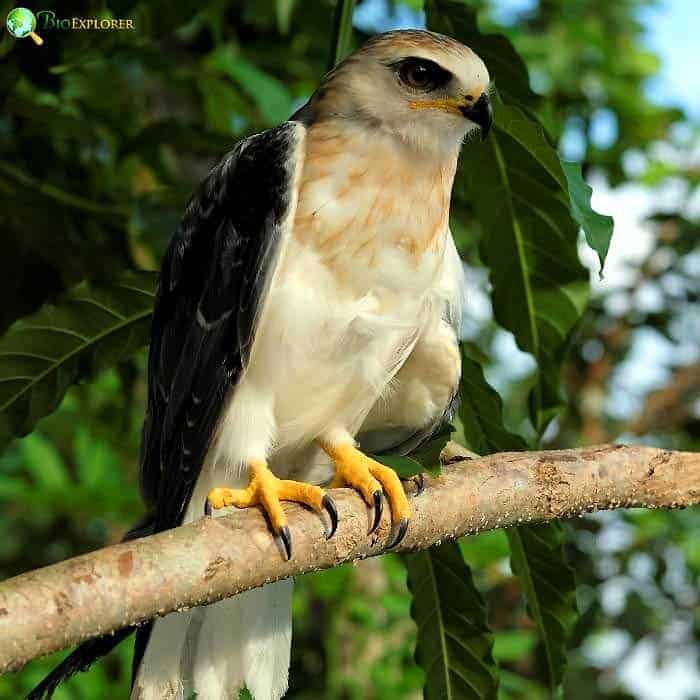
Unlike many hawk-eagles, the Sulawesi Hawk-Eagle lacks a crest. Adults have a rufous-brown head and chest with barred white underparts, whereas juveniles have a much whiter head. The species is about 25 inches long and is endemic to Sulawesi and nearby island groups, including the Togian, Banggai, Sula, Muna, and Buton islands. Nest observations in the Hasanuddin University forest found the birds stationary for 81.5 percent of observed time, consistent with a predominantly perch-based hunting strategy.
Philippine Hawk-Eagle
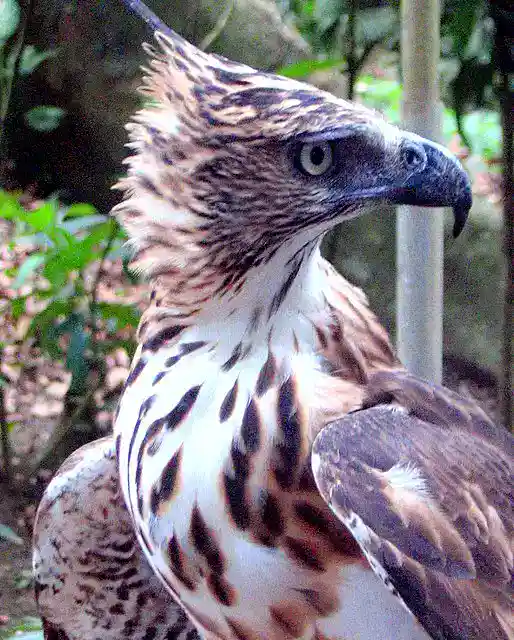
| Kingdom | Order | Family | Genus | Species |
|---|---|---|---|---|
| Animalia | Accipitriformes | Accipitridae | Nisaetus | Nisaetus philippensis |
Taxonomic separation of Pinsker’s Hawk-Eagle substantially reduced the recognized range of the Philippine Hawk-Eagle. Under the current treatment, the Philippine Hawk-Eagle is confined to Luzon and Mindoro, while the southern populations constitute a separate species.
The Philippine Hawk-Eagle is assessed as Endangered and is threatened by both lowland forest clearance and trapping for the live-bird trade. Adults are dark brown above, with a streaked head and chest and a backward-facing crest.
Pinsker’s Hawk-Eagle
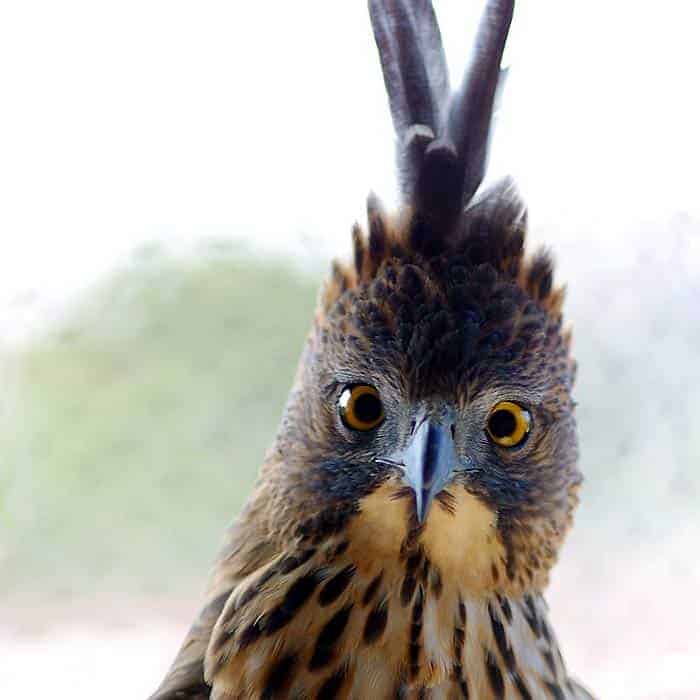
| Kingdom | Order | Family | Genus | Species |
|---|---|---|---|---|
| Animalia | Accipitriformes | Accipitridae | Nisaetus | Nisaetus pinskeri |
Pinsker’s Hawk-Eagle took the southern half of that split, holding Leyte, Samar, Negros, Basilan, Bohol and Mindanao in primary lowland and montane forest up to 1,900 meters.
Preleuthner and Gamauf described it as a subspecies in 1998 from a specimen collected in Surigao del Sur on Mindanao, and it was raised to full species around 2015. It differs from its northern counterpart in having a longer crest, a smaller frame, grayer plumage, and heavy barring on the belly and legs. It is assessed as Endangered because of forest loss and trapping. A 2024 survey of Mount Melibengoy in southern Mindanao recorded 130 bird species and identified Pinsker’s Hawk-Eagle as the most threatened species present in lower montane forest between 1,000 and 1,500 meters.
Wallace’s Hawk-Eagle
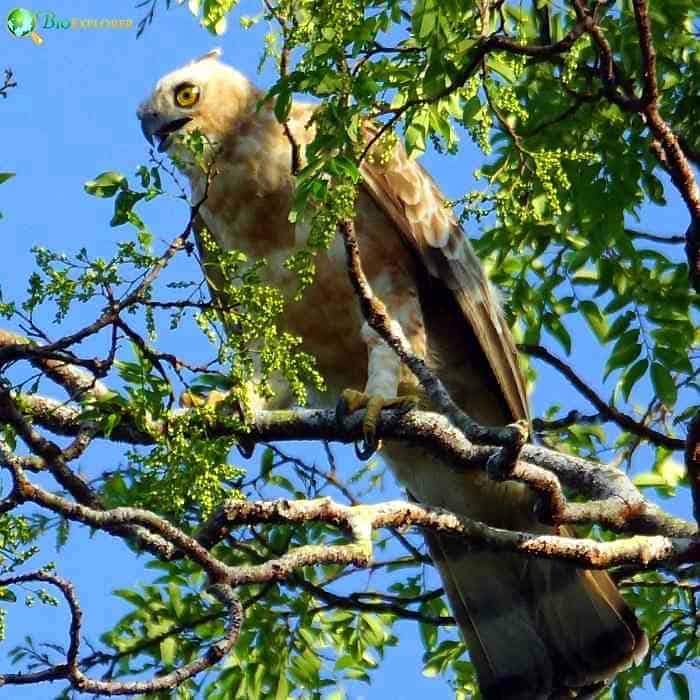
| Kingdom | Order | Family | Genus | Species |
|---|---|---|---|---|
| Animalia | Accipitriformes | Accipitridae | Nisaetus | Nisaetus nanus |
Wallace’s Hawk-Eagle is the smallest booted eagle and is frequently described as the smallest eagle overall. Adults span 37 to 41 inches and weigh 17.6 to 21.5 ounces, less than many Red-tailed Hawks. Published measurements indicate that the Great Nicobar Serpent Eagle is smaller.
Alfred Russel Wallace gave it his name. He worked out natural selection independently of Darwin while collecting across the archipelago this bird inhabits.
The species depends on lowland evergreen forest and is largely sedentary, making it especially vulnerable to local habitat clearance. Its range covers the Malay Peninsula, Sumatra, and Borneo. Global forest-cover analysis estimated habitat loss of 35 percent since 2001, among the highest reported for a forest-dependent raptor. The species is assessed as Vulnerable and declining.
True Eagles
This section covers 14 species in Aquila and Clanga, two genera within the booted-eagle subfamily Aquilinae. These include the widely distributed Golden Eagle as well as several species with restricted or declining populations.
Golden Eagle
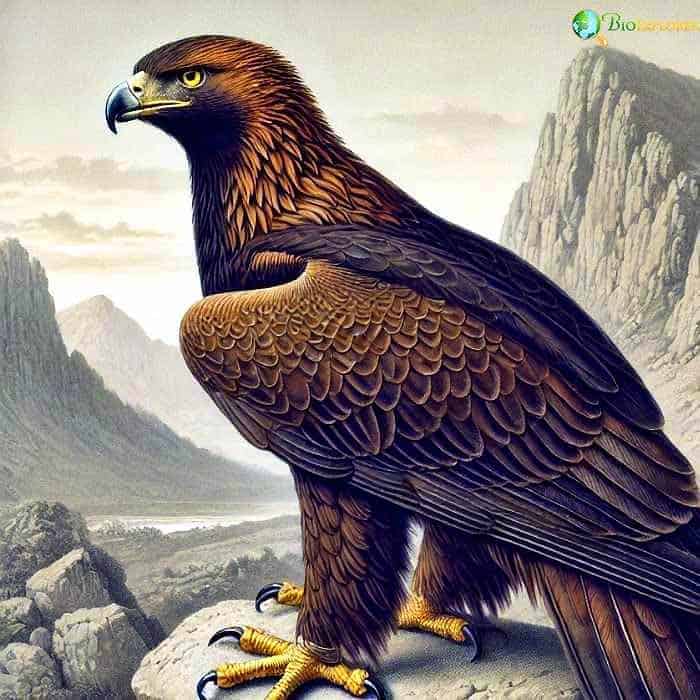
| Kingdom | Order | Family | Genus | Species |
|---|---|---|---|---|
| Animalia | Accipitriformes | Accipitridae | Aquila | Aquila chrysaetos |
Popular references commonly state that Golden Eagles approach 200 mph during steep dives. That figure should be distinguished from measured speeds during ordinary soaring and migration.
In the long-distance flight study cited here, an instrumented Golden Eagle reached a maximum ground speed of 34 meters per second, about 76 mph, with typical glides nearer 45 mph. After correction for tailwind, the highest estimated airspeed was about 54 mph. Because the tracked bird did not perform a steep dive, the study neither confirms nor refutes the much higher figure reported for stooping flight.
The species is nevertheless a fast and powerful flier. Its wingspan reaches 7 feet, females may weigh up to 14 pounds compared with less than 10 pounds for males, and it often takes terrestrial prey from low, rapid flight. Pairs sometimes hunt cooperatively, with one bird flushing prey and the other attacking.
The Golden Eagle has one of the widest distributions of any eagle, extending across much of the Northern Hemisphere. It is one of only two eagle species that breed regularly in North America.
Rabbits, hares, ground squirrels and prairie dogs are the preferred prey, and when live prey runs short it takes carrion. Nests run five to eight feet across and can weigh thousands of pounds, and birds may live around thirty years. Surveys put the United States population at roughly 30,000 golden eagles.
Verreaux’s Eagle
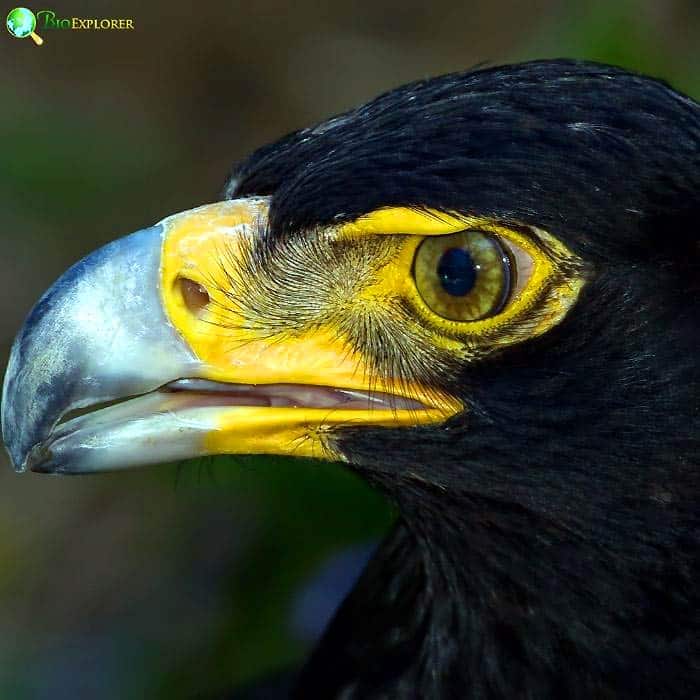
| Kingdom | Order | Family | Genus | Species |
|---|---|---|---|---|
| Animalia | Accipitriformes | Accipitridae | Aquila | Aquila verreauxii |
Reports describe Verreaux’s Eagles kicking or throwing loose objects toward predators that approach the nest, an unusual defensive behavior among raptors.
Across much of eastern and southern Africa, the species depends heavily on rock hyraxes, and eagle abundance closely tracks local hyrax density.
That specialism comes with a habitat to match: rocky foothills, gorges and montane country, where hyraxes live and cliffs make nest sites.
With a wingspan of 71 to 86 inches and a mass of up to 4,150 g, Verreaux’s Eagle is a large species. A clutch usually contains two eggs, incubation lasts about 44 days, and the older chick usually kills the younger. The species is assessed as Least Concern globally, but South Africa lists it as Vulnerable, with about 3,750 mature individuals and a 42 percent decline in occupied area between two national bird atlases. Estimated densities range from one pair per 65 km2 in the Drakensberg to one pair per 24 km2 in the Karoo. The same assessment estimated that the agricultural value of hyrax removal by a resident pair exceeded the cost of occasional lamb losses by a factor of 155.
Wedge-tailed Eagle
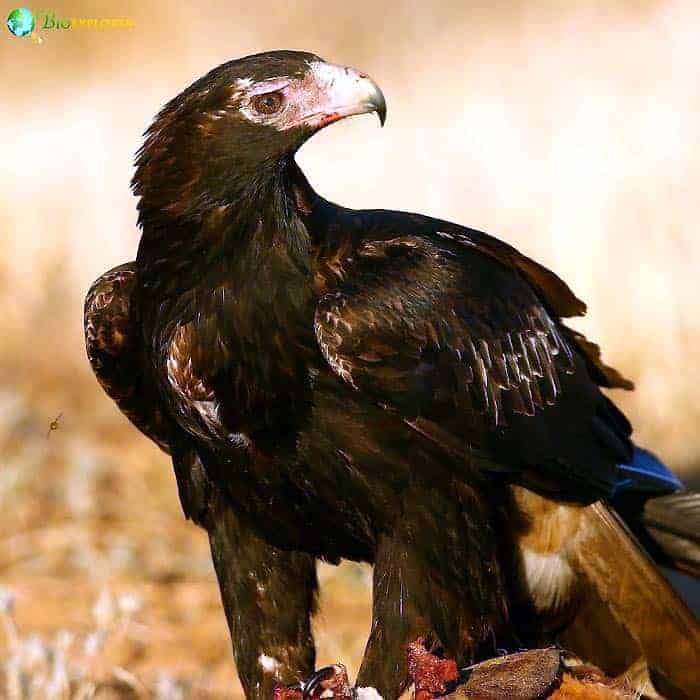
| Kingdom | Order | Family | Genus | Species |
|---|---|---|---|---|
| Animalia | Accipitriformes | Accipitridae | Aquila | Aquila audax |
Australia’s largest bird of prey is the Wedge-tailed Eagle, spanning 185 to 230 cm and weighing 3.9 to 5.8 kg, with the long wedge-shaped tail that gives it the name.
The broad diet includes rabbits, hares, young kangaroos and wallabies, sheep, lizards, birds, and carrion. Feeding on road-killed animals exposes the eagles to vehicle collisions.
The species ranges across mainland Australia, Tasmania, and southern New Guinea. It is assessed as Least Concern, although thousands were historically shot or poisoned each year as suspected lamb predators, and persecution continues.
Steppe Eagle
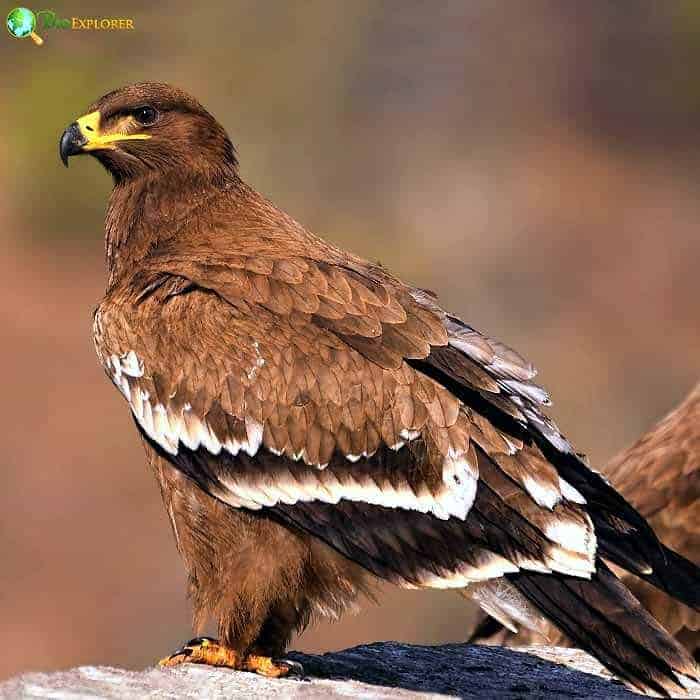
| Kingdom | Order | Family | Genus | Species |
|---|---|---|---|---|
| Animalia | Accipitriformes | Accipitridae | Aquila | Aquila nipalensis |
Researchers in Mongolia documented Steppe Eagle nests constructed partly or predominantly from the bones of large mammals, an alternative material in open steppe where sticks may be scarce.
Winter brings them together in numbers, sometimes more than a hundred birds in a single group, feeding on voles, ground squirrels, queleas, insects and carrion. Much of the hunting is done on foot.
The Steppe Eagle spans 65 to 84 inches and is assessed as Endangered. Breeding numbers are estimated to have declined by 50 to 60 percent, most visibly in Europe, and some individuals travel more than 10,000 km during migration. Conversion of steppe to agriculture, electrocution on power lines, and persecution are major threats. Because the species requires extensive steppe habitat, its conservation can also benefit other organisms that depend on the same ecosystem.
Tawny Eagle
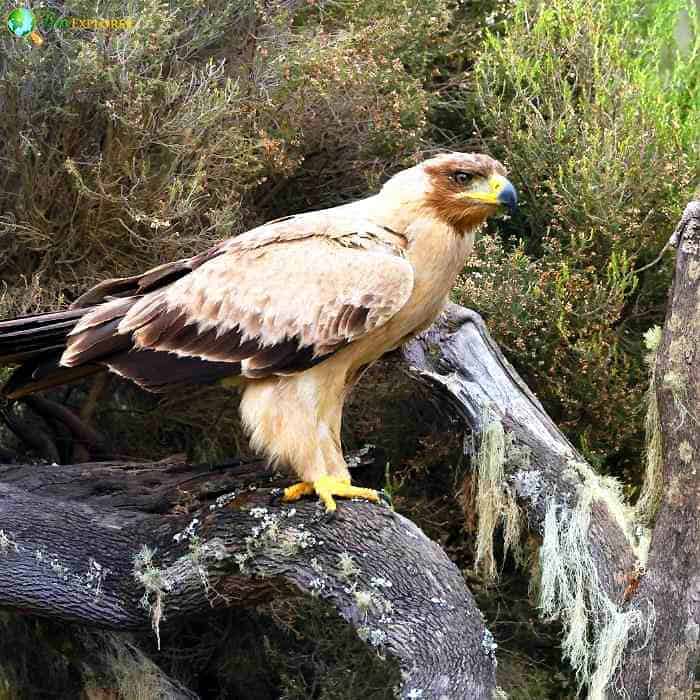
| Kingdom | Order | Family | Genus | Species |
|---|---|---|---|---|
| Animalia | Accipitriformes | Accipitridae | Aquila | Aquila rapax |
The Tawny Eagle is a highly opportunistic feeder. It frequently steals prey from other raptors, including Bateleurs, and hunts animals displaced by grass fires. It also scavenges at refuse sites.
Despite this dietary flexibility, the species is Vulnerable globally and Endangered in South Africa. The South African assessment estimated a decline of more than 60 percent over 50 years and a 58 percent contraction in occupied area, with poisoning directed at other animals identified as the principal threat. Adults span 62.5 to 72 inches and weigh up to 3,100 g.
Eastern Imperial Eagle
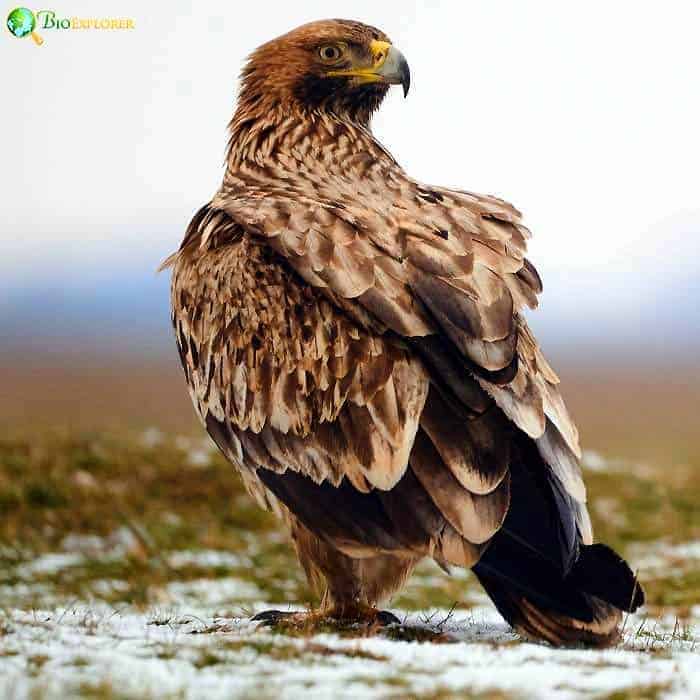
| Kingdom | Order | Family | Genus | Species |
|---|---|---|---|---|
| Animalia | Accipitriformes | Accipitridae | Aquila | Aquila heliaca |
Between central Europe and Mongolia the Eastern Imperial Eagle holds a narrow band of country, the edge where woodland meets open plain, and winters as far as Africa, northern India and China.
The Eastern Imperial Eagle has been listed as Vulnerable since 1994, with a global population of only a few thousand breeding pairs. Persecution is a major threat. A conservation project documented 54 imperial eagles killed in Hungary over several years, equivalent to 23.1 percent of the national breeding population and 14.2 percent of the European Union population reported for that period. Pairs nest in mature trees and usually raise one or two young; the Hungarian population has since increased to 205 occupied nests.
Spanish Imperial Eagle
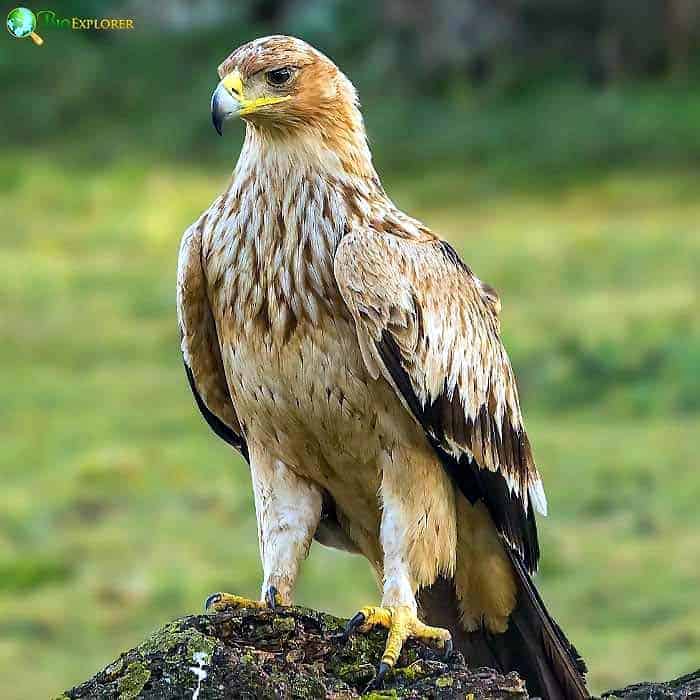
| Kingdom | Order | Family | Genus | Species |
|---|---|---|---|---|
| Animalia | Accipitriformes | Accipitridae | Aquila | Aquila adalberti |
Only the Iberian Peninsula still holds the Spanish Imperial Eagle. Morocco lost its birds altogether.
For much of the twentieth century, it was classified as Aquila heliaca adalberti, a western subspecies of the Eastern Imperial Eagle. Most current authorities recognize it as a species, although its historical relationship to the Eastern Imperial Eagle remains relevant to taxonomic discussions.
The scientific name commemorates Prince Adalbert of Bavaria. It is listed as Vulnerable, and its fortunes are tied closely to the rabbit populations that make up most of its diet. The recovery has been real: the first national census in 1974 found 39 pairs, and the 2021-22 count found 841, 821 of them in Spain.
Bonelli’s Eagle
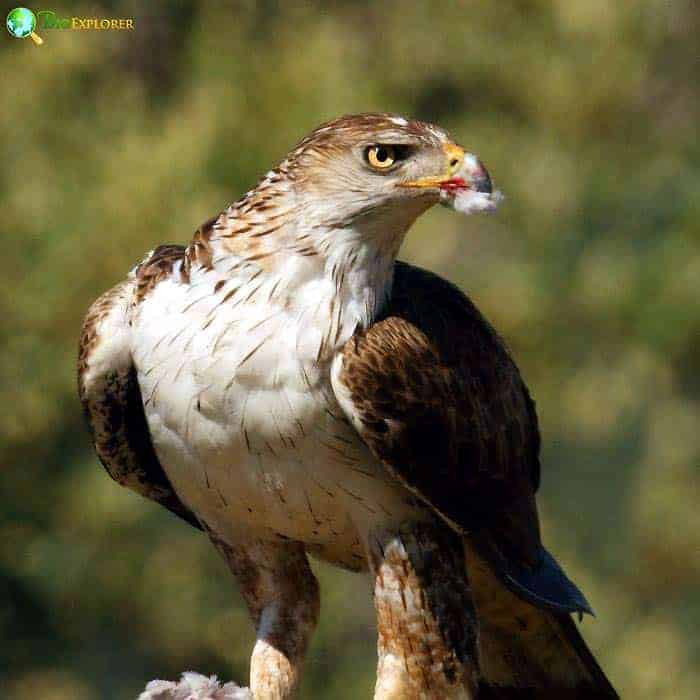
| Kingdom | Order | Family | Genus | Species |
|---|---|---|---|---|
| Animalia | Accipitriformes | Accipitridae | Aquila | Aquila fasciata |
Bonelli’s Eagle has been recorded killing Common Cranes of around 5.5 kg. Its own maximum weight is about 3 kg, so that is prey close to twice its mass.
Rabbits, hares, pigeons and partridges make up most of the diet, but the list runs on through rats, squirrels, foxes, bats and lizards.
It spans 56 to 69 inches and occupies mountains up to 3,000 meters, as well as hills, wooded plains, cliffs, and gorges from southern Europe through northern and eastern Africa to India. Pairs maintain long-term bonds, and repeatedly reused nests can reach 200 cm across and 100 cm deep.
The species is assessed as Least Concern globally. Spain supports about 66 percent of the European population, and the European assessment changed from Endangered in 2004 to Near Threatened as numbers stabilized. Electrocution on power pylons is the largest documented cause of mortality, accounting for 62 percent of deaths among non-territorial birds.
African Hawk-Eagle
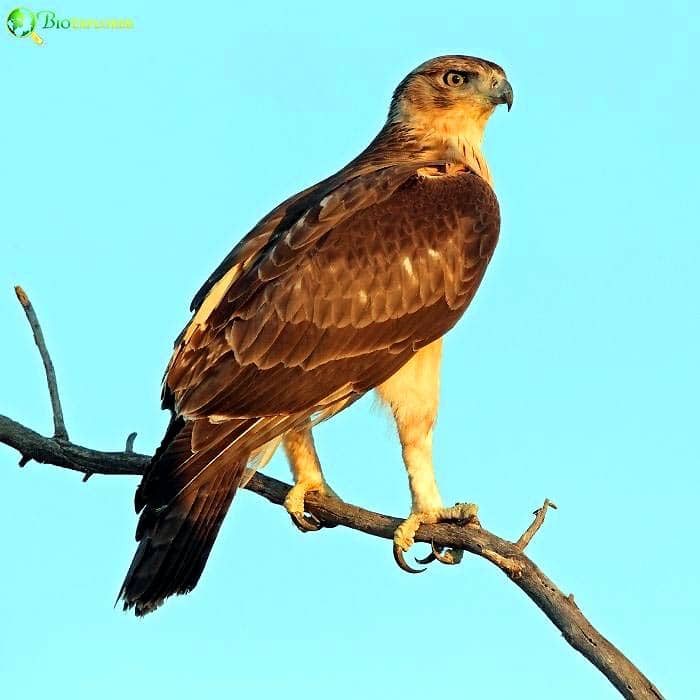
| Kingdom | Order | Family | Genus | Species |
|---|---|---|---|---|
| Animalia | Accipitriformes | Accipitridae | Aquila | Aquila spilogaster |
The African Hawk-Eagle hunts three ways: waiting on a perch, flying fast through trees to flush whatever is hiding, and soaring high before stooping. Francolins, hornbills and game birds are the usual targets, along with hares, dikdiks, squirrels, mongooses and the occasional monkey.
Nests measure about 100 cm across and up to 125 cm deep. A clutch typically contains two eggs, and the older chick usually kills the younger. Although the species is currently assessed as Least Concern globally, African road-transect data indicate a 91 percent decline over three generations, with records increasingly concentrated in protected areas.
Cassin’s Hawk-Eagle
| Kingdom | Order | Family | Genus | Species |
|---|---|---|---|---|
| Animalia | Accipitriformes | Accipitridae | Aquila | Aquila africana |
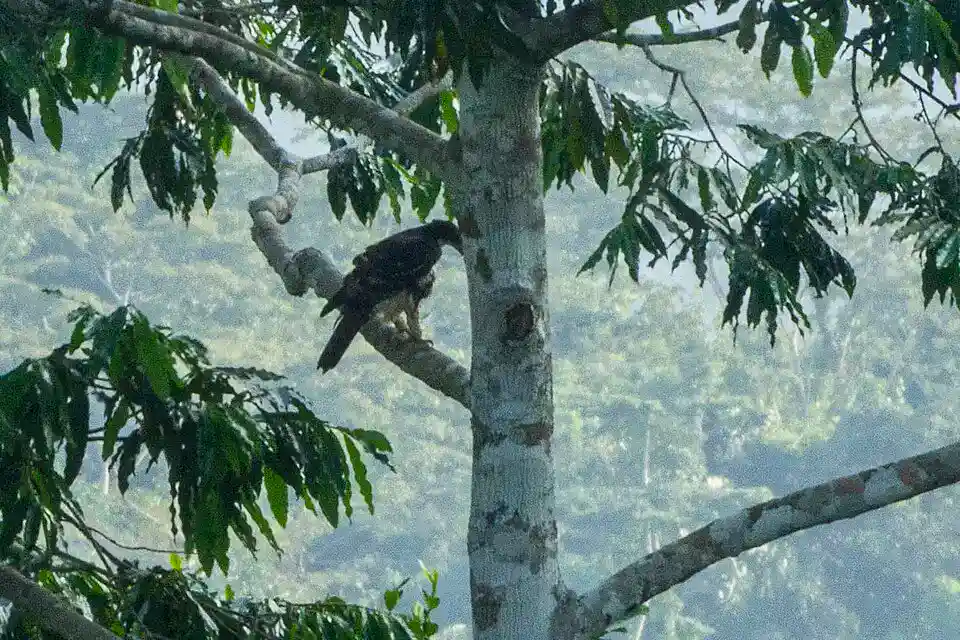
John Cassin described Cassin’s Hawk-Eagle in 1865 from a bird taken on the Ogabi River in Gabon, calling it Limnaetus africanus. Cassin worked at the Academy of Natural Sciences in Philadelphia and named several hundred birds new to science, most of them from material other people collected.
The eagle itself is small, dark above with white underparts blotched black along the lower breast, and the tail carries three black bars with a broad band at the tip.
It is tied to primary rainforest across western and central Africa, from Sierra Leone east to Uganda and south into Angola, and hunts birds and tree squirrels inside the closed canopy rather than above it. That habit is why a bird with a range spanning a dozen countries is so seldom seen.
The species is assessed as Least Concern, although its population is declining as primary forest is lost.
Gurney’s Eagle
| Kingdom | Order | Family | Genus | Species |
|---|---|---|---|---|
| Animalia | Accipitriformes | Accipitridae | Aquila | Aquila gurneyi |
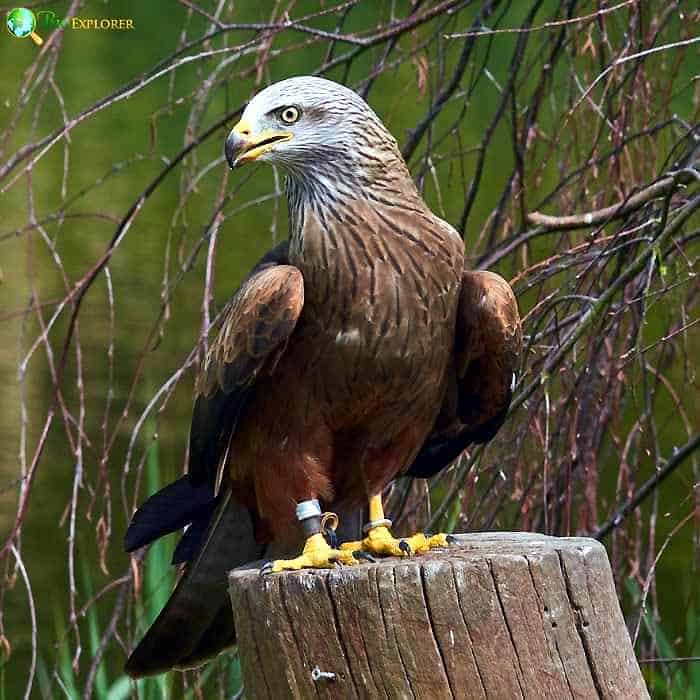
Gurney’s Eagle occupies a scatter of islands from the Moluccas through Raja Ampat and the Aru group to New Guinea, reaching the northwestern Torres Strait islands and turning up in Australia only as a vagrant.
It is a large, uniformly dark eagle of lowland and hill forest, and it is easy to mistake for a dark-morph raptor of several other kinds. In New Guinea it overlaps with the Papuan Eagle, and the two are separated more reliably by shape than by color, since Gurney’s has the long broad wings of an Aquila rather than the short rounded canopy wings of the Papuan.
G. R. Gray described it in 1861 from Batjan in the Moluccas, and it carries the name of John Henry Gurney, the nineteenth-century British ornithologist.
The species is assessed as Near Threatened and remains poorly known across most of its range. A seven-year survey on Gam Island in Raja Ampat recorded 132 bird species and identified Gurney’s Eagle among the relatively few species confined to lowland forest, a habitat under substantial development pressure.
Greater Spotted Eagle
| Kingdom | Order | Family | Genus | Species |
|---|---|---|---|---|
| Animalia | Accipitriformes | Accipitridae | Clanga | Clanga clanga |
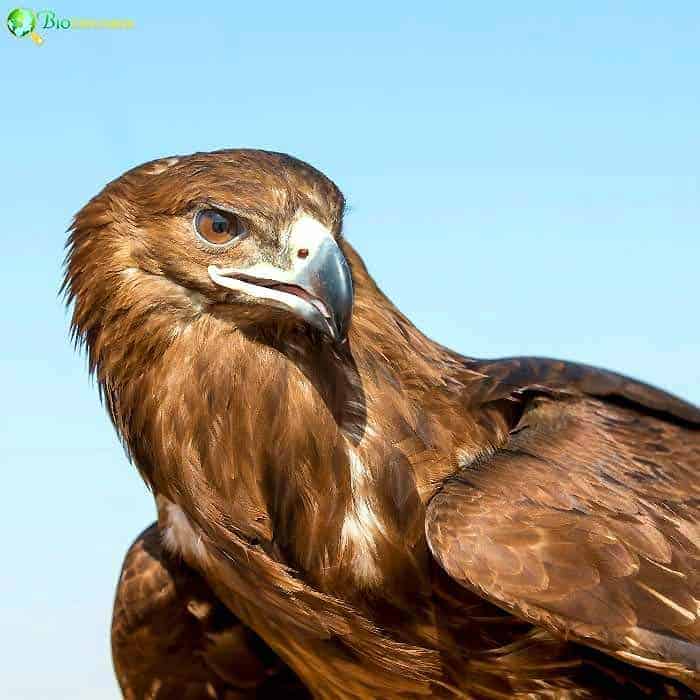
The Greater Spotted Eagle is more closely associated with wetlands than most other booted eagles. It uses floodplains, bogs, lakes, and riparian woodland and generally breeds in areas with a high water table.
The species breeds across central Eurasia and southern Asia and winters in parts of Africa, China, and Indochina. It is assessed as Vulnerable.
It also hybridizes with the Lesser Spotted Eagle across eastern Europe, extensively enough that in some populations mixed pairs outnumber pure ones. Fewer than a thousand pairs are left in Europe out of a few thousand across the whole Eurasian range.
Lesser Spotted Eagle
| Kingdom | Order | Family | Genus | Species |
|---|---|---|---|---|
| Animalia | Accipitriformes | Accipitridae | Clanga | Clanga pomarina |
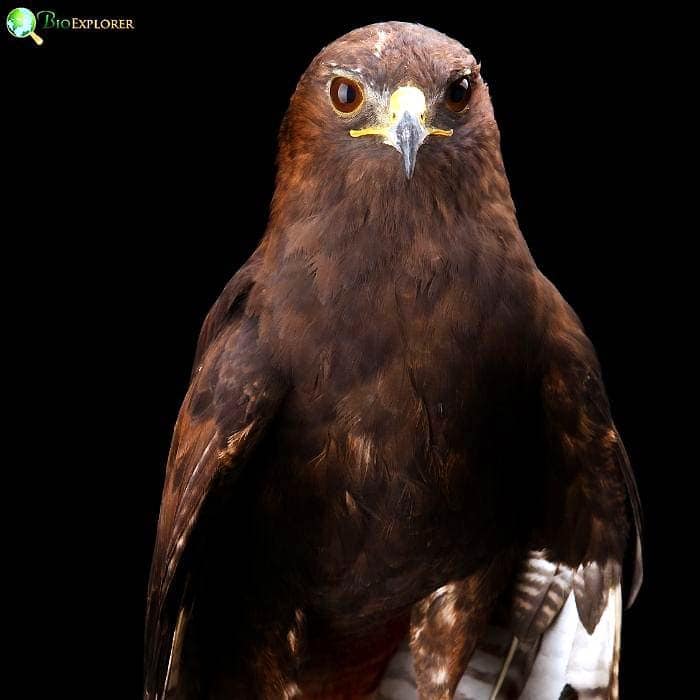
Each autumn the Lesser Spotted Eagle leaves eastern Europe and the Caspian lowlands and flies the length of Africa to winter in the south of the continent.
Brehm described it in 1831 from Pomerania, and for most of its documented history it was Aquila pomarina. The major checklists moved it into Clanga between 2012 and 2014, along with both of its spotted relatives.
Indian Spotted Eagle
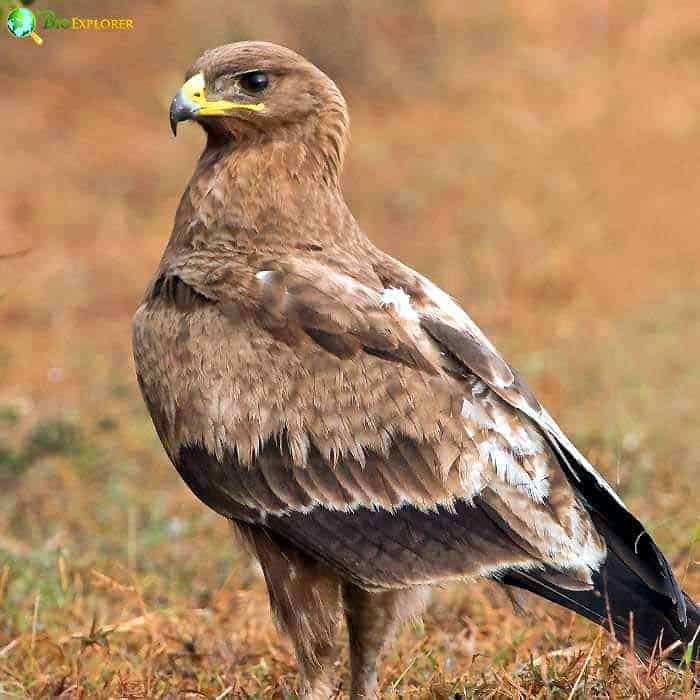
| Kingdom | Order | Family | Genus | Species |
|---|---|---|---|---|
| Animalia | Accipitriformes | Accipitridae | Clanga | Clanga hastata |
The Indian Spotted Eagle spent most of the twentieth century filed as a subspecies of the Lesser Spotted Eagle, and some authors still argue it belongs there.
Lesson described it in 1831 from Bengal as Morphnus hastatus. It moved to Aquila, then to Clanga around 2012. Today it holds India, Bangladesh and northern Myanmar, hunting over farmland and dry tropical forest rather than the wetlands its larger cousin prefers. Near Threatened.
Small Booted Eagles
This section covers six small species in Hieraaetus and Lophotriorchis, none heavier than about 1.5 kg. Genetic evidence places the Little Eagle and Booted Eagle close to Haast’s Eagle, the largest known eagle.
Booted Eagle
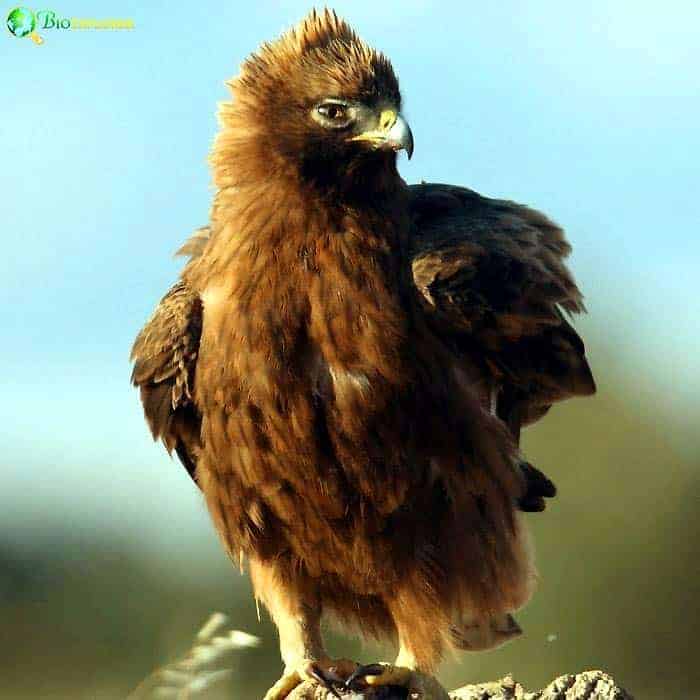
| Kingdom | Order | Family | Genus | Species |
|---|---|---|---|---|
| Animalia | Accipitriformes | Accipitridae | Hieraaetus | Hieraaetus pennatus |
Many Booted Eagles leave breeding areas in the southern Palearctic each autumn and migrate to India, Sri Lanka, Southeast Asia, or sub-Saharan Africa. African populations generally make shorter movements, and a small isolated population occurs in southwestern Africa.
Two color morphs can complicate field identification. Pale birds have clean white underparts, dark birds are uniformly brown, and both occur in the same population. An 18-year Spanish study averaged 17.1 pale fledglings and 2.3 dark fledglings per year, with a stable ratio across the study period. Gmelin described the species in 1788 as Falco pennatus; it was placed in Aquila during part of the twentieth century before being returned to Hieraaetus.
Little Eagle
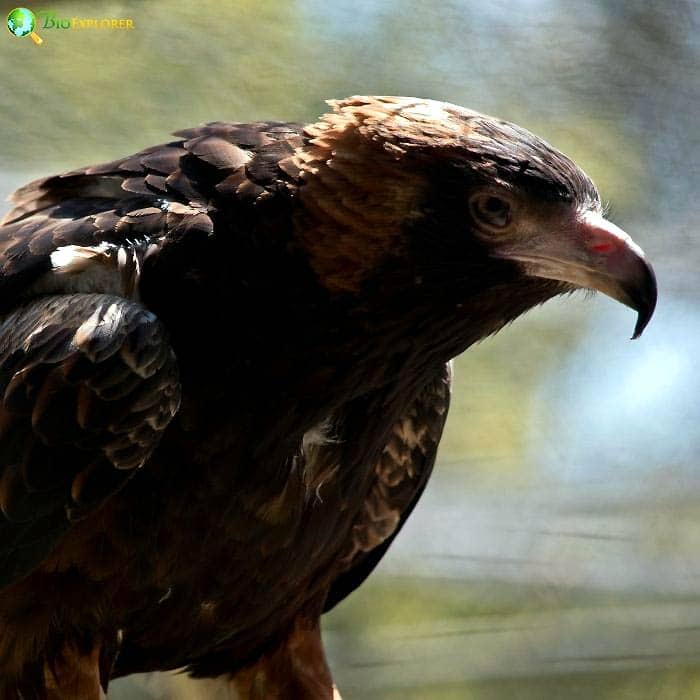
| Kingdom | Order | Family | Genus | Species |
|---|---|---|---|---|
| Animalia | Accipitriformes | Accipitridae | Hieraaetus | Hieraaetus morphnoides |
Ancient DNA revealed an unexpected relationship between the Little Eagle and Haast’s Eagle, a 10- to 15-kg species that hunted moa in New Zealand. Bunce and colleagues found that Haast’s Eagle was closely related to the Little and Booted Eagles, birds approximately one-tenth its mass.
The Haast’s Eagle lineage therefore underwent an approximately tenfold increase in body mass in less than two million years before becoming extinct after the loss of its principal prey.
The living Little Eagle spans 43 to 53 inches and weighs 23 to 44 ounces. It is endemic to Australia and inhabits open woodland and savanna. Although assessed as Least Concern globally, it is listed as Vulnerable in New South Wales, where its reporting rate fell by 39 percent between two national atlases. The number of breeding pairs recorded in the Australian Capital Territory declined from 13 in the 1980s to 3 in 2007.
Pygmy Eagle
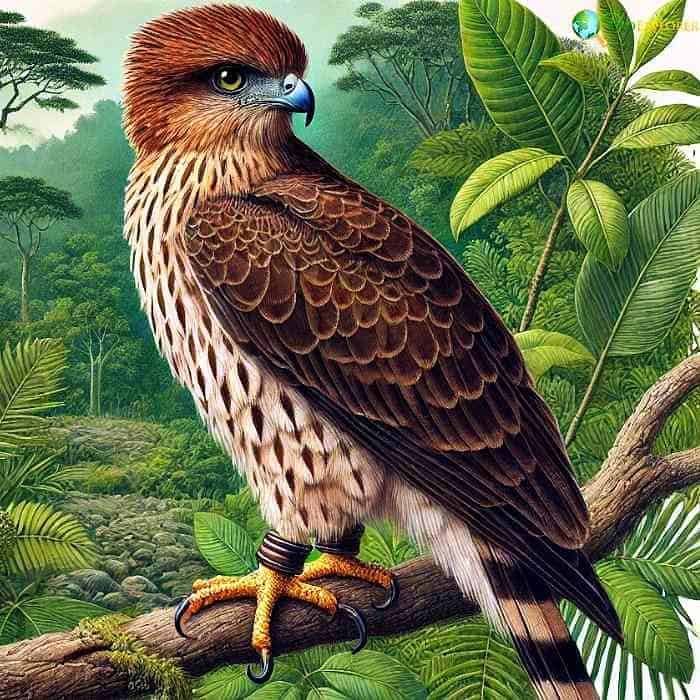
| Kingdom | Order | Family | Genus | Species |
|---|---|---|---|---|
| Animalia | Accipitriformes | Accipitridae | Hieraaetus | Hieraaetus weiskei |
Reichenow described the Pygmy Eagle in 1900 as Eutolmaetus weiskei, after which it spent most of a century filed as a New Guinean subspecies of Australia’s Little Eagle.
Gjershaug, Lerner, and Diserud revised that treatment in 2009. Their examination found that genetic distance from the Australian population in the mitochondrial cyt-b and ND2 genes was comparable to that between other accipitrid taxa recognized as separate species. Plumage and morphological differences supported the same conclusion.
Their work also redrew the map. Rather than New Guinea alone, the species holds the Vogelkop peninsula in the west of that island plus the Moluccas, including Halmahera, Ternate and Seram.
At 38 to 48 cm long, it is among the smallest eagles, and its ecology remains poorly known. Its nest was first described in 2016 at an elevation of 590 meters in the Arfak Mountains, and the same paper reported the first record from Waigeo in Raja Ampat. Some authorities continue to treat it as part of the Little Eagle.
Ayres’s Hawk-Eagle
| Kingdom | Order | Family | Genus | Species |
|---|---|---|---|---|
| Animalia | Accipitriformes | Accipitridae | Hieraaetus | Hieraaetus ayresii |
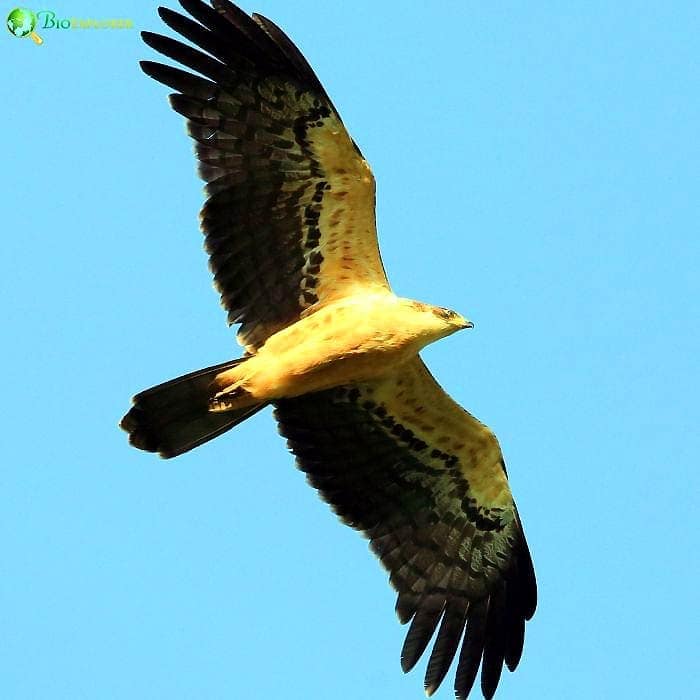
Ayres’s Hawk-Eagle often pursues pigeons and doves through the canopy. Its hunting methods range from high soaring stoops to rapid chases through cover.
The species is usually wary, although some individuals living in towns have reportedly become tolerant of people.
It sometimes uses an old nest built by another species instead of constructing a new one. Ayres’s Hawk-Eagle occurs across much of sub-Saharan Africa below 3,000 meters and is assessed as Least Concern, but it is nowhere common. Southern African atlas work recorded it in only 106 grid cells, or 2.3 percent of the region, at a mean reporting rate of 2.2 percent.
Wahlberg’s Eagle
| Kingdom | Order | Family | Genus | Species |
|---|---|---|---|---|
| Animalia | Accipitriformes | Accipitridae | Hieraaetus | Hieraaetus wahlbergi |
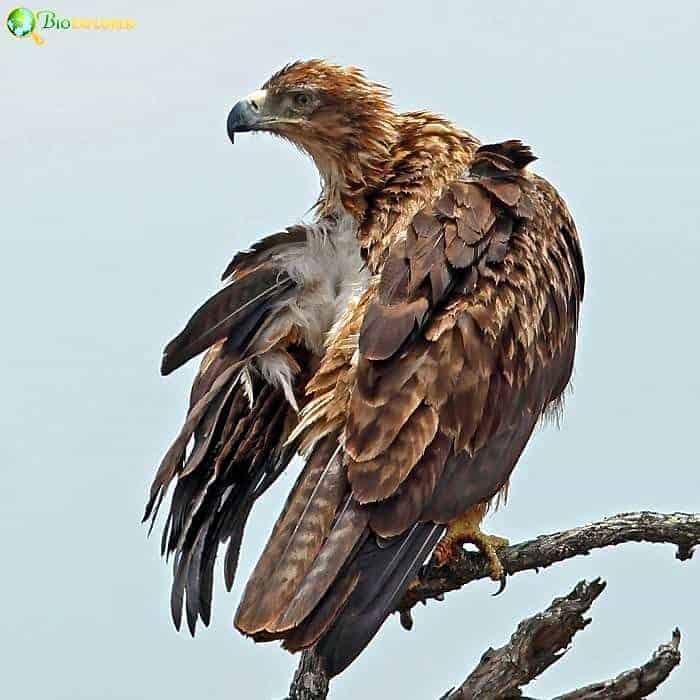
Wahlberg’s Eagle is among Africa’s smallest eagles and one of its regularly migratory raptors. GPS tracking has followed breeding birds from the savannas of eastern and southern Africa into central Africa for the non-breeding season.
It weighs as little as 437 g and takes bush squirrels, bats, mongooses, lizards, beetles, and grasshoppers. No subspecies are currently recognized. Two eggs may be laid, but siblicide means that usually only one chick fledges. The species is assessed as Least Concern, although African road transects indicate a 74 percent decline over three generations; migratory raptors in the region are declining faster than resident species.
Rufous-bellied Eagle
| Kingdom | Order | Family | Genus | Species |
|---|---|---|---|---|
| Animalia | Accipitriformes | Accipitridae | Lophotriorchis | Lophotriorchis kienerii |
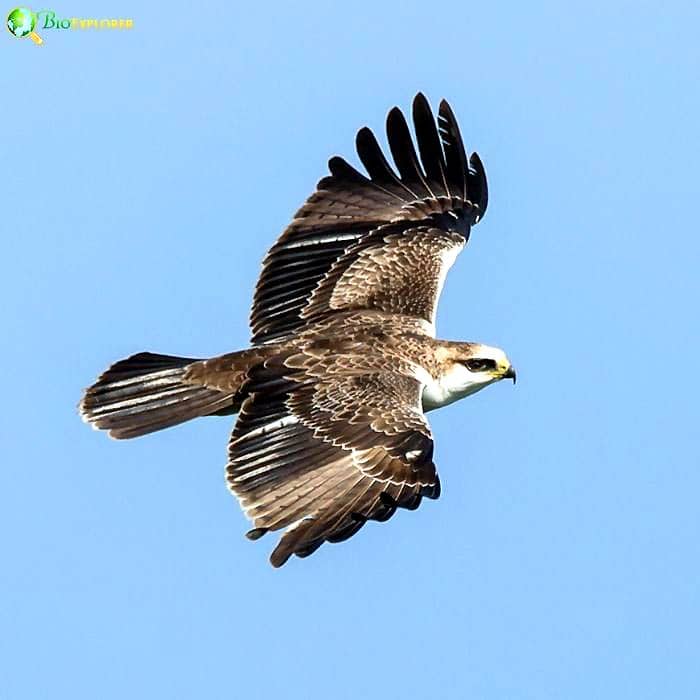
The Rufous-bellied Eagle was assessed as Least Concern in 2016 but is now classified as Near Threatened as habitat loss continues across its tropical Asian range, from India and Sri Lanka to the Philippines and Indonesia.
It takes birds in mid-air, stooping hard onto pigeons, koels, plovers, kingfishers and swiftlets, with squirrels and reptiles making up the rest. At 41 to 55 inches across and around 800 g it is small for an eagle, and it was moved out of Hieraaetus into Lophotriorchis on molecular evidence.
Large Booted Eagles
Four eagles, each the only living member of its genus.
Martial Eagle
| Kingdom | Order | Family | Genus | Species |
|---|---|---|---|---|
| Animalia | Accipitriformes | Accipitridae | Polemaetus | Polemaetus bellicosus |
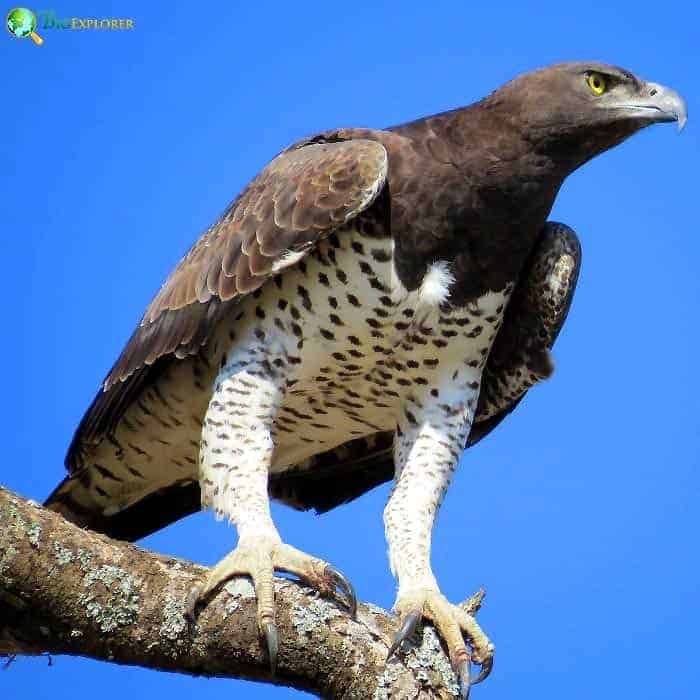
Documented Martial Eagle prey includes Spotted Eagle-owls and White-headed Vultures. More typical prey includes guineafowl, francolins, bustards, monitor lizards, hares, and monkeys.
With a wingspan of 74 to 89 inches and a mass of up to 13.6 pounds, it is Africa’s widest eagle. It typically hunts by soaring and then stooping from height, sometimes hovering briefly before a strike. Where suitable trees are scarce, it may nest on power poles.
Reproduction is slow: a clutch contains one egg, incubation lasts about 50 days, fledging takes roughly 100 days, and the juvenile remains dependent for another 8 to 12 months. Territorial birds in Kruger National Park have home ranges averaging 108 km2, whereas non-breeding floaters have ranged across areas exceeding 44,000 km2. The species was uplisted to Endangered in 2020, and South Africa’s national assessment estimates about 800 mature individuals in the country.
Crowned Eagle
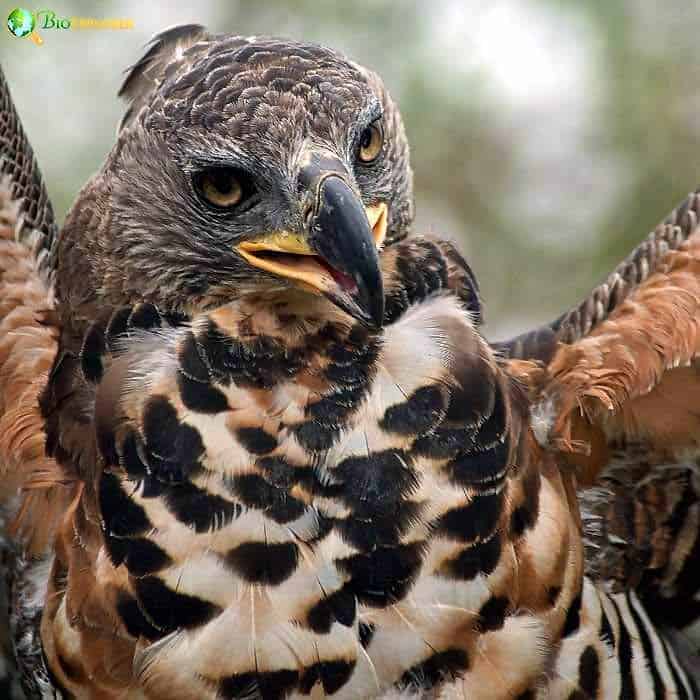
| Kingdom | Order | Family | Genus | Species |
|---|---|---|---|---|
| Animalia | Accipitriformes | Accipitridae | Stephanoaetus | Stephanoaetus coronatus |
The Crowned Eagle has been documented taking antelope up to six times its own mass. The eagle weighs 5 to 10 pounds and uses powerful legs and talons to restrain and kill prey.
Monkeys, duikers, rock hyraxes, and small antelope make up much of the diet. Evidence of raptor predation in fossil deposits is also relevant when paleontologists interpret early hominin sites. Nest-camera research on 22 breeding pairs around Durban found that rock hyraxes were the primary prey and vervet monkeys predominated where hyraxes were scarce; domestic animals accounted for only 6 percent of identifiable kills.
Its breeding cycle is among the longest of any African bird. Nest construction alone takes close to five months. Young fledge at 100 to 110 days and then stay dependent on their parents for a further 11 to 12 months, and they do not breed until about four.
The species is listed as Near Threatened. IOC uses the name Crowned Eagle, while older sources may use Crowned Hawk-Eagle or African Crowned Eagle. Its 4.5- to 5.5-foot wingspan is shorter than that of the Martial Eagle, an adaptation that improves maneuverability in forest.
Long-crested Eagle
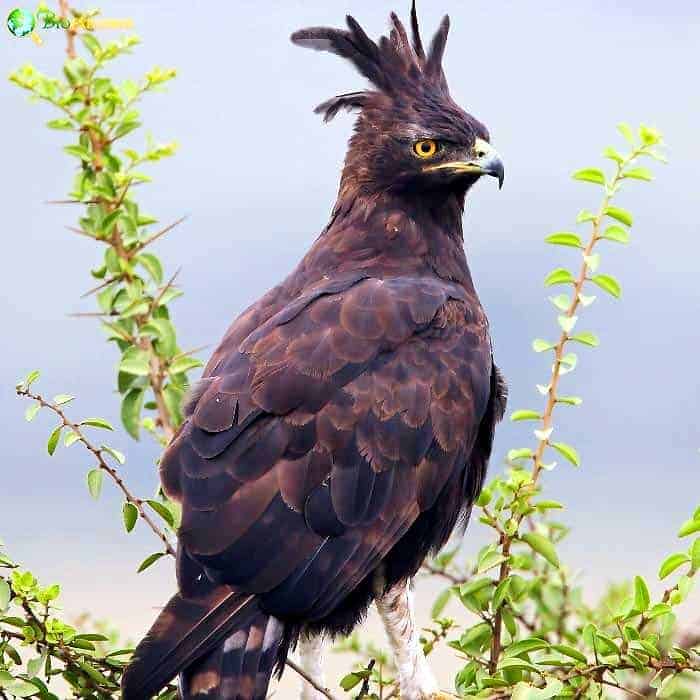
| Kingdom | Order | Family | Genus | Species |
|---|---|---|---|---|
| Animalia | Accipitriformes | Accipitridae | Lophaetus | Lophaetus occipitalis |
The Long-crested Eagle often uses agricultural landscapes. In KwaZulu-Natal, occupancy correlated more strongly with cultivated area than with any other measured habitat variable, which may help explain why this species appears to be increasing while many neighboring raptors decline. Both sexes have the long, flexible crest for which the species is named.
The species is a rodent specialist, taking vlei rats, water rats, mole rats, mice, and shrews from sit-and-wait perches along field edges. Tracked birds occupy home ranges of 3 to 7 square kilometers and select wetlands, natural forest, and savanna within them while avoiding exotic timber plantations. Its tolerance therefore applies to mixed farmland rather than planted forest. The species is assessed as Least Concern, and its population trend appears to be increasing.
Black Eagle
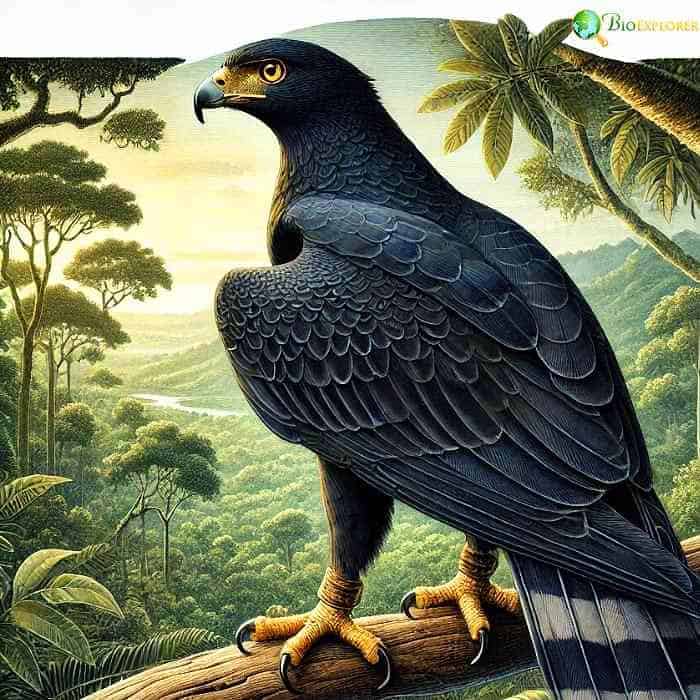
| Kingdom | Order | Family | Genus | Species |
|---|---|---|---|---|
| Animalia | Accipitriformes | Accipitridae | Ictinaetus | Ictinaetus malaiensis |
The Black Eagle specializes in searching for nests and tree hollows. It glides slowly along the forest canopy on widely splayed primaries, taking eggs, nestlings, and arboreal mammals rather than relying mainly on pursuit of adult birds.
That slow gliding flight, the long fingered wingtips and yellow cere and legs against near-black plumage make it one of the easier Asian raptors to name at distance. It ranges patchily from northern and southwestern India and Sri Lanka east to southern China, Hainan and Taiwan, and south through the Greater Sundas to Sulawesi. In mainland China alone a review mapped it across eight provinces plus Hainan and Taiwan, from 70 m in Anhui to 3,250 m in Yunnan. The world population is put at around 10,000 birds and falling with the forest. It is the only member of the genus Ictinaetus.
Snake and Serpent Eagles
Most species in this section are reptile specialists. Circaetus, Spilornis, and Terathopius belong to the circaetine lineage, which also includes the Philippine Eagle. The placement of Eutriorchis is different or uncertain, so the broader ecological group does not correspond perfectly to one clade.
The Philippine, Mountain, and Great Nicobar Serpent Eagles were formerly included within a broad Spilornis cheela complex. IOC v15.2 recognizes each as a full species, although treatments differ among authorities.
Bateleur
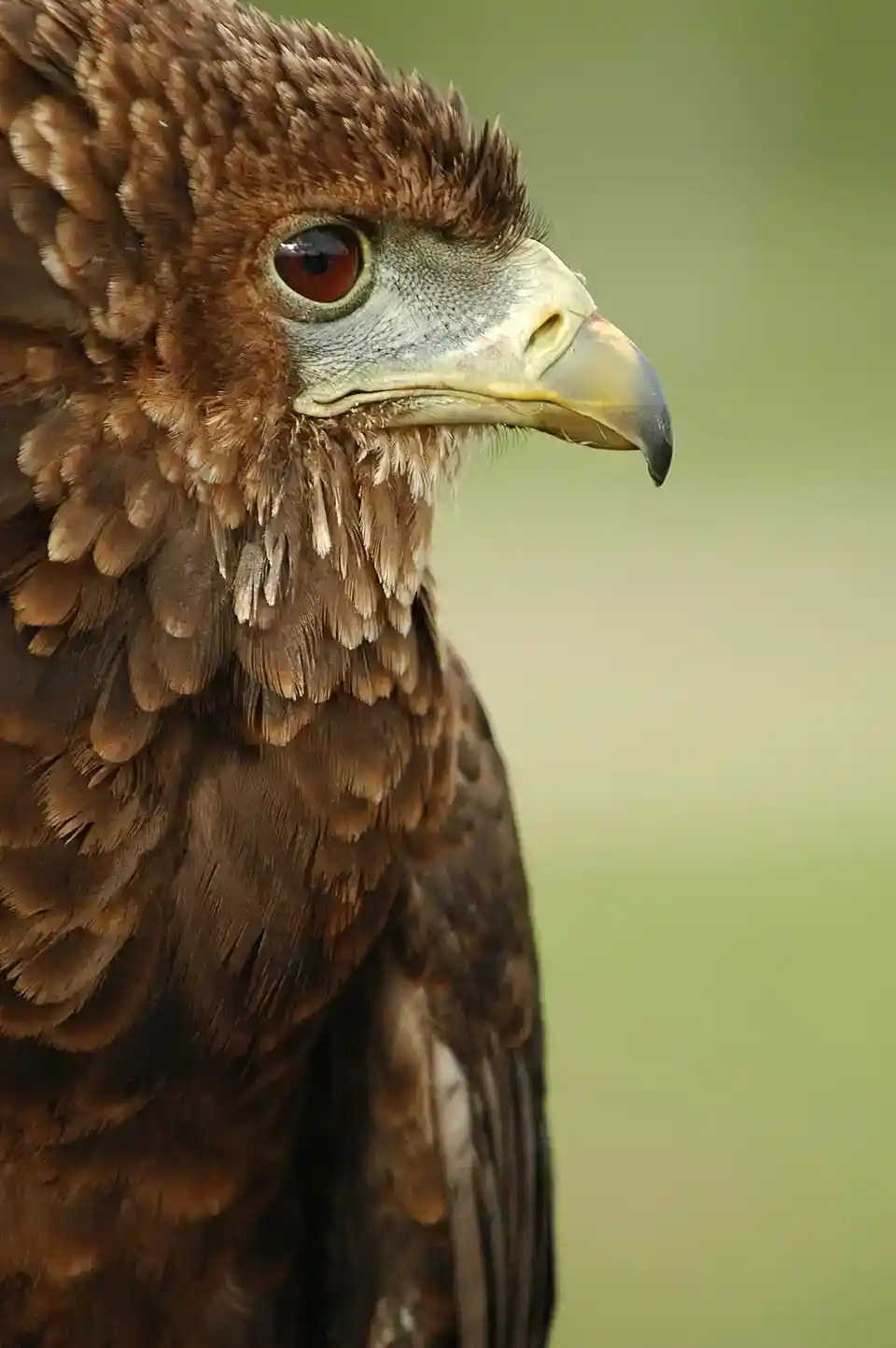
| Kingdom | Order | Family | Genus | Species |
|---|---|---|---|---|
| Animalia | Accipitriformes | Accipitridae | Terathopius | Terathopius ecaudatus |
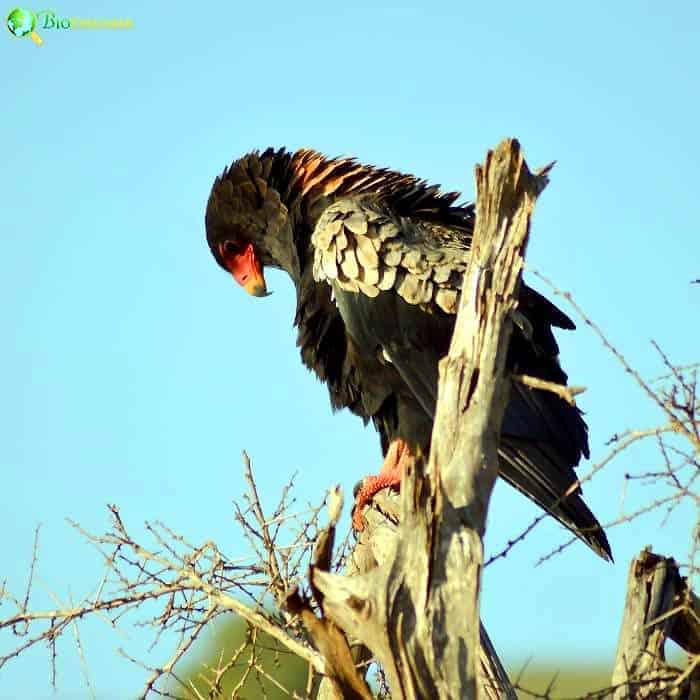
The Bateleur has an exceptionally short tail and long, narrow wings relative to its body. This form produces a distinctive rocking flight as the bird makes frequent balance corrections. An individual may cover 125 miles or more during a day of foraging.
Its bare facial and leg skin can change from pale red at rest to brighter red when the bird is agitated.
The diet includes snakes, doves, kingfishers, insects, fish, and carrion. Bateleurs locate carcasses efficiently and often arrive before larger scavenging birds.
Breeding is slow: a clutch contains one egg, fledging takes 3 to 4 months, and the juvenile remains dependent for another 4 months. Birds generally do not breed until 5 or 6 years of age, and pairs may maintain long-term bonds. The species was uplisted to Endangered in 2020. South Africa’s national assessment estimates about 900 mature individuals in the country after a 73 percent decline over three generations.
Short-toed Snake Eagle
| Kingdom | Order | Family | Genus | Species |
|---|---|---|---|---|
| Animalia | Accipitriformes | Accipitridae | Circaetus | Circaetus gallicus |
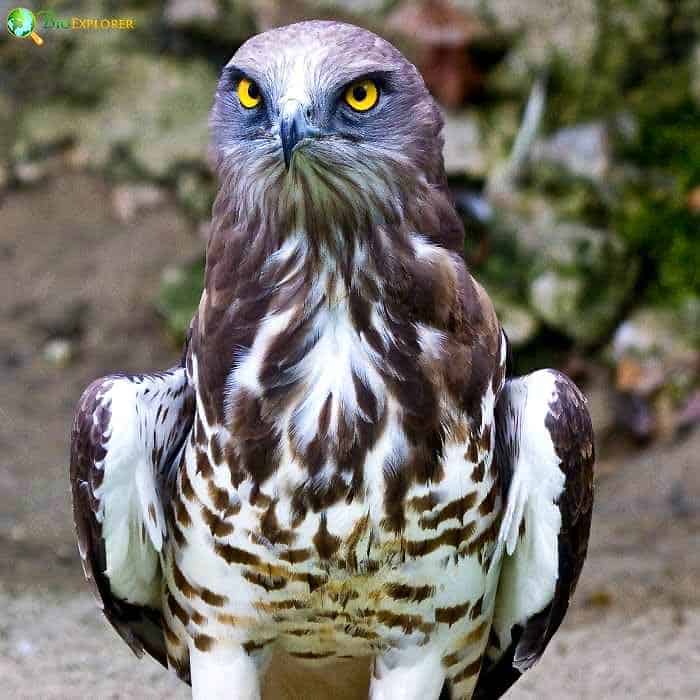
Snakes dominate the Short-toed Snake Eagle’s diet to a degree few raptors match. In Portuguese cork and holm oak parkland they made up 92.5 percent of identified prey, Montpellier snakes alone accounting for 42 percent and ladder snakes 28. Hunting means hovering over open country and dropping, or waiting on a perch and stooping.
Migration exposes the species to illegal shooting at geographic bottlenecks. In November 2019, a flock of about 15 arrived over Malta at dusk and roosted at Buskett. BirdLife Malta reported that only one bird was seen departing the following morning and suspected that most of the others had been shot.
With a wingspan of 166 to 188 cm, the species breeds from Europe and North Africa across parts of Asia. Many populations migrate through narrow land and sea crossings where persecution can be concentrated. The species is assessed as Least Concern globally.
Beaudouin’s Snake Eagle
| Kingdom | Order | Family | Genus | Species |
|---|---|---|---|---|
| Animalia | Accipitriformes | Accipitridae | Circaetus | Circaetus beaudouini |
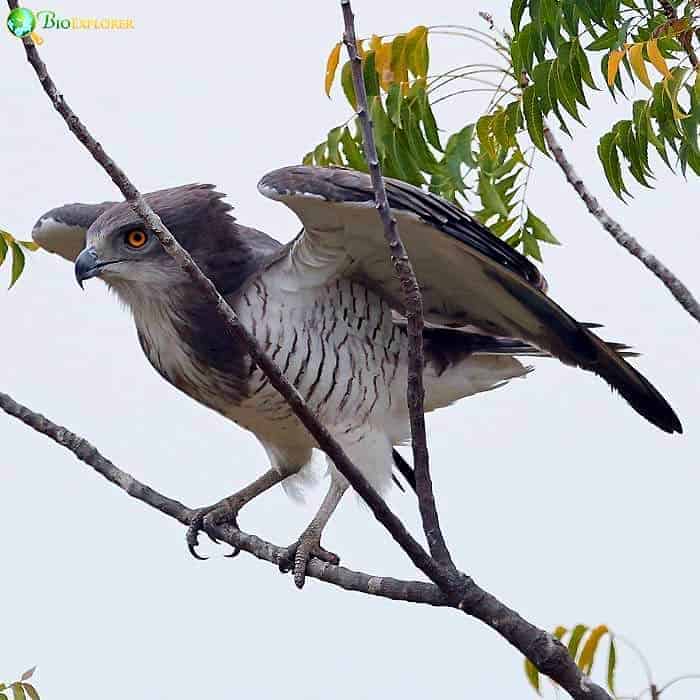
Beaudouin’s Snake Eagle holds a band of Sahel from southwestern Mauritania across to Guinea and east into Sudan and South Sudan, possibly reaching northern Uganda.
Verreaux and des Murs described the species in 1862, and it was subsequently treated for many years as a race of the Short-toed Snake Eagle. It forms a superspecies with that bird and the Black-chested Snake Eagle and is assessed as Vulnerable. Road transects covering 4,697 km in Burkina Faso found the species most frequently inside protected areas, less often in buffer zones, and rarely in farmland. This distribution is a conservation concern because 99 percent of the country lies outside protected areas.
Black-chested Snake Eagle
| Kingdom | Order | Family | Genus | Species |
|---|---|---|---|---|
| Animalia | Accipitriformes | Accipitridae | Circaetus | Circaetus pectoralis |
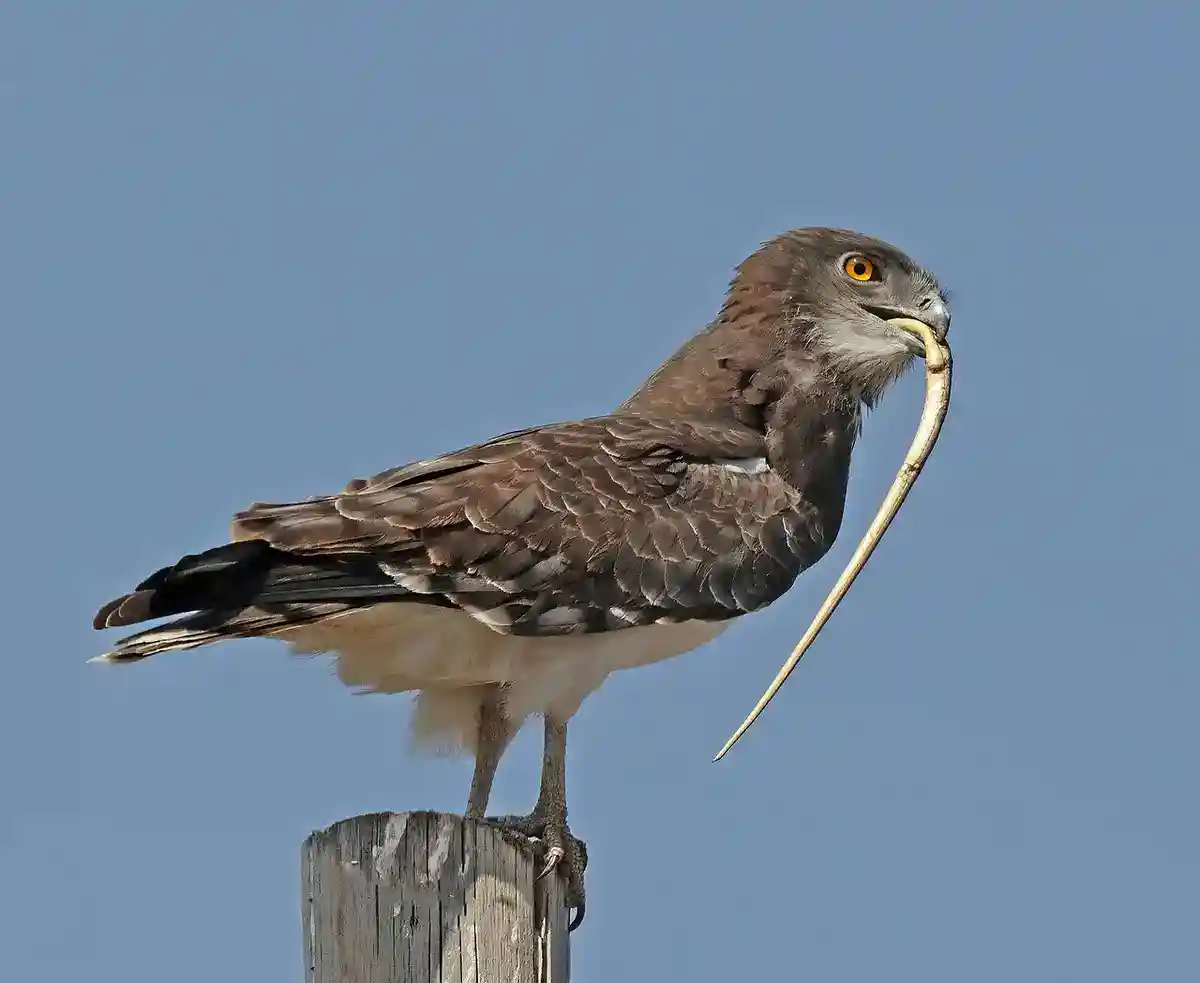
Black-chested Snake Eagles sometimes roost communally, despite generally hunting alone. Southern African records place these gatherings outside the breeding season: December to May in the former Transvaal and May to September in Zimbabwe.
Birds have also been recorded hovering and hunting after dark where artificial light spills across open ground, one of very few diurnal raptors to exploit street lighting.
Snakes are swallowed whole, while lizards, rodents, bats, birds, amphibians, and beetles supplement the diet. The range extends from Eritrea and Ethiopia south and west to South Africa, from sea level to 3,400 meters. Botswana road counts covering 120,550 km recorded approximately one bird per 1,000 km, indicating a widespread but low-density population. The species is assessed as Least Concern.
Brown Snake Eagle
| Kingdom | Order | Family | Genus | Species |
|---|---|---|---|---|
| Animalia | Accipitriformes | Accipitridae | Circaetus | Circaetus cinereus |
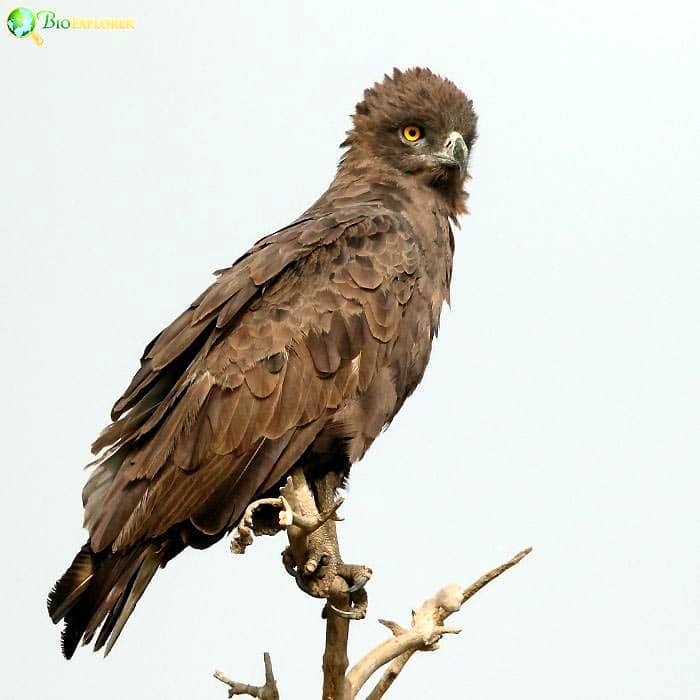
The Brown Snake Eagle regularly takes venomous snakes, including cobras and puff adders. Its legs have unusually heavy scales that provide some protection from bites.
Adults may decapitate snakes before carrying them to the nest, reducing the risk to the chick.
At 28 to 30 inches long, it is the largest snake-eagle. It hunts from prominent tree perches in sub-Saharan woodland, especially in drier habitats. Botswana roadside counts found it four times more abundant inside protected areas than outside. The species is assessed as Least Concern.
Southern Banded Snake Eagle
| Kingdom | Order | Family | Genus | Species |
|---|---|---|---|---|
| Animalia | Accipitriformes | Accipitridae | Circaetus | Circaetus fasciolatus |
The Southern Banded Snake Eagle lives almost entirely within 20 km of the sea. Its range is a thin coastal ribbon running from southern Somalia through Kenya, Tanzania and Mozambique into northeastern South Africa, in dense coastal and riverine forest from sea level to about 1,500 m.
It measures 54 to 60 cm with a wingspan of 119 to 128 cm. Mostly resident, though some birds push north into Kenya during the dry season between May and September.
The global population is estimated at 1,000 to 3,000 individuals and declining, and the species is assessed as Near Threatened. Its status is more severe in South Africa, which supports roughly 50 birds. SANBI estimated 40 to 50 mature individuals and classified the national population as Critically Endangered, with iSimangaliso Wetland Park as its core area.
Habitat loss is the principal threat, driven by timber extraction, charcoal production, collection of poles and firewood, and shifting agriculture, especially in Mozambique.
Kaup described the species from Natal. Alternative English names include Fasciated Snake-eagle and East African Snake-eagle.
Western Banded Snake Eagle
| Kingdom | Order | Family | Genus | Species |
|---|---|---|---|---|
| Animalia | Accipitriformes | Accipitridae | Circaetus | Circaetus cinerascens |
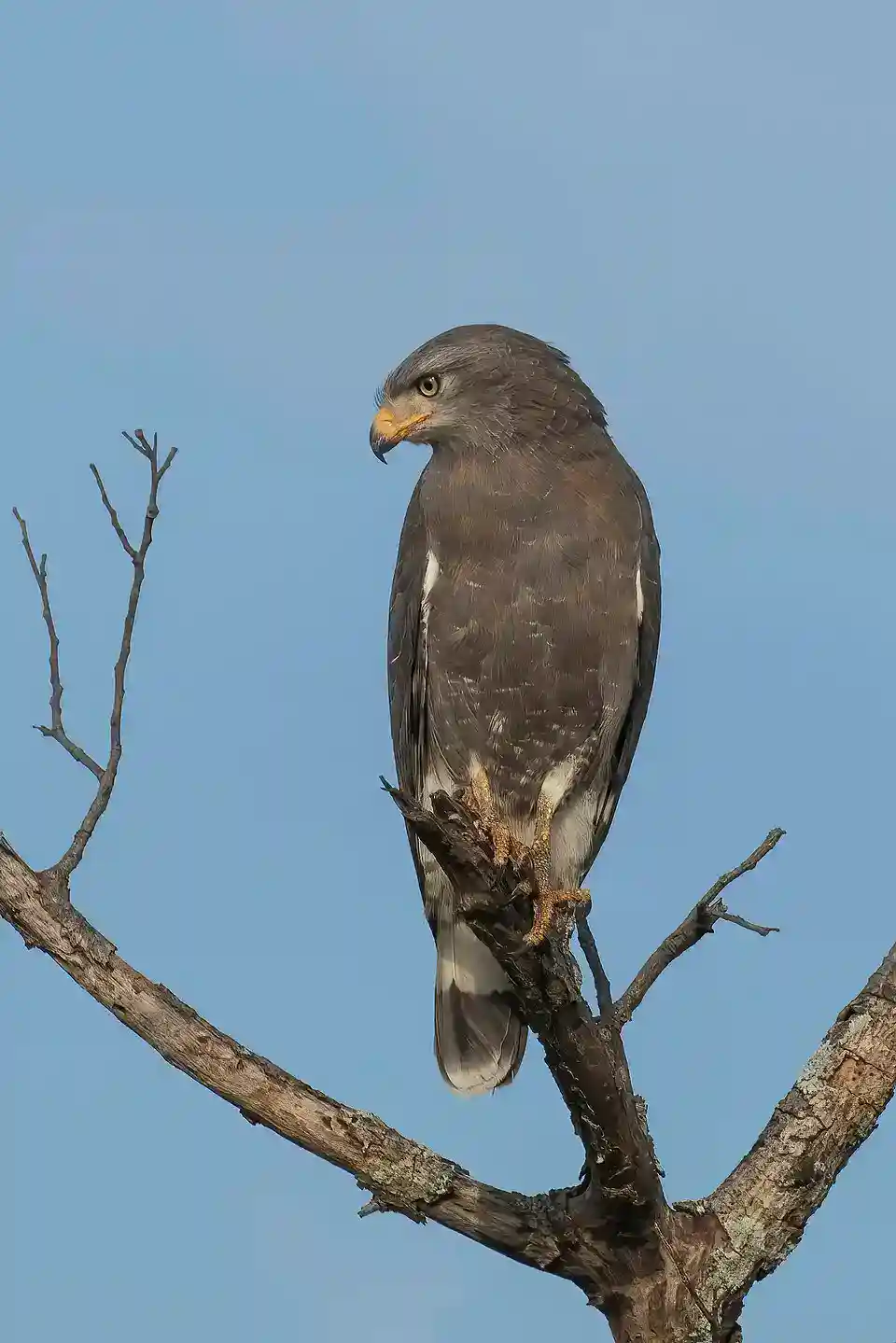
The secretive Western Banded Snake Eagle is easily overlooked. It hunts from quiet perches in riparian woodland and often takes prey directly from branches rather than foraging in open country.
It swallows both venomous and nonvenomous snakes whole and also takes lizards, frogs, fish, and insects. Early in the breeding season, it gives a loud cackling call that can be difficult to associate with this otherwise inconspicuous bird. Namibia’s population has been estimated at about 14 pairs. The species, also called the Banded Harrier-eagle, is assessed as Least Concern but is probably declining with the loss of riparian woodland.
Congo Serpent Eagle
| Kingdom | Order | Family | Genus | Species |
|---|---|---|---|---|
| Animalia | Accipitriformes | Accipitridae | Circaetus | Circaetus spectabilis |
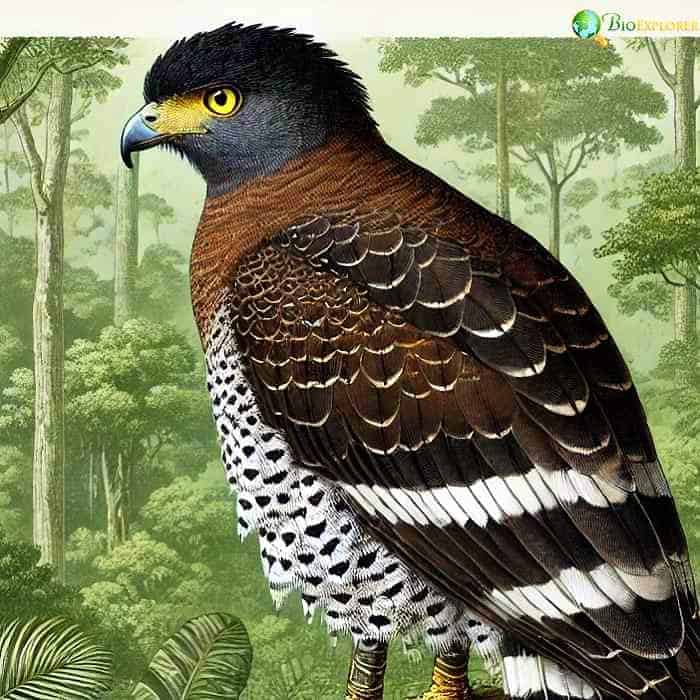
The Congo Serpent Eagle changed genus twice in three years. IOC moved it from Circaetus to Dryotriorchis in April 2022, then returned it to Circaetus in version 15.1 on the basis of a 2024 phylogenetic analysis. Both combinations therefore appear in recent literature.
The species hunts inside dense primary forest in western and central Africa, dropping from low understory perches onto snakes, chameleons, and toads. Schlegel described it in 1863 from the Gold Coast.
Sources 1
Crested Serpent Eagle
| Kingdom | Order | Family | Genus | Species |
|---|---|---|---|---|
| Animalia | Accipitriformes | Accipitridae | Spilornis | Spilornis cheela |
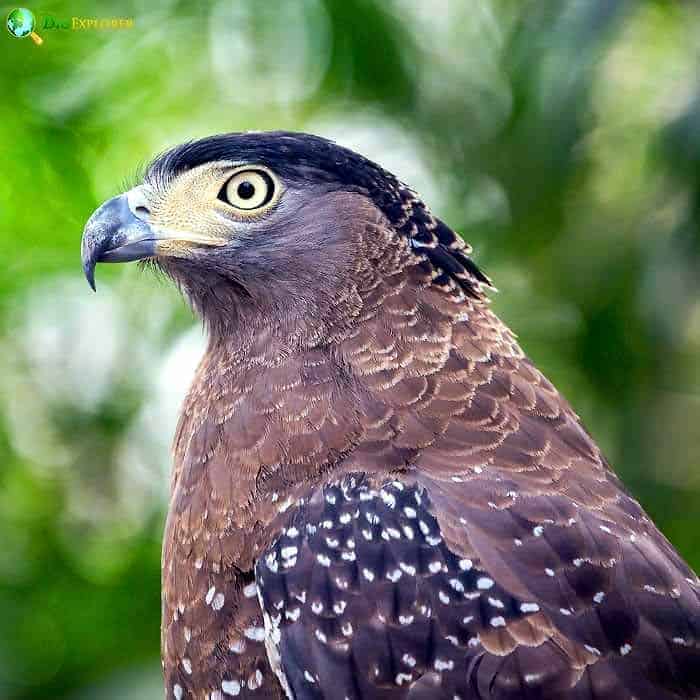
Taxonomic treatments of the Crested Serpent Eagle vary. Some authorities recognize more than 20 subspecies across its range, including six on the Indian subcontinent and Sri Lanka, whereas others recognize several island forms as full species.
Noisy for a raptor, this one calls from a perch and on the wing, especially when breeding. Tree snakes are the staple, but the list runs on through lizards, frogs, toads, eels, small birds, termites and large earthworms.
Body mass varies substantially among subspecies, from 420 to 1,800 g. In a Tamil Nadu study, reptiles accounted for 74 percent of 173 recorded feeds and birds for another 18 percent. All 27 accessible nests in that study were renovated older structures rather than newly built nests. A clutch contained one egg, mean incubation was 41.5 days, and fledging occurred after 64.5 days. The species is assessed as Least Concern.
Andaman Serpent Eagle
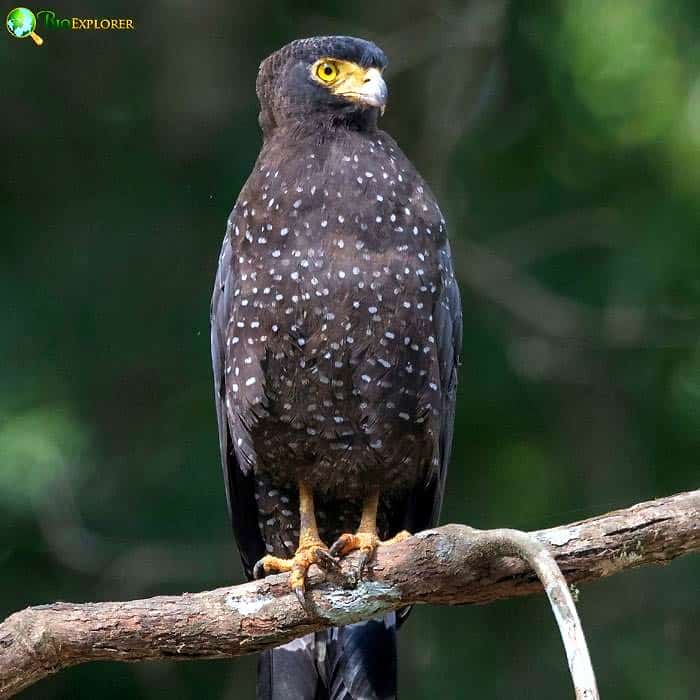
| Kingdom | Order | Family | Genus | Species |
|---|---|---|---|---|
| Animalia | Accipitriformes | Accipitridae | Spilornis | Spilornis elgini |
The Andaman Serpent Eagle is endemic to the Andaman Islands. Blyth described it in 1863 from South Andaman as Haematornis elgini, and its biology remains poorly known.
The Crested Serpent Eagle also occurs in the archipelago, making the Andamans one of the few small island groups shared by two Spilornis species. A 2021 survey found habitat partitioning between them, with the Andaman Serpent Eagle showing greater dependence on forest.
Adults are dark brown, with white spotting below and pale yellow eyes. Juveniles are paler and more heavily spotted.
The species is listed as Vulnerable and declining. Much of its behavior and ecology remains unrecorded. Together, the Andaman and Nicobar Islands support 22 raptor species, several of them endemic.
Philippine Serpent Eagle
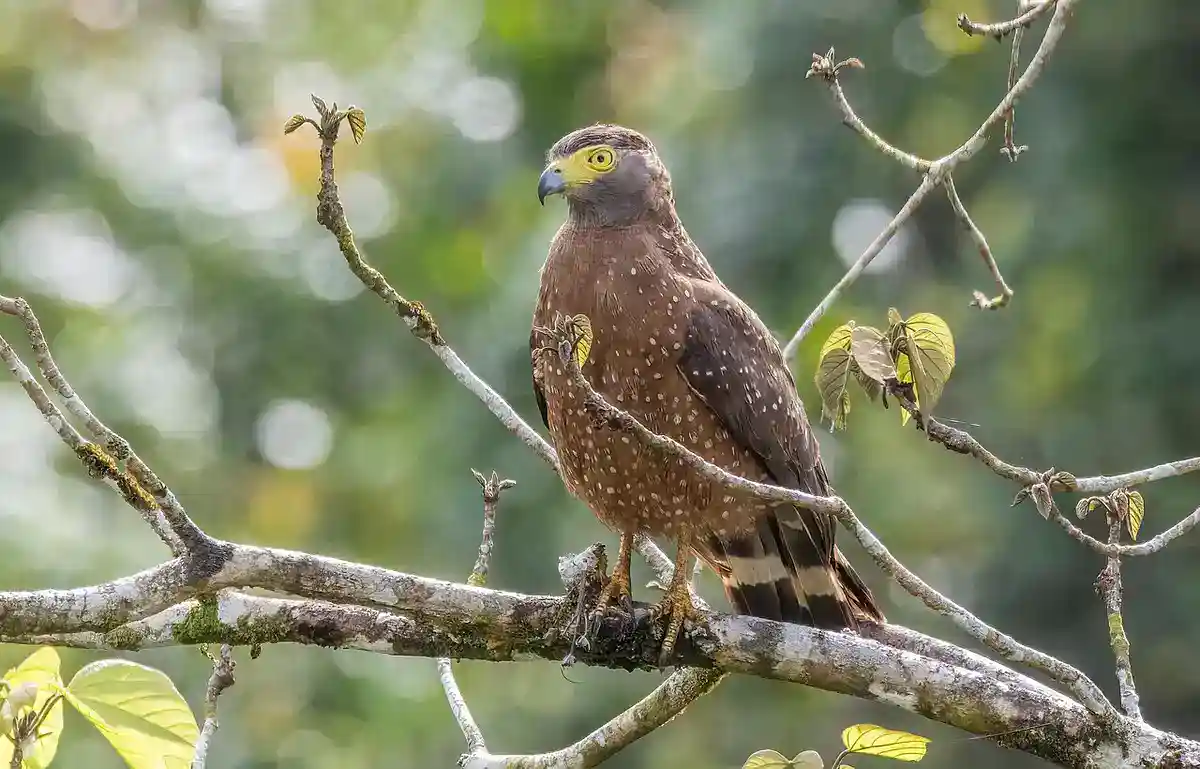
| Kingdom | Order | Family | Genus | Species |
|---|---|---|---|---|
| Animalia | Accipitriformes | Accipitridae | Spilornis | Spilornis holospilus |
Long treated as a Philippine race of the Crested Serpent Eagle, the Philippine Serpent Eagle is recognized by IOC v15.2 as a species of its own.
Its status differs from that of the Endangered Philippine Hawk-Eagle, which is restricted to Luzon and Mindoro. The Philippine Serpent Eagle occurs across much more of the archipelago and is assessed as Least Concern, illustrating that endemic status alone does not determine extinction risk.
It inhabits forest and forest edge and hunts snakes and lizards from a perch, as is typical of Spilornis. Its far-carrying call is detected more often than the bird is seen.
In one Mindanao survey, it was among the most frequently encountered birds across 10 localities. Despite its broad distribution and Least Concern status, differences in taxonomic treatment have led some general eagle lists to omit it as a separate species.
Mountain Serpent Eagle
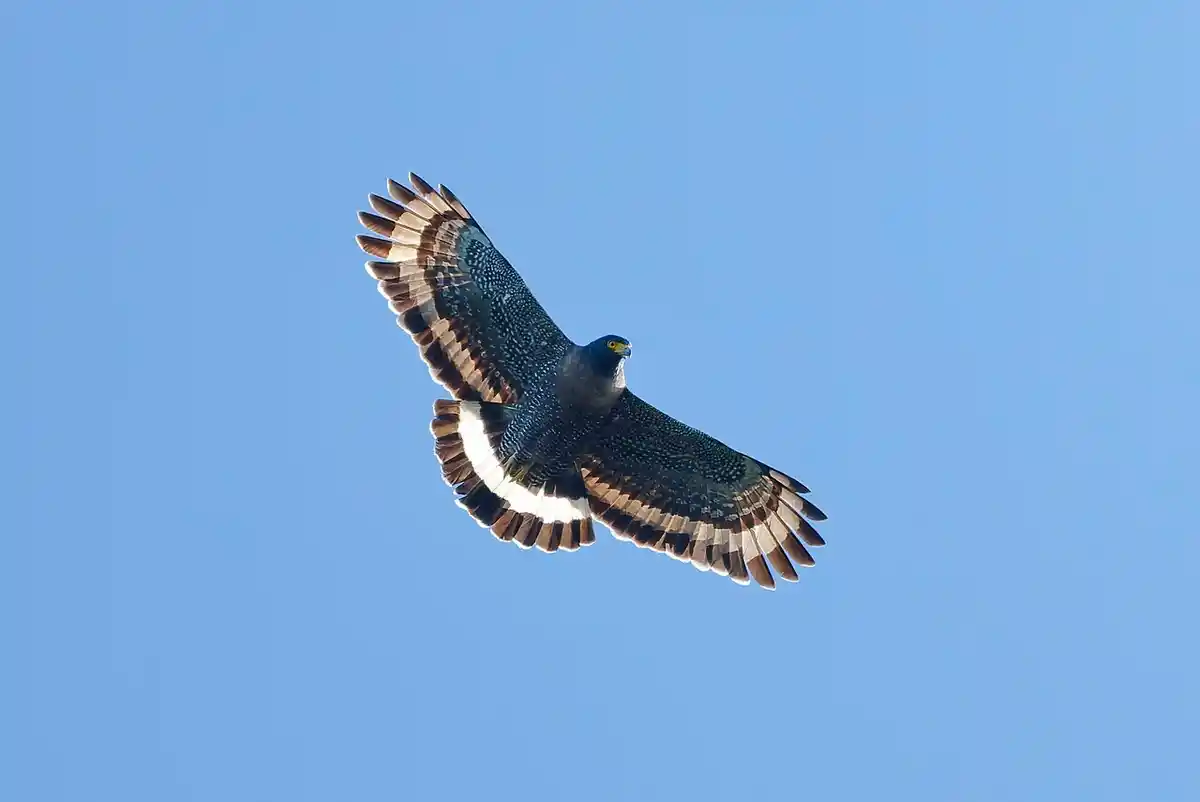
| Kingdom | Order | Family | Genus | Species |
|---|---|---|---|---|
| Animalia | Accipitriformes | Accipitridae | Spilornis | Spilornis kinabaluensis |
The Mountain Serpent Eagle is endemic to Borneo’s mountains. Its scientific name refers to Kinabalu, and it occupies montane forest above the usual elevational range of the Crested Serpent Eagle, with which it was formerly combined.
IOC, Clements, eBird, and HBW now treat it as a full species. It is assessed as Near Threatened and is restricted to a narrow elevational band on a single island.
Great Nicobar Serpent Eagle
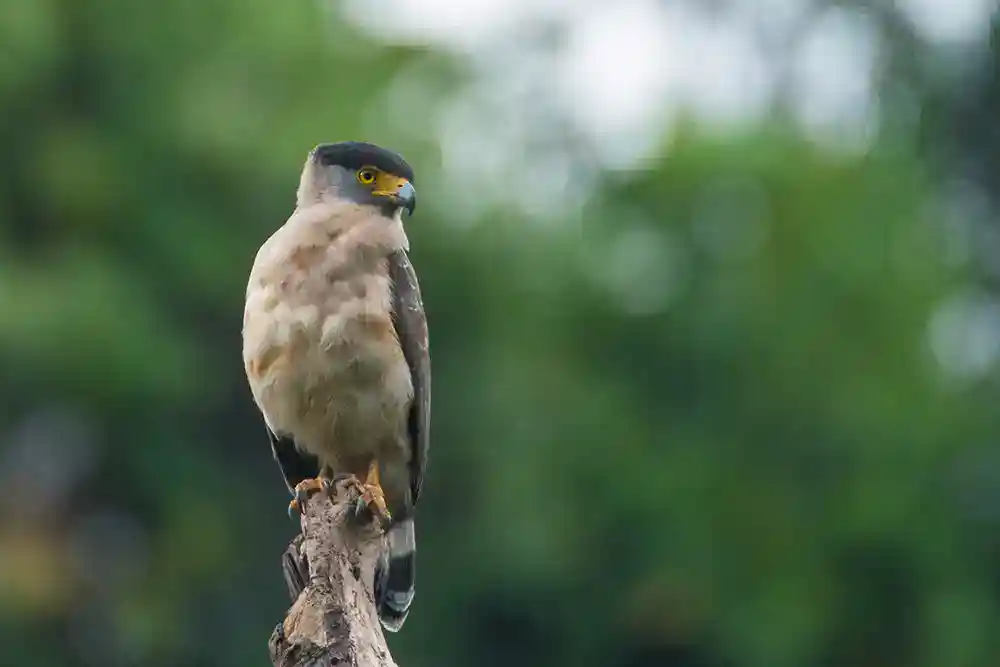
| Kingdom | Order | Family | Genus | Species |
|---|---|---|---|---|
| Animalia | Accipitriformes | Accipitridae | Spilornis | Spilornis klossi |
The Great Nicobar Serpent Eagle is assessed as Endangered and is confined to Great Nicobar and nearby islands, giving it one of the smallest ranges of any eagle.
It may also be the smallest living eagle. Reported measurements are about 450 g in mass, 38 to 42 cm in length, and 85 to 95 cm in wingspan, all below those reported for Wallace’s Hawk-Eagle. Avibase describes it as probably the smallest known eagle, while Guinness World Records lists it as the smallest eagle species.
Like the other island Spilornis it was buried inside Spilornis cheela for most of its documented history, and it is sometimes still called the South Nicobar Serpent Eagle.
The Nicobar Islands are small, low-lying, and subject to increasing development. Because no reserve population exists elsewhere, habitat loss within the archipelago poses a disproportionate risk.
Recognizing the Great Nicobar Serpent Eagle separately is therefore important both for species counts and for conservation: it is Endangered and is a strong candidate for the smallest living eagle.
Sources 1
Madagascar Serpent Eagle
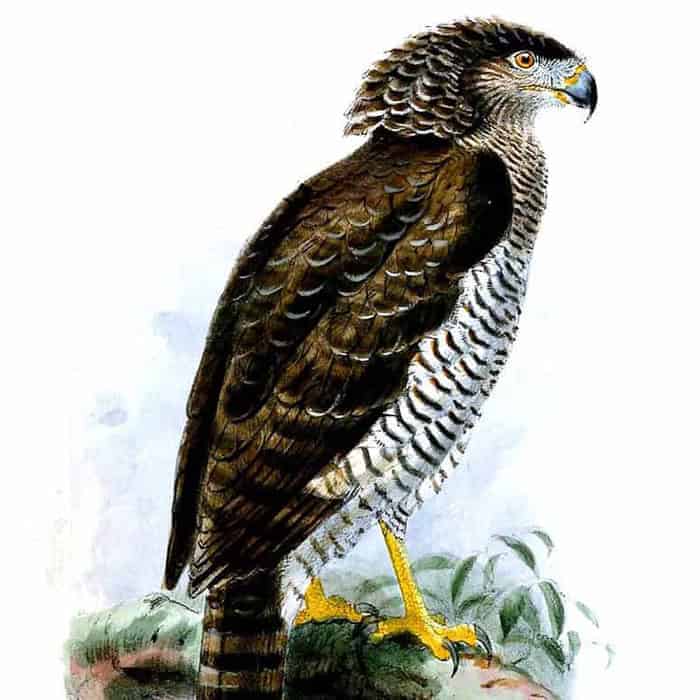
| Kingdom | Order | Family | Genus | Species |
|---|---|---|---|---|
| Animalia | Accipitriformes | Accipitridae | Eutriorchis | Eutriorchis astur |
For much of the twentieth century the Madagascar Serpent Eagle was presumed extinct. No confirmed sighting was made for decades, until birds were found again in the early 1990s.
Surviving populations occupy rainforest in northeastern and east-central Madagascar, where the eagles hunt lizards, snakes, and frogs from forest perches. A national analysis of Madagascar’s threatened forest birds had only 10 georeferenced records available for this species. Its models placed the eagle among the five species most vulnerable to climate change and indicated strong sensitivity to forest fragmentation.
Sharpe described it in 1875. The genus Eutriorchis has no other member, and the species is Endangered.
Harpy and Forest Eagles
These four forest eagles share heavy bodies, powerful feet, and short, broad wings suited to maneuvering within a forest canopy. Three—the Harpy, Crested, and Papuan Eagles—belong to the harpiine lineage. The Philippine Eagle is a circaetine that evolved a similar body form independently.
Harpy Eagle
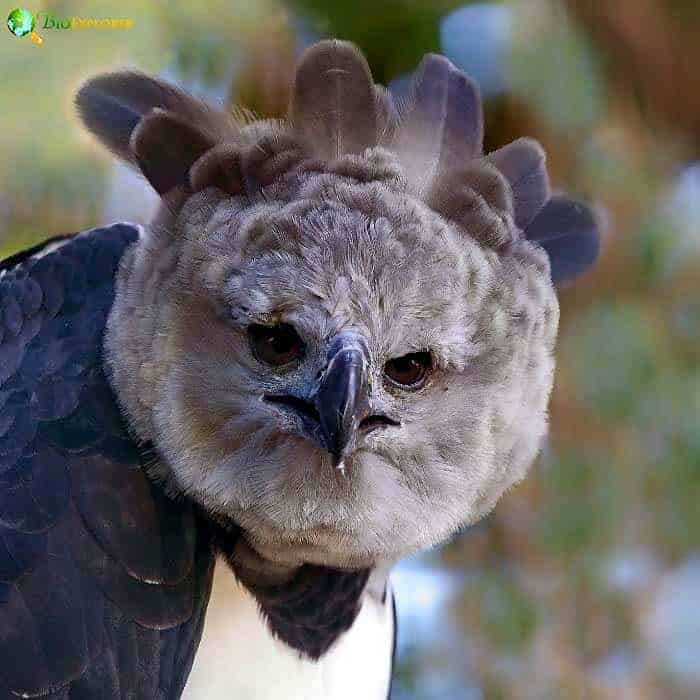
| Kingdom | Order | Family | Genus | Species |
|---|---|---|---|---|
| Animalia | Accipitriformes | Accipitridae | Harpia | Harpia harpyja |
A Harpy Eagle’s rear talons measure 3 to 4 inches, among the longest talons of any living eagle. They are adapted for seizing large arboreal prey.
It takes the black howler monkey and sloths weighing up to 8 pounds directly from the canopy, along with iguanas, parrots, porcupines, coatis, raccoons, and young deer. Observers have also recorded it killing Black Vultures and foxes.
At 9 to 20 pounds, the Harpy Eagle is among the heaviest living eagles, yet its wingspan reaches only about 6.5 feet, substantially less than that of the largest sea eagles. Its shorter wings improve maneuverability between trees, while powerful legs and feet enable it to capture large prey.
It is Vulnerable, and its range from southern Mexico to northern Argentina has broken into fragments, with Central American populations hit hardest.
Sources 1
Philippine Eagle

| Kingdom | Order | Family | Genus | Species |
|---|---|---|---|---|
| Animalia | Accipitriformes | Accipitridae | Pithecophaga | Pithecophaga jefferyi |
Proclamation No. 615 made the Philippine Eagle the national bird in 1995, signed by President Fidel V. Ramos.
The Philippine Eagle is Critically Endangered and survives on four islands. Its habitat extends from sea level to about 5,900 feet, although the loss of lowland forest has increasingly restricted populations to mountain slopes.
Pairs have been reported hunting cooperatively, with one eagle attracting a monkey’s attention while the other approaches from behind. Recorded prey includes macaques, flying squirrels, civets, bats, snakes, lizards, and other birds of prey.
The Philippine Eagle measures 2.5 to 3.3 feet long, weighs 10 to 18 pounds, and has a wingspan near 1.9 meters. Recent genomic work estimated about 392 potentially breeding pairs in the wild. Its former English name emphasized monkeys, but the diet varies among islands according to locally available prey; see also the broader group of monkey-eating eagles.
Crested Eagle
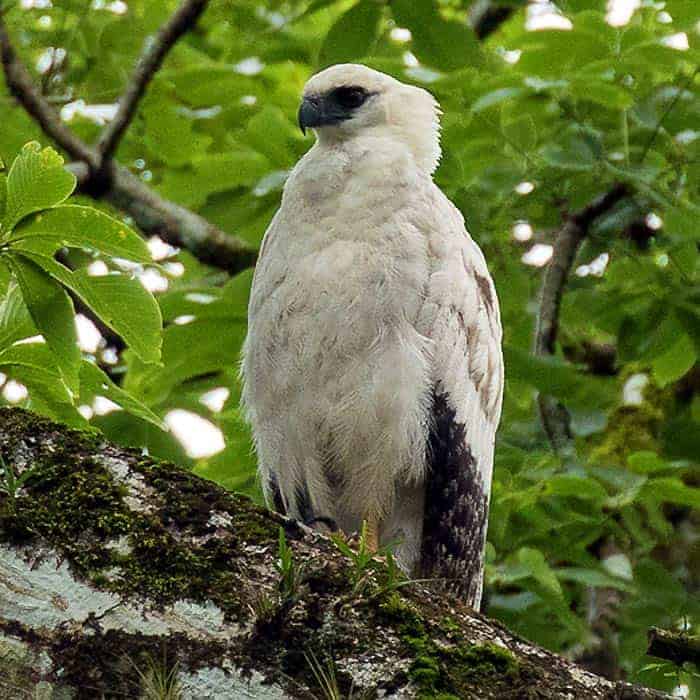
| Kingdom | Order | Family | Genus | Species |
|---|---|---|---|---|
| Animalia | Accipitriformes | Accipitridae | Morphnus | Morphnus guianensis |
Researchers observed an adult female Crested Eagle repeatedly bringing snakes, squirrels, and sloths to a recently fledged Harpy Eagle. Provisioning the young of another species is rare among birds, and the cause of this behavior remains unknown.
Breeding is slow. Pairs raise young every second year, lay one or two eggs, and no nest has ever been documented holding more than a single chick. Incubation runs 40 to 50 days and the young bird flies at about four months.
Typical prey is smaller than that taken by Harpy Eagles and includes guans, trumpeters, squirrel monkeys, young spider monkeys, opossums, kinkajous, boas, and iguanas. With a wingspan of about 70 inches and a mass of approximately 3 kg, the Crested Eagle is lighter and longer-tailed. Juveniles of the two species can be difficult to distinguish. The Crested Eagle is assessed as Near Threatened.
Papuan Eagle
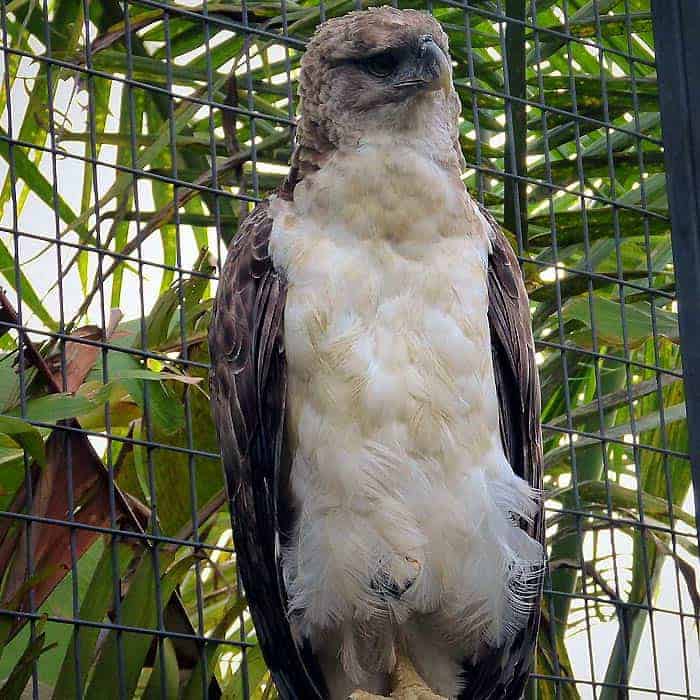
| Kingdom | Order | Family | Genus | Species |
|---|---|---|---|---|
| Animalia | Accipitriformes | Accipitridae | Harpyopsis | Harpyopsis novaeguineae |
New Guinea lacks native large placental carnivores, and the Papuan Eagle occupies part of the large-predator niche. It hunts tree kangaroos, wallabies, and possums, including prey unusually large for an eagle.
A local name is kapul eagle, derived from a term for the tree-dwelling marsupials that form part of its diet. The English name refers to the island on which it occurs.
Field workers describe it as often heard and rarely seen. The call carries a long way through closed forest, which is how surveys locate it, but the bird itself is thinly spread across the whole island and difficult to observe directly.
Breeding may occur only every second year. The species is the sole member of Harpyopsis, depends on mature rainforest, and is assessed as Vulnerable. Logging and hunting are causing further decline in an already small population.
Buzzard-Eagles
Buzzard-eagles belong to the buteonine lineage rather than the sea-eagle or booted-eagle clades. Their common names reflect their large size and eagle-like proportions.
Black-chested Buzzard-Eagle
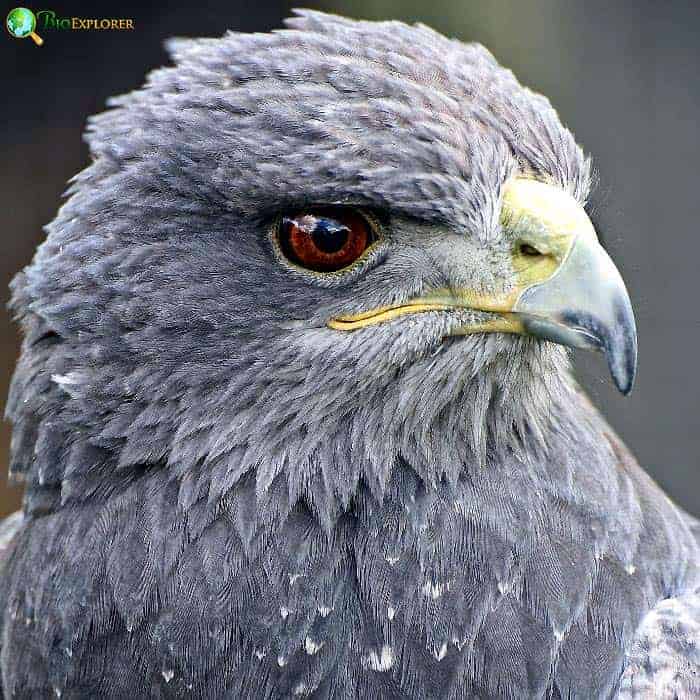
| Kingdom | Order | Family | Genus | Species |
|---|---|---|---|---|
| Animalia | Accipitriformes | Accipitridae | Geranoaetus | Geranoaetus melanoleucus |
The Black-chested Buzzard-Eagle barely perches in trees. Most of its life is spent soaring in wide circles over open, rugged, arid country, alone or in pairs, often at middle elevations in the Andes and sometimes above the treeline altogether.
Wingspan ranges from 58 to nearly 79 inches, variation associated with sex, two subspecies, and a distribution covering much of South America. The diet includes small mammals, birds, snakes, lizards, and carrion. Domestic pigeons are important prey in some areas, and the eagle also raids other birds’ nests.
Both parents share incubation in approximately equal shifts and defend the nest. Young fledge at about 50 days but remain in the parents’ territory afterward. The species is assessed as Least Concern, although numbers are declining in Chile while its range appears to be expanding in Brazil.
Chaco Eagle
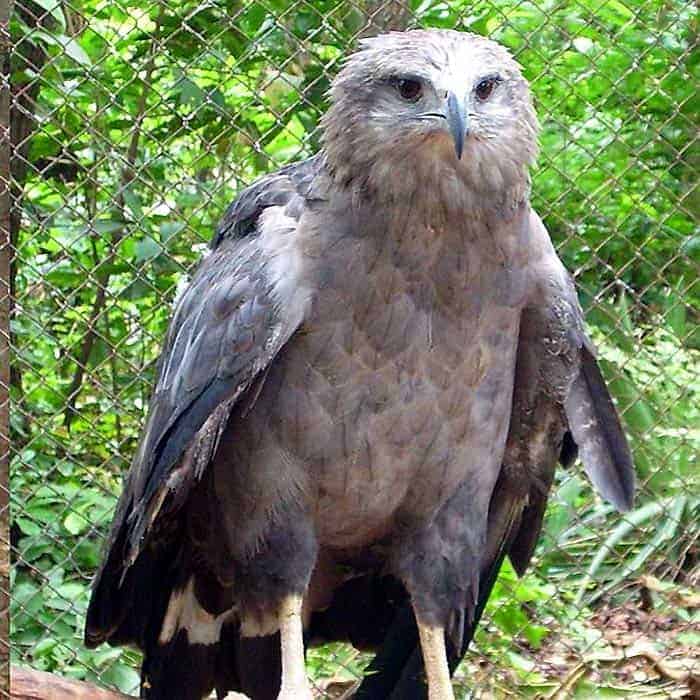
| Kingdom | Order | Family | Genus | Species |
|---|---|---|---|---|
| Animalia | Accipitriformes | Accipitridae | Buteogallus | Buteogallus coronatus |
In Argentina the Chaco Eagle is the weeping eagle, named for the sound of its call.
The total population is put at 350 to 1,500 individuals, spread thinly from central Brazil, Bolivia and Paraguay down into central Argentina. Uruguay lost its birds in the 1930s and has not had them since.
Several demographic factors limit recovery. The birds take about 5 years to reach breeding age, lay one egg per season, and experience nest failure rates above 50 percent. Among juveniles that fledge, only about 30 percent survive. At the same time, roughly 40 percent of the range has been converted from woodland to cropland, more than 100 illegal killings have been documented, and additional birds die through power-line electrocution and drowning in farm reservoirs.
One population model projected a high probability of extinction within 50 years if present conditions continued. Community outreach in several Argentine provinces has improved local attitudes and reduced illegal killing, providing evidence that targeted intervention can lower mortality.
Its diet consists mainly of armadillos and reptiles. Until 2016, it was classified as Harpyhaliaetus coronatus, and much of the published literature uses that combination.
Solitary Eagle
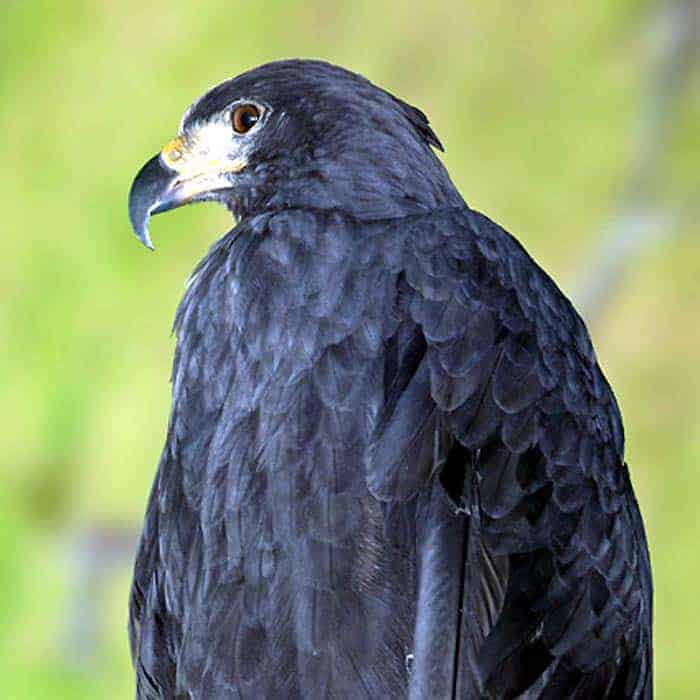
| Kingdom | Order | Family | Genus | Species |
|---|---|---|---|---|
| Animalia | Accipitriformes | Accipitridae | Buteogallus | Buteogallus solitarius |
The incubation and fledging periods of the Solitary Eagle have not been established, illustrating how little of the species’ basic breeding biology has been documented.
The Solitary Eagle occupies middle and montane elevations from Mexico through Central and South America, reaching 2,200 meters and descending to 200 meters in Colombia. Snakes may form most of its diet. It lays a single egg in a large cup of coarse sticks lined with foliage, soars high alone or in pairs, and perches in treetops. The species has lost an estimated 60.5 percent of its natural habitat and is sometimes shot for taking chickens. It is assessed as Near Threatened globally and Critically Endangered within Colombia.
Extinct Eagles
Both species disappeared within the last thousand years, after human settlement transformed their ecosystems. They are among many extinct birds whose declines were associated with hunting, habitat change, or the loss of prey. Archaeological and ecological evidence provides limited but important information about both eagles.
Haast’s Eagle

| Kingdom | Order | Family | Genus | Species |
|---|---|---|---|---|
| Animalia | Accipitriformes | Accipitridae | Hieraaetus | Hieraaetus moorei |
Female Haast’s Eagles weighed 12 to 14 kilograms. No eagle alive comes close. Males, at 9 to 10 kg, merely matched the heaviest living species.
Its proportions indicate a specialized hunting style. A wingspan of about 3 meters supported a body mass of up to 14 kg, whereas a White-tailed Eagle may span 2.44 meters at a mass of about 7 kg. The relatively high wing loading of Haast’s Eagle was suited to short, powerful attacks within New Zealand forest rather than prolonged soaring over open ground.
Probable prey included kererū, ducks, swans, geese, rails, and moa. The largest moa greatly exceeded the eagle’s mass, although smaller individuals and smaller moa species were likely more manageable prey.
The eagle disappeared after the extinction of moa removed its principal prey. Surviving evidence includes cave drawings, tools made from eagle bones, and Māori traditions that may preserve a cultural memory of the bird. Its closest living relatives weigh approximately one-tenth as much.
Its generic placement also varies. Older sources use Harpagornis moorei, whereas ancient-DNA research placed the species within Hieraaetus. Extinct taxa are not treated consistently by modern world-bird checklists, so both combinations remain in use.
Malagasy Crowned Eagle

| Kingdom | Order | Family | Genus | Species |
|---|---|---|---|---|
| Animalia | Accipitriformes | Accipitridae | Stephanoaetus | Stephanoaetus mahery |
Until people arrived, the Malagasy Crowned Eagle hunted lemurs. Known today only from subfossil bones, it was a close relative of the African Crowned Eagle that still takes monkeys, and on Madagascar the equivalent prey was primates of another kind entirely.
In an analysis of 1,141 bone specimens from 6 subfossil sites and 17 lemur species, Meador placed this eagle within an extinct predator guild that also included another raptor, a crocodylian, and a carnivoran. The analysis indicated that the raptors preferentially took smaller extinct lemur genera, including Pachylemur, Mesopropithecus, and Archaeolemur.
Several lemurs taken by this eagle are also extinct, meaning that Madagascar lost both a large predator and much of its prey community during the same broad period. The antipredator behavior of living types of lemurs may still reflect an evolutionary history that included predation by large raptors.
Eagles of North America
Two eagle species breed regularly in North America: the Bald Eagle and the Golden Eagle. Other species occur only as exceptional vagrants, most notably a Steller’s Sea Eagle recorded across the continent beginning in 2021.
Where to see Bald Eagles
Alaska supports the largest concentration of Bald Eagles. State biologists estimate 70,000 birds, or as many as 150,000 when non-breeding floaters and subadults are included. The highest nesting densities occur on the islands of Southeast Alaska.
The single best spectacle is the Chilkat Valley in late fall and early winter, where over 3,000 eagles gather to feed on spawned-out salmon. Alaska established the Chilkat Bald Eagle Preserve in 1982 specifically to protect that gathering.
In the lower 48 states, Bald Eagles are now widespread near water. Florida, the Pacific Northwest, the Mississippi Flyway, and Chesapeake Bay support large numbers, and major rivers with abundant fish and tall trees provide productive winter habitat.
Where to see Golden Eagles
In North America, Golden Eagles are primarily western birds associated with open country rather than large bodies of water. Their habitats include mountains, canyons, sagebrush, and grasslands from Alaska through the Rocky Mountains and Great Basin.
Based on data through 2016, the U.S. Fish and Wildlife Service estimated an interior western population of 31,800 and a total U.S. population of roughly 40,000, including Alaska. Although numbers appeared stable, the agency attributed 74 percent of Golden Eagle deaths after the first year of life to human-related causes.
Golden Eagles are scarce east of the Mississippi River, where sightings are notable rather than routine.
A Notable Vagrant: Steller’s Sea Eagle
In spring 2021 an adult Steller’s Sea Eagle left eastern Russia and started moving across North America.
It was seen in Alaska, then Texas, then eastern Canada. On 30 December 2021 a resident named Linda Tharp found it on the intertidal rocks at Five Islands in Georgetown, Maine, the first record for the state. It worked the Maine coast until mid-March 2022 and had reached Nova Scotia by April.
The bird was unusual not only for its origin but also for its age. Many long-distance vagrants are juveniles, whereas this individual was an adult at least four years old. It remained in northeastern North America for well over a year, moving among Quebec, New Brunswick, Nova Scotia, Maine, and southern Massachusetts.
North America therefore has two regularly breeding eagle species. The Steller’s Sea Eagle was an exceptional visitor rather than a resident third species.
Sources: U.S. Fish & Wildlife Service, eagle population status · Alaska Department of Fish and Game, Bald Eagle species profile · Maine Audubon, rare bird alert
The Largest and Smallest Eagles
The smallest eagle is probably the Great Nicobar Serpent Eagle, at around 450 g and 38 to 42 cm long, with a wingspan of 85 to 95 cm. Its omission from many general lists partly reflects differences in whether authorities treat it as a species or as part of a broader serpent-eagle complex.
Many guides instead name Wallace’s Hawk-Eagle, which has a wingspan of 37 to 41 inches and weighs 17.6 to 21.5 ounces. It is the smallest of the booted eagles and is lighter than many Red-tailed Hawks, but published measurements place the Nicobar species below it in length, weight, and wingspan.
These smaller species show why the commonly quoted eagle wingspan of 5 to 8 feet does not describe the full group; some eagles span less than 3 feet.
At the other end of the size range, the largest species depends on the measurement used.
| Species | Wingspan | Weight |
|---|---|---|
| Steller’s Sea Eagle | about 8 ft | about 15 lbs |
| Bald Eagle (female) | up to 8 ft | up to 14 lbs |
| Wedge-tailed Eagle | 6 to 7.7 ft | 4.4 to 12 lbs |
| Golden Eagle | up to 7 ft | up to 14 lbs |
| Harpy Eagle | up to 6.5 ft | 9 to 20 lbs |
| Philippine Eagle | about 6.5 ft | 10 to 18 lbs |
| Little Eagle | 3.6 to 4.5 ft | 1.5 to 2.7 lbs |
| Wallace’s Hawk-Eagle | 3.1 to 3.4 ft | 1.1 to 1.3 lbs |
| Great Nicobar Serpent Eagle | 2.8 to 3.1 ft | about 1 lb |
The widest eagles are not necessarily the heaviest. Steller’s, White-tailed, and large female Bald Eagles can approach 8 feet across. A Harpy Eagle has a shorter wingspan, generally no more than about 6.5 feet, but the largest females can weigh about 20 pounds, compared with approximately 14 pounds in the largest female Bald Eagles.
The contrast reflects different flight environments. Long, broad wings assist sea eagles that soar over open water, whereas the shorter, broader wings of Harpy and Philippine Eagles improve maneuverability within rainforest. These forest eagles also have exceptionally robust legs and feet for capturing large arboreal prey.
Across the species covered here, wingspans range from under 3 feet to about 8 feet. Maximum measurements overlap among the largest sea eagles, while Harpy and Steller’s Sea Eagles are among the heaviest living species. The identity of the “largest” eagle therefore depends on the measurement used.
Sources: Measurements for each eagle are cited in the corresponding entry below. Additional comparisons use the National Park Service account of the Red-tailed Hawk and the National Audubon Society account of Steller’s Sea-Eagle.
Frequently Asked Questions
This guide counts 69 living species, plus 2 that became extinct within the last thousand years. The exact figure depends on the checklist because “eagle” is a common name applied to large raptors in several lineages rather than a formal taxonomic rank. Species limits here follow the IOC World Bird List v15.2.
The answer depends on the measurement. Steller’s, White-tailed, and large female Bald Eagles can approach 8 feet in wingspan. Harpy and Steller’s Sea Eagles are among the heaviest, with reported maximum masses near 20 pounds. The Philippine Eagle is also among the largest forest eagles.
Probably the Great Nicobar Serpent Eagle, at about 450 g and 38 to 42 cm long. Many guides name Wallace’s Hawk-Eagle, which spans 37 to 41 inches and weighs 17.6 to 21.5 ounces, but published measurements place the Nicobar species below it in length, weight, and wingspan.
Flight speed depends on behavior and wind. An instrumented Golden Eagle reached a ground speed of about 76 mph during a long migratory flight, corresponding to an estimated airspeed near 54 mph after correction for tailwind. Popular references report Golden Eagles approaching 200 mph in steep dives, but the migration study cited here did not test that behavior and cannot confirm or refute the dive-speed figure.
Available measurements do not support a simple claim that every eagle sees eight times better than a human. Some large raptors resolve fine detail at roughly twice human spatial resolution, while measured acuity in Harris’s Hawks overlaps the human range. Eagles also have specialized retinal anatomy, including two foveae in each eye, and remain among the animals with the best eyesight.
Falcons belong to the separate order Falconiformes and are not close relatives of eagles. Eagles and hawks both occur within Accipitridae, and their common names overlap: eagles are generally larger and more powerfully built, but no single anatomical feature separates every eagle from every hawk.
Diet varies among lineages; see the separate guide to what eagles eat. Sea and fish eagles take mainly fish and other aquatic prey. Snake eagles specialize in reptiles. Booted eagles take mammals, birds, and reptiles, while large forest eagles such as the Harpy Eagle take arboreal mammals including sloths and monkeys.
Eagles nest in tall trees, on cliff ledges, and occasionally on power poles or the ground. Many species reuse and enlarge the same nest for years. Bald Eagle nests are the largest built by any North American bird and can reach 10 feet across and weigh thousands of pounds.
Two species breed regularly in North America: the Bald Eagle and the Golden Eagle. A Steller’s Sea Eagle from eastern Russia wandered across the continent beginning in 2021, but it was an exceptional vagrant rather than a resident third species.
An adult Bald Eagle has a white head and tail contrasting with a dark brown body. A Golden Eagle is mostly brown, with golden feathering across the nape. Bald Eagles are strongly associated with coasts, rivers, and lakes, whereas Golden Eagles usually hunt in open mountains, canyons, grasslands, and shrublands.
Alaska supports the largest concentration of Bald Eagles, and more than 3,000 may gather in the Chilkat Valley in late fall to feed on spawned-out salmon. In the lower 48 states, Bald Eagles are common near large rivers, lakes, and coasts, especially in winter. Golden Eagles are most readily found in open western landscapes and are scarce east of the Mississippi.
No. The Bald Eagle was removed from the U.S. endangered species list in 2007. Surveys conducted in 2018 and 2019 estimated 316,700 individuals and 71,400 nesting pairs in the lower 48 states. The species remains protected under federal law.
Sources: Mitkus et al., J Comp Neurol 2017 · Potier, Mitkus & Kelber, Proc R Soc B 2018. Other figures are cited in the relevant sections above.
About the author

Cite this page
BioExplorer. (2026, August 26). Types of Eagles. https://www.bioexplorer.net/animals/birds/eagles/