
Order Malvales / Hibiscus & Mallow Flowers
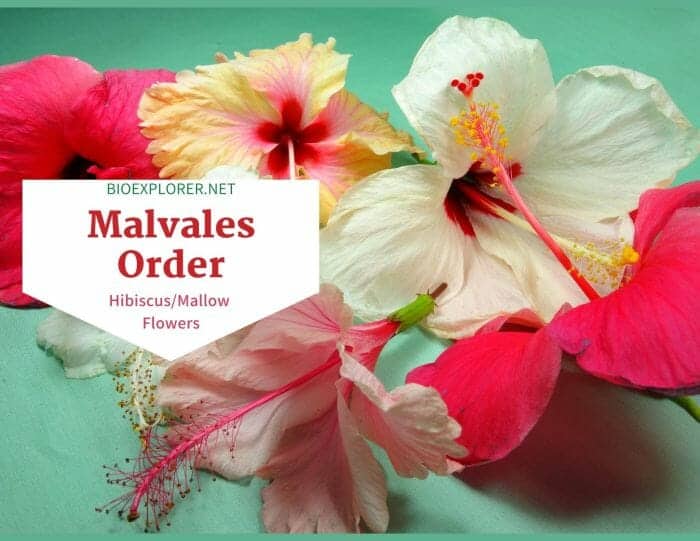
Malvales[1] is a medium-sized order, commonly called the Hibiscus or mallow order, mainly consisting of woody plants that feature showy five-petaled flowers with an epicalyx.
The members of this order are distributed across various habitats worldwide. In addition, several members hold economic importance as a source of natural fibers, food crops, and ornamentals.
The order comprises 10 families, 338 genera, and around 6,000 species.
Jump to:
Malvales Pronunciation

Malvales Distribution
- Malvaceae – Most species are distributed in tropical parts of the world. Still, a few plants grow in temperate regions as well.
- Cistaceae, also called the rock rose family, grow in temperate or warm temperate areas, particularly in the Mediterranean region.
- Muntingiaceae is a small family distributed in the Neotropics.
- Neuradaceae is a small family of annual herbs or rarely perennial. The species of this family grow in desert areas from Africa to India.
- Thymelaeaceae consists of trees, perennial herbs, or lianas that occur worldwide except rarely in icy areas. Thymelaeceae are particularly common in tropical Australia and Africa.
- Sphaerosepalaceae is a small family of deciduous trees that grow in Madagascar.
- Sarcolaenaceae is mainly comprised of evergreen trees only known to grow in Madagascar.
- Dipterocarpaceae flowers are usually evergreen trees that prefer humid lowland tropics but are most concentrated in West Malaysia.
- Cytinaceae is a small family that grows across Mexico to Costa Rico, northern Colombia, the Mediterranean, South Africa, and Madagascar.
- Bixaceae are native to tropical America. One species is widely cultivated in tropical places, including China.
Order Malvales Characteristics
Malvales are usually recognized by the following characteristics:
- Pulvinate, spiral leaves tend to have palmate venation or at least a pair of lateral veins that emerge from the very base of the blade.
- Stellate or fasciculate hairs and their derivatives are also common.
- Usually, the bark is tough and very fibrous due to the stratified phloem.
- Sometimes, the calyxWhat is calyx?A collective term for all the sepals of a flower; the lowermost whorl of floral orgrans (Plural form is calyces). is valvate, while the corollaWhat is corolla?A collective term referring to the petals of a flower. is usually contorted.
- Usually, numerous stamens are present.
- The capsule is muricate or spiny.
- The seeds or inner side of the carpel walls are conspicuously hairy sometimes.
Cistaceae are aromatic shrubs that tend to have the following characteristics:
- Opposite leaves are joined mainly by their broad bases.
- The inner three sepals are much larger than the two outer sepals.
- When the free petals are in a bud, they are crumpled.
- There are numerous stamens.
- The seed coat is mostly gelatinous.
- The endospermis starchy.
- The embryo is almost strongly curved.
Neuradaceae consist of small herbaceous or sub-woody plants that are native to warm areas of the Sahara-Indian desert. They tend to display the following characteristics:
- Small, toothed leaves that do not have stipules.
- White flowers with petals that dry a distinctive shade of purplish color.
- The petals are spreading.
- There are ten stamens and mostly 10 individual and erect styles.
- The fruits are spiny.
Thymelaeaceae have the following distinctive characteristics:
- A highly fibrous bark.
- Usually, entire and opposite leaves do not have stipules.
- The leaves usually have relatively close, parallel venation.
- When the leaves fall off, they leave behind prominent raised scars on the stem.
- The leaf’s indumentum has unicellular hairs and is mostly silky-adpressed.
- In several taxa, there are notably flexible twigs.
- The plants, some of which are very poisonous, usually have an unpleasant smell.
- The flowers are usually arranged in heads.
- A long hypanthium in most species.
- The petals and sepals are either equal in size, or the petals are smaller.
Sphaerosepalaceae are a small family that displays an excellent level of diversity.
Some common characteristics of this family include:
- Broad, intrapetiolar stipules that almost encircle the stem.
- The flowers are primarily 4-merous, and the sepals appear in decussating pairs.
- Single seeded carpels.
Cistaceae consist of aromatic shrubs that grow in broad, sunny areas, usually on a chalky or sandy substrate. They often exhibit the following characteristics:
- Opposite leaves that have broad, even connate bases.
- The inner three sepals are contorted at times, such that the aestivation is extremely quincuncial with two outer sepals that are much smaller than the others.
- Free petals that are crumpled when in the bud and contorted in a direction opposite the three large sepals.
- Numerous stamens are usually sensitive to touch.
Dipterocarpaceae are trees that can be recognized by the following characteristics:
- Usually, two-ranked, coriaceous leaves with strong, parallel secondary veins and scalariform tertiaries are pretty close.
- Often fasciculate or stellate hairs on the leaves.
- The petioles are geniculate.
- Usually, the inflorescences are notably monochasial.
- The small flowers are pointed in the bud and have a notably contorted corolla.
- Commonly the fruits are distinctive and usually have unequal, large sepals surrounding the single-seeded nuts. However, there are other fruit types too.
Cytinaceae are achlorophyllous parasites (that lack chlorophyll). They tend to have the following features:
- Inflorescences are racemose and sometimes capitate such that the individual flowers have a moderate size and can be easily noticed.
- Basally connate perianth that is more or less spreading and exists in a single whorl.
- Extrorse stamens (staminate flowers).
- The style is quite long and extends towards the apex (carpelate flowers).
Muntingiaceae can be recognized by the following characteristics:
- Toothed, two-ranked, leaf blades with asymmetric bases and heteromorphic prophylls similar to stipules.
- Their flowers appear in extra-axillary fascicles.
- Valvate calyx.
- Shortly clawed corolla that is crumpled in the bud.
- Numerous stamens.
Malvaceae are easily recognizable even when they are sterile based on the following features:
- A fibrous bark.
- Stipulate, alternate leaves with toothed margins, ± palmate venation, and indumentum stellate to lepidote.
- Mucilage is also a common trait.
- The flowers and fruits have a combination of characters that make them distinguishable:
- The flowers usually have a valvate, connate calyx with a nectary at the base inside.
- A contorted corolla.
- Usually, numerous stamens that are connate and/or fasciculate.
- The fruit’s inner wall and/or the seed’s surface are usually hairy.
Sarcolaenaceae tend to have the following characteristics:
- The flowers of these plants are distinctive in having a massive “involucre“, sometimes an enclosing bract and an extrastaminal disc.
- Sarcolaena‘s lamina has parallel lines on the underside.
- Stellate hairs.
The Bixaceae has plants that are distinctive in having the following set of characteristics:
- Fibrous bark.
- Canals carrying red or orange exudate.
- Branches that end at the inflorescence.
- Flowers are large and have anthers that spread pollen through terminal pores.
- Leaves with palmate venation, scale-like hairs, and stipules enclose the bud.
- The ovules are produced on the ovary’s walls.
- Spiny capsule.
- The seeds have a pulpy coat.
Example Species
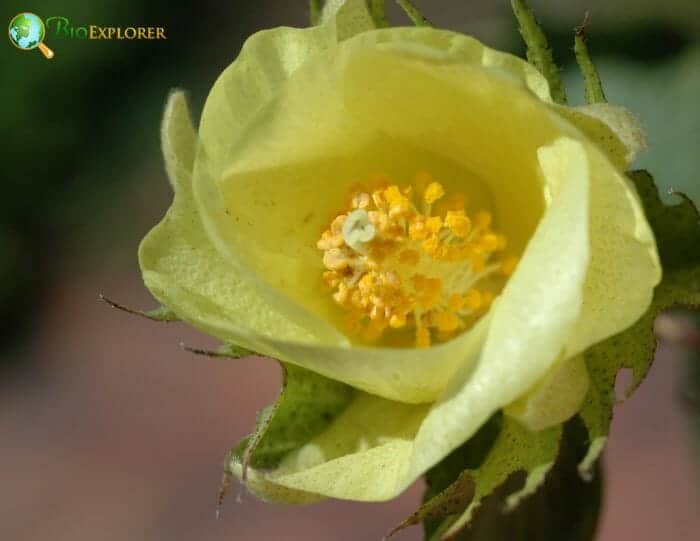
- Gossypium: Several species hold immense economic importance as it is a Cotton source produced commercially for the textiles industry.
- Edgeworthia, Daphne, and Gnidia: The bark of the plants is used to manufacture the highest quality paper and cordage.
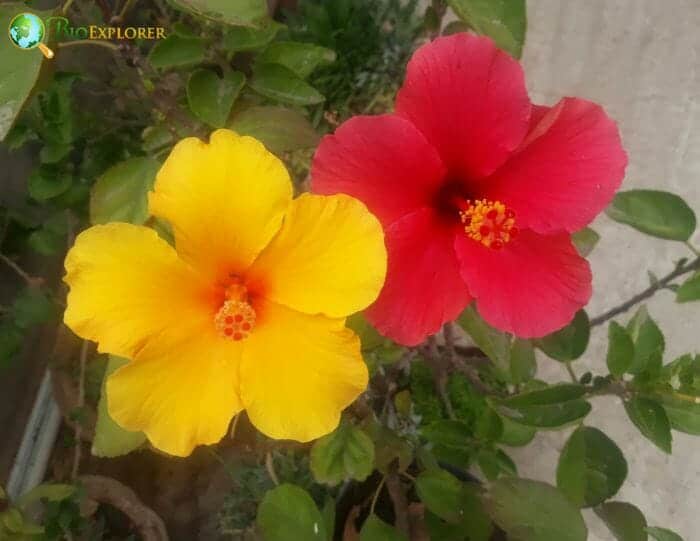
- Hibiscus rosa-sinensis commonly called Chinese Hibiscus, is grown as an ornamental for its large, almost bell-shaped blossoms. The cultivated varieties yield red, white, yellow, or orange flowers.
- Abelmoschus esculentus commonly called Okra- is used as a vegetable and a thickener in food preparation.
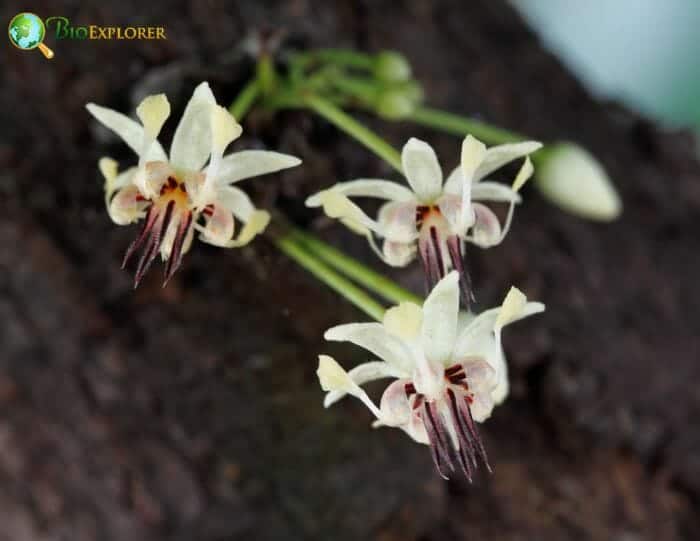
- Theobroma cacao: Also called cacao, is cultivated commercially. The plant’s seeds, called cocoa beans, are processed to produce cocoa butter, cocoa powder, and chocolate.
Cite this page
BioExplorer. (2026, August 26). Order Malvales / Hibiscus & Mallow Flowers. https://www.bioexplorer.net/order-malvales/