A Rare All-Yellow Parakeet Was Photographed in Brazil, a First for Its Species
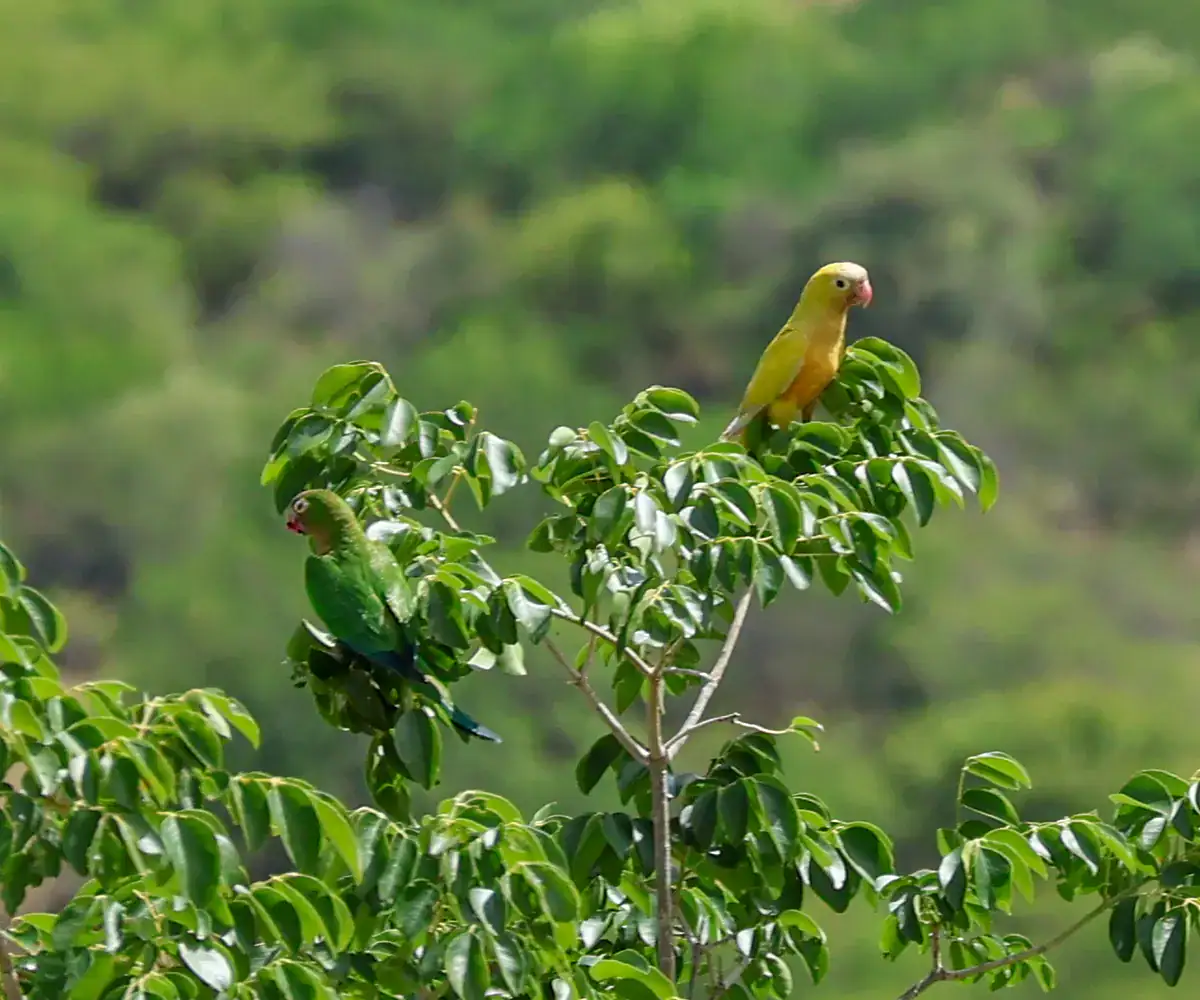
Flavism in birds is a rare color mutation, and wild parrots with it are seldom recorded. Cactus parakeets are usually olive green with an orange belly, but in February 2025, a biologist in northeastern Brazil photographed one that was almost entirely yellow. It is the first documented case of flavism in a wild cactus parakeet.
Rafael Salú Cavalcante made the sighting near Pico do Yayu, a rocky peak in Santa Luzia, Paraíba. He and six colleagues from the Federal University of Paraíba described the bird on October 23, 2026, in the journal Ornithology Research. Salú Cavalcante spoke with BioExplorer about the find.
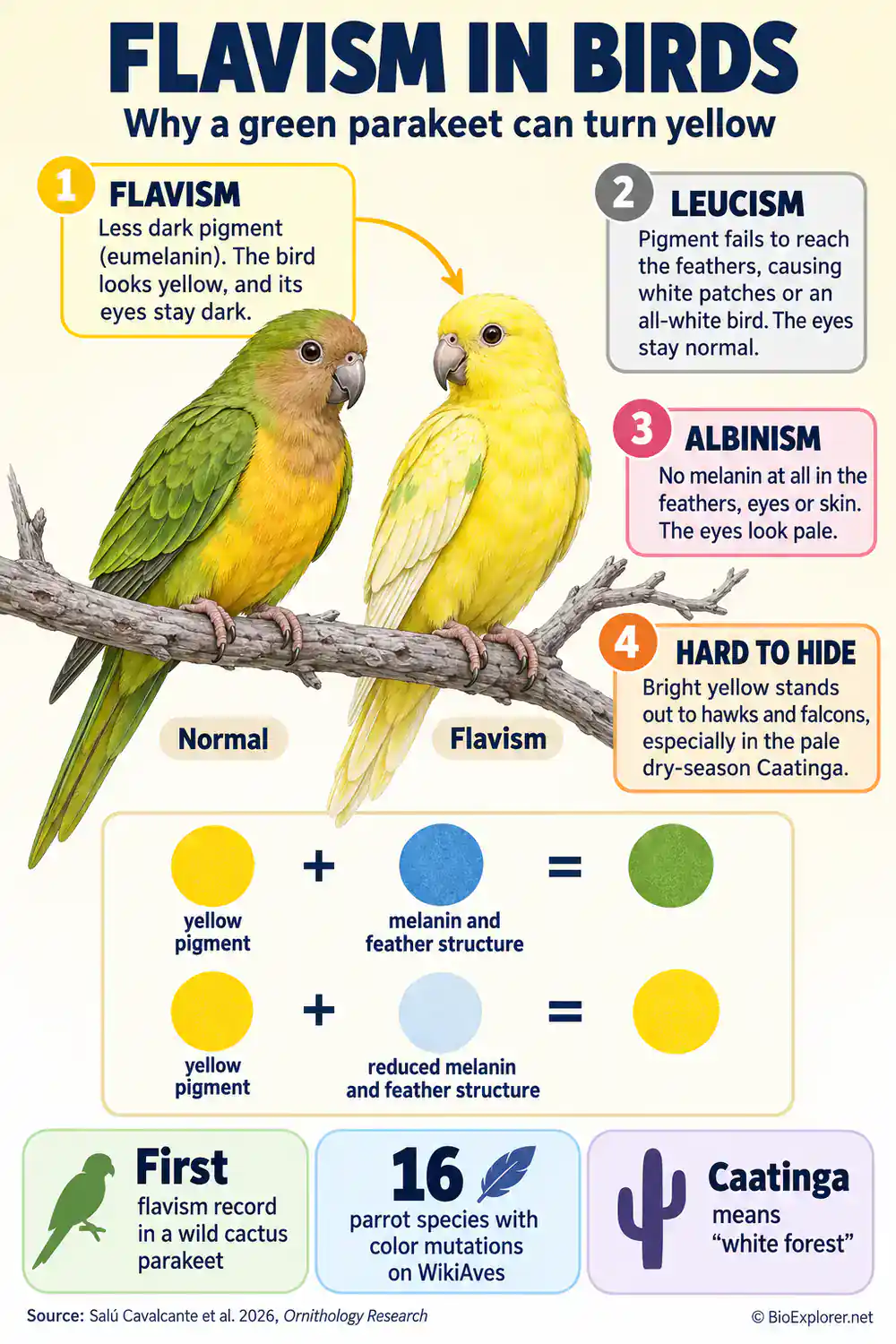
Flavism is a rare color mutation that reduces the dark pigment eumelanin in feathers. Affected birds look mostly yellow but keep some of their other pigments. Unlike albino birds, they still have normally dark eyes.
Flavism in Birds Guide:
A Yellow Surprise
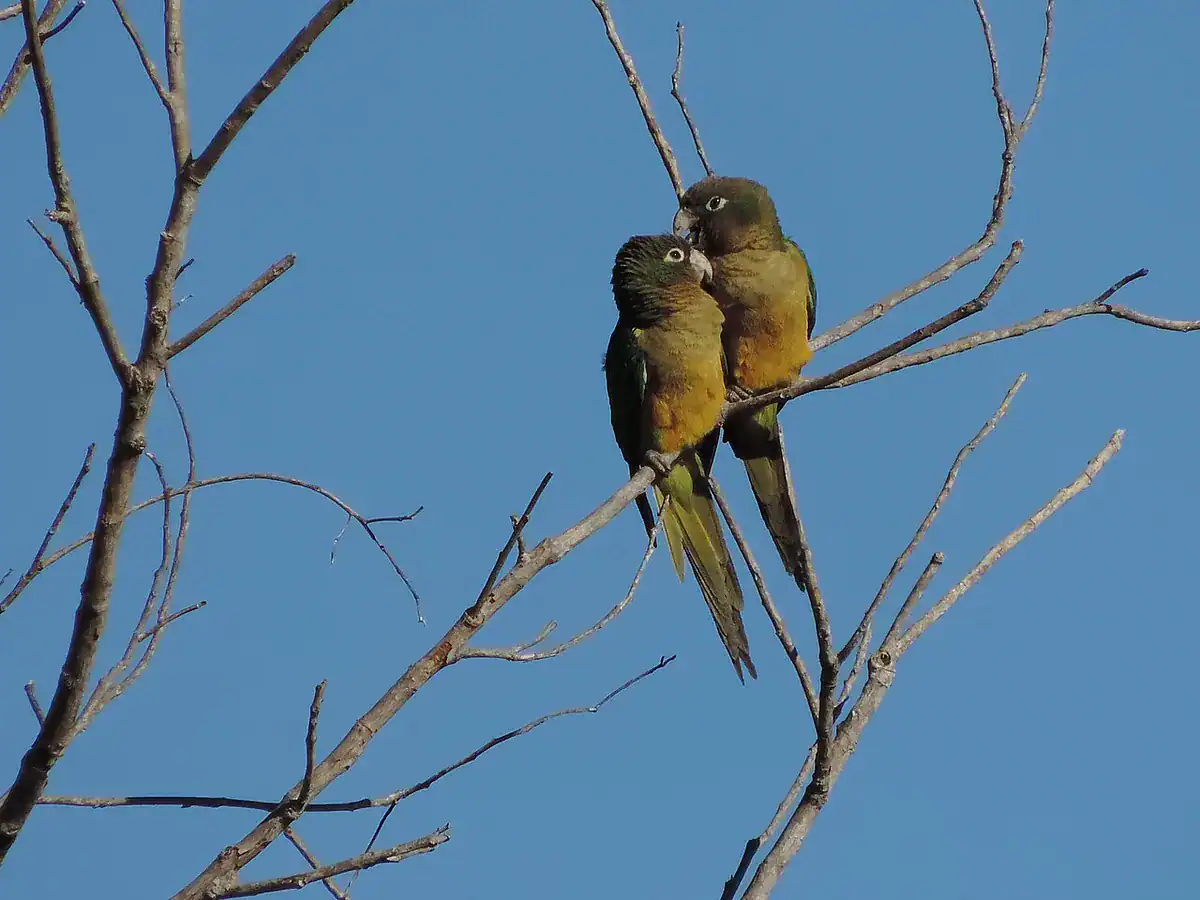
The cactus parakeet (Eupsittula cactorum) lives only in the Caatinga of northeastern Brazil. Salú Cavalcante had been hiking for about an hour and a half when he came across a small flock. He “immediately noticed an individual with striking, entirely yellow plumage,” he told BioExplorer.
According to the paper, six parakeets flew over the area twice at about 8 a.m. on February 27, 2025. Two of them, including the yellow bird, then landed in a pereiro tree about 3 meters tall. Salú Cavalcante took 16 photographs from roughly 15 meters away.
“Right after I finished documenting the bird and the flock took flight, I was deeply moved, knowing right away that I had witnessed an extraordinary chromatic mutation,” he said. The yellow parakeet’s wing and tail feathers had a whitish-yellow tone, with only small patches of green on its body.
Flavism, Not Albinism
Several conditions can alter a bird’s normal colors, and they are often confused. Some come from inherited genetic changes, while others may involve development or diet.
Albinism removes all melanin from the feathers, eyes and skin, as seen in rare albino crows. Leucism leaves the eyes normal but produces white patches, or an all-white bird, because pigment fails to reach the feathers.
Flavism is different. It reduces eumelanin, the pigment behind dark tones, but does not shut down melanin production completely. The bird keeps some of its other pigments, so it looks yellowish rather than white.
In the field, Salú Cavalcante first thought the parakeet might show either leucism or flavism. Later, he studied the high-resolution photographs on his computer. The bird “maintained normally pigmented dark eyes and did not display the complete white depigmentation characteristic of classic albinism or total leucism,” he explained.
The team identified the condition as flavism from the bird’s appearance in those photos. No feathers or DNA were collected, so the exact genetic cause in this parakeet has not been determined.
Why a Green Bird Turns Yellow
Parrots rank among the most colorful birds, partly because they make yellow and red pigments, called psittacofulvins, that no other birds have. A 2024 study in G3: Genes, Genomes, Genetics explains that a parrot’s green combines yellow pigment with blue structural color. That blue is not a pigment. It comes from light interacting with the feather’s fine structure and its melanin granules.
When melanin is reduced or missing, the blue component can weaken or disappear, leaving the yellow pigment more visible. That is why a green parrot with less melanin can look yellow.
Salú Cavalcante said the cactus parakeet kept its yellow pigment and showed faint, residual greenish reflections in parts of its feathers. That pattern points to melanin that was reduced but not gone.
Other parrots show related mutations. Lutinism removes melanin but leaves the yellow and red psittacofulvins untouched, producing a mostly yellow or reddish bird, unlike an all-white albino. Cyanism does the opposite, suppressing the psittacofulvins so that blue structural color dominates.
Life in the Flock
The yellow cactus parakeet did not seem to be treated differently by its flockmates. “The individual was fully integrated into the flock, vocalizing, foraging, and flying alongside the other parakeets with no apparent signs of rejection or social exclusion,” Salú Cavalcante said.
Predators may pose a greater risk. “The species’ typical olive-green and orange coloration provides critical camouflage against visual aerial predators such as hawks and falcons,” he explained. He said the brilliant yellow “completely compromises this crypsis,” the scientific term for blending in.
The White Forest
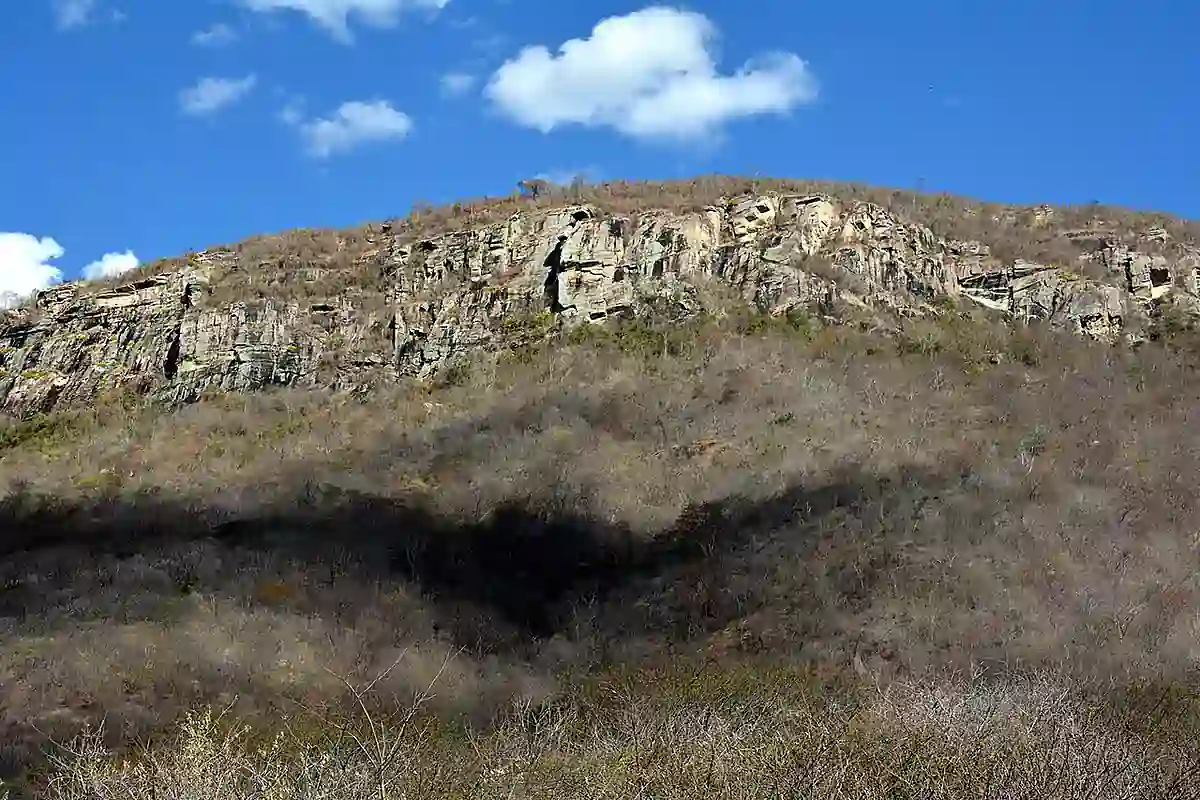
The cactus parakeet’s home makes the problem worse at certain times of year. Salú Cavalcante noted that the name Caatinga comes from the Tupi-Guarani language and means “white forest.” The name refers to the pale, bare landscape left when the trees drop their leaves in the dry season.
“Against this stark backdrop of whitish branches and dry vegetation, a bright yellow bird stands out prominently,” he said. In his view, this is why wild records of the mutation are so rare. “This lack of camouflage explains why wild records of this chromatic aberration are exceptionally scarce and why so few individuals likely survive long enough to reach reproductive maturity,” Salú Cavalcante said.
Help From Birdwatchers
The team also searched WikiAves, a Brazilian website where birdwatchers share their photos. They found 16 parrot species in Brazil with photographed color mutations, including flavism, lutinism, cyanism and leucism. None of the photos showed another unusual cactus parakeet.
One close relative stood out. The peach-fronted parakeet (Eupsittula aurea), from the same genus, had WikiAves photos showing both flavism and lutinism. The authors note that the WikiAves records of the other species had not appeared in the scientific literature before.
“Citizen science has established itself as one of the most powerful and transformative tools in contemporary ornithology,” Salú Cavalcante said. “In our study, WikiAves allowed us to compile and evaluate historical records of plumage aberrations across Brazilian psittacines at a macro-geographic scale, uncovering patterns that would remain hidden without this collective effort.”
A Changing Landscape
The cactus parakeet is listed as Least Concern on the IUCN Red List. Still, the paper notes growing pressure from habitat loss, farming and poaching for the illegal wildlife trade. The parakeets lay their eggs in tree cavities and in termite mounds built in trees, so losing trees hurts them directly.
Around Santa Luzia, wind farms, solar plants and mining have caused heavy habitat loss, especially on higher mountains. The authors raise the possibility that habitat fragmentation and inbreeding could make color mutations more common. However, they stress that any link between flavism and habitat change is speculative, because the record involves a single bird.
At a Glance
| Detail | What the paper reports |
|---|---|
| Species | Cactus parakeet (Eupsittula cactorum) |
| Color variation | Flavism, identified from photographs |
| Date and time | February 27, 2025, about 8 a.m. |
| Place | Near Pico do Yayu, Santa Luzia, Paraíba, Brazil |
| Flock | Six birds; the yellow bird perched with one flockmate |
| Photos | 16 photos from about 15 meters |
| WikiAves search | 16 parrot species with color mutations in Brazil |
| Red List status | Least Concern |
FAQs
Flavism in birds is a rare color mutation that reduces eumelanin, the pigment behind dark feather tones. Affected birds look mostly yellow or pale but keep some other pigments and normally dark eyes.
Albino birds lack melanin in their feathers, eyes and skin, so they have pale eyes. Leucistic birds have white patches, or are all white, but have normal eyes. Flavistic birds have reduced dark pigment and look yellowish, with normal eyes.
The yellow cactus parakeet was photographed near Pico do Yayu in Santa Luzia, Paraíba, in northeastern Brazil. It was seen on February 27, 2025, in a flock of six.
A green parrot’s color comes from yellow psittacofulvin pigment combined with blue structural color, which depends on feather structure and melanin. When melanin is reduced, the blue can fade and the parrot looks yellow.
Possibly. Biologist Rafael Salú Cavalcante says the normal olive green and orange of the cactus parakeet helps hide it from hawks and falcons, while bright yellow stands out against the pale dry-season Caatinga. No study has yet measured whether flavistic cactus parakeets face higher predation.
No. The cactus parakeet is listed as Least Concern on the IUCN Red List. Its population still faces pressure from habitat loss, farming and poaching for the illegal wildlife trade.
Cite this page
BioExplorer. (2026, October 27). A Rare All-Yellow Parakeet Was Photographed in Brazil, a First for Its Species. https://www.bioexplorer.net/flavism-in-birds.html/