
Theoretical Biology: Modeling Life’s Patterns
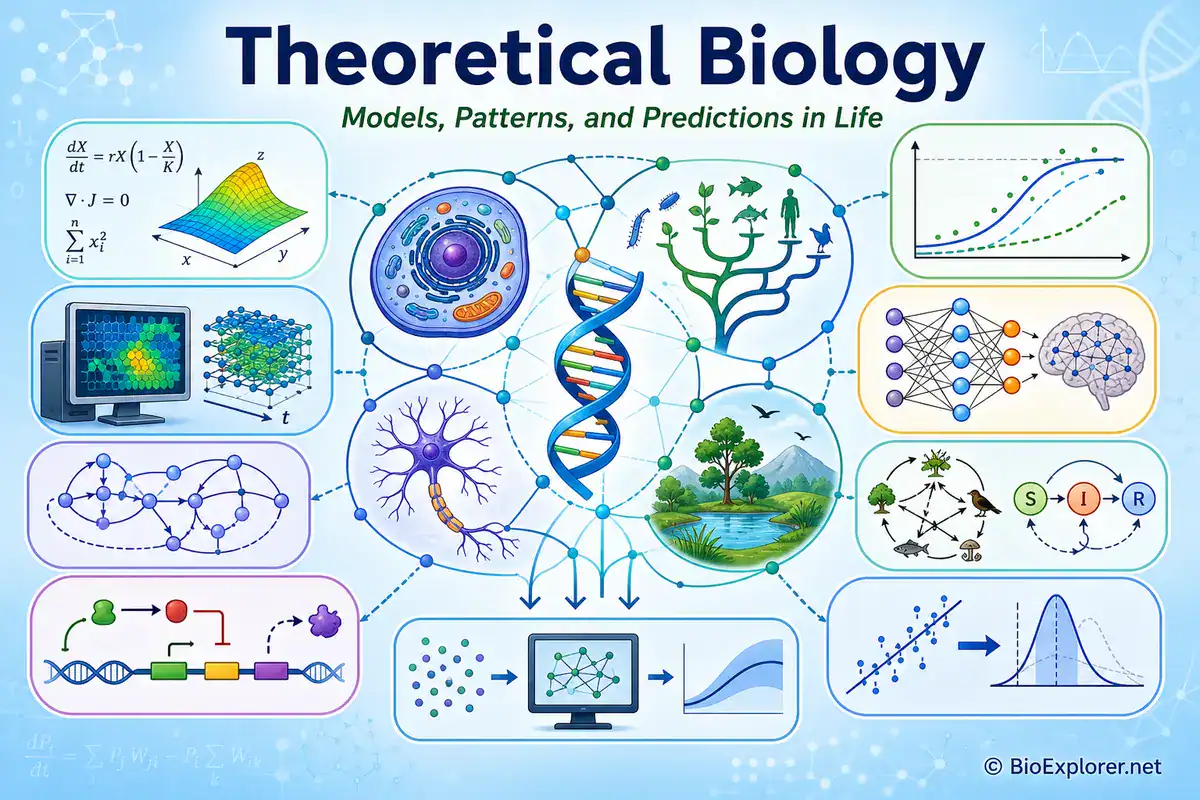
Theoretical biology is the branch of biology that uses ideas, mathematical models, computer simulations, logic, and systems thinking to understand how living systems work. Instead of only describing what organisms do, theoretical biology asks why biological patterns happen, how they can be explained, and what predictions can be tested with data or experiments.
Theoretical biology connects closely with evolutionary biology, ecology, genetics, molecular biology, cell biology, computational biology, systems biology, mathematical biology, medicine, neuroscience, and biotechnology. It helps scientists study complex biological systems that are difficult to understand through observation alone.
Theoretical Biology Guide:
- Theoretical Biology Definition and Meaning
- History of Theoretical Biology
- What Do Theoretical Biologists Study?
- Why Models Matter in Biology
- Major Branches of Theoretical Biology
- Mathematical Biology
- Computational Biology
- Systems Biology
- Evolutionary and Ecological Modeling
- Examples of Theoretical Biology in Real Life
- Theoretical Biology Techniques and Tools
- Why Is Theoretical Biology Important?
- Careers in Theoretical Biology
- Theoretical Biology vs Related Fields
- Related Biology Fields
- Recommended Theoretical Biology Resources
- Mathematical and Theoretical Biology
- Systems Biology and Modeling
- Computational and Mathematical Modeling
- Theoretical Biology FAQs
Theoretical Biology Definition and Meaning
Theoretical biology is the study of biological systems using theories, models, abstractions, mathematics, and computational methods. A theoretical biologist may build a model of population growth, disease spread, gene regulation, tumor growth, animal behavior, ecosystem stability, evolution, or cell signaling.
A simple theoretical biology definition is this: theoretical biology uses models and reasoning to explain biological patterns and predict how living systems may behave under different conditions.
Theoretical biology does not replace experimental biology. Good biological theory should connect with real observations, experiments, field data, or laboratory measurements. A model is useful only when it helps clarify a problem, generate testable predictions, compare possible explanations, or reveal hidden assumptions.
History of Theoretical Biology
Theoretical thinking has always been part of biology. Early naturalists proposed broad explanations for development, inheritance, classification, adaptation, and the relationships between organisms and their environments. Over time, biology became more quantitative as scientists began using mathematics to study growth, heredity, populations, epidemics, and evolution.
In the twentieth century, theoretical biology grew through population genetics, evolutionary theory, mathematical ecology, systems theory, cybernetics, biophysics, developmental models, and early computational biology. Models helped scientists understand natural selection, genetic drift, predator-prey cycles, disease spread, enzyme kinetics, neural activity, and pattern formation.
Today, theoretical biology is stronger than ever because modern biology produces enormous amounts of data. Genomics, proteomics, imaging, ecology, neuroscience, and medicine all generate complex datasets that often require mathematical and computational models to interpret.
What Do Theoretical Biologists Study?
Theoretical biologists study the rules, patterns, and mechanisms that may explain living systems. They often work with experimental scientists to turn biological questions into models that can be tested, refined, or rejected.
- Evolution: How natural selection, mutation, migration, recombination, and genetic drift shape populations.
- Ecology: How species interact, compete, cooperate, spread, decline, or coexist in ecosystems.
- Genetics: How genes, alleles, inheritance, mutation, and gene networks influence traits.
- Cell biology: How cells divide, communicate, organize, move, and respond to signals.
- Development: How organisms grow from embryos and form patterns, tissues, and body plans.
- Neuroscience: How neurons, circuits, feedback, and networks generate behavior and perception.
- Disease: How infections, tumors, immune responses, and treatments change over time.
- Systems biology: How many interacting parts produce behavior at the level of cells, tissues, organisms, or populations.
Why Models Matter in Biology
A biological model is a simplified representation of a real living system. Models can be verbal, visual, mathematical, statistical, computational, or mechanical. Their job is not to capture every detail. Their job is to make a complex problem easier to understand and test.
For example, a model of an epidemic may include susceptible, infected, and recovered individuals. It will not include every detail of human behavior, immune history, geography, and viral genetics. Even so, it may help scientists estimate how fast an infection could spread or how interventions might change the outcome.
| Model Type | What It Does | Example in Biology |
|---|---|---|
| Conceptual Model | Explains a system using ideas, diagrams, or relationships. | A diagram showing how predators, prey, and food supply interact. |
| Mathematical Model | Uses equations to describe biological change or relationships. | Population growth, enzyme kinetics, or disease transmission models. |
| Computational Model | Uses computer simulations to explore complex systems. | A simulation of tumor growth, neural networks, or ecosystem change. |
| Statistical Model | Uses data to estimate patterns, uncertainty, and relationships. | Predicting species distribution from climate and habitat data. |
| Network Model | Represents biological parts as nodes and interactions as links. | Gene regulatory networks, food webs, protein interaction networks. |
Major Branches of Theoretical Biology
Theoretical biology is not one narrow subject. It includes several overlapping areas that use models, logic, mathematics, computation, and systems thinking to study life.
| Branch | What It Studies | Example Topics |
|---|---|---|
| Mathematical Biology | Uses equations and mathematical reasoning to study biological systems. | Population models, epidemic models, enzyme kinetics, evolution, pattern formation. |
| Computational Biology | Uses algorithms, simulations, data analysis, and computing to study biology. | Genomics, protein modeling, biological networks, machine learning, simulations. |
| Systems Biology | Studies how interacting parts produce behavior in whole biological systems. | Gene networks, signaling pathways, metabolism, cell states, disease systems. |
| Theoretical Ecology | Uses models to study ecosystems, populations, communities, and species interactions. | Predator-prey cycles, competition, food webs, biodiversity, ecosystem stability. |
| Theoretical Evolutionary Biology | Uses models to study evolution and genetic change over time. | Natural selection, genetic drift, mutation, adaptation, speciation, game theory. |
| Theoretical Developmental Biology | Studies how organisms form patterns, tissues, and body plans. | Morphogenesis, gene regulation, gradients, cell differentiation, pattern formation. |
| Biophysical Modeling | Applies physical and mathematical principles to living systems. | Membranes, protein folding, diffusion, molecular motors, neural signaling. |
Mathematical Biology
Mathematical biology uses mathematics to describe, analyze, and predict biological behavior. It is one of the most important foundations of theoretical biology.
Mathematical models can help scientists understand how populations grow, how infections spread, how genes change in populations, how animals compete, how cells regulate signals, and how biological rhythms emerge.
- Population models: Estimate how populations grow, shrink, or stabilize.
- Predator-prey models: Study how predators and prey affect one another over time.
- Epidemic models: Study how infectious diseases spread through populations.
- Evolutionary models: Study how gene frequencies and traits change across generations.
- Pattern formation models: Study how repeated biological patterns may form during development.
Computational Biology
Computational biology uses computer science, statistics, data analysis, algorithms, and simulations to study biological systems. It is especially important when biological data are too large or complex to analyze manually.
Computational biology can help researchers compare genomes, model protein structures, simulate cell behavior, analyze brain activity, predict species ranges, study disease progression, or identify patterns in medical data.
Theoretical biology and computational biology often work together. A theoretical idea may become a mathematical model, and that model may then be tested through computer simulation or compared with real data.
Systems Biology
Systems biology studies biological systems as interacting wholes. Instead of looking only at one gene, one protein, or one pathway, systems biology asks how many parts work together to create behavior at the level of a cell, tissue, organ, organism, or population.
This matters because living systems often show emergent behavior. Emergent behavior means the whole system does something that cannot be understood by studying each part in isolation. Examples include immune responses, brain activity, development, metabolism, and ecosystem dynamics.
Systems biology often uses networks, simulations, feedback loops, high-throughput data, and repeated cycles of modeling and experimentation.
Evolutionary and Ecological Modeling
Evolution and ecology are two of the strongest areas for theoretical biology because they involve change over time, complex interactions, uncertainty, and large-scale patterns.
In evolutionary biology, models help scientists study natural selection, adaptation, genetic drift, mutation, migration, kin selection, sexual selection, and speciation. These models can show why some traits spread while others disappear.
In ecology, models help scientists study population growth, food webs, biodiversity, invasive species, habitat loss, climate change, and ecosystem stability. They can help test how a change in one species or environmental factor may affect the wider ecosystem.
Examples of Theoretical Biology in Real Life
Theoretical biology may sound abstract, but it affects many practical areas of science and medicine.
- Disease spread: Models can estimate how infections move through populations and how control measures may reduce transmission.
- Cancer research: Models can explore tumor growth, treatment resistance, immune response, and cancer evolution.
- Drug development: Models can help predict how biological pathways respond to drug targets.
- Conservation biology: Models can estimate extinction risk, habitat needs, and population recovery.
- Climate change biology: Models can predict how species ranges and ecosystems may shift as conditions change.
- Neuroscience: Models can help explain neural activity, learning, memory, and network behavior.
- Developmental biology: Models can explain how patterns form in embryos, tissues, and organs.
- Genomics: Models can help interpret large genetic datasets and gene regulatory networks.
Theoretical Biology Techniques and Tools
Theoretical biologists use different tools depending on the biological problem. Some tools are mathematical, some are computational, and some are statistical.
| Tool or Method | What It Does | Example Use |
|---|---|---|
| Differential Equations | Describe how biological systems change over time. | Population growth, epidemics, chemical reactions, cell signaling. |
| Agent-Based Models | Simulate many individual agents following simple rules. | Animal movement, disease spread, cell behavior, social insects. |
| Network Analysis | Studies connections among biological parts. | Gene networks, protein interactions, food webs, neural circuits. |
| Game Theory | Studies strategic interactions among individuals or genes. | Cooperation, competition, mating behavior, conflict, social evolution. |
| Statistical Modeling | Finds patterns and estimates uncertainty in biological data. | Species distribution, clinical risk, gene expression, population trends. |
| Machine Learning | Uses algorithms to detect patterns or make predictions from data. | Protein prediction, image analysis, genomics, disease classification. |
| Simulation | Tests how a model behaves under different conditions. | Climate effects, ecosystem changes, cancer growth, viral spread. |
Why Is Theoretical Biology Important?
Theoretical biology is important because living systems are complex. A cell, organism, ecosystem, or disease process may contain many interacting parts. Without models, scientists may see the details but miss the larger pattern.
Theoretical biology helps scientists organize knowledge, test assumptions, compare explanations, make predictions, and design better experiments. It can reveal which variables matter most, which outcomes are likely, and which hypotheses deserve more testing.
It is especially valuable when experiments are expensive, slow, unethical, impossible, or too complex to interpret directly. For example, researchers cannot easily test every possible ecological collapse, cancer mutation, epidemic pathway, or evolutionary scenario in the real world. Models help explore those possibilities carefully.
Careers in Theoretical Biology
Theoretical biology can lead to careers in academia, medicine, biotechnology, pharmaceuticals, public health, conservation, environmental science, data science, artificial intelligence, and computational research.
- Theoretical biologist: Builds models and theories to explain biological systems.
- Mathematical biologist: Uses mathematical tools to study biological processes.
- Computational biologist: Uses computation, algorithms, and data analysis to study biology.
- Systems biologist: Studies how interacting biological parts produce system-level behavior.
- Bioinformatics scientist: Analyzes biological data such as DNA, RNA, protein, or pathway data.
- Evolutionary modeler: Studies how traits, genes, and populations change over time.
- Ecological modeler: Studies populations, ecosystems, biodiversity, and environmental change.
- Disease modeler: Studies infection spread, treatment effects, or disease dynamics.
- Quantitative biologist: Applies mathematics, statistics, and computation to biological questions.
- Research data scientist: Uses models and large datasets to solve biological or medical problems.
Theoretical Biology vs Related Fields
Theoretical biology overlaps with several fields, but each has a different emphasis.
| Field | Main Focus | How It Connects to Theoretical Biology |
|---|---|---|
| Theoretical Biology | Uses models, concepts, mathematics, and reasoning to explain biological systems. | Provides broad frameworks for understanding life. |
| Mathematical Biology | Uses equations and mathematical analysis in biology. | Provides many of the formal tools used in theoretical biology. |
| Computational Biology | Uses computers, algorithms, simulations, and large datasets. | Tests and applies models using data and computation. |
| Systems Biology | Studies how interacting parts create system-level behavior. | Uses theoretical and computational models to study complex biological networks. |
| Experimental Biology | Uses experiments and observations to test biological ideas. | Provides the data needed to build, test, and refine theories. |
Related Biology Fields
Theoretical biology is closely connected to evolutionary biology, because models help explain natural selection, genetic drift, adaptation, and speciation. It also connects with ecology, because ecosystems, food webs, populations, and biodiversity often require mathematical and computational models.
It overlaps with genetics and molecular biology through gene networks, population genetics, genome analysis, and molecular systems. It connects with cell biology and developmental biology through models of cell signaling, cell division, tissue growth, and pattern formation.
Theoretical biology also supports neuroscience, biotechnology, microbiology, and biochemistry by helping scientists model networks, pathways, microbes, proteins, and biological systems.
Recommended Theoretical Biology Resources
These external resources can help readers explore mathematical biology, computational biology, systems biology, modeling, and complex biological systems in more detail.
Mathematical and Theoretical Biology
- Society for Mathematical Biology
A major professional society supporting education, research, and information sharing in mathematical and computational biology. - Bulletin of Mathematical Biology
A research journal covering mathematical approaches to biological questions. - eLife: Theory, Models and Biology
A useful article on the role of theoretical ideas and mathematical models in biology.
Systems Biology and Modeling
- NIH: Systems Biology as Defined by NIH
A clear explanation of systems biology as a way to understand the larger biological picture. - NIH Intramural Research Program: Systems Biology
An overview of systems biology as a research approach for understanding health and disease. - NCBI Bookshelf: Systems Biology Introduction
A reference introduction to biological systems, self-organization, energy, and information.
Computational and Mathematical Modeling
- The Mathematical Modeling Process in Biosciences
A peer-reviewed discussion of how biological problems can be formalized and analyzed through models. - Computational Models in Systems Biology
A peer-reviewed resource on dynamic computational models, reproducibility, and standards in systems biology. - Perspectives on Computational Modeling of Biological Systems
A peer-reviewed overview of computational models used to simulate biological processes and generate testable hypotheses.
Theoretical Biology FAQs
Theoretical biology is the branch of biology that uses models, mathematics, computation, and reasoning to explain biological systems and make testable predictions.
A theoretical biologist studies biological patterns, models, evolution, ecology, genetics, cell behavior, development, disease dynamics, systems biology, and complex biological systems.
No. Mathematical biology is a major part of theoretical biology, but theoretical biology also includes conceptual models, computational models, systems thinking, and biological theory.
Models are important because they simplify complex biological systems, test assumptions, compare explanations, make predictions, and help scientists design better experiments.
An example of theoretical biology is using a mathematical model to predict how an infection spreads, how a population grows, or how natural selection changes gene frequencies.
Theoretical biology builds models and explanations, while experimental biology collects evidence through experiments and observations. Strong biological research often uses both.
Computational biology often overlaps with theoretical biology because computer simulations and algorithms can test models, analyze complex data, and predict biological behavior.
Related careers include theoretical biologist, mathematical biologist, computational biologist, systems biologist, bioinformatics scientist, ecological modeler, evolutionary modeler, and disease modeler.
Cite this page
BioExplorer. (2026, July 27). Theoretical Biology: Modeling Life’s Patterns. https://www.bioexplorer.net/divisions_of_biology/theoretical_biology/