
Variegated Spider Monkey
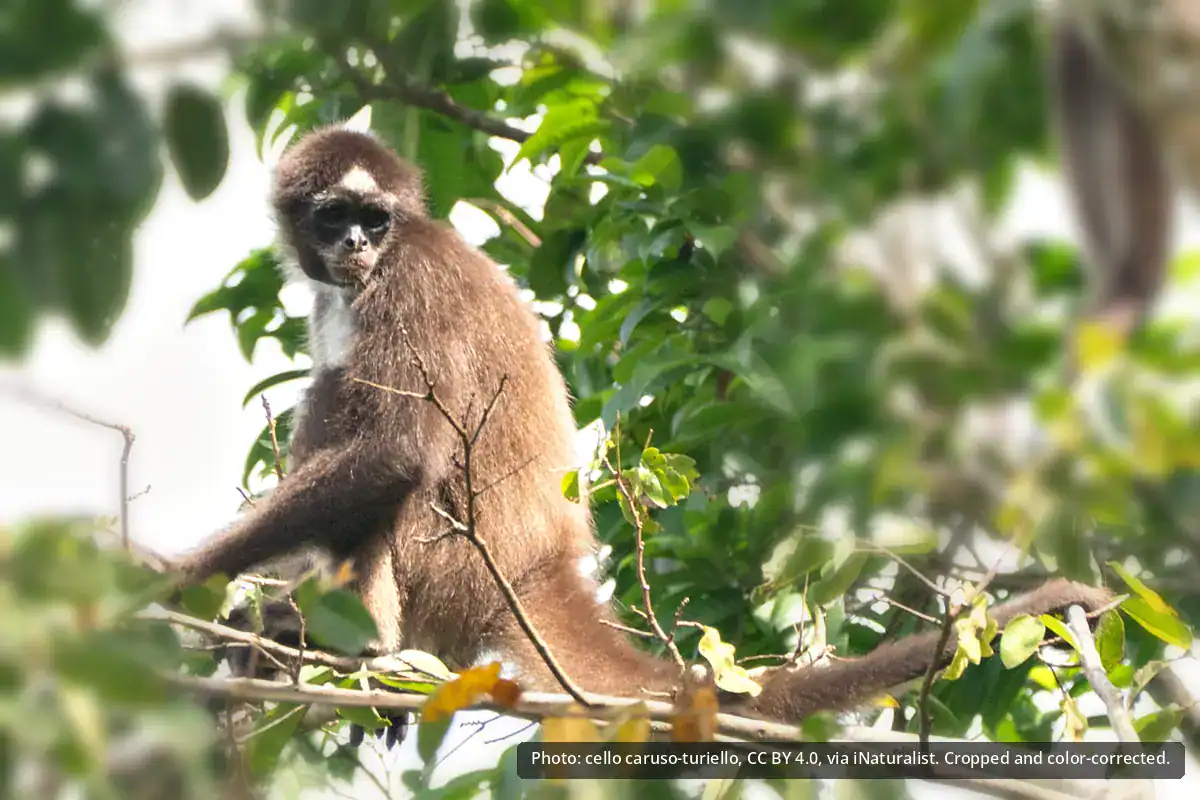
The variegated spider monkey lives only in northern Colombia and northern Venezuela. It is also called the brown spider monkey. This long-limbed primate wears a white triangle on its forehead. The IUCN Red List classes it as Critically Endangered.[1] Its assessors project a decline of 80% or more over 45 years. Heavy hunting and forest loss drive that decline.
This Critically Endangered spider monkey lives only in Colombia and Venezuela.
- Common NamesVariegated Spider Monkey, Brown Spider Monkey, Mono Araña Café
- Taxonomy Classification Year1828
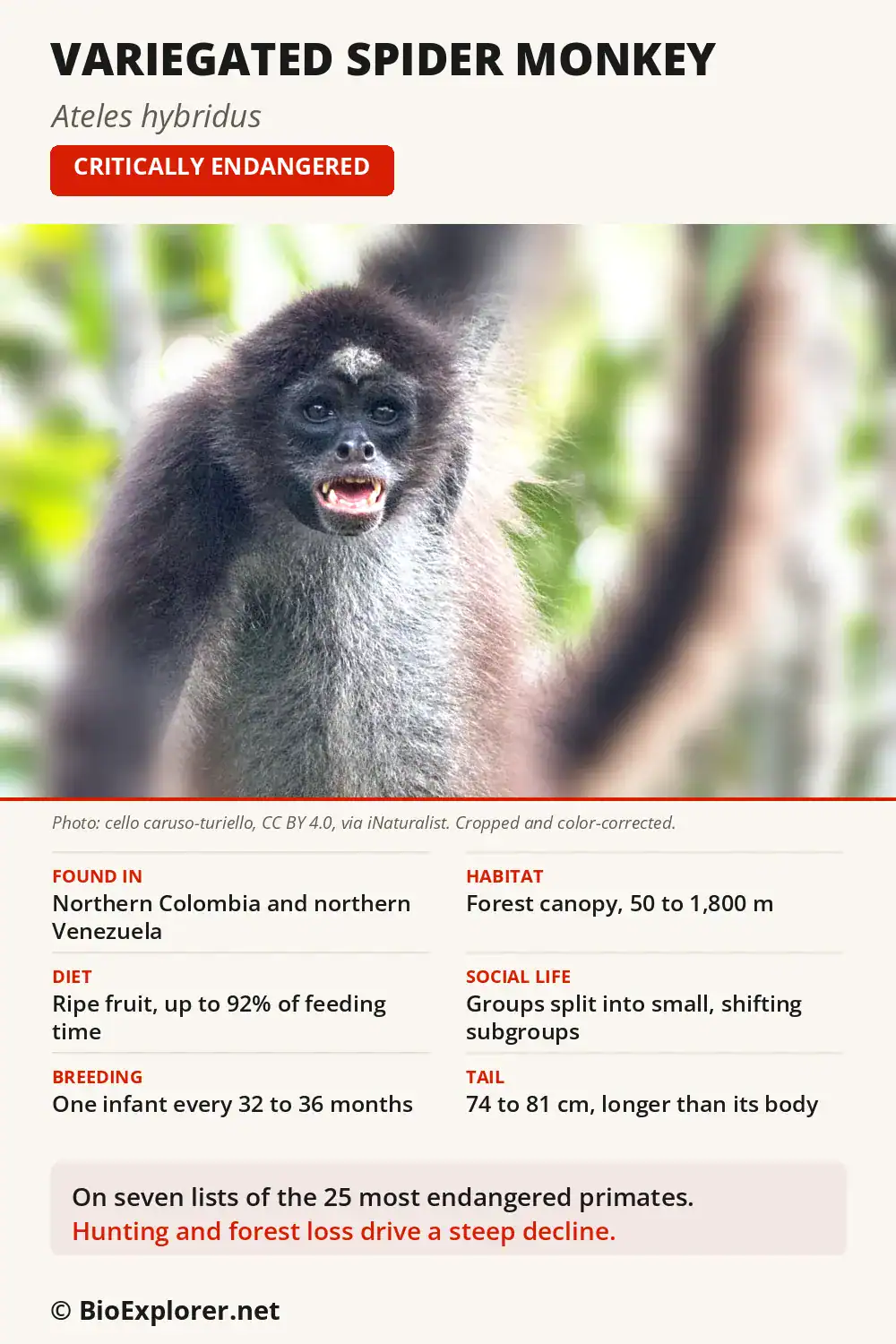
- Monkey SizeHead and body 45 to 50 cm (18 to 20 in); tail 74 to 81 cm (29 to 32 in); recorded adults about 6.5 to 10.5 kg
- Skin Color(s)Pale wood-brown back; darker brown head; whitish or buff underside and inner limbs; white forehead triangle
- HabitatEvergreen, semi-deciduous, riparian and montane tropical forest, mainly in the upper canopy
- DietFrugivorous (mainly ripe fruit; also young leaves, flowers, seeds and decaying wood)
- Native CountriesColombia, Venezuela
- Ripe fruit filled 92% of feeding time in one Colombian forest.
- Females give birth only about once every three years.
- Less than 20% of its historical Colombian range remains forested.
- Groups in one 65 ha fragment used only about 30 ha each.
- It has appeared on seven Primates in Peril lists.
Variegated Spider Monkey Distribution
 )
 )
Variegated Spider Monkey Guide:
Names and Taxonomy
Isidore Geoffroy Saint-Hilaire described this monkey as Ateles hybridus.[2] The Mammal Diversity Database dates his description to 1828. The Red List and other sources give 1829. Its other English name is the brown spider monkey. In Spanish it is called mono araña café.
It belongs to Ateles, the genus of the spider monkeys. Like its relatives, it is one of the New World monkeys. For decades it counted as a form of the white-bellied spider monkey. Genetic work in 1999 supported full species status.[3] The Red List dates their split to about 3 million years ago.
Two forms were once named, hybridus and brunneus. The Magdalena River was thought to divide them. A 2015 genetic study found strong gene flow across the river.[4] Current authorities recognize no subspecies. Older accounts still split it in two.
Its relatives include the black spider monkey. Another is the Peruvian spider monkey. The genus also holds the white-cheeked spider monkey. Another relative is the black-headed spider monkey. Geoffroy's spider monkey completes the group.
Physical Appearance
This is a large, long-tailed monkey. Males measure 47 to 50 cm from head to rump.[5] Females measure 45 to 48 cm. The tail is longer than the body. In males it reaches 76 to 81 cm. In females it reaches 74 to 76 cm. Seven museum females weighed 7.5 to 10.5 kg. Two males weighed about 7.9 to 8.6 kg. Field data from three males gave 6.5 to 8.5 kg. Recorded adults weighed about 6.5 to 10.5 kg.
The back is pale wood-brown, and the head is darker brown. The underside is whitish or buff. That pale color runs along the inner limbs and under the tail. A distinct white triangle marks the forehead. Some individuals have grayish-blue eyes. Its coat places it among the brown monkeys.
A young Venezuelan female had a black face and small black ears.[6] She also had whitish whiskers. Each hand carried only a tiny, nailless thumb. Like other atelids, it has a long, strong, prehensile tail.
Range and Habitat
In Colombia it lives in the middle Magdalena River basin. It also occurs in the Serranía de Perijá. Others live on the southern slopes of Sierra Nevada de Santa Marta. In Venezuela it ranges along both sides of the Andes. A separate population survives in Guatopo National Park. The Red List records it from 50 to 1,800 m. Most Colombian populations live in lowland forest below 1,000 m.
It uses evergreen, semi-deciduous, riparian and montane tropical forests. It counts among the rainforest monkeys of northern South America. It spends most of its time high in the canopy. It sometimes uses the middle and lower levels. It is rarely seen in the understory.
At El Paujil reserve, researchers estimated densities in two forest types.[7] Undisturbed forest held about 29 monkeys per km². Logged forest held about 38 per km². They detected none in young secondary forest or flood plains.
Diet and Feeding
Ripe, fleshy fruit makes up about 80% of a spider monkey's diet. At Las Quinchas, ripe fruit filled 92% of feeding time.[8] The monkeys used at least 123 plant species. That fruit habit makes it one of the true frugivorous monkeys.
When fruit runs short, it eats young leaves and flowers. It also takes immature seeds, floral buds, aerial roots and decaying wood. Small fragments change the menu. In one fragment, leaves made up 37% of feeding time.[9]
Groups also visit mineral licks to eat soil.[10] At Las Quinchas, visits came almost only on dry days.
Spider monkeys swallow many seeds and pass them whole. That makes them important seed dispersers for canopy trees and lianas.
Social Life
Spider monkey groups hold about 30 animals. They range from 15 to 60. Members are rarely all together. They travel, feed and rest in small, shifting subgroups. Scientists call this fission-fusion social life.
One study followed two groups in a small forest fragment.[11] One group held 14 to 16 animals. The other held 10 to 14. Subgroups averaged about five adults in one group. They averaged about three in the other. Each group used roughly 30 ha of the 65 ha fragment. Spider monkeys in continuous forest usually range far wider.
Males in one fragment attacked the infants of other species.[12] Most targets were infants of the red howler monkey. One was a young capuchin.
Four primate species share these central Colombian forests.[13] One is the varied white-fronted capuchin. Another is the gray-handed night monkey. The red howler is the fourth. Serranía de San Lucas also holds the silvery brown bare-face tamarin.
Breeding and Life Cycle
Female spider monkeys leave their birth group at about six years old. They reach sexual maturity at about eight or nine. Gestation lasts 226 to 232 days. A mother bears a single infant. Births come 32 to 36 months apart on average.
No birth season is known for this species. Newborns have been seen in August in the Magdalena Valley. The Red List gives a generation length of 15 years. Late maturity and slow breeding make losses hard to replace.
Conservation Status
The Red List has rated it Critically Endangered since 2003. It was Endangered in 2000. The 2020 assessment lists it under criterion A4cd. It projects a fall of at least 80% over three generations. Forest loss of 20 to 30% drives part of that decline. The assessors add that heavy hunting may matter even more. Hunters take it for meat and for the pet trade.
It appeared on six consecutive lists from 2004 through 2014.[14] Primates in Peril names the world's 25 most endangered primates. It returned for the 2023 to 2025 list.[15] CITES lists the species on Appendix II.
Threats and Pressures
In Colombia, less than 20% of its historical range remains forested. Many forest fragments are too small to hold viable groups. Large forests survive only in a few ranges. These include San Lucas, Perijá, Catatumbo and Las Quinchas. Even there, people hunt it for food and medicine. Hunting can drive whole local populations extinct.
In Venezuela, habitat loss appears to be the greatest threat. Cattle ranching has cleared much of Zulia's lowland forest. Logging presses on the San Camilo and Ticoporo forests. Some central Venezuelan sites showed no monkeys when resurveyed.
A 2015 account found under 1% of its Colombian habitat protected. Most wild populations live outside protected areas.
Protection and Recovery
Colombian parks with records include Catatumbo-Barí and Selva de Florencia. Little is known about the size of those protected populations. In Venezuela, Guatopo and Sierra de Perijá national parks hold populations. Guatopo also protects a key water supply for Caracas.
In central Colombia, WCS and partners have planted 6.2 km of corridors.[16] The corridors connect about 1,300 ha of forest. WCS reported estimated occupancy rising from 0.15 to 0.65. That covers 2015 to 2020, with margins of 0.09 and 0.13. WCS credits the program's combined conservation actions. These include conservation agreements, corridors and moving lone animals into groups.
European zoos have run a breeding program since 2000.[17] About 70 animals there descend from 16 founders. The program keeps 92% of the founders' gene diversity.
It is listed among the monkeys starting with V. Compare it with other types of monkeys in our full guide.
Common Questions
It lives only in northern Colombia and northern Venezuela. Most groups live in lowland and foothill forest.
It eats mostly ripe fruit. One Colombian group spent 92% of feeding time on fruit. It adds young leaves, flowers, seeds and decaying wood.
Forest loss and heavy hunting threaten it. Its assessors project a decline of at least 80% over 45 years.
Its head and body measure 45 to 50 cm. Its tail is longer, at 74 to 81 cm. Recorded adults weighed about 6.5 to 10.5 kg.
Females usually have one infant every 32 to 36 months. Gestation lasts about 226 to 232 days.
Yes. Both names refer to Ateles hybridus. Its Spanish name is mono araña café.
Cite this page
BioExplorer. (2026, November 2). Variegated Spider Monkey. https://www.bioexplorer.net/animals/mammals/monkeys/variegated-spider-monkey/
About the author

Wildlife Writer and Photographer, BioExplorer.net
Arjun is a science writer and wildlife photographer at BioExplorer.net. He turns new research on animals into clear, accurate reads for curious readers. His work covers animal behavior, ecology, and newly described species. He holds a Cornell Lab of Ornithology certificate in bird biology. He is pursuing an HBSc at the University of Toronto Mississauga.