
Spider Monkeys
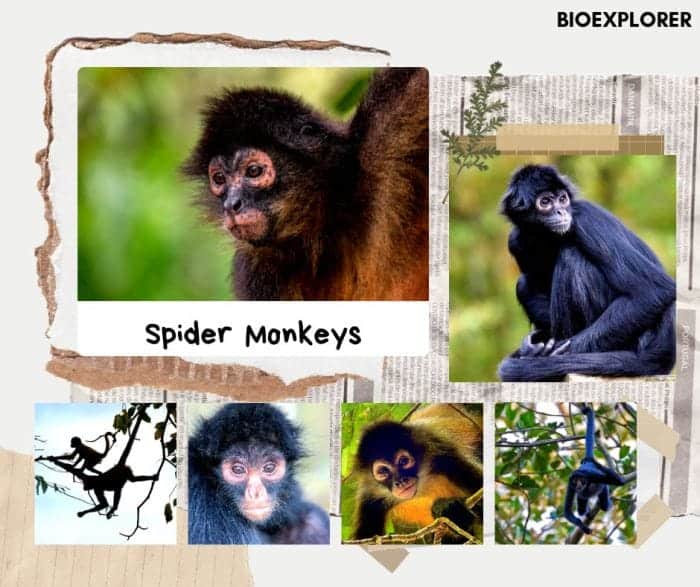
Known for their spindly limbs and long prehensile tails, spider monkeys make up the Ateles genus of New World primates. These acrobatic monkeys inhabit tropical forests from southern Mexico down to Bolivia, adeptly swinging through high rainforest canopies.
Researchers have identified 7 species of spider monkeys thus far, with the Geoffroy’s spider monkey (Ateles geoffroyi) being the most widespread in Central America and having 5 distinct subspecies.
Spider monkeys get their name from their stretched-out arms, mobile shoulders and dangling tail that give them a distinctive spidery look while brachiating through the forest. Though mainly fruit eaters, they are omnivores also feasting on leaves, flowers, nuts, seeds, buds and even occasional insects using their hook-like fingers.
Spider monkey groups exhibit fluid fission-fusion social dynamics, breaking into small sub-groups during daily foraging then recombining at night for grooming and sleeping huddled together. While males stay with their natal group, females leave to join new communities after reaching maturity.
The World Wildlife Fund[1] classifies spider monkeys as endangered due to extensive tropical deforestation throughout their home ranges in South and Central America. But they play pivotal forest regeneration roles via seed dispersal while foraging. Conserving spider monkeys ensures healthy rainforest ecosystems.
Spider Monkeys
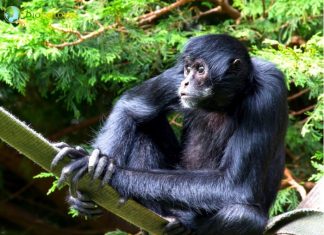
Black Spider Monkey

Black-Headed Spider Monkey

Geoffroy’s Spider Monkey
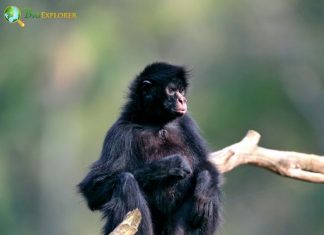
Peruvian Spider Monkey

Variegated Spider Monkey

White-bellied Spider Monkey

White-cheeked Spider Monkey
Spider Monkeys By Taxonomists
| Black spider monkey | Ateles paniscus | 1758 | Linnaeus |
| White-bellied spider monkey | Ateles belzebuth | 1806 | É. Geoffroy Saint-Hilaire |
| White-cheeked Spider Monkey | Ateles marginatus | 1809 | É. Geoffroy Saint-Hilaire |
| Peruvian spider monkey | Ateles chamek | 1812 | Humboldt |
| Central American Spider Monkey | Ateles geoffroyi | 1820 | Kuhl |
| Variegated Spider Monkey | Ateles hybridus | 1829 | I. Geoffroy Saint-Hilaire |
| Black-headed spider monkey | Ateles fusciceps | 1866 | Gray |

What Do Spider Monkeys Eat?
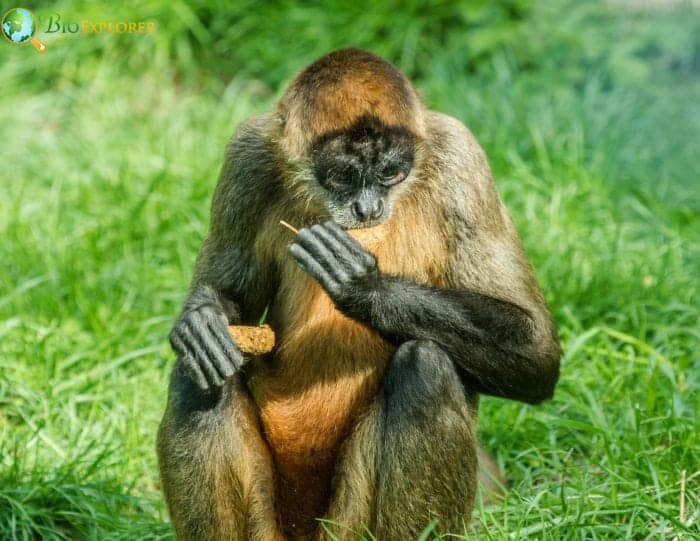
Spider monkeys primarily eat ripe fruit from rainforest trees, supplemented by young leaves, seeds, flowers and flower buds. Favored fruits include figs, mangos, guavas and papayas. Spider monkeys utilize their hooked fingers and long tails to reach out and grab fruits on distant terminal branches.
Since ripe fruit is patchy, spider monkeys must traverse large home ranges searching for food. This constant brachiating keeps them fit. When fruits are scarce, they fall back on leaves, seeds and occasional insects to supplement nutrition.
An interesting fact about spider monkeys is that they rarely descend to the rainforest floor, doing almost everything high up in trees including sleeping, travelling, socializing, breeding and eating. Their arboreal nature offers safety from ground predators.
Unique Adaptations
Spider monkeys possess several key adaptations that aid fruit foraging in their canopy niche:
- Prehensile tails act as fifth limbs for grabbing branches.
- Flexible shoulder joints allow extensive arm rotation.
- Hook-like fingers to grasp and pick fruits.
- Highly dexterous hands peel fruits.
- Large molars crush seeds, stems and peelings.
- Fusion-fission groups cover more feeding terrain.
Their nimble limbs and quick reflexes enable spider monkeys to exploit diverse rainforest food sources. But it comes at an enormous energetic cost, driving their conservation needs.
What Eats Spider Monkeys?

Despite their large size and social bands, spider monkeys fall prey to several rainforest predators, mainly large cats like jaguars and pumas that can climb up and snatch them from trees. Other predators include:
- Harpy eagles and crest eagles
- Boas and anacondas by constricting limbs
- Ocelots and margays that stealthily stalk family bands
- Tayras who raid sleeping sites on lower branches
However, the greatest threat remains habitat destruction by humans clearing forests for farms and development, leaving little safety cover for the endangered monkeys to hide or feed.
Maintaining large forest tracts ensures thriving spider monkey populations that developed exquisite evolutionary fruit foraging adaptations over millennia of rainforest existence.
Cite this page
Bio Explorer. (2026, March 21). Spider Monkeys. https://www.bioexplorer.net/animals/mammals/monkeys/spider/