
Shock-headed Capuchin
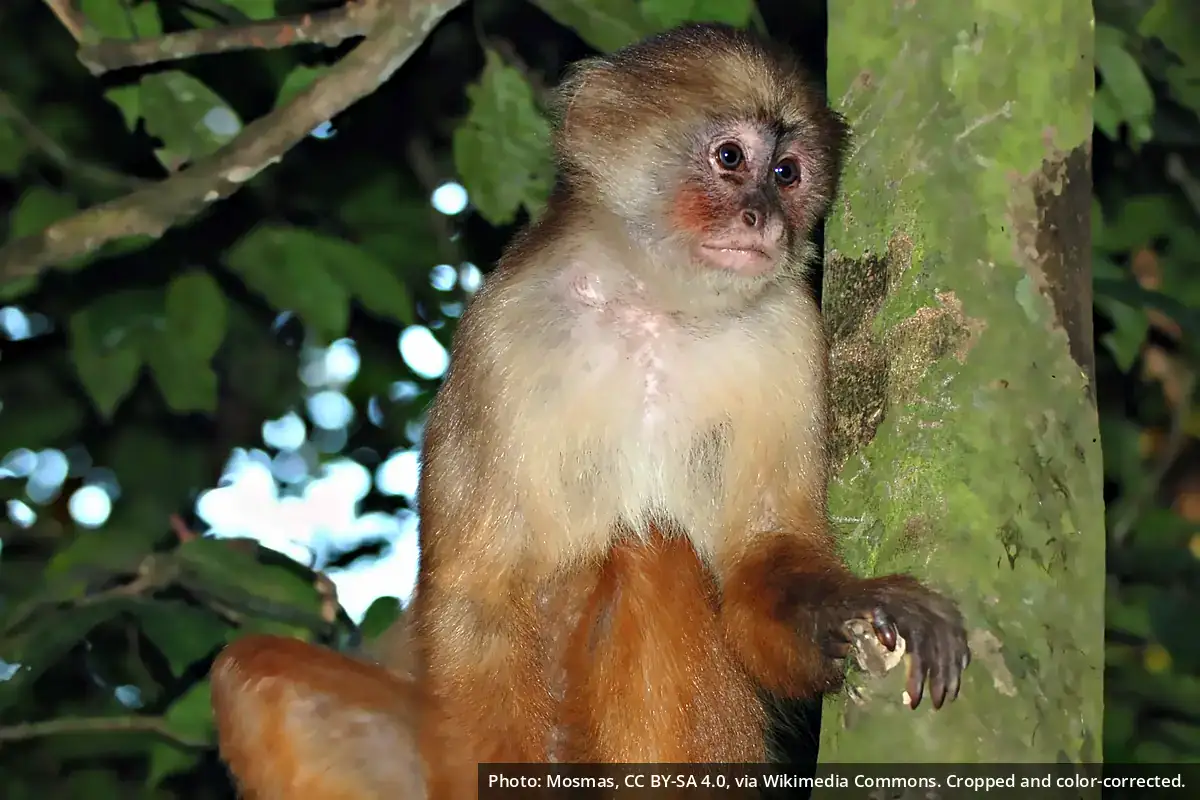
The shock-headed capuchin is a slender capuchin of the southwestern Amazon. Its scientific name is Cebus cuscinus. It lives in southeastern Peru and northwestern Bolivia. It is one of the New World monkeys. The IUCN lists it as Near Threatened.[1]
This Near Threatened capuchin lives in southeastern Peru and northwestern Bolivia.
- Common NamesShock-headed capuchin, sapajou ébouriffé, capuchino pálido
- Taxonomy Classification Year1901
- Monkey Size39 to 46 cm (15.4 to 18.1 in), head and body
- Skin Color(s)Tawny-ocher coat, large dark brown cap, whitish shoulder fronts
- HabitatLowland terra firme and flooded forest, and montane forest to 1,800 m
- DietFruit, insects, figs and beetle-damaged palm nuts
- Native CountriesPeru and Bolivia; possibly Brazil (Acre)
- Oldfield Thomas named it in 1901 from a Peruvian specimen.
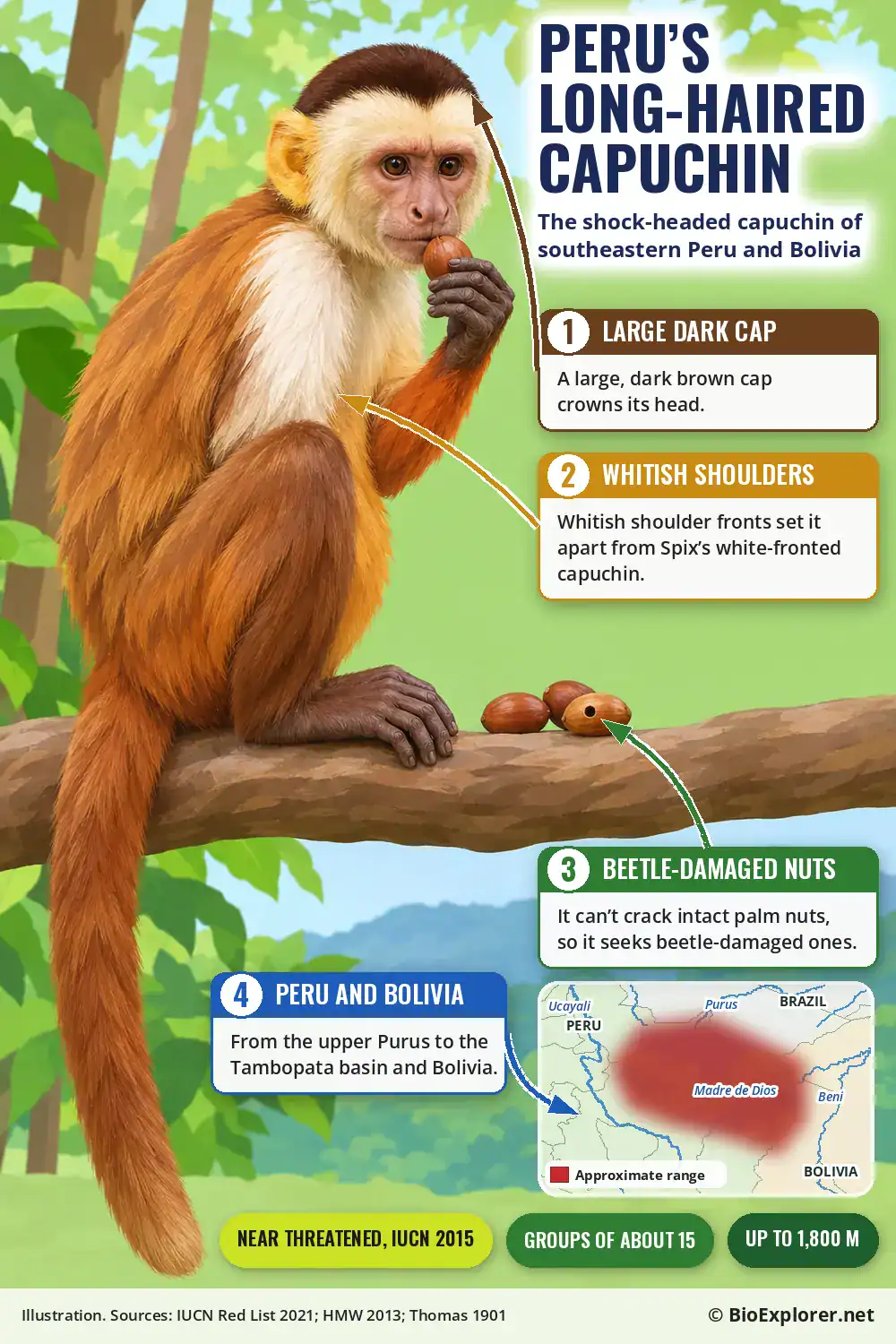
- Its large, dark brown cap sets it apart.
- It cannot crack intact palm nuts, so it seeks beetle-damaged ones.
- It often travels with black-capped squirrel monkeys.
- Hunting and forest loss are driving its decline.
Shock-headed Capuchin Distribution
 )
 )
Shock-headed Capuchin Guide:
Name and Classification
Oldfield Thomas described it in 1901 as Cebus flavescens cuscinus.[2] He ranked it as a subspecies, not a species. His type was an old female from Callanga, Cuzco, Peru. It came from 1,500 m and was collected in 1898. Otto Garlepp collected it. Thomas set it apart by its large brown crown patch.
Thomas also noted its unusually long facial fur. It is longer than in most capuchins, he wrote. Its fur is longer and silkier than in Spix's white-fronted capuchin.[3]
For most of the 20th century, it sat inside Cebus albifrons. In 2005, Mammal Species of the World listed it as C. albifrons cuscinus.[4] That work also folded the Marañón form, yuracus, into it.
In 2012, a DNA study proposed splitting the white-fronted capuchins.[5] Jean Boubli and colleagues called the southwestern forms poorly defined. These are yuracus, cuscinus and unicolor. Their study did not sample cuscinus at all. A 2010 study had sequenced two specimens. They grouped with different white-fronted lineages.
The handbook and the IUCN now treat it as a full species. The IUCN still calls its true relations unclear. It may be distinct, or it may belong with yuracus. It may even group with albifrons or unicolor.
The Mammal Diversity Database takes a broader view.[6] It folds cuscinus into Humboldt's white capuchin, C. albifrons. A 2018 genetic study also urged caution.[7] It advised keeping the four traditional untufted species for now.
Physical Description
The handbook calls it less brightly colored than Spix's white-fronted capuchin. Its back is tawny-ocher toward the shoulders and tawny further back. Its limbs are browner and blend into the back.
The cap is large, distinct and dark brown. Thomas measured it at about 5 cm across. The dark cap and brownish limbs place it among the brown monkeys.
The sexes differ in head pattern. Males have a broad pale forehead that sets off the cap. Females have a dark brown brow band joined to the cap.
The fronts of the shoulders and inner upper arms are whitish. The forearms are orange-rufous on the outside. The underparts are ocher-orange and silvery, with a buff chest.
Thomas described the ears as covered in shiny yellowish hair. The tail is cinnamon-brown above and brown below. It turns a little paler toward the tip.
Sources differ on the hands and feet. Thomas found whitish fingers and toes on his old female. The handbook gives dark hands and brown to auburn feet.
Size and Weight
Males measure about 40 cm (15.7 in) in head and body. Females measure 39 to 46 cm (15.4 to 18.1 in). The tail is about 44 cm (17.3 in) in males. In females it runs 39 to 47.5 cm (15.4 to 18.7 in).
The handbook gives a weight of 2.8 to 3 kg. That is 6.2 to 6.6 lb. It does not split the weight by sex. It also gives no sample size for these figures.
Similar Species Compared
Two close relatives live to the north and east. The IUCN and the handbook treat both as full species. The MDD still folds both into Cebus albifrons.
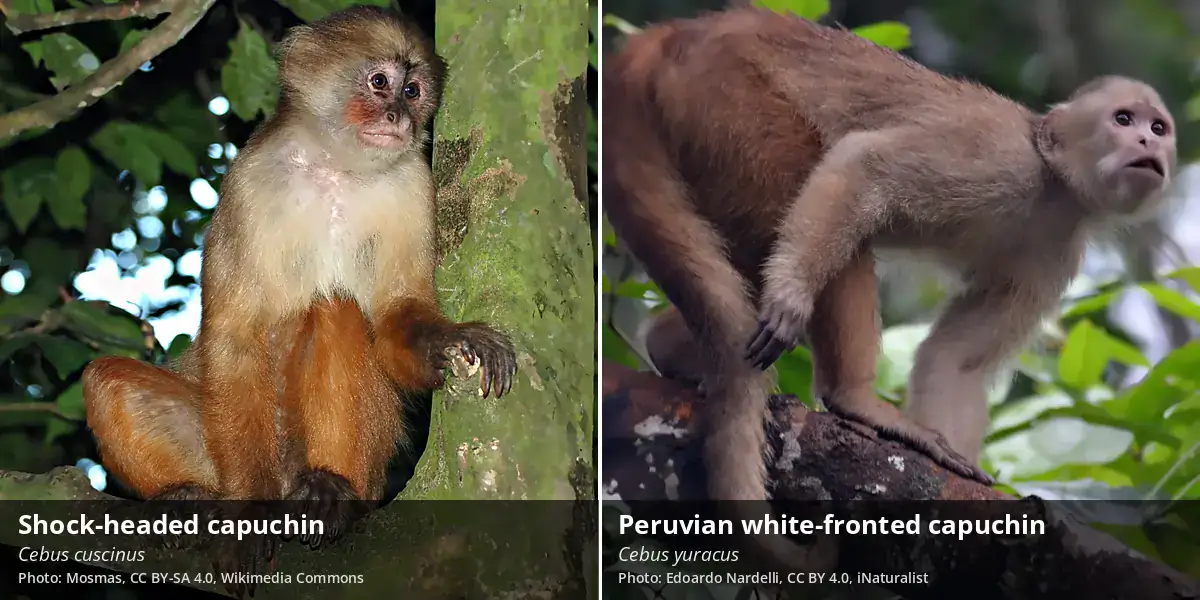
The Peruvian white-fronted capuchin lives north of the Amazon.[8] Its range lies west of the Ucayali. Its forehead, face sides, chest and outer arms are gray. Its cap is dark to very dark brown. The shock-headed capuchin lacks that gray, with orange-rufous forearms instead. The IUCN lists the Peruvian form as Near Threatened.[9]
The Spix's white-fronted capuchin lives south of the Amazon.[10] Its range reaches west to the Ucayali in Peru. It is a brighter ocher, with reddish limbs and tail. It has no white on the front of its shoulders. The IUCN lists it as Vulnerable.[11] Where their ranges meet is not known.
| Trait | Shock-headed capuchin | Peruvian white-fronted capuchin | Spix's white-fronted capuchin |
|---|---|---|---|
| Scientific name | Cebus cuscinus | Cebus yuracus | Cebus unicolor |
| Range | Southeast Peru and northwest Bolivia, perhaps Acre | South Colombia, east Ecuador, northeast Peru | Brazil south of the Solimões, east Peru, presumably north Bolivia |
| Habitat | Lowland to montane forest, up to 1,800 m | Lowland to montane forest, up to 2,000 m | Lowland terra firme and flooded forest, savanna forest patches |
| Coat and key marks | Long silky tawny coat, large dark cap, whitish shoulders | Ocherous brown, gray front, dark to very dark brown cap | Bright ocher, reddish limbs, near-black cap, no white on shoulders |
| Head and body | Males 40 cm, females 39 to 46 cm | Males 43 cm, females 37 cm | 36.5 to 37.5 cm, sex not given |
| Tail | Males 44 cm, females 39 to 47.5 cm | Males 47 cm, females 45 cm | 42 to 46 cm, sex not given |
| Weight | 2.8 to 3 kg, sex not given | 2.4 to 7 kg, as printed | Not known |
| Diet | Mainly fruit and insects, figs and palm nuts | Fruit, flowers, seeds, arthropods, eggs, small vertebrates | Fruit, palm fruit pulp, invertebrates |
| Group size | Mean about 15, Manu | 5 to 35, Ecuador | 12 to 16, one site |
| IUCN status | Near Threatened (assessed 2015) | Near Threatened (assessed 2015) | Vulnerable (assessed 2020) |
Range and Distribution
Its range is poorly known, the handbook says. It starts on the south bank of Peru's upper Rio Purus. It runs west into the Río Urubamba Valley in Cuzco. It takes in the upper Río Madre de Dios. To the south and east, it reaches the Tambopata basin.
From there, it extends into northwestern Bolivia. It may also reach Acre State in Brazil. No confirmed Acre record appears in the sources used here. The handbook calls its supposed range relatively small.
It ranks among the Peruvian monkeys and the Bolivian monkeys. The handbook calls its whole range hypothetical.
Habitat Needs
It lives in lowland terra firme and seasonally flooded forest. It also climbs into montane forest on the Andean slopes. The handbook and the IUCN give a ceiling of 1,800 m. Thomas's type came from 1,500 m.
These forests make it one of the types of rainforest monkeys. It uses the middle to upper canopy. Now and then it forages on the ground.
Diet and Behavior
Most of what is known comes from Manu National Park, Peru. There, early studies recorded it as C. albifrons. Fruit and insects form most of its diet. That mix files it among the omnivorous monkeys.
In the wet season, fruit is 99% of its plant food. In the dry season, that share drops to 53%. Palm seeds then matter more. In the early dry season, palm fruit took 56% of feeding time. Figs took another 41%.
It cannot crack whole Astrocaryum palm nuts. The large-headed capuchin can. So this monkey hunts for nuts that beetles have already attacked. It sniffs and shakes them, then bangs them on a branch. Then it scrapes out the kernel. Some days this takes over two hours, for less reward.
Its prey is mostly ants and wasps, grasshoppers and crickets, and moths. It searches leaf litter, leaves and liana tangles. Two Manu studies put ants at 21% and 35% of prey.[12] It also bites or breaks open closed hiding places.
A year at Manu broke down like this. Insect foraging took 39% of the day and plant feeding 22%. Travel took 21% and rest 12%.
Groups mix males and females, averaging about 15 animals. Home ranges top 150 ha. A group travels 1.5 to 2.2 km a day. It has no core area. Groups usually move apart when another comes within 100 m.
The handbook says males stay in their birth group. They form coalitions to defend it. The IUCN, citing capuchin studies, says males disperse. Two males can push a single large-headed capuchin male off food. It often travels with the black-capped squirrel monkey. The two species split up to sleep and rejoin each morning.
Harpy eagles, other large raptors, cats, tayras and snakes prey on it. Adult males mob ground predators with silent threat displays.
Lower Urubamba surveys found white-fronted capuchin groups of 6 to 13.[13] Eight other primates shared those forests. They included the emperor tamarin and black-headed night monkey. The Peruvian spider monkey lived there too. So did a tufted capuchin. The MDD folds that form into the Guianan brown capuchin, Sapajus apella.
Little is known of its breeding. Receptive females solicit males, and not only the top male. The handbook gives no gestation or birth season data.
Population and Status
The IUCN assessed it on 26 January 2015. It listed it as Near Threatened, almost Vulnerable under A3cd. The assessment was amended and republished in 2021. It projects a decline of 25% or more from 2019 to 2066. That 48-year span equals three generations. The trend is decreasing.
The IUCN gives no population estimate. On the lower Urubamba, white-fronted capuchins were estimated at 11.3 per km².
Peru's 2014 national threatened list includes no capuchin.[14] So it has no national threat category in Peru.
Major Threats
The IUCN names hunting as the main threat. Forest loss and fragmentation add to it. Forest loss is speeding up across its range.
At current rates, Acre could lose over 30% of its forest. That span is 48 years. Cusco and Madre de Dios could lose about 15%. La Paz and Pando in Bolivia could lose about 10%.
Live capture is a third threat. Cebus capuchins made up 18% of primates in illegal trade. That figure covers Peru from 2000 to 2014. They also made up 33% of primates in illegal zoos and circuses.
Development and settlement have cleared forest in parts of its range. Hunting has followed, the handbook adds.
Conservation Efforts
It is listed on CITES Appendix II. It occurs in Manu National Park and Biosphere Reserve in Peru. In Bolivia, the IUCN lists Madidi National Park and Manuripi-Heath National Reserve. Experts know it from only a handful of protected areas.
Natural canopy bridges may help it cross cleared strips. On the lower Urubamba, cameras watched branches over a gas pipeline clearing.[15] White-fronted capuchins crossed on them many times.
Its taxonomy remains the biggest open question. Only two of its specimens have been sequenced so far.
Explore more monkeys starting with S. Or browse all types of monkeys.
Common Questions
The shock-headed capuchin lives in southeastern Peru and northwestern Bolivia. It may also reach Acre State in Brazil.
The IUCN lists the shock-headed capuchin as Near Threatened, not Endangered. It projects a decline of at least 25% by 2066.
The shock-headed capuchin has a long, silky, tawny coat. It has a large dark brown cap and whitish shoulder fronts.
A male shock-headed capuchin measures about 40 cm in head and body. The handbook gives a weight of 2.8 to 3 kg.
The shock-headed capuchin eats mainly fruit and insects. In the dry season, it relies on figs and beetle-damaged palm nuts.
The IUCN treats the shock-headed capuchin as a full species. The Mammal Diversity Database places it under Cebus albifrons.
Cite this page
BioExplorer. (2026, November 14). Shock-headed Capuchin. https://www.bioexplorer.net/animals/mammals/monkeys/shock-headed-capuchin/
About the author

Wildlife Writer and Photographer, BioExplorer.net
Arjun is a science writer and wildlife photographer at BioExplorer.net. He turns new research on animals into clear, accurate reads for curious readers. His work covers animal behavior, ecology, and newly described species. He holds a Cornell Lab of Ornithology certificate in bird biology. He is pursuing an HBSc at the University of Toronto Mississauga.