
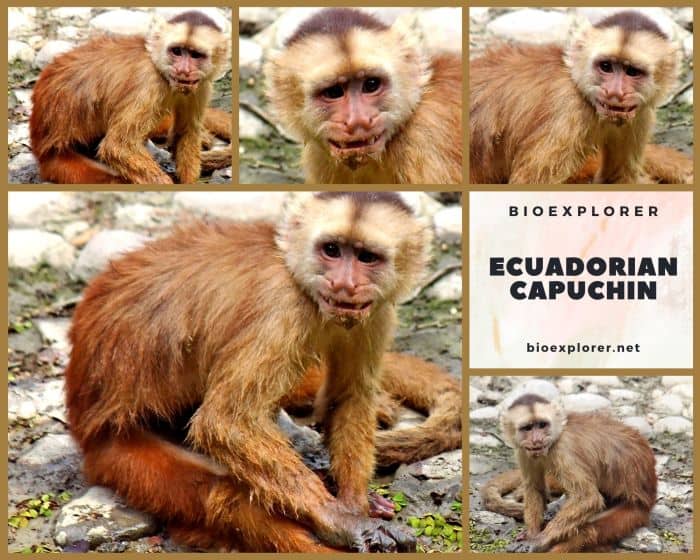
Ecuadorian Capuchin
| Kingdom | Order | Family | Genus | Species |
|---|---|---|---|---|
| Animalia | Primates | Cebidae | Cebus | Cebus aequatorialis |

Ecuadorian White-fronted Capuchin Distribution
Countries
Ecuador ( )
)
)
Peru ( )
)
)Ecuadorian Capuchin Characteristics
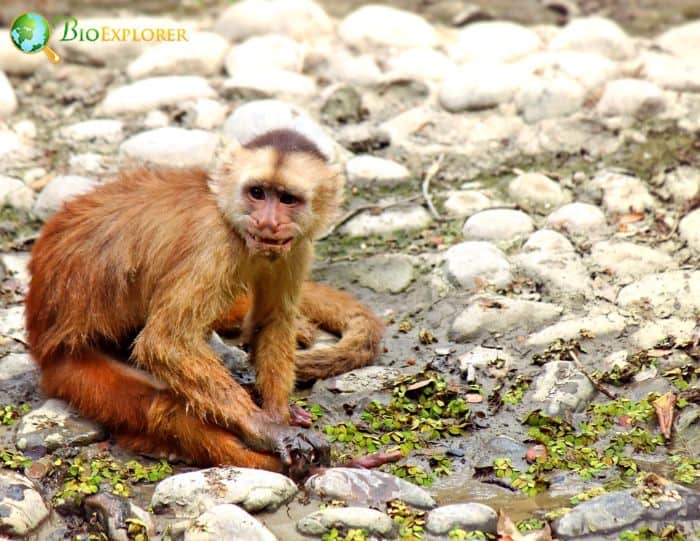
The Ecuadorian capuchin[1], also known as the Ecuadorian white-fronted capuchin, is a species of a graceful capuchin monkey in the Cebidae family.
- It has cream-colored whitish fur on the face, belly, and chest and light cinnamon-red fur on the body, head, neck, and outer limbs.
- The nose is flat with large nostrils, and the eyes are forward-facing and large. Its tail is almost as long as its body.
- It is prehensile but is used only for balance. Its tail is cloaked in fur and can only support an adult’s weight for a short time.
- Their arms are nearly as long as their legs. Their feet and hands have 5 fingers with big toes and opposable thumbs.
- As with most members of the capuchin family, these species are dexterous.
Ecuadorian Capuchin Facts
- Ecuadorian capuchins live in multi-male and multi-female groups of 5-18 individuals, with nearly equal numbers of males and females.
- Like all capuchin species, male Ecuadorian capuchins move from their natal group to a new group when they are fully grown.
- The highest-ranking female dominates all group members except the highest-ranking male.
- Aggressive vocalizations and displays are used when conflict arises between groups, particularly near feeding areas.
- Grooming, which helps keep monkeys’ fur clean and free of parasites, is also a way to bond and relax. Still, dominant individuals groom much more than other group members.
Suggested Reading: All Monkey Species
Cite this page
BioExplorer. (2026, August 26). Ecuadorian Capuchin. https://www.bioexplorer.net/animals/mammals/monkeys/ecuadorian-capuchin/