A Museum Skull Revealed a New Bandicoot Species That Vanished a Century Ago
For decades, a small skull sat in the South Australian Museum under the wrong name. It was filed as a golden bandicoot. A new study shows it belonged to a species no one had ever named.
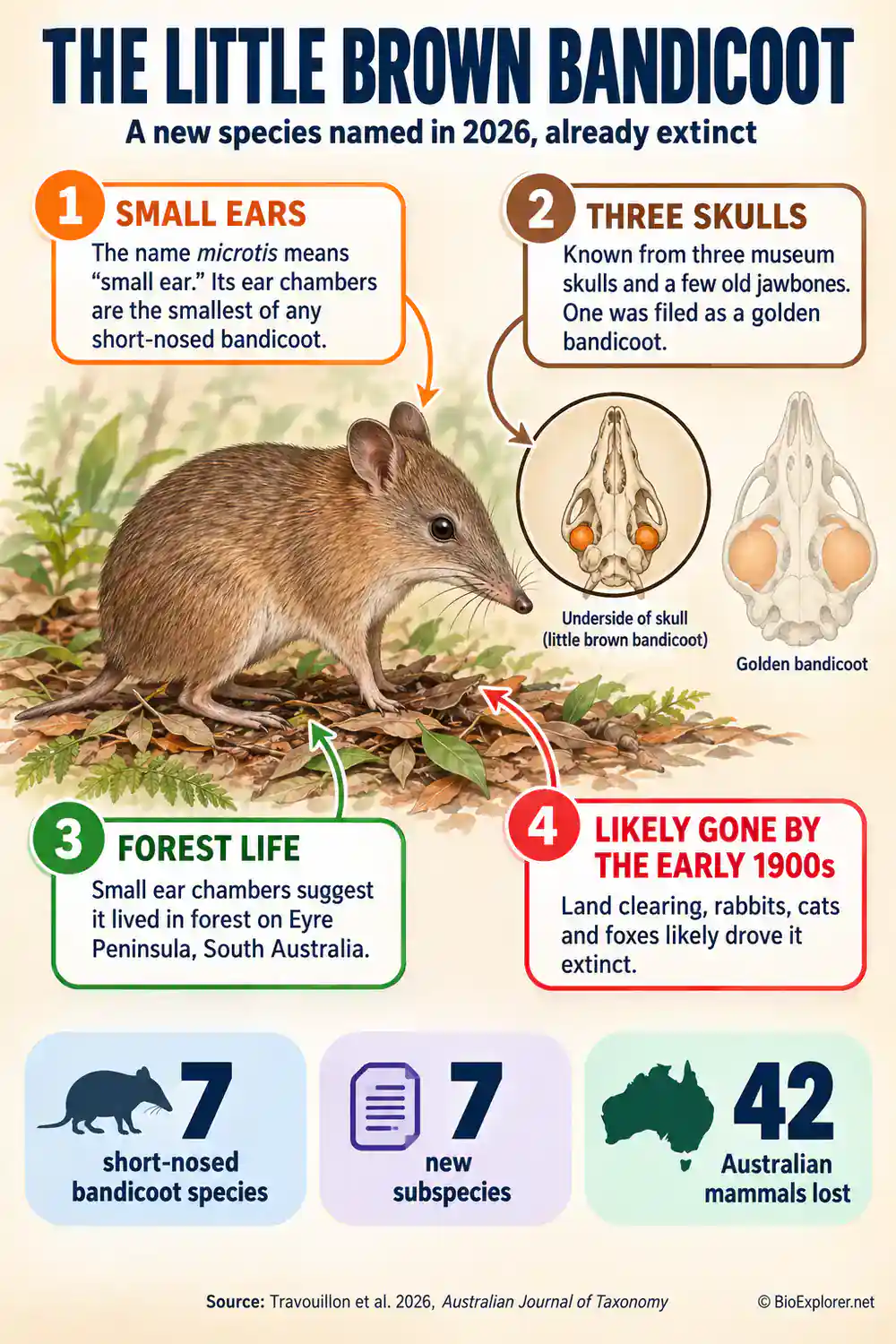
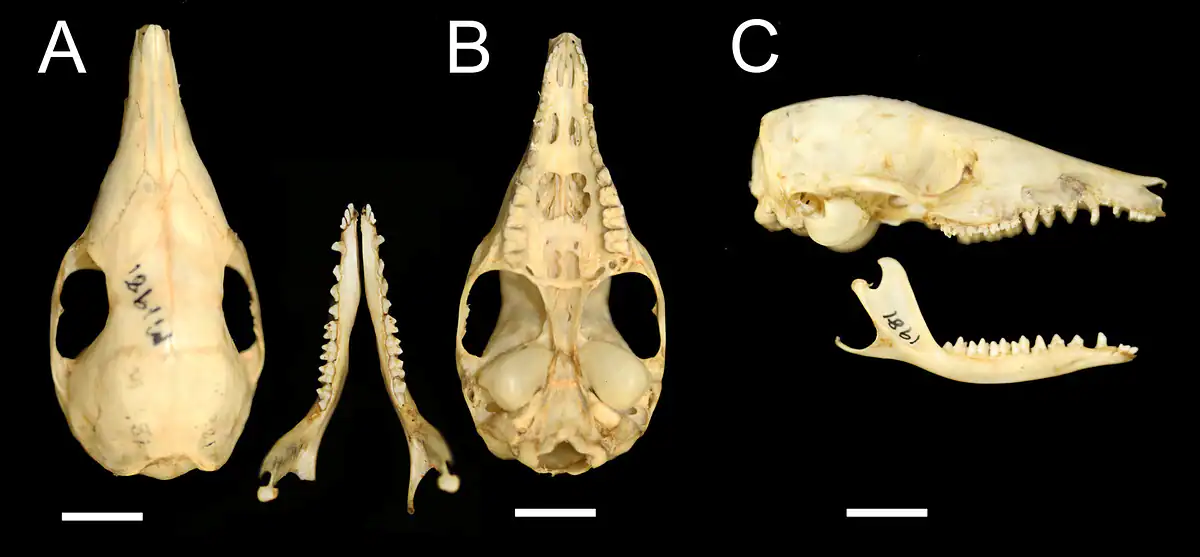
Scientists have now formally described the Little Brown Bandicoot, Isoodon microtis. Its skulls show it was the smallest member of its genus, and it is already extinct. The species is known from just three skulls and a handful of old jawbones from South Australia’s Eyre Peninsula.
The new bandicoot species appears in a 53-page revision of Australia’s short-nosed bandicoots, published October 14, 2026, in the Australian Journal of Taxonomy. Lead author Kenny Travouillon, curator of terrestrial zoology at the Western Australian Museum, spoke with BioExplorer about the find.
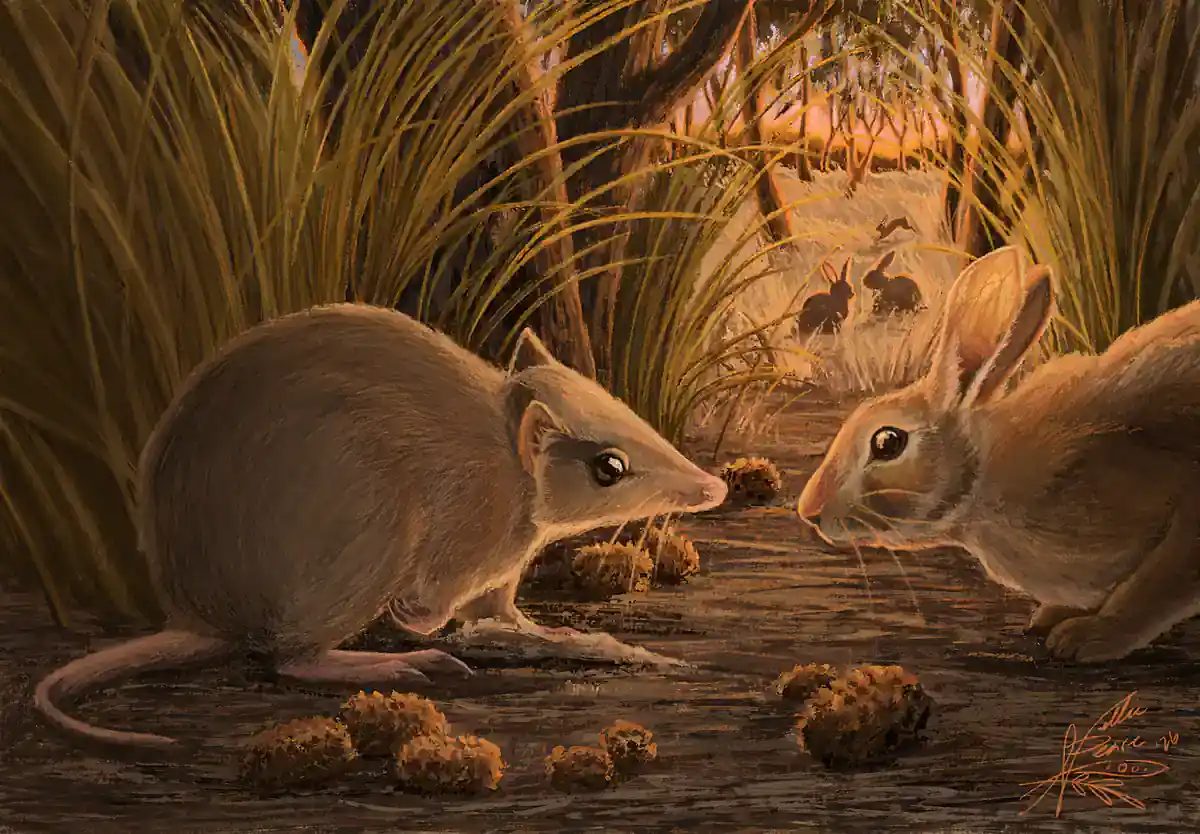
The Little Brown Bandicoot (Isoodon microtis) is a small Australian marsupial named in October 2026 from three museum skulls. It lived on Eyre Peninsula in South Australia. Researchers think it disappeared in the late 1800s or early 1900s, although the exact date is unknown.
Jump to:
Three Mystery Skulls
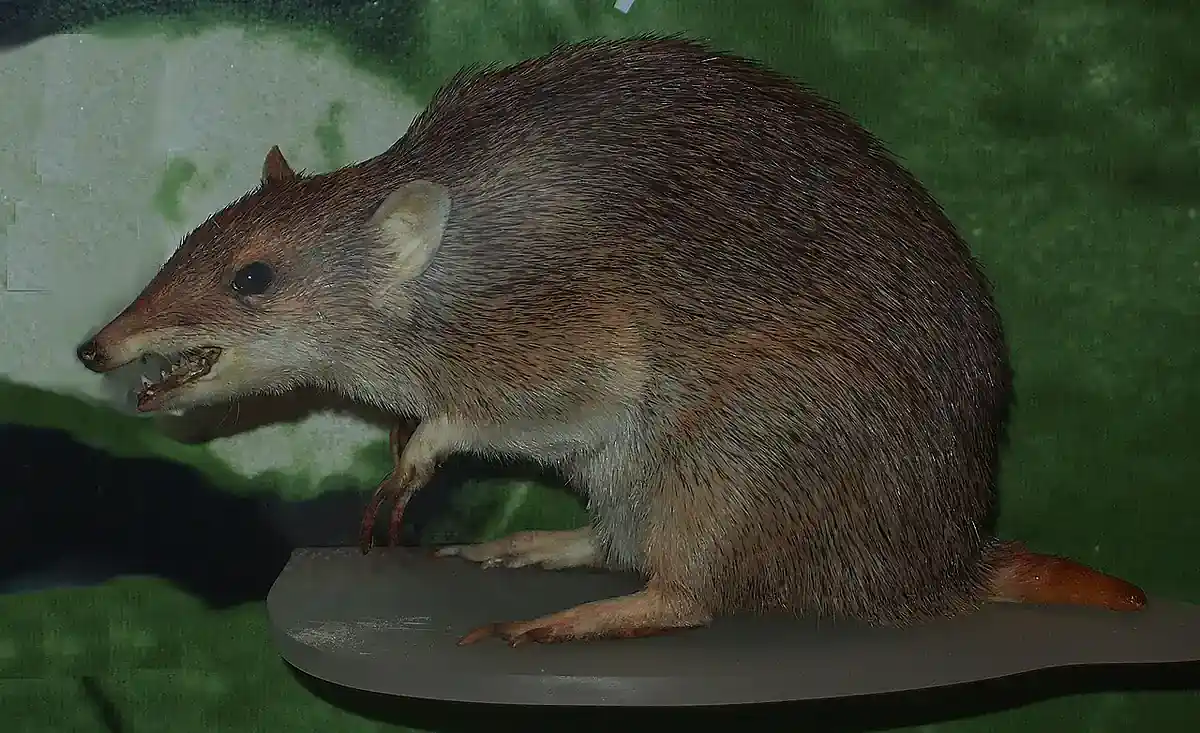
Bandicoots are small, ground-dwelling marsupials that dig for their food with large claws and strong forearms. They are among the many types of mammals found only in Australia and New Guinea. Scientists named 11 short-nosed bandicoot species (genus Isoodon) over the years, then cut the list to three in the 1990s.
To sort out the short-nosed bandicoots, Travouillon’s team examined skulls and skins in museum collections across Australia. They also sequenced thousands of genes. While checking collections at Museum Victoria and the South Australian Museum, Travouillon came across three small skulls that did not fit any known bandicoot.
The oldest of the three skulls has a story of its own. According to the paper, Mrs. Symonds Clark donated it to the South Australian Museum in October 1920, a few months after her husband died. He was an ornithologist and bird keeper who also collected mammal skulls, and his only trip outside Adelaide in the likely period was to Eyre Peninsula.
The other two skulls trace back even further. The paper links them to Frederick George Waterhouse, the South Australian Museum’s first curator. The museum sent them to Museum Victoria, probably in the 1860s, where they were labeled only as an unknown Isoodon.
What Gave It Away
The key difference lay in the auditory bullae, two bony chambers on the underside of the skull that house the middle ear. Their size and shape vary between bandicoot species. Travouillon explained that the bulla amplifies low-frequency sounds and helps a bandicoot detect predators such as owls.
Golden bandicoots have small skulls but very large bullae. The three mystery skulls were small enough to pass for a golden bandicoot’s at first glance. “The bullae were really small too, which made it obvious to me that this was a different species,” Travouillon told BioExplorer.
That feature gave the Little Brown Bandicoot its scientific name. Microtis means “small ear” in Greek. Its bullae are the smallest, relative to skull size, of any short-nosed bandicoot.
How It Lived
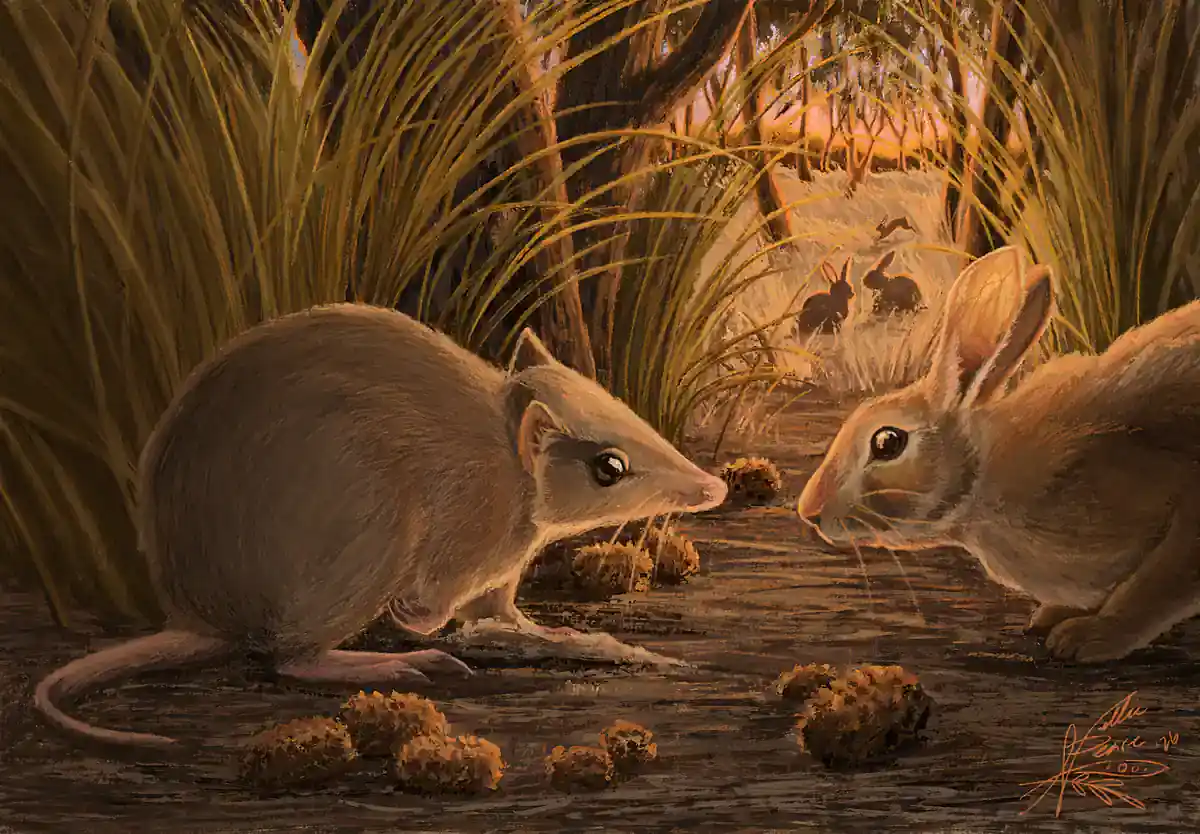
Little is known about the Little Brown Bandicoot’s life. “Being only represented by 3 skulls, there is limited information we can get about this species,” Travouillon said. No skins exist, so the bandicoot’s fur color and tail length are not known for certain. The illustration at the top of this article is an artist’s reconstruction.
The skulls still offer clues. “Having small bullae does tell us that it was most suited for forested areas, where low frequency hearing is less effective,” Travouillon explained. No habitat records come with the specimens, so that forest link is an inference from skull anatomy.
The team also tried to recover DNA from the skulls, but the attempt failed. As a result, the Little Brown Bandicoot rests on skull shape alone.
The paper places the Little Brown Bandicoot closest to the southern brown bandicoot in its family tree. It shared Eyre Peninsula with a larger bandicoot, now called Isoodon fusciventer terrenus. The authors suggest the two species may have avoided competing by using different parts of the habitat.
Why It Vanished
No one knows exactly when the Little Brown Bandicoot died out. “Our best guess is that it disappeared in the late 1800s to early 1900s,” Travouillon said. The skulls carry no collection dates, but all three reached museums by 1920.
During that period, large areas of native forest and bushland on Eyre Peninsula were cleared for farming. Travouillon said introduced rabbits would have competed with the bandicoots, while cats and foxes would have preyed on them. “These are the most likely reasons why it went extinct,” he said.
The Little Brown Bandicoot joins a long list of losses. A 2015 study in PNAS found that more than 10 percent of Australia’s 273 endemic land mammals have died out in about 200 years. Feral cats, red foxes and changed fire patterns are the most likely causes. Using that study and later updates, the new bandicoot paper counts 42 Australian mammal species lost since European colonization. Nearly 20 percent of them are bandicoots and bilbies.
A Bigger Shake-Up
The Little Brown Bandicoot is the headline, but the revision changes much more. The team combined DNA from thousands of genes with skull measurements and every available type specimen. The genus Isoodon now holds seven species instead of five.
Besides the new species, the New Guinea Brown Bandicoot (Isoodon moresbyensis) is raised to full species rank. The paper also names seven new subspecies across Australia’s short-nosed bandicoots:
- Isoodon auratus bundilarri, a golden bandicoot from the Kimberley, named with the Uunguu word for the golden bandicoot from Wunambal Gaambera Country.
- Isoodon auratus marchinbarensis, a golden bandicoot from Marchinbar Island.
- Isoodon fusciventer halae, a quenda named for researcher Marie Hale, who first identified it.
- Isoodon fusciventer dawensis, a quenda from tiny Daw Island in Western Australia.
- Isoodon fusciventer insulanus, a quenda from St Francis Island, South Australia. The name means “islander.”
- Isoodon fusciventer terrenus, a quenda from South Australia, now found only in the Mount Lofty Ranges, on Fleurieu Peninsula and on Kangaroo Island.
- Isoodon macrourus capensis, a northern brown bandicoot from Cape York.
What It Means Now
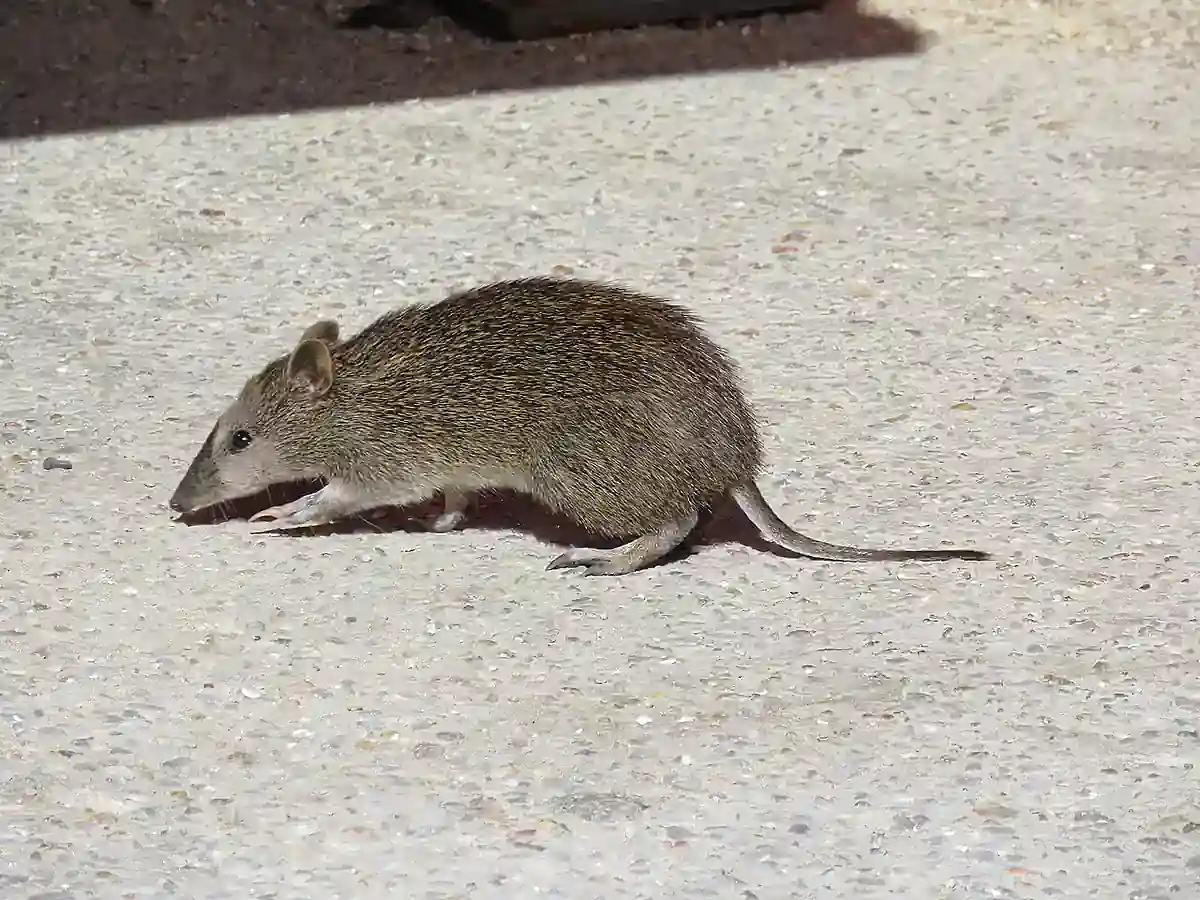
The study also changes the map for an endangered marsupial. South Australian bandicoots once counted as the southern brown bandicoot (Isoodon obesulus obesulus) now belong to the quenda instead. That shrinks the endangered subspecies’ range to southeastern Australia, from Sydney through Victoria to the southeastern corner of South Australia.
A NSW government profile lists the eastern southern brown bandicoot as Endangered under national law. The study’s authors write that the subspecies’ conservation status “needs urgent reassessment.” The authors also warn that translocation plans which mix bandicoot populations need to account for the new subspecies.
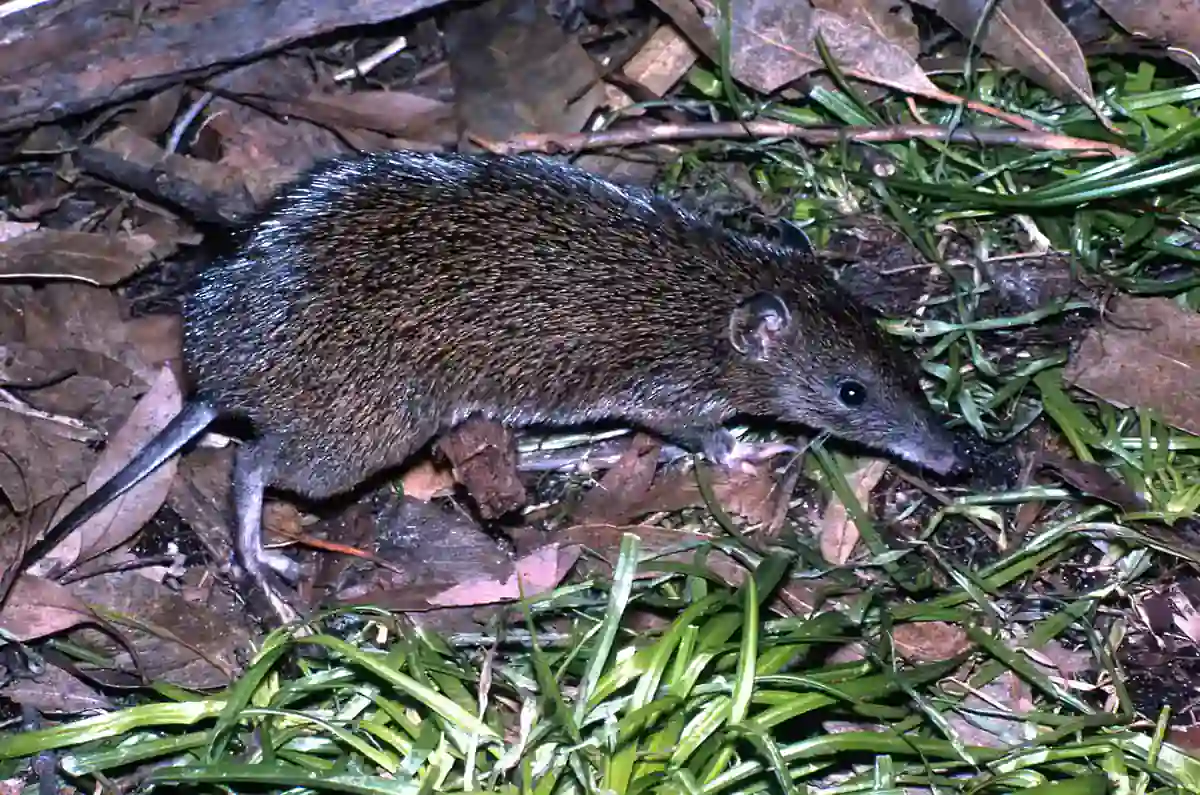
Travouillon said protecting the surviving bandicoots comes down to two things. “We need to make sure there is habitat protected for them to live in, and that introduced species are controlled so that they do not over compete with them or over predate on them,” he said.
It is not an easy task but it can be done and there are already successes in some areas, like in Western Australia, where the quendas are doing much better now, as a result of habitat protection and control of introduced predators.
Kenny Travouillon, Western Australian Museum
Protecting habitat and controlling predators are core tools of conservation biology. Those tools came too late for the Little Brown Bandicoot, but they are already helping its living relatives.
At a Glance
| Taxon | What changed |
|---|---|
| Little Brown Bandicoot (Isoodon microtis) | New species, already extinct, Eyre Peninsula |
| New Guinea Brown Bandicoot (I. moresbyensis) | Raised to full species |
| Golden Bandicoot (I. auratus) | Two new subspecies, Kimberley and Marchinbar Island |
| Quenda (I. fusciventer) | Four new subspecies, range now includes South Australia |
| Northern Brown Bandicoot (I. macrourus) | One new subspecies, Cape York |
| Southern Brown Bandicoot (I. obesulus obesulus) | Range reduced, status needs reassessment |
FAQs
The Little Brown Bandicoot (Isoodon microtis) is an extinct Australian marsupial named in October 2026. Its skulls show it was the smallest short-nosed bandicoot, and it is known from three museum skulls and some old jawbones.
Yes. The Little Brown Bandicoot is the only extinct species in its genus. Lead author Kenny Travouillon estimates it disappeared in the late 1800s to early 1900s.
The Little Brown Bandicoot lived on Eyre Peninsula in South Australia. Its small ear chambers suggest it was best suited to forested areas.
The Little Brown Bandicoot most likely disappeared because of land clearing for farming, competition from introduced rabbits, and predation by cats and foxes.
After the 2026 revision, the short-nosed bandicoot genus Isoodon has seven species. They are the golden, Cape York brown, northern brown, New Guinea brown and southern brown bandicoots, the quenda, and the extinct Little Brown Bandicoot.
The eastern southern brown bandicoot (Isoodon obesulus obesulus) is listed as Endangered nationally in Australia. The 2026 study shrinks its range and says its status needs urgent reassessment.
Cite this page
BioExplorer. (2026, October 27). A Museum Skull Revealed a New Bandicoot Species That Vanished a Century Ago. https://www.bioexplorer.net/new-bandicoot-species.html/