
What Is Biophysics?
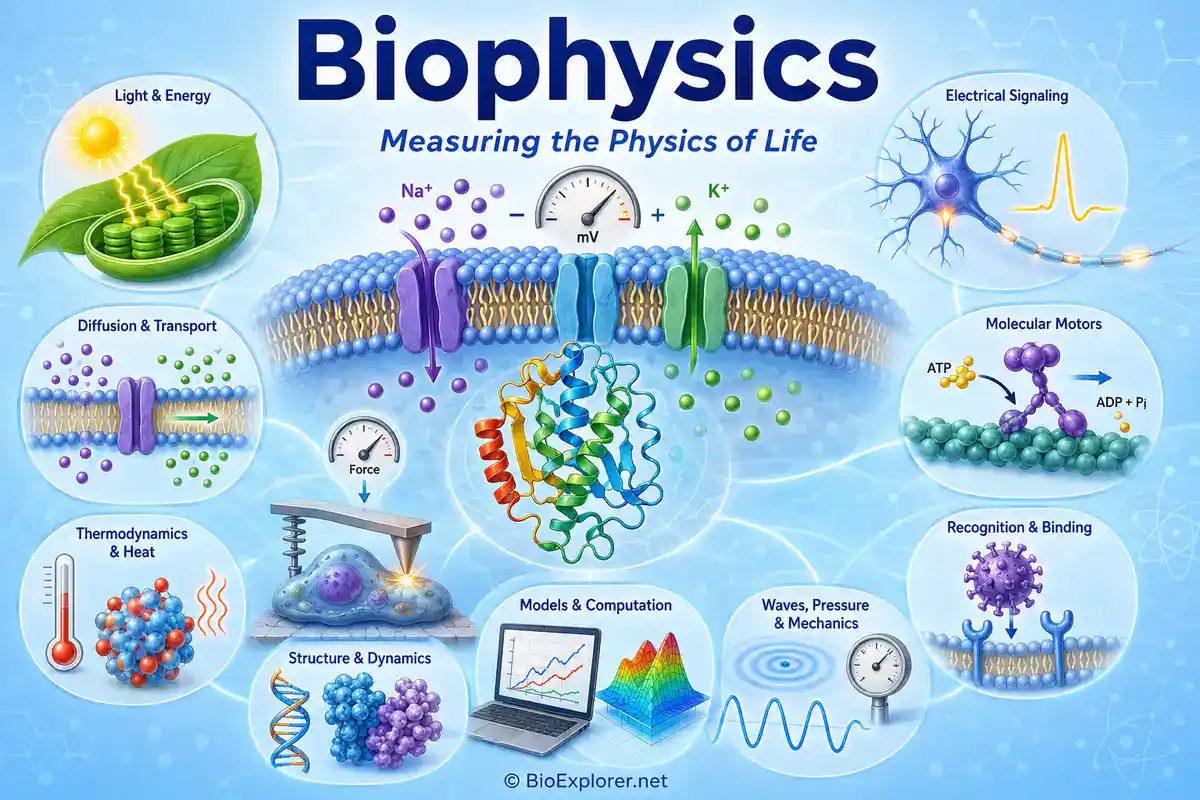
Biophysics is the branch of biology that uses physics, mathematics, chemistry, and computation to understand how living systems work. It studies life through measurable things such as force, energy, motion, voltage, heat, pressure, diffusion, structure, light, time, and probability.
Biophysics becomes useful when biology is too small, too fast, too complex, or too dynamic to explain by description alone.
A protein folds. A membrane holds voltage. A neuron fires. A motor protein walks. A cell senses stiffness. A leaf captures light. A virus binds a receptor. Biophysics turns these events into measurements, models, and mechanisms.
Biophysics Guide:
- Life Runs on Physical Limits
- The Measurements Hidden Inside Biology
- Proteins Are Moving Machines, Not Frozen Sculptures
- Membranes Turn Chemistry Into Electricity
- Bioenergetics: How Living Systems Pay Their Energy Bills
- Cells Feel, Pull, Squeeze, and Flow
- Seeing the Invisible Without Destroying It
- Models Are Experiments With Assumptions Exposed
- Where Biophysics Sits Among Biology Fields
- History of Biophysics: Only the Milestones That Changed the Field
- Biophysics in Medicine and Biotechnology
- Biophysics Careers
- Related BioExplorer Resources
- Recommended Biophysics Resources
- Biophysics FAQs
Life Runs on Physical Limits
Living systems are not exempt from physics. Cells must move molecules through crowded spaces. Membranes must separate charges. Proteins must fold into shapes that are stable enough to work but flexible enough to move. Muscles must convert chemical energy into force. Blood must flow. Light must be absorbed before photosynthesis or vision can begin.
Biophysics studies those limits directly. It asks how biology works when molecules are jostled by heat, when cells are pulled by force, when ions cross membranes, when enzymes collide with substrates, when DNA bends, and when proteins change shape in millionths of a second.
That makes biophysics different from simply adding physics terms to biology. It is a way of testing whether a biological explanation fits the energy, geometry, timing, force, and probability available inside living matter.
The Measurements Hidden Inside Biology
A biophysicist often begins with a biological event and then looks for the physical quantity that controls it. The same method can be used at the scale of atoms, proteins, membranes, cells, tissues, organs, and ecosystems.
| Physical Quantity | Biological Example | Why It Matters |
|---|---|---|
| Force | Motor proteins pulling cargo, muscles contracting, cells gripping surfaces. | Explains movement, shape change, mechanosensing, and tissue mechanics. |
| Energy | ATP use, photosynthesis, ion gradients, protein folding. | Shows what biological work is possible and what must be powered. |
| Voltage | Neurons firing, heart cells signaling, ion channels opening. | Explains electrical signaling in nerves, muscles, and membranes. |
| Diffusion | Oxygen entering cells, proteins finding partners, signals spreading. | Shows how random molecular motion can limit or enable biological events. |
| Structure | Protein folds, DNA shape, ribosomes, viruses, membranes. | Reveals how molecular shape produces biological function. |
| Time | Enzyme rates, folding speeds, channel opening, reaction kinetics. | Connects molecular events with real biological timing. |
| Light | Vision, fluorescence microscopy, photosynthesis, optogenetics. | Helps study and control biological systems using photons. |
| Noise | Random gene expression, single-molecule behavior, cell-to-cell variation. | Explains why living systems vary even under similar conditions. |
Proteins Are Moving Machines, Not Frozen Sculptures
A protein’s shape matters, but biophysics treats shape as only the beginning. Proteins bend, twist, vibrate, bind, release, open, close, and shift between conformations. These movements allow enzymes to catalyze reactions, channels to open, receptors to signal, antibodies to bind, and motors to move.
This is why biophysics overlaps so strongly with structural biology and biochemistry. A static model can show where atoms are. A biophysical view asks how stable the structure is, how fast it moves, what energy barrier separates one state from another, and how binding changes the system.
For related BioExplorer reading, see Building Blocks of Proteins and Structural Biology.
Membranes Turn Chemistry Into Electricity
Biological membranes are only a few nanometers thick, but they control some of life’s most important physical gradients. They separate inside from outside, hold ion differences, organize proteins, shape cell boundaries, and help convert chemical energy into electrical and mechanical work.
Membrane biophysics studies lipid bilayers, ion channels, pumps, transporters, receptors, membrane curvature, membrane tension, and electrical potential. This helps explain nerve impulses, muscle contraction, heartbeat, hormone signaling, kidney transport, bacterial energy production, and mitochondrial ATP synthesis.
In this sense, a membrane is not just a barrier. It is a physical device made by cells.
Bioenergetics: How Living Systems Pay Their Energy Bills
Life must constantly manage energy. Cells use energy to build molecules, move cargo, copy DNA, pump ions, maintain temperature, repair damage, divide, and respond to signals. Biophysics studies how energy moves through these processes without violating thermodynamics.
Bioenergetics includes ATP, redox reactions, proton gradients, electron transport, photosynthesis, respiration, and molecular machines. It explains why mitochondria, chloroplasts, and bacterial membranes are physical energy converters as much as they are biological structures.
For related BioExplorer pages, see Cellular Respiration, Photobiology methods and protocols, and Biochemistry.
Cells Feel, Pull, Squeeze, and Flow
Cells are not bags of chemicals. They are physical structures that resist force, generate force, change shape, crawl, divide, adhere, and respond to stiffness. A white blood cell squeezing through tissue, a cancer cell invading a matrix, a muscle fiber contracting, or a stem cell responding to surface stiffness all involve mechanics.
Where Do Stem Cells Come From?
Cellular biophysics studies cytoskeletons, molecular motors, membrane tension, cell stiffness, fluid flow, adhesion, mechanosensitive channels, and collective cell movement. This connects biology with biomechanics, tissue engineering, cancer biology, developmental biology, and physiology.

Biophysics Methods and Protocols
Seeing the Invisible Without Destroying It
Many biological structures are too small to see with ordinary light microscopy. Others are too fragile, too wet, too fast, or too dynamic for simple observation. Biophysics has helped create many of the tools that let scientists see or measure living systems without reducing them to guesswork.
| Technique | What It Measures or Reveals | Common Use |
|---|---|---|
| X-ray Crystallography | Atomic structures from diffraction patterns of crystals. | Protein structures, DNA structure, enzyme active sites, drug binding. |
| Cryo-Electron Microscopy | Biomolecular structures frozen in thin ice and imaged by electrons. | Large protein complexes, viruses, ribosomes, membrane proteins. |
| NMR Spectroscopy | Atomic environments and molecular motions in solution. | Protein structure, dynamics, binding, folding, and small-molecule interactions. |
| Fluorescence Microscopy | Light emitted by labeled molecules or natural fluorophores. | Protein location, cell signaling, movement, organelles, live-cell imaging. |
| Single-Molecule Methods | Behavior of one molecule at a time instead of population averages. | Molecular motors, folding paths, binding events, DNA mechanics. |
| Patch Clamp | Electrical currents through ion channels or cell membranes. | Neurons, heart cells, muscle cells, channels, drug effects. |
| Optical Tweezers | Tiny forces applied to molecules or cells using focused light. | DNA stretching, motor proteins, molecular mechanics. |
| Molecular Dynamics Simulation | Computer models of atomic motion over time. | Protein movement, membrane behavior, ligand binding, conformational change. |
Models Are Experiments With Assumptions Exposed
Biophysics often uses mathematical models because living systems can be too complex to understand by intuition alone. A model may describe ion flow across a membrane, diffusion inside a cell, enzyme kinetics, protein folding, tissue mechanics, population movement, or the spread of a molecular signal.
A good model is not a decorative equation. It makes assumptions visible. It predicts what should happen if a rate changes, a force increases, a channel opens, a molecule binds, or a membrane becomes more permeable. Then experiments can test whether the model is useful.
This is where biophysics overlaps with theoretical biology, computational biology, systems biology, and quantitative physiology.
Where Biophysics Sits Among Biology Fields
Biophysics is not a replacement for other biology fields. It is a measurement-driven layer that helps explain how physical rules shape biological function.
| Field | Main Question | How Biophysics Adds Value |
|---|---|---|
| Biochemistry | What chemical reactions happen in living systems? | Measures rates, energy changes, binding forces, molecular motion, and enzyme mechanisms. |
| Molecular Biology | How do DNA, RNA, and proteins control life? | Explains molecular interactions, folding, recognition, gene regulation, and structural constraints. |
| Cell Biology | How do cells organize and function? | Measures diffusion, mechanics, transport, membrane voltage, crowding, and cell shape. |
| Structural Biology | What do biological molecules look like in 3D? | Connects structure with movement, stability, energy, binding, and function. |
| Physiology | How do organs and body systems work? | Models flow, pressure, electrical signaling, mechanics, transport, and feedback. |
| Neurobiology | How do nervous systems signal and adapt? | Studies action potentials, ion channels, synapses, membrane voltage, and neural computation. |
| Radiobiology | How does radiation affect life? | Explains energy deposition, molecular damage, DNA breaks, dose, and repair kinetics. |
History of Biophysics: Only the Milestones That Changed the Field
The history of biophysics is the history of making life measurable. The most important turning points gave scientists new ways to connect living function with electricity, structure, energy, atomic detail, computation, and molecular motion.
| Year | Milestone | Why It Matters |
|---|---|---|
| 1780s | Luigi Galvani’s experiments helped establish animal electricity as a biological phenomenon. | Linked living tissue with electrical activity and helped prepare the ground for electrophysiology. |
| 1952 | Alan Hodgkin and Andrew Huxley published their quantitative model of the nerve impulse. | Showed how ion movements across membranes can explain action potentials. |
| 1953 | James Watson and Francis Crick proposed the DNA double helix, supported by X-ray diffraction work from Rosalind Franklin and Maurice Wilkins. | Made molecular structure central to heredity and information transfer. |
| 1958 | John Kendrew and colleagues reported the first atomic model of a protein, myoglobin. | Showed that protein structures could be solved at atomic detail. |
| 1971 | The Protein Data Bank was established as a public archive for macromolecular structures. | Created a shared foundation for structural biology, molecular modeling, and drug discovery. |
| 1976 to 1981 | Erwin Neher and Bert Sakmann developed and applied patch-clamp methods to measure currents through single ion channels. | Made it possible to study individual channels in cell membranes. |
| 1990s onward | Single-molecule methods expanded the study of molecular motors, folding, DNA mechanics, and binding events. | Allowed scientists to see variation hidden by population averages. |
| 2017 | Jacques Dubochet, Joachim Frank, and Richard Henderson received the Nobel Prize in Chemistry for developing cryo-electron microscopy for high-resolution biomolecular structure determination. | Marked cryo-EM as a major method for seeing biomolecules in solution-like states. |
Biophysics in Medicine and Biotechnology
Biophysics has practical value because many diseases begin as physical failures at the molecular or cellular level. A protein misfolds. A channel opens too often. A receptor binds too tightly. A membrane loses its gradient. A tumor cell changes stiffness. A drug fails to reach its target shape. These are biological problems, but they are also physical problems.
Biophysics supports drug discovery, imaging, radiation therapy, dialysis, pacemakers, prosthetics, biosensors, nanopore sequencing, protein engineering, biomaterials, and molecular diagnostics. It also helps explain why a drug binds one protein but not another, why a mutation changes stability, or why a membrane protein is hard to study.
Biophysics Careers
Biophysics careers often sit between disciplines. A biophysicist may build instruments, model proteins, measure ion channels, analyze images, study molecular motors, design drug screens, work on biomaterials, develop imaging tools, or study how cells respond to physical environments.
- Molecular biophysicist: Studies proteins, nucleic acids, membranes, binding, folding, and molecular motion.
- Structural biophysicist: Uses tools such as X-ray crystallography, cryo-EM, NMR, and modeling to study biomolecular structure.
- Membrane biophysicist: Studies lipid bilayers, ion channels, pumps, receptors, and transporters.
- Cellular biophysicist: Measures cell mechanics, signaling dynamics, transport, diffusion, and cell shape.
- Computational biophysicist: Uses simulations, models, statistics, and algorithms to study biological systems.
- Single-molecule biophysicist: Studies individual molecules instead of averaging whole populations.
- Biophysical chemist: Studies molecular interactions, thermodynamics, kinetics, and chemical forces in biological systems.
- Biomedical imaging scientist: Develops or applies imaging tools for research, diagnosis, or therapy.
- Biomaterials scientist: Designs materials that interact with cells, tissues, or biological molecules.
- Neurobiophysicist: Studies ion channels, membrane voltage, synapses, and electrical signaling in nervous systems.
Related BioExplorer Resources
Use these BioExplorer pages to connect biophysics with molecular structure, energy, cells, signals, radiation, and biological function:
- Molecular Biology
- Structural Biology
- Biochemistry
- Cell Biology
- Physiology
- Neurobiology
- Neuroscience
- Photobiology
- Radiobiology
- Theoretical Biology
- Pharmacology
- Biotechnology
- Building Blocks of Proteins
- Building Blocks of Nucleic Acids
- Cellular Organization
- Cellular Respiration
Recommended Biophysics Resources
These external resources are useful for learning about biophysics, molecular structure, biophysical techniques, membranes, protein data, molecular visualization, and careers.
- Biophysical Society: What Is Biophysics? A clear introduction to biophysics, examples, careers, and applications.
- Britannica: Biophysics A concise reference overview of biophysics, its history, and major study areas.
- Biophysical Journal A major peer-reviewed journal covering experimental and theoretical biophysics.
- Annual Review of Biophysics Review articles on major biophysics topics, methods, and discoveries.
- RCSB Protein Data Bank A major resource for 3D structures of proteins, nucleic acids, and biological complexes.
- PDB-101 Educational resources for molecular structures, proteins, DNA, viruses, enzymes, and molecular machines.
- Worldwide Protein Data Bank The global organization that manages the archive of experimentally determined macromolecular structures.
- Electron Microscopy Data Bank A public archive for electron microscopy maps used in structural biology and cryo-EM research.
- Biological Magnetic Resonance Data Bank A resource for NMR data related to biological molecules.
- International Union for Pure and Applied Biophysics An international organization supporting biophysics research and communication.
- European Biophysical Societies’ Association A federation of European biophysical societies and meetings.
- Nobel Prize: Cryo-Electron Microscopy Official Nobel background on cryo-EM and high-resolution biomolecular structure determination.
Biophysics FAQs
Biophysics is the branch of biology that uses physics, mathematics, chemistry, and computation to understand living systems, including molecules, membranes, cells, tissues, organs, and organisms.
Biophysicists study protein structure, molecular motion, membranes, ion channels, cell mechanics, bioenergetics, imaging, molecular machines, diffusion, force, voltage, and biological modeling.
Biochemistry focuses on chemical processes in living systems. Biophysics focuses on physical principles such as energy, force, motion, structure, voltage, diffusion, and molecular dynamics.
Molecular biophysics studies biological molecules such as proteins, DNA, RNA, lipids, and complexes using physical measurements, structural methods, thermodynamics, kinetics, and modeling.
Membrane biophysics studies lipid bilayers, ion channels, pumps, transporters, receptors, membrane voltage, membrane tension, and how membranes control biological signaling and transport.
Common biophysics tools include X-ray crystallography, cryo-electron microscopy, NMR spectroscopy, fluorescence microscopy, patch clamp, optical tweezers, single-molecule methods, and molecular simulations.
Biophysics is important because it explains how physical laws shape living systems. It helps scientists understand proteins, membranes, nerves, muscles, cells, imaging, drug discovery, and disease mechanisms.
Biophysics careers include molecular biophysicist, structural biophysicist, membrane biophysicist, cellular biophysicist, computational biophysicist, single-molecule biophysicist, imaging scientist, and biomaterials scientist.
Cite this page
BioExplorer. (2026, September 30). What Is Biophysics?. https://www.bioexplorer.net/divisions_of_biology/biophysics/