
Preuss’s Red Colobus
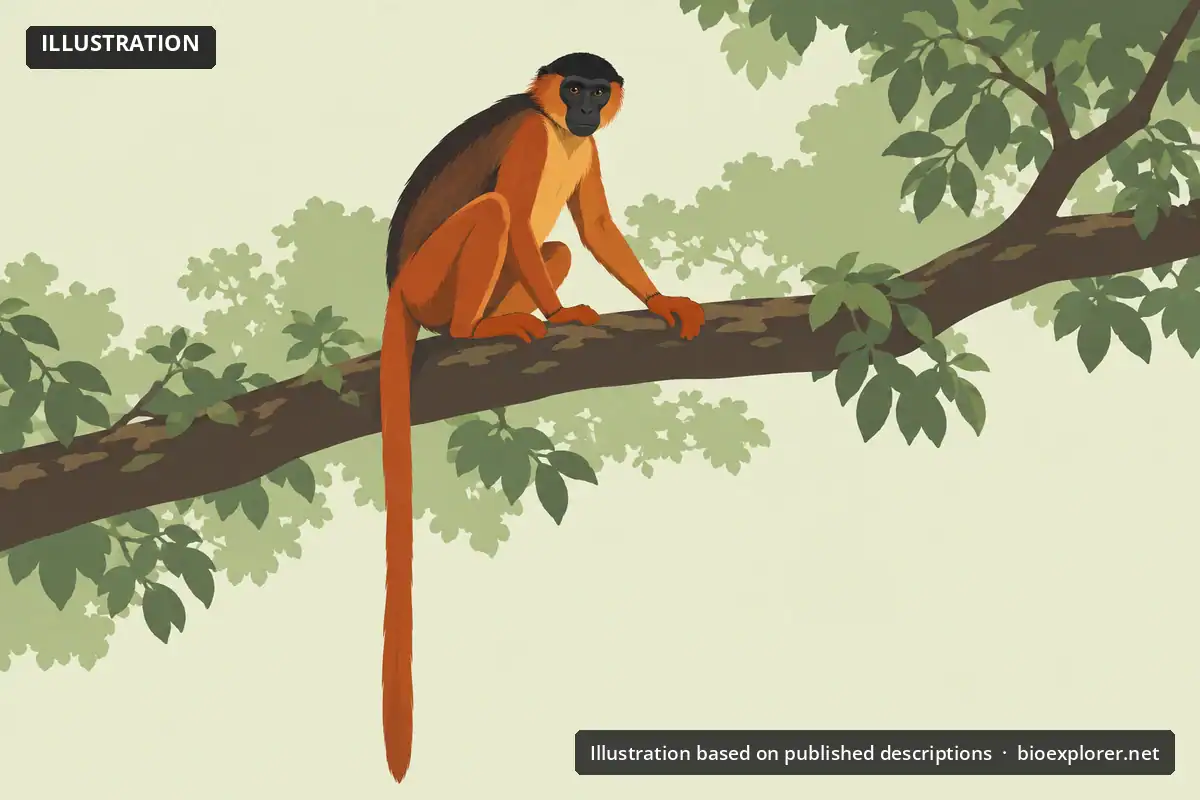
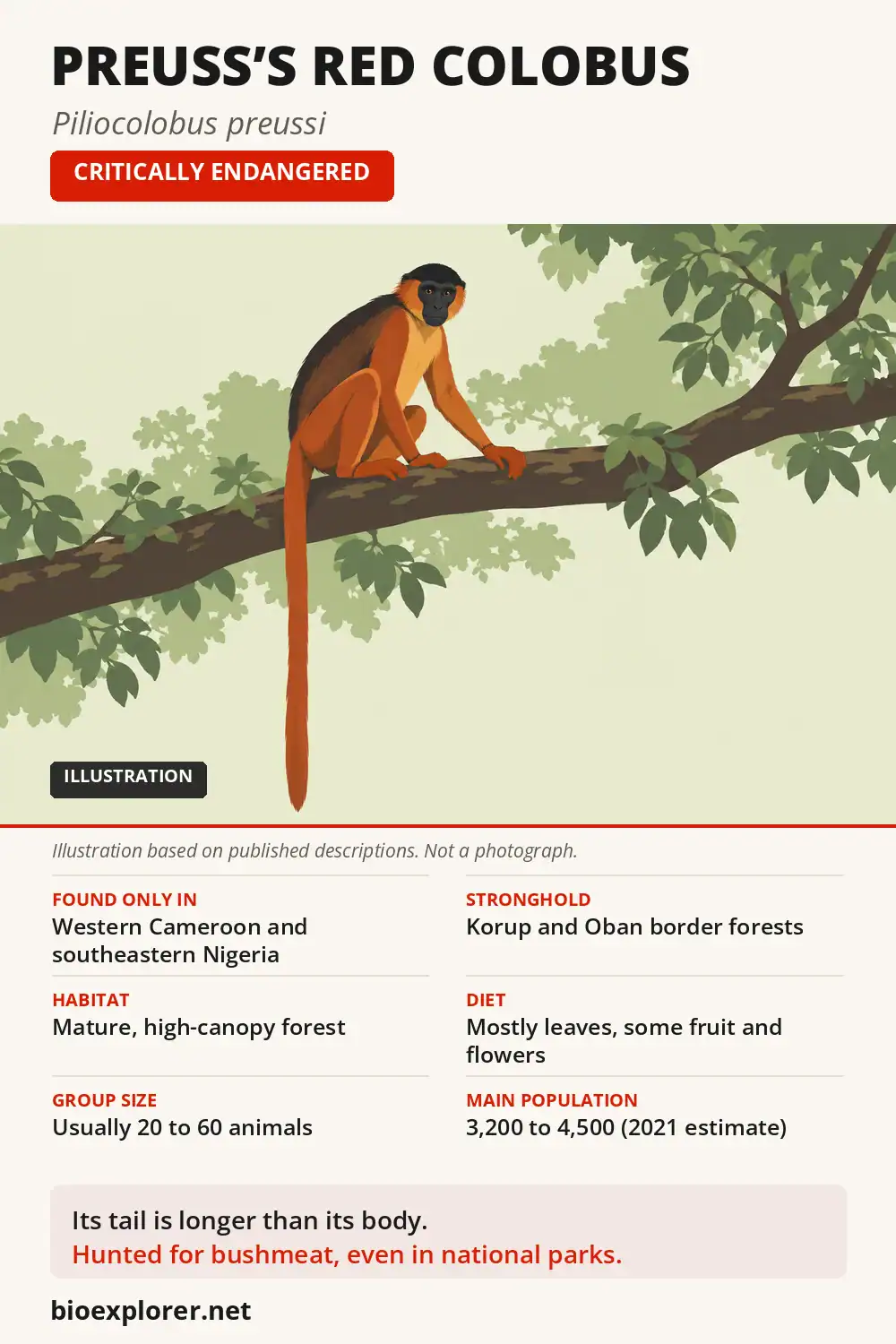
Preuss's red colobus is one of Africa's rarest monkeys.[3] It lives only in western Cameroon and southeastern Nigeria.[3] Its home is mature forest with a tall, closed canopy.[3] Most survivors live in the border forests of Korup and Oban.[3] The IUCN lists the species as Critically Endangered.[3]
Hunters kill it for bushmeat, even inside national parks.[3] It is one of the most threatened monkeys of Cameroon.[7] Logging began in Ebo in 2023.[13] A remnant population may survive in the wider Ebo-Makombe-Ndokbou forest block.[3][11] Here is what field research tells us about it.
A leaf-eating monkey of the Cameroon and Nigeria border forests. Hunting and logging have pushed it to the edge.
- Common NamesPreuss's Red Colobus, Colobe de Preuss
- Taxonomy Classification Year1900
- Monkey SizeHead and body 56 to 63 cm in males, about 62 cm in females; tail about 76 cm
- Skin Color(s)Black crown and facial skin, brown to blackish back, deep orange cheeks, limbs and tail, pale reddish-gold belly
- HabitatMature, high-canopy forest
- DietHerbivorous
- Native CountriesCameroon, Nigeria
- Scientific name: Piliocolobus preussi[1]
- First described: by Matschie in 1900[1]
- IUCN status: Critically Endangered, assessed in 2019[12]
- Range: Cameroon and Nigeria only[3]
- Diet: mostly leaves, plus some fruit and flowers[5][16]
- Group size: usually 20 to 60, sometimes over 100[12]
Preuss's Red Colobus Distribution
 )
 )
Preuss's Red Colobus Guide:
Taxonomy and Names
Preuss's red colobus belongs to the family Cercopithecidae.[1] Within it, the species sits in the subfamily Colobinae.[1] Matschie described the species in 1900.[1] The type specimen came from Elephant Lake, near Barombi, Cameroon.[1] Its museum catalog number is ZMB 6588.[1]
Red colobus taxonomy has long been unsettled.[3] Experts have recognized anywhere from 1 to 17 species.[3] The 2021 action plan recognizes 17 red colobus species.[3] One of them, P. badius, is split into two subspecies.[3] That gives 18 distinct red colobus forms in all.[3]
Older papers treated this monkey as a subspecies.[3] Some listed it as Procolobus badius preussi.[3] Others treated it as Procolobus pennantii preussi.[4] That made it a subspecies of Pennant's red colobus monkey.[4] Today, MDD and GBIF both accept it as a full species.[1][2] GBIF lists Procolobus preussi and Colobus preussi as synonyms.[2]
The species has other names in other languages.[2] In French it is the colobe de Preuss.[2] German speakers call it the Preuss-Stummelaffe.[2] In Spanish it is the colobo rojo de Camerún.[2]
Where It Lives
Historically, the species occurred more widely than it does today.[3] Its old range lay in forests between the Cross and Sanaga rivers.[3] It needs mature forest with a high canopy.[3]
Today, most of the population lives in one block of border forest.[3] That block runs from Korup National Park in Cameroon.[3] It reaches into the Ikpan sector of Nigeria's Oban Division.[3] The Oban Division is part of Cross River National Park.[3] In Nigeria, the species survives only in this division.[6] A 2014 wildlife survey rediscovered it in Cross River National Park.[8]
A few red colobus may also survive farther southeast.[3] Their possible refuge is the Ebo, Makombe and Ndokbou forest block.[3] That block lies more than 180 km southeast of Korup.[3] Survival there is unconfirmed and needs more surveys.[3] The former Ebo park proposal covered about 1,100 km².[3]
Appearance and Size
Its black crown merges into black facial skin.[5] The back ranges from brown to almost black.[5] The cheeks, limbs and tail are a deep orange.[5] The belly is a pale reddish gold.[5]
Infants look quite different from adults.[5] They are born with black backs and light gray undersides.[5]
Females measure about 62 cm (24 in) from head to rump.[5] Males measure 56 to 63 cm (22 to 25 in).[5] The tail is longer still, at about 76 cm (30 in).[5]
Diet and Feeding
Leaves make up most of its diet.[16] It favors young leaves during the rainy season.[16] One study recorded it feeding on 17 plant species.[16] It also eats some fruit and flowers.[5]
Groups and Behavior
Groups hold several adult males and several adult females.[5] Observed groups usually contain 20 to 60 animals.[12] Some counts have exceeded 100.[12] The species is active by day, high in the canopy.[5]
Population and Decline
No reliable count exists for the species as a whole.[3] The 2021 action plan estimated the main population.[3] It put Korup and Oban at 3,200 to 4,500 monkeys.[3] Surveys summarized in that plan found Korup group sightings very low.[3] Those surveys showed a clear, steady decline in abundance.[3] The species may already be gone from areas northeast of Korup.[3] These include forest near Bajo and Mgbegati villages.[3]
Sightings in Nigeria are just as scarce. Oban patrols ran from December 2014 to December 2017.[12] They logged a group-sighting rate of 0.001 groups per km.[12] That is roughly one group encounter per 1,000 km walked.[12]
The southern forests tell a similar story. Between 2002 and 2012, observers saw several groups in Ebo and Ndokbou.[3] By 2010, groups turned up only in northwest Ebo.[3] Transect surveys found none in 2017 and 2018.[3] In 2019, one possible red colobus call was reported near Mount Sinai.[3][11] That record could not confirm the species was still present.[3][11] Overall primate abundance in Ndokbou was under half that of Korup.[11]
The species has been listed as Critically Endangered since 2008.[12]
Main Threats
Hunting is the main cause of its decline.[3] People kill it for food and for the commercial bushmeat trade.[3] Red colobus make up a large share of the regional bushmeat trade.[3] Hunting happens even inside both national parks.[3]
Habitat loss adds more pressure.[3] Logging, farming and mining all cut into its forest.[3] Roads and other infrastructure do too.[3] Oil palm plantations sit next to Korup and the Ebo forest.[3] A pineapple plantation was also proposed inside the Oban Division.[3]
Logging pressure in Ebo has grown since 2020.[13] A 2020 logging decree there was repealed after protests.[13] A road had already been cut toward the forest's center.[13] It included 24 bridges.[13] Monitors reported it was built without social or environmental impact studies.[13] Road construction was suspended in 2022.[13] In April 2023, a new decree followed.[13] It turned over 68,000 hectares of Ebo into timber production land.[13] A logging company received a harvest permit, and logging began.[13]
Conservation Efforts
The species is protected under Cameroonian wildlife law.[7] Re:wild has called it the most threatened monkey in Cameroon.[7]
Civil unrest forced conservation work in Korup to be suspended from 2017.[3] It followed conflict in Cameroon's South West and North West regions.[3] Community-based wildlife monitoring now operates in Korup.[14] Local teams use camera traps, acoustic recorders and line transects.[14] In 2023, a project in the Korup periphery focused on this species.[15] It was awarded US$12,500 in partial funding.[15] The grant came from the Mohamed bin Zayed Species Conservation Fund.[15]
The IUCN red colobus action plan covered 2021 to 2026.[3] It named three priority sites for this species.[3] They are Korup, the Ebo, Makombe and Ndokbou block, and Oban.[3] The plan estimated US$172,000 for its recommended actions here.[3] That figure excludes long-term and recurring costs.[3]
In Nigeria, WCS began an anti-poaching program in Oban in 2016.[9] Rangers use SMART software to plan and record their patrols.[9] Hunting there has reportedly declined gradually.[9] An earlier project ran in 2014 and 2015 with IUCN SOS funding.[10] It targeted shotgun hunters and removed camps and wire snares.[10]
Want to meet more primates like this one? Browse our full guide to the many types of monkeys.
Preuss's Red Colobus FAQ
It lives only in western Cameroon and southeastern Nigeria. Most survivors live in the Korup and Oban forests.
Preuss's red colobus eats mostly leaves. It favors young leaves in the rainy season. It also eats some fruit and flowers.
No reliable global count exists. In 2021, an IUCN action plan estimated the main population. It put Korup and Oban at 3,200 to 4,500. Numbers elsewhere remain uncertain.
Hunting for bushmeat is the main cause. Logging, farming and plantations also destroy its forest.
Males measure 56 to 63 cm from head to rump. Females measure about 62 cm. The tail adds about 76 cm more.
Observed groups usually hold 20 to 60 animals. Some counts have exceeded 100.
Matschie described Preuss's red colobus in 1900. The type specimen came from near Barombi, Cameroon.
Cite this page
BioExplorer. (2026, November 2). Preuss’s Red Colobus. https://www.bioexplorer.net/animals/mammals/monkeys/preusss-red-colobus/
About the author

Wildlife Writer and Photographer, BioExplorer.net
Arjun is a science writer and wildlife photographer at BioExplorer.net. He turns new research on animals into clear, accurate reads for curious readers. His work covers animal behavior, ecology, and newly described species. He holds a Cornell Lab of Ornithology certificate in bird biology. He is pursuing an HBSc at the University of Toronto Mississauga.