
Heck’s Macaque
Primate Profile
Heck’s Macaque
Macaca hecki · Native to Indonesia
Kingdom
Animalia
Phylum
Chordata
Class
Mammalia
Order
Primates
Family
Cercopithecidae
Genus
Macaca
Species
hecki
Authority
(Matschie, 1901)
Photo
VU
IUCN STATUSVulnerable
- Common NameHeck’s Macaque
- Year Classified1901
- Body Size44.5 to 57 cm (17.52 to 22.44 in)
- Skin ColorSilky black
- HabitatRainforest, mountains
- DietOmnivorous
- Native CountriesIndonesia
Heck’s Macaque Distribution
Countries
Indonesia ( )
)
)Explore all monkeys of Indonesia
Heck’s Macaque Characteristics
The Heck’s Macaque[1] (Macaca hecki) is a macaque native to Sulawesi, Indonesia. This Old-World monkey is diurnal.
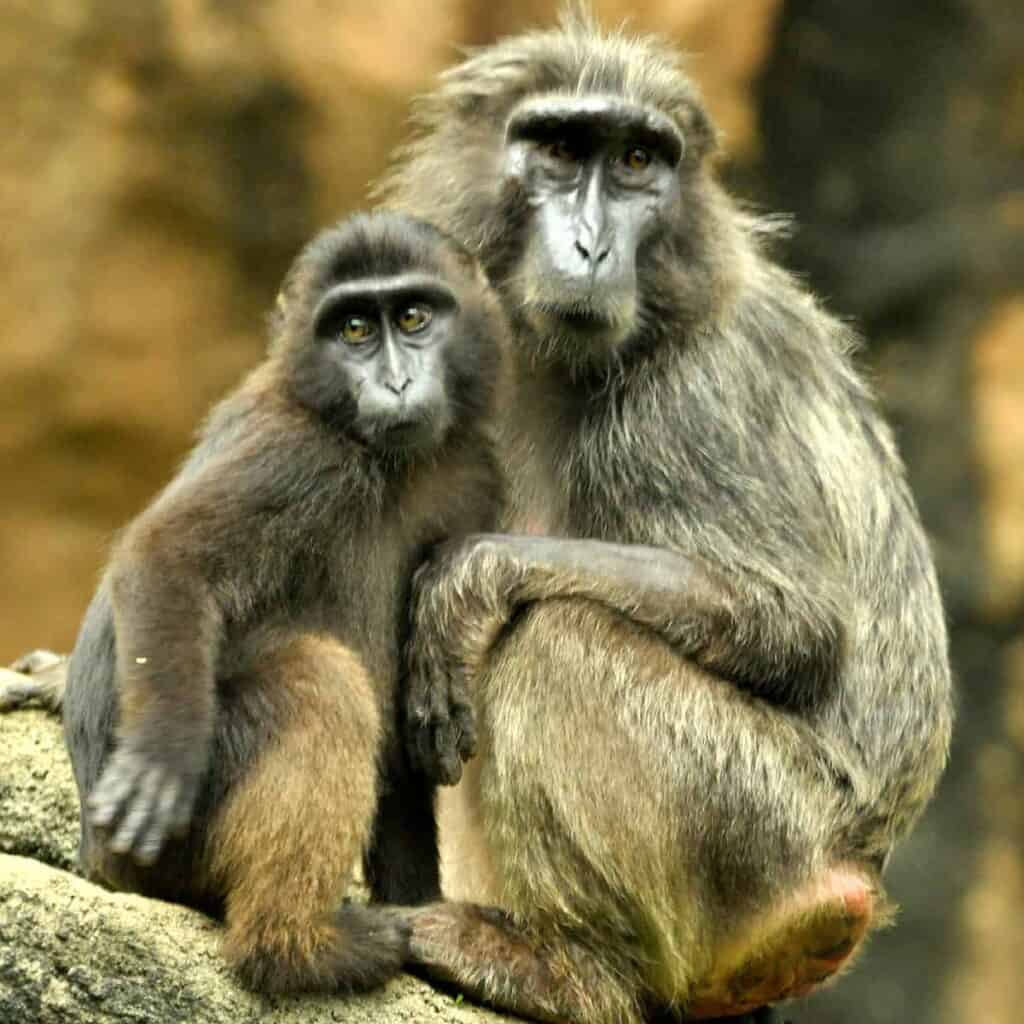
- Heck’s macaques are rarely observed or photographed, so it isn’t easy to describe their appearance. However, they do look quite similar to black-crested macaques.
- They both have tiny, almond-shaped brown eyes, silky black fur, and small vestigial tail tips, leading some to misidentify these Old-World Monkeys as great apes.
- However, there are still some significant differences, primarily the spiny black crest on a black-crested macaque’s head, which the Heck’s macaque lacks.
- Heck’s macaques have a broad, prominent forehead and narrow faces with sunken cheeks.
Heck’s Macaque Facts
- Heck’s macaques are probably diurnal and semi-arboreal in primary and secondary tropical forests. They move on all fours through the forest floor and the treetops.
- They have a multi-male, multi-female social system with group sizes ranging from 10 to 20 individuals.
- Based on the marital line, there is a hierarchical system between group members, which makes sense since female species do not leave their natal group.
- The open-mouthed gaze is a posture used to express threat, performed with a fixed gaze and an open mouth with covered teeth.
- Due to their frugivorous diet, Heck’s macaques will likely act as seed dispersers throughout their habitat.
Suggested Reading: Monkey Species List
Cite this page
BioExplorer. (2026, August 26). Heck’s Macaque. https://www.bioexplorer.net/animals/mammals/monkeys/hecks-macaque/