Chacma Baboon

Chacma Baboon

KingdomOrderFamilyGenusSpecies
AnimaliaPrimatesCercopithecidaePapioPapio ursinus

Chacma Baboon
IUCN Status: Least-Concern
  • Common Name: Chacma Baboon
  • Taxonomy Classification Year: 1792
  • Monkey Size: 50.8 to 114.3 cm (20.00 to 45 in)
  • Skin Color(s): Light gray or dark olive-brown
  • Habitat: Scrub forest, chaparral, savanna or grassland
  • Diet: Omnivorous
  • Native Countries: Angola, Botswana, Mozambique, Namibia, South Africa, Zambia

Chacma Baboon Distribution

Author: Al MacDonald Editor: Fritz Lekschas License: CC BY-SA 3.0 ID: ISO 3166-1 or "_[a-zA-Z]" if an ISO code is not available United Arab Emirates Afghanistan Albania Armenia Angola Argentina Austria Australia Azerbaijan Bosnia and Herzegovina Bangladesh Belgium Burkina Faso Bulgaria Burundi Benin Brunei Darussalam Bolivia (Plurinational State of) Brazil Bahamas Bhutan Botswana Belarus Belize Canada Democratic Republic of Congo Central African Republic Congo Switzerland Côte d'Ivoire Chile Cameroon China Colombia Costa Rica Cuba Cabo Verde Cyprus Czechia Germany Denmark Djibouti Dominica Dominican Republic Algeria Ecuador Estonia Egypt Eritrea Spain Ethiopia Finland Falkland Islands (Malvinas) France Gabon United Kingdom of Great Britain and Northern Ireland Georgia Ghana Greenland Gambia Guinea Equatorial Guinea Greece Guatemala Guinea-Bissau Guyana Honduras Croatia Haiti Hungary Indonesia Ireland Israel India Iraq Iran (Islamic Republic of) Iceland Italy Jamaica Jordan Japan Kenya Kyrgyzstan Cambodia Comoros Korea (Democratic People's Republic of) Korea, Republic of Kuwait Kazakhstan Lao People's Democratic Republic Lebanon Saint Lucia Sri Lanka Liberia Lesotho Lithuania Luxembourg Latvia Libya Morocco Moldova, Republic of Montenegro Madagascar North Macedonia Mali Myanmar Mongolia Mauritania Malta Mauritius Maldives Malawi Mexico Malaysia Mozambique Namibia New Caledonia Niger Nigeria Nicaragua Netherlands Norway Nepal New Zealand Oman Panama Peru Papua New Guinea Philippines Pakistan Poland Puerto Rico Portugal Paraguay Qatar Romania Serbia Russian Federation Rwanda Saudi Arabia Solomon Islands Seychelles Sudan Sweden Singapore Slovenia Slovakia Sierra Leone Senegal Somalia Suriname South Sudan Sao Tome and Principe El Salvador Syrian Arab Republic Eswatini Chad Togo Thailand Tajikistan Turkmenistan Tunisia Turkey Trinidad and Tobago Taiwan, Province of China Tanzania, United Republic of Ukraine Uganda United States of America Uruguay Uzbekistan Saint Vincent and the Grenadines Venezuela (Bolivarian Republic of) Viet Nam Vanuatu Yemen South Africa Zambia Zimbabwe
Countries
Angola
Botswana
Mozambique
Namibia
South Africa
Zambia

Chacma Baboon Characteristics

Chacma Baboon

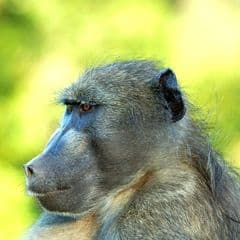
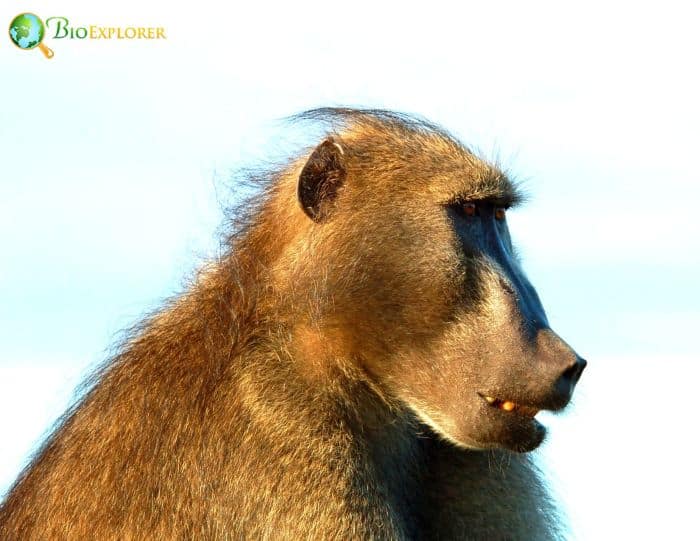
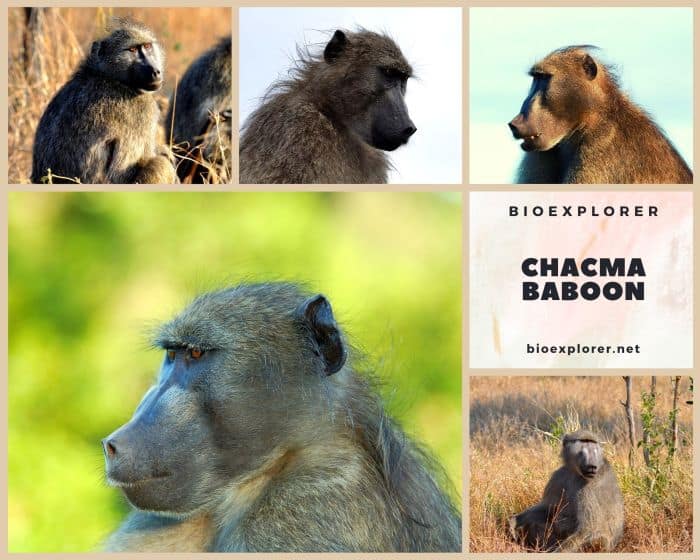
Like all other baboons[1], the Chacma baboon, the Cape baboon, belongs to the Old-World monkey family.

  • It’s among the largest of all monkeys. These large primates have a dog-like snout and large, distinctive canines (females have smaller canines).
  • Chacma baboons have a narrow upper face and large skulls. Also, they have long limbs and a relatively short tail.
  • These species have short, thick hair. Unlike their relatives (like Guinea baboons, Hamadryas, and Anubis), they don’t have manes but only have small tufts or clumps of hair around their faces.
  • Males tend to grow these clumps of hair tight around their necks. The fur of Chacma baboons can range in color from dark olive brown to light gray.
  • Their feet, hands, limbs, and back are typically covered with darker hair (e. g., dark brown or black).
  • Their snout and underparts are brown and tan. Also, Chacmas have a dark purple-black face. In general, the color of their hair is very different.

What Do Chacma Baboons Eat?
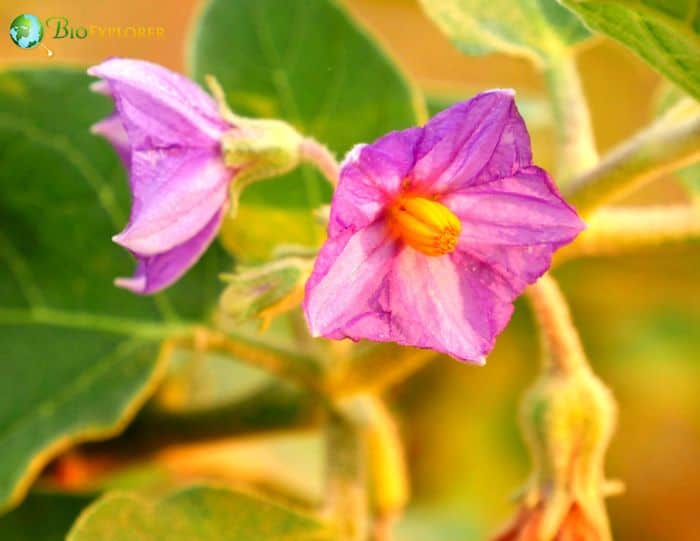
What Do Chacma Baboons Eat? (Solanum incanum)

Being omnivorous, the Chacma Baboon nourishes on many food sources including[¶]:

  • Répteis (Reptilia)
  • Arthropodes (Arthropoda)
  • Hexapoda (Insecta)
  • Birds (Aves)
  • Mamífero (Mammalia)
  • Nightshade (Solanum um incanum)
  • Persimmons (Diospyros)
  • Tamarind (Tamarindus indica)
  • Aroma (Dichrostachys cinerea)
  • Spiny Jackal Berry (Diospyros senensis).
  • Apon-Apon (Pistia stratiotes)
  • Snake Bean Plant (Bobgunnia madagascariensis).
  • Gum Arabic Tree (acaciaia nilotica).
  • Rigid Star Berry (Diospyros squarrosa).
  • Milkwood (Tabernaemontana)
  • Sycamore Fig (Ficus sycomorus).
  • Spurge (Euphorbia)
  • Flatsedge (Cyperus)
  • Vegetable Ivory Palm (Hyphaene petersiana).
  • Jamestown Weed (Datura stramonium).
  • Angel’s Trumpet (Datura inoxia).

What Eats Chacma Baboons?
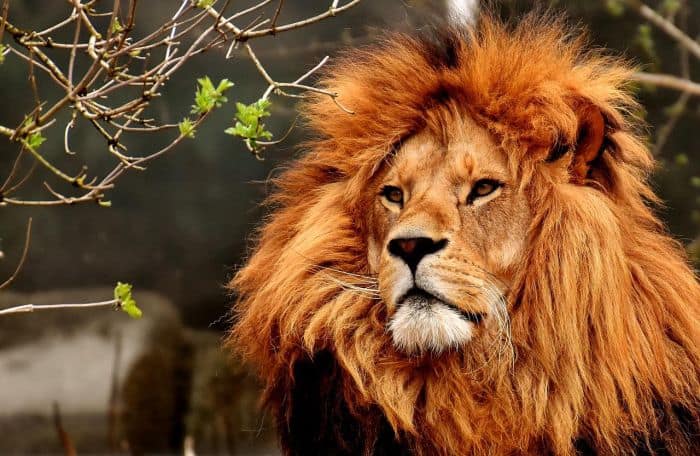
What Eats Chacma Baboons?

Leopards (Panthera pardus), Lions (Panthera leo), Black-Backed Jackals (Canis mesomelas) and Brown Hyenas (Hyaena brunnea) are the main predators of Chacma Baboons[§].

Chacma Baboon Facts
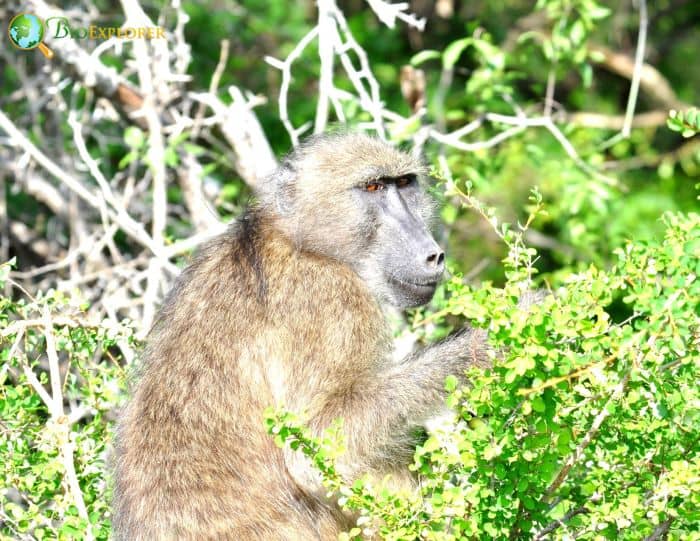
Papio Ursinus

  • Chacma baboons have a habit of flipping over rocks in search of food. So, it’s pretty easy to spot where a group of Chacmas once foraged.
  • In arid areas like Namibia, chacmas can survive without water for up to 20 days by eating food with high water content.
  • They are terrestrial and quadrupedal primates. When they run, their style resembles the gallop of a horse.
  • Grooming is a vital social activity that strengthens the relationship between a family group. Male-female grooming is used during grooming and courtship.
  • Aggressive alpha males will resort to infanticide, killing baby baboons still dependent on their mother for milk. Therefore, women make friends with men to reduce this risk.

Cite this page

Bio Explorer. (2026, January 28). Chacma Baboon. https://www.bioexplorer.net/animals/mammals/monkeys/chacma-baboon/

Key References

  • [1]“Chacma baboon – SANBI”. Accessed August 22, 2022. Link.
  • [¶] – Fricke, E.C., Svenning, J. Accelerating homogenization of the global plant-frugivore meta-network. Nature 585, 74-78 (2020). https://doi.org/10.1038/s41586-020-2640-y.
  • [¶] – Seltzer, Carrie; Wysocki, William; Palacios, Melissa; Eickhoff, Anna; Pilla, Hannah; Aungst, Jordan; Mercer, Aaron; Quicho, Jamie; Voss, Neil; Xu, Man; J. Ndangalasi, Henry; C. Lovett, Jon; J. Cordeiro, Norbert (2015): Plant-animal interactions from Africa. figshare. https://dx.doi.org/10.6084/m9.figshare.1526128. De Boer, W.F. and Ntumi, C.P. and Correia, A.U. and Mafuca, J.M., 2000. Diet and distribution of elephant in the Maputo Elephant Reserve; Mozambique. African Journal of Ecology, 38(3), pp.188-201. https://ndownloader.figshare.com/files/2231424
  • [¶] – fgabriel1891/Palm-Frugivore_Interactions_Neo-AfrotropicsPETERS, CR. 1993. SHELL STRENGTH AND PRIMATE SEED PREDATION OF NONTOXIC SPECIES IN EASTERN AND SOUTHERN AFRICA. International Journal of Primatology. 315-344
  • [§] – Middleton, O.S, Svensson, H, Scharlemann, J.P.W, Faurby, S, Sandom, C.J. CarniDIET 1.0: A database of terrestrial carnivorous mammal diets. Global Ecology and Biogeography. https://doi.org/10.1111/geb.13296. Craig, Christie A., Eleanor I. Brassine, and Daniel M. Parker. “A record of cheetah (Acinonyx jubatus) diet in the Northern Tuli Game Reserve, Botswana. “African Journal of Ecology 55.4 (2017): 697-700.

Leave a Reply

Your email address will not be published. Required fields are marked *