White-bellied Spider Monkey

White Bellied Spider Monkey

KingdomOrderFamilyGenusSpecies
AnimaliaPrimatesAtelidaeAtelesAteles belzebuth

White-bellied Spider Monkey
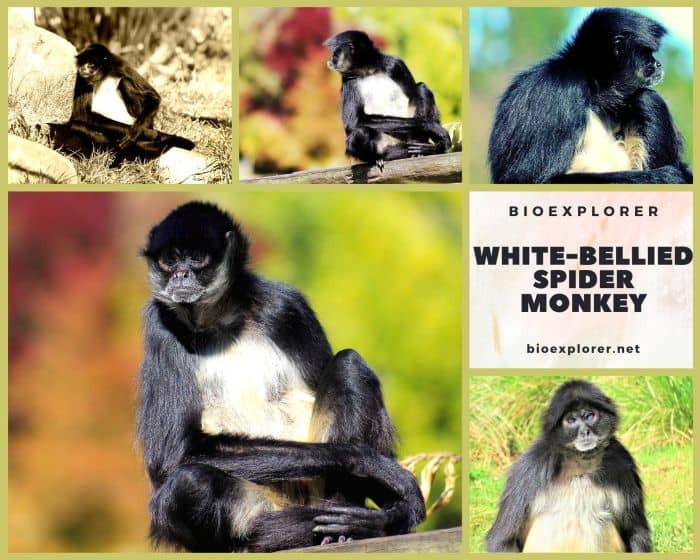
IUCN Status: Endangered
  • Common Name: White-bellied Spider Monkey
  • Taxonomy Classification Year: 1806
  • Monkey Size: 34 to 59 cm (13.39 to 23.23 in)
  • Skin Color(s): Black and yellow-creamy
  • Habitat: Rainforest
  • Diet: Herbivorous
  • Native Countries: Colombia, Ecuador, Venezuela, Peru, Brazil

White-bellied Spider Monkey Distribution

Author: Al MacDonald Editor: Fritz Lekschas License: CC BY-SA 3.0 ID: ISO 3166-1 or "_[a-zA-Z]" if an ISO code is not available United Arab Emirates Afghanistan Albania Armenia Angola Argentina Austria Australia Azerbaijan Bosnia and Herzegovina Bangladesh Belgium Burkina Faso Bulgaria Burundi Benin Brunei Darussalam Bolivia (Plurinational State of) Brazil Bahamas Bhutan Botswana Belarus Belize Canada Democratic Republic of Congo Central African Republic Congo Switzerland Côte d'Ivoire Chile Cameroon China Colombia Costa Rica Cuba Cabo Verde Cyprus Czechia Germany Denmark Djibouti Dominica Dominican Republic Algeria Ecuador Estonia Egypt Eritrea Spain Ethiopia Finland Falkland Islands (Malvinas) France Gabon United Kingdom of Great Britain and Northern Ireland Georgia Ghana Greenland Gambia Guinea Equatorial Guinea Greece Guatemala Guinea-Bissau Guyana Honduras Croatia Haiti Hungary Indonesia Ireland Israel India Iraq Iran (Islamic Republic of) Iceland Italy Jamaica Jordan Japan Kenya Kyrgyzstan Cambodia Comoros Korea (Democratic People's Republic of) Korea, Republic of Kuwait Kazakhstan Lao People's Democratic Republic Lebanon Saint Lucia Sri Lanka Liberia Lesotho Lithuania Luxembourg Latvia Libya Morocco Moldova, Republic of Montenegro Madagascar North Macedonia Mali Myanmar Mongolia Mauritania Malta Mauritius Maldives Malawi Mexico Malaysia Mozambique Namibia New Caledonia Niger Nigeria Nicaragua Netherlands Norway Nepal New Zealand Oman Panama Peru Papua New Guinea Philippines Pakistan Poland Puerto Rico Portugal Paraguay Qatar Romania Serbia Russian Federation Rwanda Saudi Arabia Solomon Islands Seychelles Sudan Sweden Singapore Slovenia Slovakia Sierra Leone Senegal Somalia Suriname South Sudan Sao Tome and Principe El Salvador Syrian Arab Republic Eswatini Chad Togo Thailand Tajikistan Turkmenistan Tunisia Turkey Trinidad and Tobago Taiwan, Province of China Tanzania, United Republic of Ukraine Uganda United States of America Uruguay Uzbekistan Saint Vincent and the Grenadines Venezuela (Bolivarian Republic of) Viet Nam Vanuatu Yemen South Africa Zambia Zimbabwe
Countries
Colombia
Ecuador
Venezuela
Peru
Brazil

White-Bellied Spider Monkey Characteristics
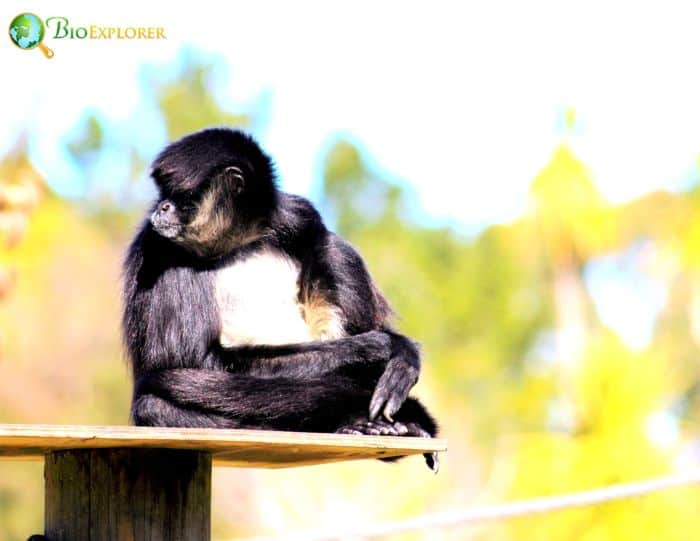
White Bellied Spider Monkey

The white-bellied spider monkey[1] (Ateles belzebuth), also called the long-haired or white-fronted spider monkey, is an endangered species of spider monkey, a species of New-World monkey.

  • It is found in the northwestern Amazon in Brazil, Colombia, Venezuela, Ecuador, and Peru, extending south to the lower Ucayali River and east to the Branco.
  • The limbs of white-bellied spider monkeys are long, muscular, and very strong. In addition, its shoulders are such that its arms can fully rotate.
  • The elbows allow the forearms to pronate, and the large carpal tendons make their wrists extremely flexible.
  • Its hands are long, thin, and thumbless. Instead, their four long fingers form a perfect hook to help them swing on branches.
  • Its torso is short. All of these characteristics perfectly match this monkey’s supportive mode of locomotion.
  • Its long, muscular tail is broad at the base, thin at the tip, and can bend, twist, and curl. It’s prehensile and tactile.
  • The underside is bare with ridges like those found on the undersides of the feet and hands. They have a narrow face with a tiny chin, narrow snout, and large sockets in which almond-shaped brown eyes are fixed.
  • The skull is round, and its ears are similar to ours. White-bellied spider monkeys, which live in lowland forests, have blackish fur on their backs and front legs and creamy-yellow fur on their abdomens; those from mountain forests have a greater variety of colors.

What Do White-bellied Spider Monkeys Eat?
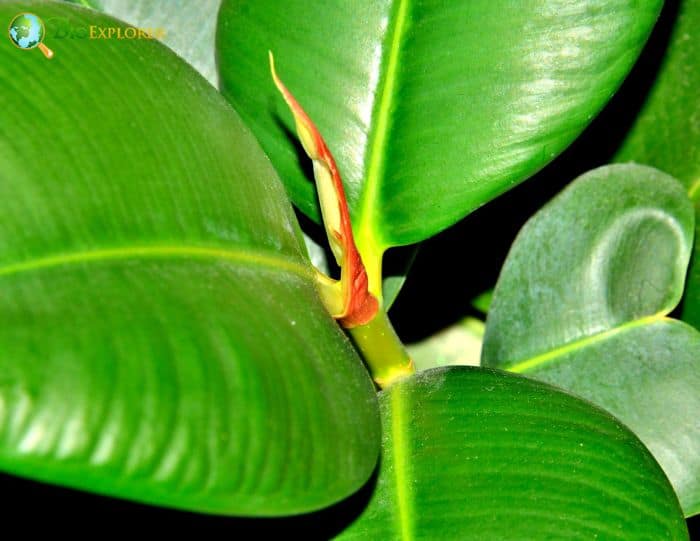
What Do White Bellied Spider Monkeys Eat Rubber Plants?

The White-bellied Spider Monkey diet includes[¶]:

  • Amarillo (Guatteria punctata)
  • Rabo De Ranton (Casearia aculeata).
  • Pachiuba (Socratea exorrhiza)
  • Fig (Ficus)
  • Guamo (Inga acreana)
  • Cuero De Rana (Laetia procera).
  • Abiu (Pouteria caimito)
  • Breadnut (Brosimum alicastrum)
  • Caucho Rubber (Castilla ulei).
  • Trichilia (Trichilia)
  • Hinchahuevos (Sapium laurifolium)
  • Maraximbé (Trichilia tuberculata)
  • Guiana Brosimum (Brosimum guianense).
  • Chalahuite (Inga acrocephala)
  • Pacae Colorado (Inga alba).
  • American Muskwood (Guarea guidonia).
  • Hogplum (Spondias mombin)
  • Figueira-Acreana (Ficus sphenophylla)
  • Icecreambean (Inga edulis)
  • Sweetwood (Nectandra membranacea)
  • Maripa Palm (Attalea maripa).

White-Bellied Spider Monkey Facts
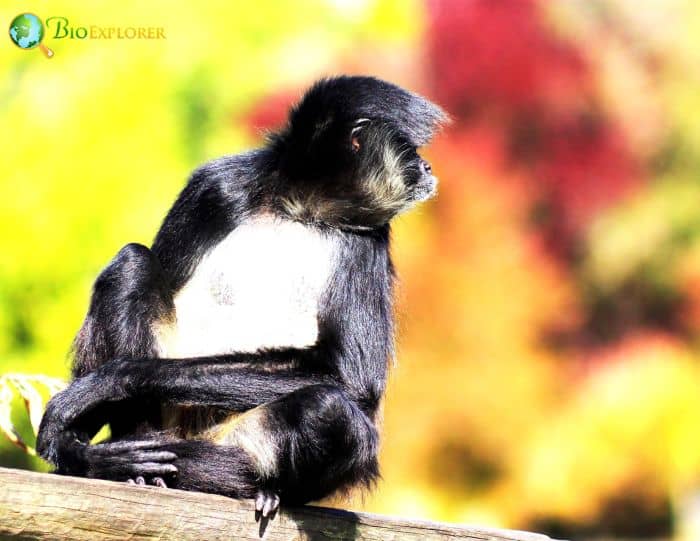
Ateles Belzebuth

  • These arboreal monkeys spend most of their time in the canopy. They rarely go down. When they do, they drink water, eat dirt, traverse a treeless area, or run away from an aggressive opponent.
  • In the treetops, white-bellied spider monkeys move freely between branches. They can cover large distances quickly using various modes of locomotion.
  • White-bellied spider monkeys live in groups of 6-25 individuals, sometimes more. Group size varies by area, with larger groups found in undisturbed patches of woodland.
  • Male white-bellied spider monkeys patrol the boundaries of the group’s territory to repel potential invaders and can cause serious injury if they bite by an intruder.
  • These spider monkeys also rub leaves on their bodies. The scents can be used as a natural insect repellent, but they can also signal social status and attract a mate.

Suggested Reading: Types of Monkeys

Cite this page

Bio Explorer. (2026, January 7). White-bellied Spider Monkey. https://www.bioexplorer.net/animals/mammals/monkeys/white-bellied-spider-monkey/

Key References

  • [1]“Manually Fix”. Accessed August 18, 2022. Link.
  • [¶] – Fricke, E.C., Svenning, J. Accelerating homogenization of the global plant-frugivore meta-network. Nature 585, 74-78 (2020). https://doi.org/10.1038/s41586-020-2640-y.
  • [¶] – fgabriel1891/Palm-Frugivore_Interactions_Neo-AfrotropicsKarubian, Jordan; Ottewell, Kym; Link, Andres; Di Fiore, Anthony. 2015. Genetic consequences of seed dispersal to sleeping trees by white-bellied spider monkeys. Acta Oecologica-International Journal of Ecology. 50-58
  • [¶] – fgabriel1891/Palm-Frugivore_Interactions_Neo-AfrotropicsStevenson, Pablo R.; Link, Andres; Gonzalez-Caro, Sebastian; Fernanda Torres-Jimenez, Maria. 2015. Frugivory in Canopy Plants in a Western Amazonian Forest: Dispersal Systems, Phylogenetic Ensembles and Keystone Plants. Plos One. e0140751
  • [¶] – fgabriel1891/Palm-Frugivore_Interactions_Neo-AfrotropicsSilvius, K. M.; Fragoso, J. M. V.. 2002. Pulp handling by vertebrate seed dispersers increases palm seed predation by bruchid beetles in the northern Amazon. Journal of Ecology. 1024-1032
  • [¶] – fgabriel1891/Palm-Frugivore_Interactions_Neo-AfrotropicsDew, J. L.. 2005. Foraging, food choice, and food processing by sympatric ripe-fruit specialists: Lagothrix lagotricha poeppigii and Ateles belzebuth belzebuth. International Journal of Primatology. 1107-1135
  • [¶] – fgabriel1891/Palm-Frugivore_Interactions_Neo-AfrotropicsRusso, S. E.; Campbell, C. J.; Dew, J. L.; Stevenson, P. R.; Suarez, S. A.. 2005. A multi-forest comparison of dietary preferences and seed dispersal by Ateles spp.. International Journal of Primatology. 1017-1037

Leave a Reply

Your email address will not be published. Required fields are marked *