
Weeping Capuchin
| Kingdom | Order | Family | Genus | Species |
|---|---|---|---|---|
| Cebus castaneus |
- Common Name: Wedge-capped capuchin
- Taxonomy Classification Year: 1851
- Monkey Size: 60.5 to 112 cm (23.82 to 44.09 in)
- Skin Color(s): Pale buff
- Habitat: Forest, rainforest, mountains
- Diet: Omnivorous
- Native Countries: Brazil, Guyana, Suriname, French Guiana

Wedge-capped capuchin Distribution
Countries
Brazil
Guyana
Suriname
French Guiana
Weeping Capuchin Characteristics
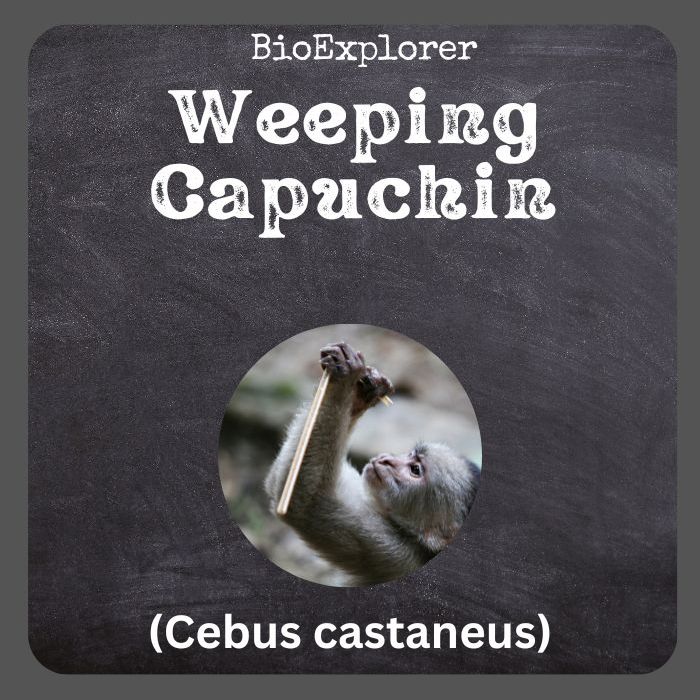
The Weeping capuchin[1], also known as the chestnut capuchin and chestnut weeper capuchin (Cebus castaneus), is a capuchin monkey endemic to northeastern Brazil, southern Guyana, French Guiana, and Suriname. This primate is also known as Wedge-capped capuchin.
- Weeping Capuchins have the tiniest body size (500 mm long), like small dogs in body size.
- The tail of this species is semi-prehensile and about the same length as the body, giving it a total length of about 84 cm.
- Males and females generally weigh around 2.5 to 2.8 kg, but males can weigh around 800 g more. The body is mainly cream to pale beige.
- The head is the same color as the body but has a black-to-dark gray wedge-shaped patch extending across the skull from the forehead.
- The forearms also show this dark black-to-gray color. The tail has a black tip and is often curled at the tip. This “ringtail” is strong enough to support the entire body weight for long periods and is often used when feeding to free up the hands.
Weeping Capuchin Facts
- Weeping capuchins are very social animals. They live in groups of about 10-33 individuals.
- These Wedge-capped capuchins do not display territorial behavior in mating systems. Still, they compete for food and water resources with troops of external capuchins and other Cebid monkeys.
- Weeping capuchins seem to have a particular affinity for a centipede, which releases a venom believed to act as an insect repellant for capuchins.
- These capuchins are polygamous. One dominant male is responsible for mating with all receptive females in the pack.
- In captivity, a capuchin can live up to 55 years. However, Capuchin monkeys live an average of 34-36 years in the wild.
Suggested Reading: Types of Monkeys In The World
Cite this page
Bio Explorer. (2026, January 28). Weeping Capuchin. https://www.bioexplorer.net/animals/mammals/monkeys/weeping-capuchin/