
Laotian Langur
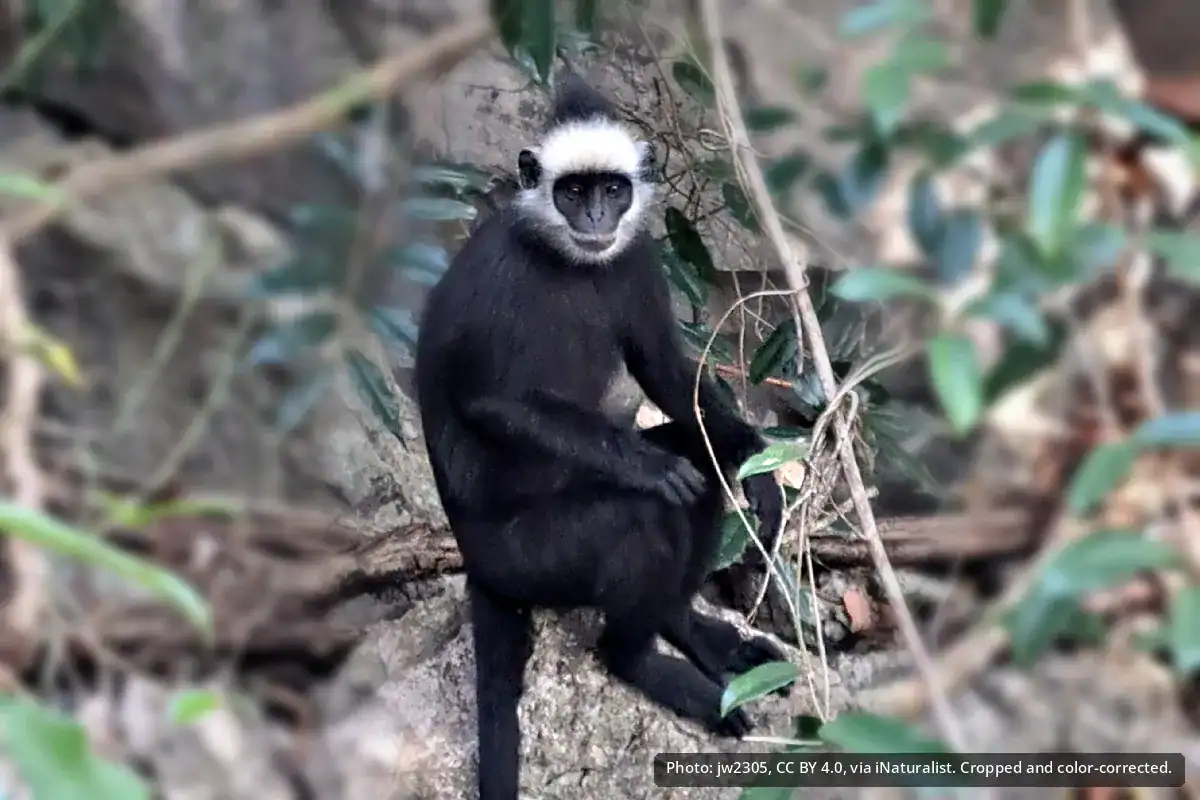
The Laotian langur is a black leaf monkey with a white brow. Its scientific name is Trachypithecus laotum.[1] It lives only in central Laos, on steep cliffs and karst. It is one of the Old World monkeys. The IUCN lists it as Endangered.[2]
This Endangered langur lives on steep cliffs in central Laos.
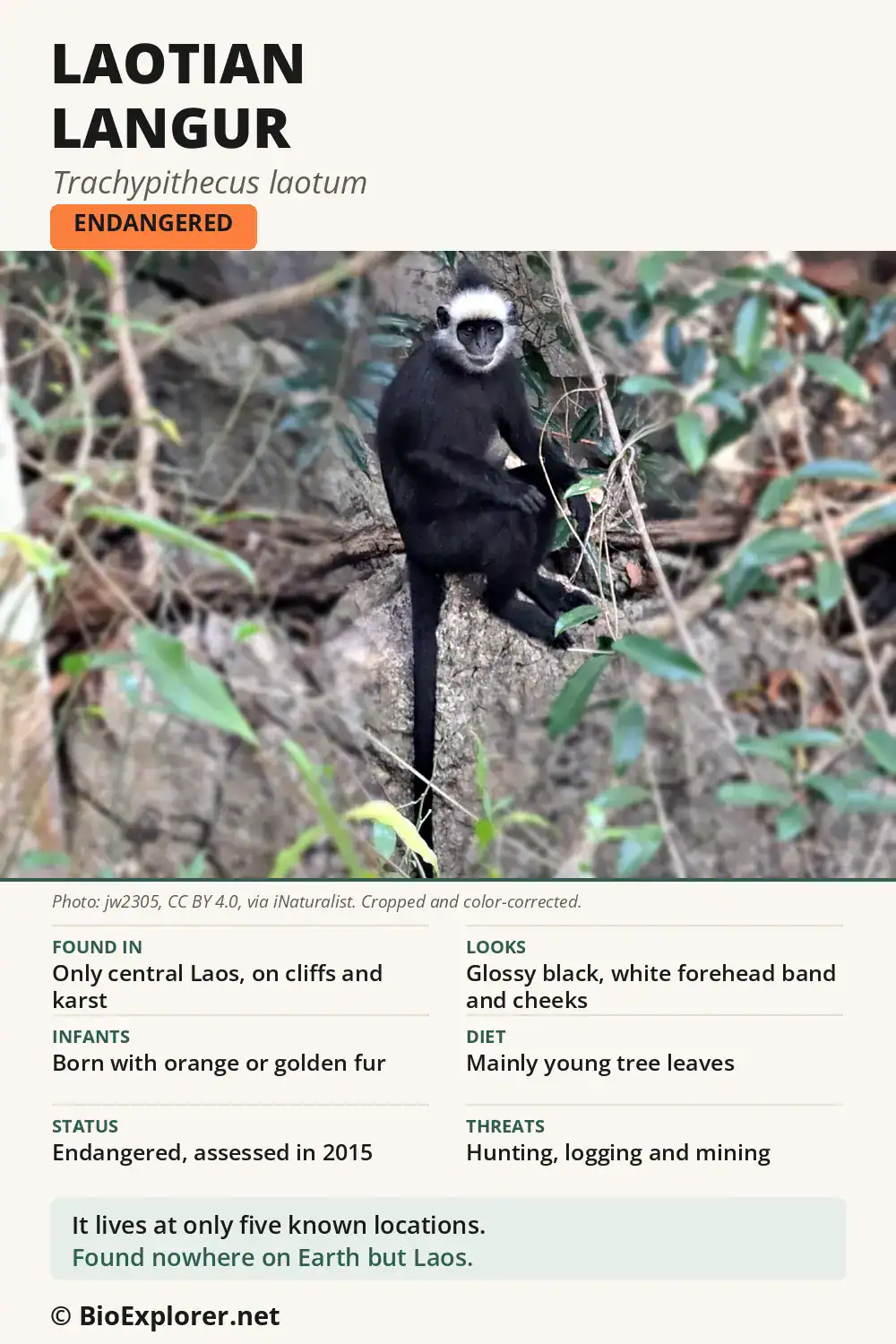
- Common NamesLaotian langur, Laos langur, Lao langur, Lao leaf monkey, white-browed black langur
- Taxonomy Classification Year1921
- Monkey Size46 to 54 cm (18 to 21 in), head and body, from three museum specimens
- Skin Color(s)Glossy black body, white forehead band, white cheeks and ear area
- HabitatEvergreen forest on karst and cliffs, seen at 160 to 900 m
- DietLeaves, mainly young leaves
- Native CountriesLaos
- Its glossy black coat contrasts with a white forehead band.
- White hair also covers its cheeks and the area around its ears.
- Its infants are born with orange or golden fur.
- It feeds mainly on young leaves.
- It sleeps on cliffs and in caves.
Laotian Langur Distribution
 )
Laotian Langur Guide:
Name and Classification
Oldfield Thomas named this monkey in 1921.[3] He called it Pithecus laotum. His type specimen was an adult male, collected in February 1920. It came from Ban Na Sao, beside the Mekong in Laos. Thomas described it as "a black species with white face."
In the 1960s to 1990s, experts lumped it with François' langur. Today the IUCN and the Mammal Diversity Database treat it separately. It has no subspecies.
It belongs to the francoisi group of seven black karst langurs. The group includes the Hatinh langur and the Indochinese black langur. Delacour's langur and the white-headed langur belong to it too. So do the Cat Ba langur and François' langur. Browse more types of langurs on our hub.
A 2020 study compared the group's mitochondrial genomes.[4] Its sister lineage holds the Hatinh and Indochinese black langurs. The two lineages split about 0.59 million years ago.
Physical Description
Its body, limbs and tail are a deep, glossy black. That coat places it among the black monkeys of Asia.
The head is what sets it apart. A broad white band crosses the forehead.[5] A thin black hairline edges the top of the face. White hair also covers the cheeks and the area around the ears. Pale hairs ring the mouth and chin.
A black crest runs back over the crown. Crest hairs measure 40 to 50 mm (1.6 to 2 in). Long hairs on the shoulders form a mantle.
Adult females have a patch of orange-yellow hair around the genitals.
Infants look very different from adults. They are born with orange or golden fur.[6] Juveniles shift from yellowish or orange toward black and white. Adult males are much larger than adult females.
Size and Weight
Few Laotian langurs have ever been measured. The figures below come from three museum specimens.
The type specimen was an adult male. Its head and body measured 48.5 cm (19 in). Its tail was 84.5 cm (33 in) long. Two adult females measured 53.5 and 46 cm (21 and 18 in). Their tails were 89.5 cm and 81 cm (35 and 32 in).
Its tail is much longer than its body. No weight has been published for this species.
Similar Species Compared
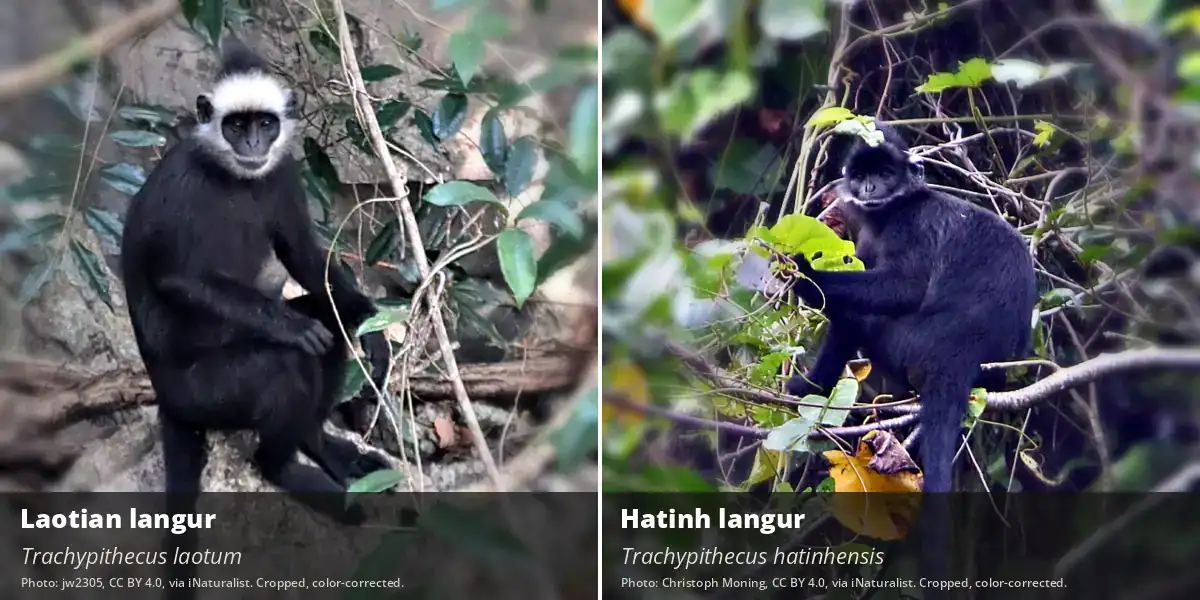
The Hatinh langur is one of its two closest relatives.[7] It is a close look-alike. It lives in limestone hills of north-central Vietnam and east-central Laos. Its white mark is only a narrow stripe. It runs from the mouth corner past the ear to the nape. It also has a white moustache. The Laotian langur instead has a broad white band across the forehead.
The Indochinese black langur replaces it in southern Phou Hin Poun. Its head is all black. The IUCN treats it as a synonym of the Hatinh langur.
François' langur lives farther north, in south-central China and northern Vietnam.[8] Two narrow white lines run from its mouth toward its ears. Thomas used that difference to name the Laotian langur in 1921.
| Trait | Laotian langur | Hatinh langur | Indochinese black langur | François' langur |
|---|---|---|---|---|
| Scientific name | Trachypithecus laotum | Trachypithecus hatinhensis | Trachypithecus ebenus | Trachypithecus francoisi |
| Range | Central Laos, in Bolikhamxai and Khammouan | North-central Vietnam and east-central Laos | Southern Phou Hin Poun and other karst in central Laos | South-central China and northern Vietnam |
| Habitat | Karst and other cliffs in evergreen forest | Forested limestone karst, up to 1,500 m | Not known | Limestone forest, mostly below 600 m |
| Coat and key marks | Black, white forehead band and white cheeks | Black, white stripe from mouth to nape, white moustache | Black, with an all-black head | Black, white stripe from mouth corner to ear |
| Head and body | Male 48.5 cm, one specimen | Male 66.5 cm, one specimen | Not known | Males 47 to 63.5 cm, nine specimens |
| Tail | Male 84.5 cm, one specimen | Male 81 cm, one specimen | Not known | Males 74 to 90 cm, nine specimens |
| Weight | Not known | Male 8 kg, one specimen | Not known | Males 5.7 to 9.45 kg, four specimens |
| Diet | Young leaves observed, wild diet poorly studied | 81% leaves in an enclosure study | Not known | Mostly leaves, 53% to 90% by site |
| Group size | 2 to 6 seen in 2020, 15 to 25 estimated in 2015 | Average 6 to 8, largest 30 | Not known | 9 to 10 in intact populations |
| IUCN status | Endangered (assessed 2015) | Endangered (assessed 2015) | Not assessed separately | Endangered (assessed 2015) |
Range and Distribution
The Laotian langur is found only in Laos. It lives in two central provinces, Bolikhamxai and Khammouan. Its extent of occurrence is under 5,000 sq km (1,930 sq mi).
Its stronghold is Phou Hin Poun National Protected Area.[9] It also lives in Nam Sanam Provincial Protected Area. It reaches the southern part of Nam Kading National Protected Area. The Nam Kading River is thought to mark its northern limit.
Southward, all-black langurs replace it near 17°40′N. Where the two forms meet is still unclear. Langurs at Hin Nam No belong to the Hatinh langur group.
Habitat Needs
This langur needs steep, rocky ground. It lives on limestone karst and on other sheer escarpments. Large rock faces are key features of its home.
It uses tall evergreen and semi-evergreen forest on and below the cliffs. It also enters open, scrubby areas among the rocks. Those forests make it one of the rainforest monkeys of Southeast Asia.
Sightings span 160 to 900 m (520 to 2,950 ft). The IUCN thinks its upper limit may be higher. In a 2020 survey, sightings averaged about 314 m (1,030 ft).
In 1921, Thomas was told it lived wholly on the ground. Later fieldwork found it feeding in trees.
Diet and Feeding
The Laotian langur eats leaves. Its wild diet is still poorly studied. In 2020, field teams saw it feed mainly on young tree leaves. That leafy diet places it among the herbivorous monkeys.
It shares feeding trees with the Assam macaque. The macaques sometimes push langur groups out of a tree. The langurs fed earlier in the morning than the macaques. They also fed higher in the canopy.
Behavior and Groups
The Laotian langur is active by day. In 2020, 40% of sightings came between 6 and 8 a.m. None came after 4 p.m.
At night, it returns to sleeping sites on cliffs. Survey teams found both old and fresh sleeping sites on the rock. Local villagers know its call and where it sleeps.
The 2015 assessment estimated natural groups at 15 to 25 animals. Groups that large were seen in Phou Hin Poun in 1998. The 2020 survey found much smaller groups, of just 2 to 6. Group size fell significantly between 1994 and 2020.
Few young were seen in 2020. The team counted one juvenile and no infants. Nothing has been published on its breeding season.
Other primates share its cliffs. They include the stump-tailed macaque and the Southern white-cheeked gibbon.
Population and Status
The 2015 assessment gave no total population estimate. It still considered the species abundant within its range. It put suitable habitat at under 2,000 sq km (770 sq mi). That habitat is badly fragmented. The Red List says the assessment needs updating.
Survey counts give a rough picture. A 2010 survey recorded 26 groups at 21 points. The 2020 survey counted 35 langurs in 9 groups. It walked 64.1 km (39.8 mi) of transects.
The IUCN assessed it as Endangered in 2015, under criterion B1ab(iii,v). It lives at only five locations. Its numbers and habitat quality are both declining. It was listed as Vulnerable in 2008.
Much of its range lies far from villages. Parts may never be visited by people. P. Phiapalath reported this via J. W. Duckworth in 2016.
Major Threats
Hunting is the main threat. People hunt it for food. Its bones may also be traded to Vietnam and China. There, monkey bones are used in traditional medicine.
Villagers reported that a group of 12 was killed in 2018. They said langur bones sold for about 80,000 Kip per kg. That was about 9 to 10 US dollars.
Selective logging takes tall trees from karst forest. Farmers also clear forest patches in the karst. Mining companies work near Ban Kuankacha, close to the total protection zone. A new truck road reaches the mining site.
Its rugged cliffs have protected it so far. A 2011 review warned that this cannot be relied on forever.
Conservation Efforts
Lao law totally protects this langur.[10] It sits in the prohibited category of the 2007 wildlife law. It is also listed on CITES Appendix II. Since March 2025, CITES has recommended suspending commercial trade with Laos.
Most of its range lies inside Phou Hin Poun National Protected Area. The 2021 study says Order 15/PM effectively banned logging in 2016. In 2016, IUCN's Lao program was working there.
The 2015 assessment recorded no recovery plan or systematic monitoring. It recorded no Laotian langurs in captivity. It called for research on numbers, trends, range and taxonomy.
Explore more monkeys starting with L. Or browse all types of monkeys.
Common Questions
The Laotian langur lives only in central Laos. It is found in Bolikhamxai and Khammouan provinces.
The Laotian langur is glossy black with a broad white forehead band. Its cheeks and ear area are white too.
The Laotian langur eats leaves, mainly young tree leaves. Its wild diet is poorly studied.
Yes. The IUCN assessed the Laotian langur as Endangered in 2015. Hunting and habitat loss threaten it.
Museum Laotian langurs measured 46 to 54 cm, head and body. Their tails were 81 to 90 cm.
The Laotian langur has a broad white forehead band. The Hatinh langur has only a thin cheek stripe.
Cite this page
BioExplorer. (2026, October 27). Laotian Langur. https://www.bioexplorer.net/animals/mammals/monkeys/laotian-langur/
About the author