
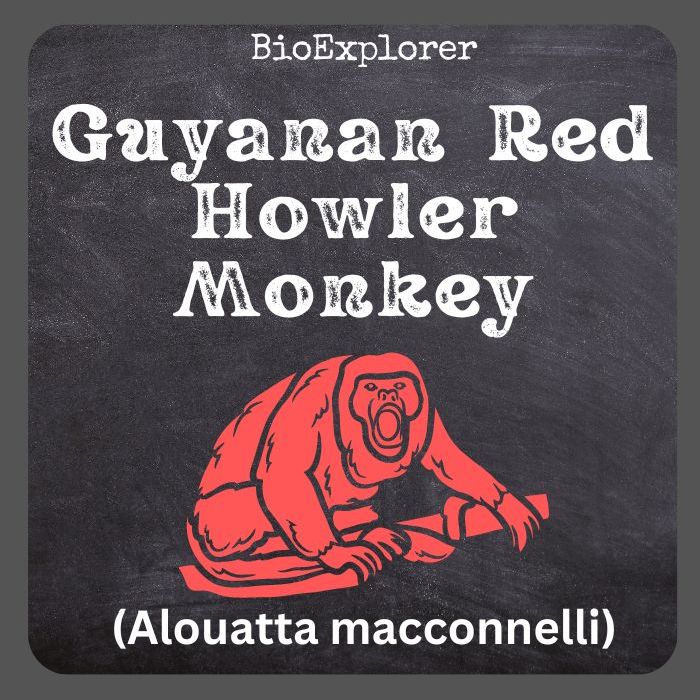
Guyanan Red Howler Monkey
| Kingdom | Order | Family | Genus | Species |
|---|---|---|---|---|
| Animalia | Primates | Atelidae | Alouatta | Alouatta macconnelli |
- Common Name: Guianan Red Howler
- Taxonomy Classification Year: 1910
- Monkey Size: 46 to 72 cm (18.11 to 28.35 in)
- Skin Color(s): Deep reddish-brown
- Habitat: Forest, rainforest
- Diet: Omnivorous
- Native Countries: Guyana, Suriname, Trinidad and Tobago, Venezuela, Brazil

Guianan Red Howler Distribution
Countries
Guyana ( )
)
)
Suriname ( )
)
)
Trinidad and Tobago ( )
)
)
Venezuela ( )
)
)
Brazil ( )
)
)Guyanan Red Howler Monkey Characteristics
The Guyanan Red howler monkey[1] (Alouatta macconnelli) also known as Guianan Red Howler, is a New World Monkey native to Guyana, Suriname, Trinidad, Venezuela, and Brazil.
- Guyanan red howlers are somewhat sexually dimorphic.
- Females have a body length of 46 to 57 cm; males, which are larger, have a body length of 49 to 72 cm.
- Both sexes in this species have a long prehensile tail of about 49 to 75 cm.
- The coat color of both males and females is a deep reddish brown, although the shade slightly varies with age.
- These red howlers have a large neck with a massive lower jaw and hyroid bones, giving them an imposing expression.
What Do Guianan Red Howlers Eat?
The Guianan Red Howler nourishes on these food sources but not limited to[¶]:
- Laurel Espada (Ocotea floribunda).
- Palo De Gallina (Alchorneopsis floribunda).
- Assai Palm (Euterpe oleracea).
- Conejo (Protium tenuifolium)
- Black Manwood (Minquartia guianensis).
- Hogplum (Spondias mombin)
- Inga Grande (Inga alata).
- Trichilia (Trichilia)
- Mata Palos (Ficus amazonica).
- Wild Balata (Micropholis guyanensis).
- Cuero De Rana (Laetia procera).
- Maripa Palm (Attalea maripa).
- Icecreambean (Inga edulis)
- Fourleaf Buchenavia (Buchenavia tetraphylla).
- Bulletwood (Manilkara bidentata)
- Pacae Colorado (Inga alba).
- Jamaican Cherry Fig (Ficus americana).
- Guiana Brosimum (Brosimum guianense).
Guyanan Red Howler Monkey Facts
- Guyanan red howler monkeys are social creatures in large groups of 3 to 10 individuals.
- Each troop has a hierarchy consisting of a single dominant alpha male, sometimes with 1 or 2 subadult males. The rests are females and their young.
- They are primarily passive, exhibiting unusually aggressive behavior. When aggressive interactions occur, it is typically between individuals of the same sex.
- Mature migratory males will attack the dominant male of a group for territory and females, with a frontal fight resulting in injury, loss of toes and tail, or even death.
- A solitary migrant female species that desires access to a group will exhibit submissive behavior and constantly follow the group for several days or even months, only to be constantly chased and bitten by the females of the resident group.
- Guyanan red howlers are arboreal and diurnal; they forage, travel during the day, and sleep at night, mainly in tree canopies 15 to 20 meters high.
What Do Guianan Red Howlers Eat?
The Guianan Red Howler nourishes on these food sources but not limited to[¶]:
- Laurel Espada (Ocotea floribunda).
- Palo De Gallina (Alchorneopsis floribunda).
- Assai Palm (Euterpe oleracea).
- Conejo (Protium tenuifolium)
- Black Manwood (Minquartia guianensis).
- Hogplum (Spondias mombin)
- Inga Grande (Inga alata).
- Trichilia (Trichilia)
- Mata Palos (Ficus amazonica).
- Wild Balata (Micropholis guyanensis).
- Cuero De Rana (Laetia procera).
- Maripa Palm (Attalea maripa).
- Icecreambean (Inga edulis)
- Fourleaf Buchenavia (Buchenavia tetraphylla).
- Bulletwood (Manilkara bidentata)
- Pacae Colorado (Inga alba).
- Jamaican Cherry Fig (Ficus americana).
- Guiana Brosimum (Brosimum guianense).
Suggested Reading: Types Of Monkey With Pictures and Facts
Cite this page
BioExplorer. (2026, August 26). Guyanan Red Howler Monkey. https://www.bioexplorer.net/animals/mammals/monkeys/guyanan-red-howler-monkey/