Geoffroy’s Spider Monkey

Geoffroy's Spider Monkey

KingdomOrderFamilyGenusSpecies
AnimaliaPrimatesAtelidaeAtelesAteles geoffroyi

Geoffroy's spider monkey
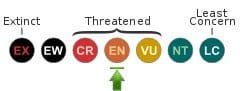
IUCN Status: Endangered
  • Common Name: Central American Spider Monkey
  • Taxonomy Classification Year: 1820
  • Monkey Size: 30 to 63 cm (12 to 25 in)
  • Skin Color(s): Black, brown, or reddish
  • Habitat: Forest, rainforest
  • Diet: Herbivorous
  • Native Countries: Mexico, Costa Rica, Belize, El Salvador, Honduras, Guatemala, Panama, Nicaragua

Central American Spider Monkey Distribution

Author: Al MacDonald Editor: Fritz Lekschas License: CC BY-SA 3.0 ID: ISO 3166-1 or "_[a-zA-Z]" if an ISO code is not available United Arab Emirates Afghanistan Albania Armenia Angola Argentina Austria Australia Azerbaijan Bosnia and Herzegovina Bangladesh Belgium Burkina Faso Bulgaria Burundi Benin Brunei Darussalam Bolivia (Plurinational State of) Brazil Bahamas Bhutan Botswana Belarus Belize Canada Democratic Republic of Congo Central African Republic Congo Switzerland Côte d'Ivoire Chile Cameroon China Colombia Costa Rica Cuba Cabo Verde Cyprus Czechia Germany Denmark Djibouti Dominica Dominican Republic Algeria Ecuador Estonia Egypt Eritrea Spain Ethiopia Finland Falkland Islands (Malvinas) France Gabon United Kingdom of Great Britain and Northern Ireland Georgia Ghana Greenland Gambia Guinea Equatorial Guinea Greece Guatemala Guinea-Bissau Guyana Honduras Croatia Haiti Hungary Indonesia Ireland Israel India Iraq Iran (Islamic Republic of) Iceland Italy Jamaica Jordan Japan Kenya Kyrgyzstan Cambodia Comoros Korea (Democratic People's Republic of) Korea, Republic of Kuwait Kazakhstan Lao People's Democratic Republic Lebanon Saint Lucia Sri Lanka Liberia Lesotho Lithuania Luxembourg Latvia Libya Morocco Moldova, Republic of Montenegro Madagascar North Macedonia Mali Myanmar Mongolia Mauritania Malta Mauritius Maldives Malawi Mexico Malaysia Mozambique Namibia New Caledonia Niger Nigeria Nicaragua Netherlands Norway Nepal New Zealand Oman Panama Peru Papua New Guinea Philippines Pakistan Poland Puerto Rico Portugal Paraguay Qatar Romania Serbia Russian Federation Rwanda Saudi Arabia Solomon Islands Seychelles Sudan Sweden Singapore Slovenia Slovakia Sierra Leone Senegal Somalia Suriname South Sudan Sao Tome and Principe El Salvador Syrian Arab Republic Eswatini Chad Togo Thailand Tajikistan Turkmenistan Tunisia Turkey Trinidad and Tobago Taiwan, Province of China Tanzania, United Republic of Ukraine Uganda United States of America Uruguay Uzbekistan Saint Vincent and the Grenadines Venezuela (Bolivarian Republic of) Viet Nam Vanuatu Yemen South Africa Zambia Zimbabwe
Countries
Mexico
Costa Rica
Belize
El Salvador
Honduras
Guatemala
Panama
Nicaragua

Geoffroy’s Spider Monkey Characteristics
Geoffroy's Spider Monkey

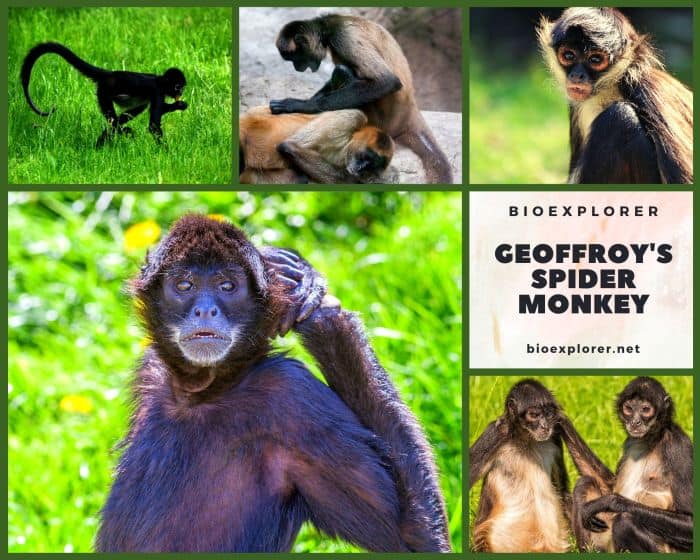
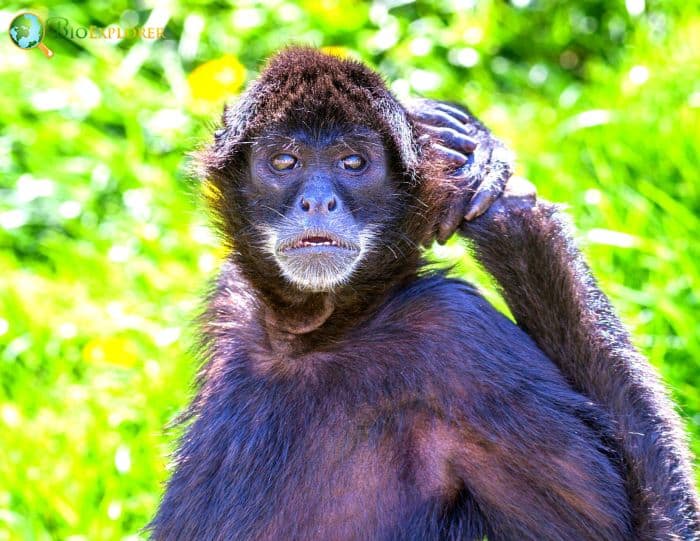
Geoffroy’s spider monkey[1] also called the Central American spider monkey or black-handed spider monkey, is a species of spider monkey, a New World species of monkey, native to Central America, parts of Mexico, and perhaps a small part of Colombia.

  • Like other monkeys and great apes, Geoffroy’s spider monkeys have large, opposed toes on their feet that can quickly grab branches.
  • As the name suggests, these monkeys have black hands and feet. Their fur coats vary in color from tan to black or reddish brown.
  • Babies are born black, but their fur lightens in the first five months of life. After that, a small head rests on a flexible body.
  • Their expressive faces are hairless, with unpigmented skin framing the eyes and muzzle in a pale facial mask.

What Do Geoffroy’s Spider Monkeys Eat?
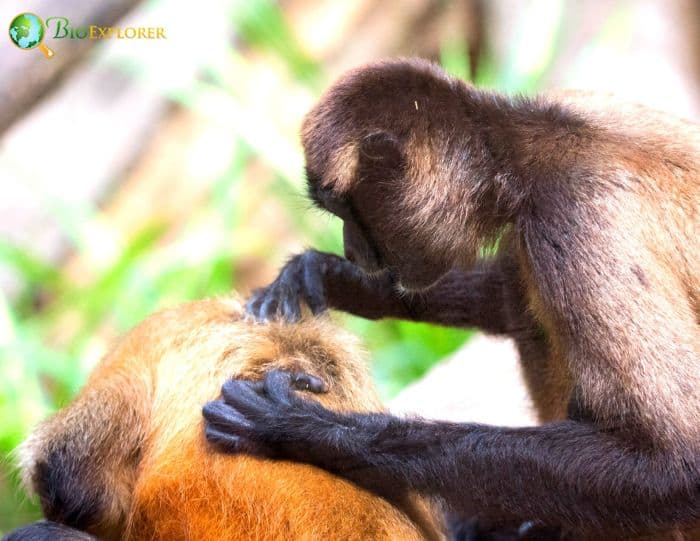
Ateles Geoffroyi

According to the study published[¶], the Geoffroy’s spider monkey feeds on several plant matters, including these prominent sources:

  • Breadnut (Brosimum alicastrum)
  • Strawberrytree (Muntingia calabura)
  • Gumbo Limbo (Bursera simaruba).
  • Cedro Macho (Aralia excelsa).
  • False Chiggergrape (Coccoloba venosa).
  • Icecreambean (Inga edulis)
  • Mango (Mangifera indica)
  • Jagua (Genipa americana)
  • Pachiuba (Socratea exorrhiza)
  • Requia Colorada (Trichilia cipo).
  • Panama Hat Plant (Carludovica palmata).
  • Smooth Manjack (Cordia laevigata).
  • Pumpwood (Cecropia peltata)
  • Malaysian Apple (Syzygium malaccense).
  • Guarumo (Cecropia obtusifolia)
  • Conejo (Protium tenuifolium)
  • Guabo Pachón (Inga goldmanii).
  • Star Apple (Chrysophyllum cainito).
  • Angelica Tree (Dendropanax arboreus).
  • Abas (Psidium guajava)
  • False Coffee (Faramea occidentalis).
  • Panama Tree (Sterculia apetala).
  • Guarumo Amarillo (Cecropia longipes).
  • Amate (Ficus obtusifolia)
  • Hogplum (Spondias mombin)
  • Chirimoya (Annona spraguei)
  • Puerto Rico Silver Palm (Coccothrinax barbadensis).

What Eats Geoffroy’s Spider Monkeys?

Two main predators of this Central American primate are jaguars (Panthera onca) and Cougars (Puma concolor)[§].

Geoffroy’s Spider Monkey Facts

  • The genus name Ateles means “imperfect“, a reference to the vestigial thumb of the monkey.
  • The species name geoffroyi is honored by Étienne Geoffroy Saint-Hilaire, a French naturalist.
  • Primatologists believe that the enlarged clitoris of female Geoffroy’s spider monkeys helps males decide which female to approach for mating. It allows the male species to gauge a woman’s sexual receptivity.
  • Geoffroy’s spider monkeys’ modes of locomotion include walking, climbing, or crawling along delicate branches, swinging from one branch to another.
  • Often, they rub their fur with a mixture of saliva and crushed linden leaves as a natural insect repellent.
  • The Geoffroy’s spider monkey consists of five recognized subspecies residing in various parts of Central America and Mexico. These include the Hooded spider monkey (A. g. grisescens) in southern Mexico, the ornately-patterned Ornate spider monkey (A. g. ornatus) in Costa Rica and Panama, the Yucatan spider monkey (A. g. yucatanensis) in the Yucatan Peninsula, the Mexican spider monkey (A. g. vellerosus) in Veracruz, and the nominate Nicaraguan spider monkey subspecies (A. g. geoffroyi) found in Nicaragua, Honduras and northern Costa Rica.

Suggested Reading: All Monkeys

Cite this page

Bio Explorer. (2026, January 5). Geoffroy’s Spider Monkey. https://www.bioexplorer.net/animals/mammals/monkeys/geoffroys-spider-monkey/

Key References

  • [1]“Habitat Characteristics of Black-handed Spider Monkeys (Ateles geoffroyi) at La Suerte Biological Field Station, Costa Rica”. Accessed August 16, 2022. Link.
  • [¶] – Fricke, E.C., Svenning, J. Accelerating homogenization of the global plant-frugivore meta-network. Nature 585, 74-78 (2020). https://doi.org/10.1038/s41586-020-2640-y.
  • [¶] – fgabriel1891/Palm-Frugivore_Interactions_Neo-AfrotropicsZona, S. & Henderson, A. (1989) A review of animal mediated seed dispersal of palms. Selbyana, 11, 6-21. Online Update 2006 ((http://www.virtualherbarium.org/palms/psdispersal.html).
  • [¶] – fgabriel1891/Palm-Frugivore_Interactions_Neo-AfrotropicsWright, S. J.; Duber, H. C.. 2001. Poachers and forest fragmentation alter seed dispersal, seed survival, and seedling recruitment in the palm Attalea butyraceae, with implications for tropical tree diversity. Biotropica. 583-595
  • [¶] – fgabriel1891/Palm-Frugivore_Interactions_Neo-AfrotropicsGonzalez-Zamora, Arturo; Arroyo-Rodriguez, Victor; Chaves, Oscar M.; Sanchez-Lopez, Sonia; Stoner, Kathryn E.; Riba-Hernandez, Pablo. 2009. Diet of Spider Monkeys (Ateles geoffroyi) in Mesoamerica: Current Knowledge and Future Directions. American Journal of Primatology. Aug-20
  • [¶] – fgabriel1891/Palm-Frugivore_Interactions_Neo-AfrotropicsRusso, S. E.; Campbell, C. J.; Dew, J. L.; Stevenson, P. R.; Suarez, S. A.. 2005. A multi-forest comparison of dietary preferences and seed dispersal by Ateles spp.. International Journal of Primatology. 1017-1037
  • [¶] – fgabriel1891/Palm-Frugivore_Interactions_Neo-AfrotropicsBeckman, Noelle G.; Muller-Landau, Helene C.. 2007. Differential effects of hunting on pre-dispersal seed predation and primary and secondary seed removal of two neotropical tree species. Biotropica. 328-339
  • [¶] – fgabriel1891/Palm-Frugivore_Interactions_Neo-AfrotropicsSezen, Uzay U.; Chazdon, Robin L.; Holsinger, Kent E.. 2009. Proximity is not a proxy for parentage in an animal-dispersed Neotropical canopy palm. Proceedings of the Royal Society B-Biological Sciences. 2037-2044
  • [¶] – fgabriel1891/Palm-Frugivore_Interactions_Neo-AfrotropicsSezen, Uzay U.; Chazdon, Robin L.; Holsinger, Kent E.. 2007. Multigenerational genetic analysis of tropical secondary regeneration in a canopy palm. Ecology. 3065-3075
  • [¶] – fgabriel1891/Palm-Frugivore_Interactions_Neo-AfrotropicsScherbaum, Carmen; Estrada, Alejandro. 2013. Selectivity in feeding preferences and ranging patterns in spider monkeys Ateles geoffroyi yucatanensis of northeastern Yucatan peninsula, Mexico. Current Zoology. 125-134
  • [¶] – fgabriel1891/Plant-Frugivore-Interactions-SouthEastAsiaFleming, T. Breitwisch, Whitesides, G. 1987. Patterns of Tropical Vertebrate Frugivore Diversity. Annual Review of Ecology and Systematics, Vol. 18.
  • [§] – Middleton, O.S, Svensson, H, Scharlemann, J.P.W, Faurby, S, Sandom, C.J. CarniDIET 1.0: A database of terrestrial carnivorous mammal diets. Global Ecology and Biogeography. https://doi.org/10.1111/geb.13296. Craig, Christie A., Eleanor I. Brassine, and Daniel M. Parker. “A record of cheetah (Acinonyx jubatus) diet in the Northern Tuli Game Reserve, Botswana.”�African Journal of Ecology55.4 (2017): 697-700.

Leave a Reply

Your email address will not be published. Required fields are marked *