
Old World Monkeys Vs. New World Monkeys
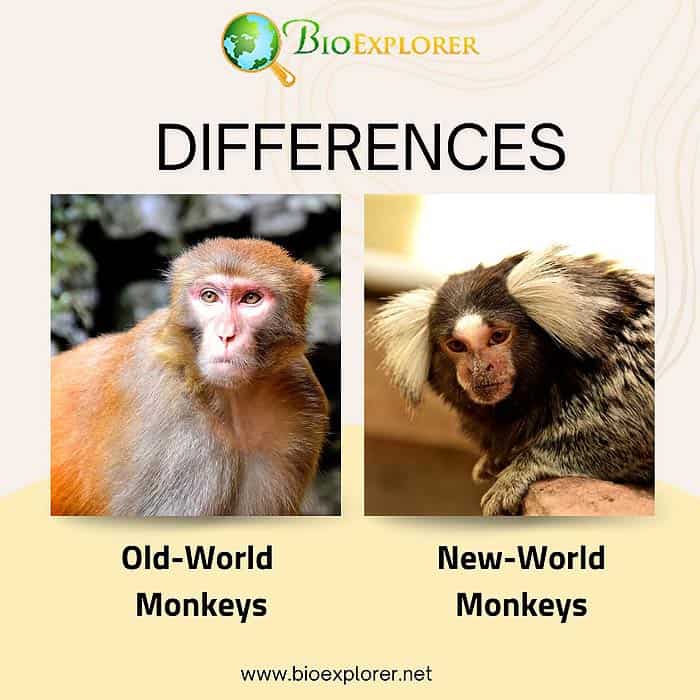
Old World monkeys hail from two continents, Africa and Asia, living in various terrains, including rainforests, savannah, mountains, and shrublands. Old-World Monkeys are the largest primate family in the world. Baboons, macaques, colobus, Guenons, and langurs are examples of old-world monkeys.
New World monkeys come from tropical regions of central and south American countries. Marmosets, sakis, night monkeys, spider monkeys, Uakaris, and tamarins are examples of New-World Monkeys.
Old-World Monkeys vs New-World Monkeys
| Aspect | Old World Monkeys | New World Monkeys |
|---|---|---|
| Taxonomic Family | Cercopithecidae. | Cebidae, Callitrichidae, Atelidae, Pitheciidae, and Aotidae. |
| Geographic Origin | Africa and Asia. | The Americas. |
| Relative Body Size | Medium to large-sized. | Small to medium-sized. |
| Diet | Either herbivorous or omnivorous depending on the subfamily. | Varies a lot by species, but many are frugivorous or insectivorous. |
| Active Time | All species are diurnal. | All species are diurnal except for the 11 night monkey species (which are nocturnal). |
| Hands | They possess nails and opposable thumbs. | They possess no nails and non-opposable thumbs. |
| Tail | Non-prehensile. | Prehensile or non-prehensile depending on the species. |
| Teeth | Dental formula of 2.1.2.3 (meaning each quadrant of the mouth has 2 incisors, 1 canine, 2 premolars, and 3 molars). | Dental formula of 2.1.3.3 (meaning each quadrant of the mouth has 2 incisors, 1 canine, 3 premolars, and 3 molars). |
| Eyes | Trichromatic vision. | Depending on the species and sex, vision can be monochromatic, dichromatic, or trichromatic. |
| Nose | Downward-facing nose and nostrils. | Flat, broad nose with sideways-facing nostrils. |
| Sexual Behaviour | Most species fall somwhere between polygynous and polygynandrous. | Smaller species tend to stick to monogamy, while larger ones are typically polygamous. |
| Gestation | Gestation period is typically around 5 to 7 months. | Gestation period is, on average, about 5 months. |

330+ Types of Monkeys
Monkeys are classified into two main groups: Old-world monkeys and New-world monkeys. Explore all 334 different types of monkeys and their facts here.
Read more
Cite this page
BioExplorer. (2026, August 26). Old World Monkeys Vs. New World Monkeys. https://www.bioexplorer.net/animals/mammals/monkeys/differences/