
Azara’s Night Monkey

| Kingdom | Order | Family | Genus | Species |
|---|---|---|---|---|
| Animalia | Primates | Aotidae | Aotus | Aotus azarae |
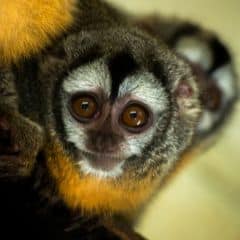
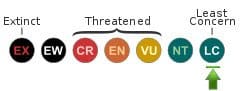
- Common Name: Azara’s Night Monkey
- Taxonomy Classification Year: 1811
- Monkey Size: 24 to 37 cm (9 to 14 inches)
- Skin Color(s): Grayish-brown
- Habitat: Forests
- Diet: Frugivorous
- Native Countries: Bolivia, Paraguay, Brazil, Peru, Argentina

Azara’s Night Monkey Distribution
Countries
Bolivia ( )
)
)
Paraguay ( )
)
)
Brazil ( )
)
)
Peru ( )
)
)
Argentina ( )
)
)Azara’s Night Monkey Characteristics
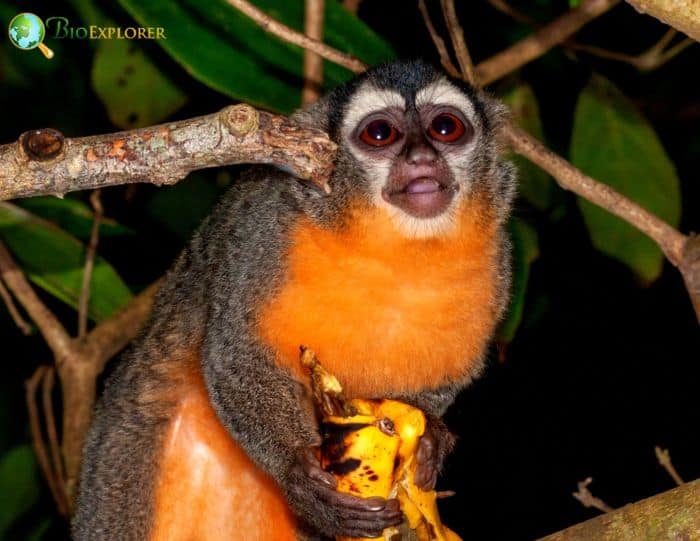
Azara’s night monkeys[1], also known as southern night monkeys and Azara’s owl monkeys, are native to the Gran Chaco region of South America, a vast area with many different ecosystems, from savannas to grasslands to dry spiny forests and gallery forests.
- Azara’s night monkeys sport startling markings. Their abdomen is a beautiful orange color contrasting with the gray-brown woolly fur on their body. Their ears are short, round, and barely visible. Their facial expressions are highlighted by white hair.
- Their large round eyes are hazel brown with large black pupils framed by light brown hair, making them resemble owls.
- Their nose is flat and small, with the nostrils turning sides. Azara’s night monkeys have a throat pouch that allows them to make loud sounds.
- They have large finger and toe pads and opposable thumbs. The large, muscular legs make these species agile jumpers.
Azara’s Night Monkey Facts
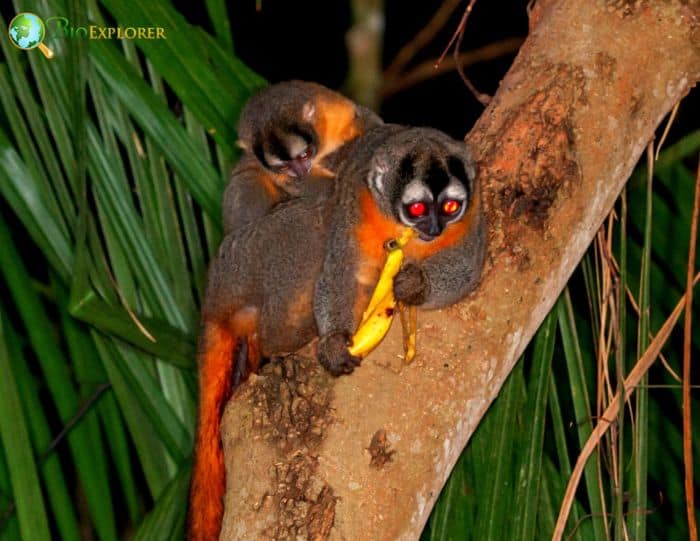
- The scientific name of this monkey is made up of two words: aotus, meaning without ears, and Azara, about Félix Manuel de Azara, a Spanish naturalist.
- Genetic testing has shown that the males of this species mated pairs are the fathers of the babies they care for.
- Grooming has barely been observed in feral groups, but captive studies show that monogamous pairs sometimes groom each other.
- Although not quite visible, their eyes have a physical feature found in a few primate species. Each retina has only one type of cone, resulting in a lack of color vision.
- Although primarily nocturnal, some populations of Azara’s night monkeys are unique among nocturnal monkeys in that they are active both day and night.
Suggested Reading: Common Monkey Species
Cite this page
BioExplorer. (2026, August 26). Azara’s Night Monkey. https://www.bioexplorer.net/animals/mammals/monkeys/azaras-night-monkey/