
Southern Yellow-Cheeked Gibbon

| Kingdom | Order | Family | Genus | Species |
|---|---|---|---|---|
| Animalia | Primates | Hylobatidae | Nomascus | Nomascus gabriellae |
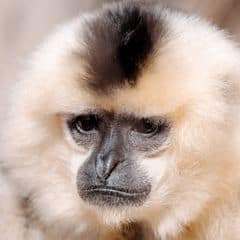
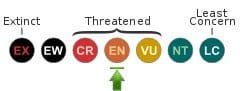
- Common Names: Golden-cheeked gibbon, Buffed-cheeked gibbon, Red-cheeked gibbon, Southern yellow-cheeked crested gibbon, or Golden-cheeked crested gibbon
- Taxonomy Classification Year: 1909
- Monkey Size: 60 to 80 cm (23.62 to 31.50 in)
- Skin Color(s): Brownish-yellow
- Habitat: Rainforest
- Diet: Herbivorous
- Native Countries: Vietnam, Laos, Cambodia

Southern Yellow-Cheeked Gibbon Distribution
Countries
Vietnam ( )
)
)
Laos ( )
)
)
Cambodia ( )
)
)Southern Yellow-Cheeked Gibbon Characteristics
The southern yellow-cheeked gibbon[1] is a species of gibbon endemic to Cambodia, Laos, and Vietnam.
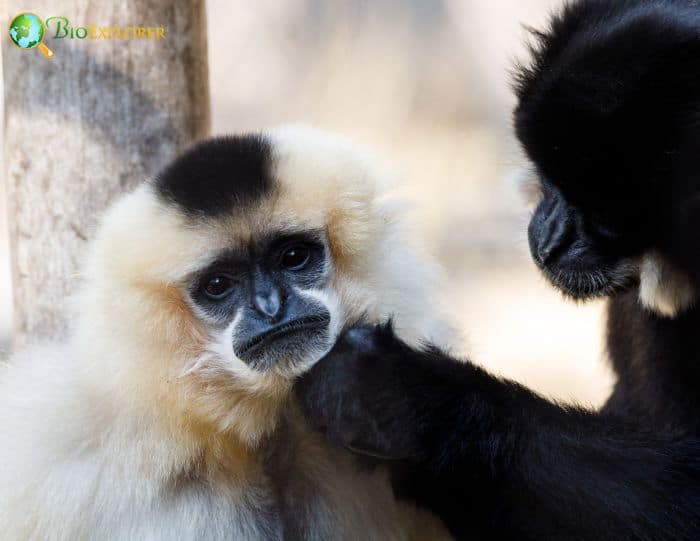
- Gibbons have relatively long legs and extremely long arms. The hands are so long that they seem hooked.
- The thumbs of the hands are not extended and are not used to swing from branch to branch; instead, those thumbs are used more for grooming behavior. The body is usually held in an upright position.
- In southern yellow-cheeked gibbons, males have small brown cheek spots that extend to the base of the eyes and may be slightly separated on the neck.
- The females of this species are smaller than other female gibbons and have a black rim on their ears.
- Females are usually brownish-yellow in color and may have a slight gray tint to the darker hair on the chest, the edges of the toes and fingers, and the outer forearm.
Southern Yellow-Cheeked Gibbon Facts
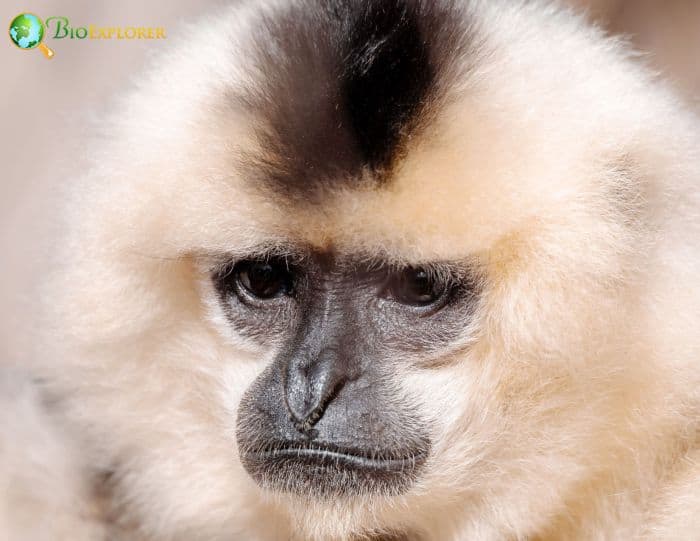
- The southern yellow-cheeked gibbons were discovered and named after Gabrielle Maud Vassal, a British naturalist.
- They live almost exclusively in trees and rarely leave the canopy’s safety and comfort.
- The coloration that develops throughout their lives plays a vital role in signaling sex and maturity in yellow-cheeked gibbons.
- Researchers have identified the basic syntax and grammar in gibbon songs, making them a unique model for studying the development and evolution of language.
- While other ape species sometimes rely on brachiation, gibbons are the true virtuosos of this method of movement, taking it to levels of efficiency that no chimpanzee, orangutan, Bonobo, or human could even dream of.
Suggested Reading: Types of Gorillas and Monkeys
Cite this page
BioExplorer. (2026, August 26). Southern Yellow-Cheeked Gibbon. https://www.bioexplorer.net/animals/mammals/apes/southern-yellow-cheeked-gibbon/