
Radiobiology: How Radiation Affects Living Things
Radiobiology, also called radiation biology, is the branch of biology that studies how radiation affects living cells, tissues, organs, and organisms. It explains how radiation interacts with DNA, proteins, water, membranes, chromosomes, and cellular repair systems.
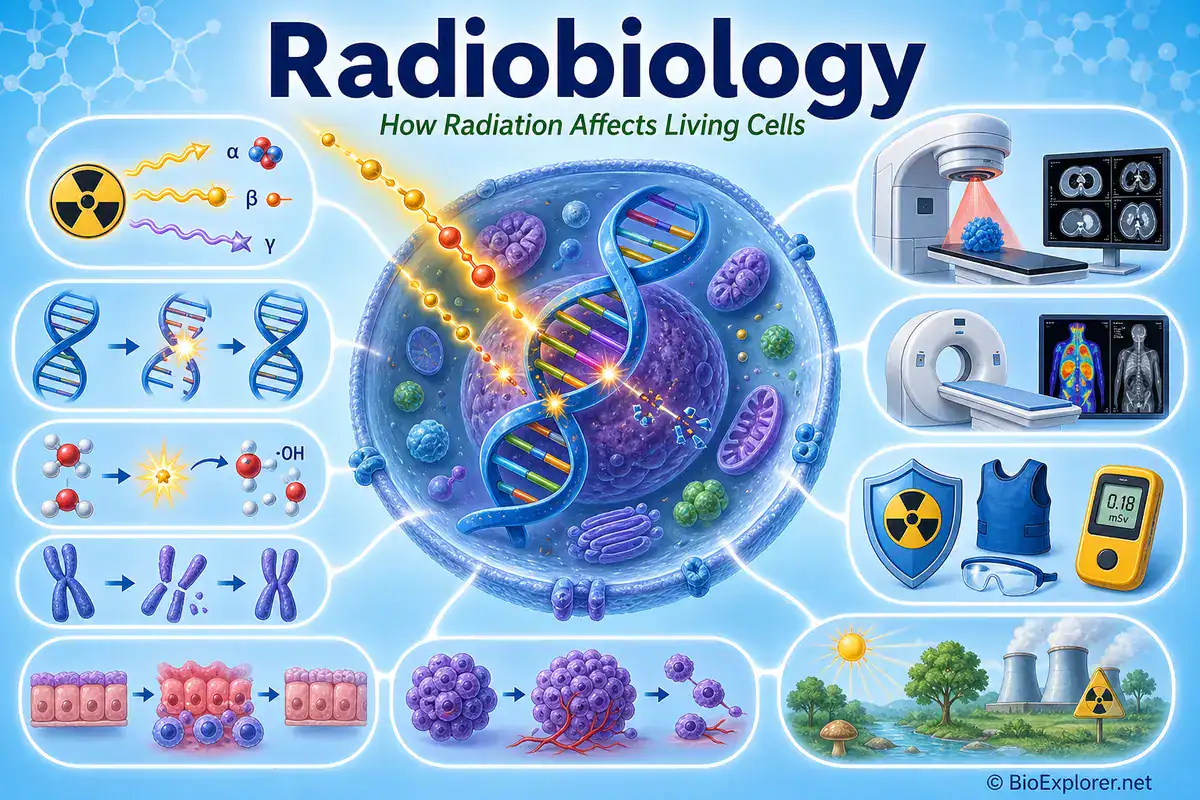
Radiobiology connects closely with cell biology, molecular biology, genetics, biochemistry, biophysics, oncology, medicine, radiation protection, biotechnology, and environmental health. It helps scientists understand DNA damage, radiation therapy, radiosensitivity, cancer risk, radiation exposure, and the biological effects of ionizing radiation.
Radiobiology Guide:
- Radiobiology Definition and Meaning
- Key Discoveries in the History of Radiobiology
- What Do Radiobiologists Study?
- Types of Radiation in Radiobiology
- Ionizing vs Non-Ionizing Radiation
- How Radiation Affects Cells and DNA
- DNA Damage and Repair
- Cell Death, Mutation, and Cancer Risk
- Radiobiology in Cancer Treatment
- Radiosensitivity and Radioresistance
- The 5 Rs of Radiobiology
- Radiation Dose, Dose Rate, and Exposure
- Radiation Protection
- Radiobiology Techniques and Tools
- Why Is Radiobiology Important?
- Careers in Radiobiology
- Radiobiology vs Related Fields
- Related Biology Fields
- Recommended Radiobiology Resources
- Radiation Health and Safety
- Radiation Therapy and Cancer
- Radiobiology and DNA Damage
- Radiobiology FAQs
Radiobiology Definition and Meaning
Radiobiology is the scientific study of the effects of radiation on living systems. It focuses especially on how radiation changes cells and DNA, how organisms repair radiation damage, and how radiation can either harm tissues or be used carefully in medicine.
A simple radiobiology definition is this: radiobiology studies how radiation affects life at the molecular, cellular, tissue, and organism level.
The field is important because radiation can damage biological molecules, especially DNA. At controlled doses, radiation can also be used in cancer treatment, medical imaging, sterilization, research, and biotechnology. The challenge is understanding dose, timing, tissue response, and risk.
Key Discoveries in the History of Radiobiology
Radiobiology developed from discoveries in radiation physics, genetics, cell biology, and cancer treatment. These milestones helped scientists understand how radiation interacts with living tissue, especially DNA and dividing cells.
| Year | What Was Discovered | Significance |
|---|---|---|
| 1895 | Wilhelm Röntgen discovered X-rays. | Opened the door to medical imaging and the study of how penetrating radiation affects living tissue. |
| 1896 | Henri Becquerel discovered natural radioactivity. | Showed that some materials spontaneously emit penetrating radiation, creating a foundation for radiation biology. |
| 1898 | Marie and Pierre Curie discovered polonium and radium. | Provided powerful radioactive sources that shaped early radiation research and cancer treatment. |
| 1906 | Bergonié and Tribondeau linked radiosensitivity with cell division and differentiation. | Helped explain why rapidly dividing, less differentiated cells are often more radiation-sensitive. |
| 1927 | Hermann J. Muller showed that X-rays induce mutations in fruit flies. | Proved that ionizing radiation can alter heredity and damage genetic material. |
| 1953 | L. H. Gray and colleagues described the oxygen effect in radiotherapy. | Showed that oxygen levels strongly influence radiation sensitivity, helping explain tumor hypoxia and radioresistance. |
| 1956 | Theodore Puck and Philip Marcus developed mammalian cell survival methods after X-ray exposure. | Helped establish quantitative cell-survival assays, including the basis for clonogenic radiobiology experiments. |
| 1959-1960 | M. M. Elkind and Harriet Sutton demonstrated repair of sublethal radiation damage. | Explained why splitting radiation dose over time can allow some cells to repair damage between exposures. |
What Do Radiobiologists Study?
Radiobiologists study how radiation interacts with living matter. Some focus on molecules and cells. Others study tissues, tumors, whole organisms, radiation workers, astronauts, patients receiving radiation therapy, or populations exposed to environmental radiation.
- DNA damage: How radiation causes base damage, single-strand breaks, double-strand breaks, and chromosome changes.
- DNA repair: How cells detect and repair radiation-induced damage.
- Cell survival: Why some cells survive radiation while others die or stop dividing.
- Radiosensitivity: Why some tissues, tumors, and cell types respond strongly to radiation.
- Radioresistance: Why some cells resist radiation damage or repair it effectively.
- Radiation therapy: How radiation is used to damage cancer cells while limiting injury to normal tissue.
- Radiation protection: How exposure can be reduced through dose control, shielding, distance, and time.
- Radiation risk: How dose, dose rate, radiation type, and tissue type influence biological effects.
Types of Radiation in Radiobiology
Radiobiology often focuses on ionizing radiation because it has enough energy to remove electrons from atoms and molecules. This can damage DNA directly or indirectly through reactive molecules formed from water. Some forms of non-ionizing radiation, such as ultraviolet radiation, can also cause biological damage, but they act differently from X-rays, gamma rays, or charged particles.
| Radiation Type | What It Is | Biological Importance |
|---|---|---|
| X-rays | High-energy electromagnetic radiation used in imaging and therapy. | Can ionize atoms and damage DNA at sufficient dose. |
| Gamma Rays | High-energy radiation emitted from radioactive nuclei. | Deeply penetrating ionizing radiation used in medicine and research. |
| Alpha Particles | Heavy charged particles made of two protons and two neutrons. | Low penetration but highly damaging if radioactive material enters the body. |
| Beta Particles | High-energy electrons or positrons from radioactive decay. | Can damage tissues depending on energy, dose, and exposure route. |
| Neutrons | Uncharged particles released in some nuclear reactions. | Can be biologically damaging and require specialized shielding. |
| Protons and Heavy Ions | Charged particles used in some forms of radiation therapy and research. | Can deposit energy in targeted patterns useful for certain treatments. |
| Ultraviolet Radiation | Non-ionizing radiation from sunlight and artificial sources. | Can damage DNA in skin cells, especially through UV-induced photochemical changes. |
Ionizing vs Non-Ionizing Radiation
The difference between ionizing and non-ionizing radiation is central to radiobiology. Ionizing radiation has enough energy to remove electrons from atoms or molecules. Non-ionizing radiation does not usually remove electrons, but some types can still affect tissues through heat, photochemical reactions, or other mechanisms.
| Radiation Category | Main Feature | Examples |
|---|---|---|
| Ionizing Radiation | Has enough energy to ionize atoms and can damage DNA directly or indirectly. | X-rays, gamma rays, alpha particles, beta particles, neutrons, protons. |
| Non-Ionizing Radiation | Does not usually ionize atoms but may still affect tissues depending on wavelength, intensity, and exposure. | Ultraviolet, visible light, infrared, microwaves, radiofrequency radiation. |
For biology students, the key point is simple: ionizing radiation can directly change atoms and molecules inside cells. That is why it is important in radiation therapy, radiation safety, DNA damage research, and cancer risk studies.
How Radiation Affects Cells and DNA
DNA is one of the most important biological targets of ionizing radiation. Radiation can damage DNA directly by interacting with the DNA molecule itself. It can also damage DNA indirectly by splitting water molecules and creating reactive molecules that then attack DNA, proteins, lipids, and other cell structures.
Cells respond to radiation damage in several ways. They may repair the damage correctly, repair it incorrectly, pause the cell cycle, die, become senescent, or survive with a mutations. The final outcome depends on dose, dose rate, radiation type, oxygen level, cell type, repair capacity, and the stage of the cell cycle.
To understand the DNA side of this process, see BioExplorer’s guide to building blocks of nucleic acids. For cell-level context, see cellular organization.
DNA Damage and Repair
Radiation can cause several types of DNA damage. Some damage is relatively easy for cells to repair. Other damage, especially clustered damage and double-strand breaks, can be more difficult and biologically serious.
| Damage Type | What It Means | Why It Matters |
|---|---|---|
| Base Damage | A DNA base is chemically altered. | May cause mutation if not repaired correctly. |
| Single-Strand Break | One strand of the DNA helix is broken. | Often repairable, but still biologically important. |
| Double-Strand Break | Both DNA strands are broken close together. | Can be lethal or mutagenic if misrepaired. |
| Clustered DNA Damage | Multiple nearby lesions occur in a small DNA region. | Can be harder for repair systems to fix accurately. |
| Chromosome Aberration | Large-scale chromosome damage or rearrangement occurs. | Can affect cell survival, mutation, cancer risk, or inherited cell changes. |
Cells use DNA repair pathways to respond to radiation damage. If repair succeeds, the cell may survive normally. If repair fails or introduces errors, the result may be cell death, mutation, chromosome instability, or long-term biological risk.
Cell Death, Mutation, and Cancer Risk
Radiation effects can be grouped in two broad ways. Some effects happen when many cells are damaged or killed, especially at higher doses. Other effects involve changes such as mutations that may increase cancer risk over time.
In radiobiology, scientists often distinguish between tissue reactions and stochastic effects. Tissue reactions usually have dose thresholds, meaning they tend to appear only after enough cells in a tissue are affected. Stochastic effects, such as radiation-induced cancer risk, are usually discussed in terms of probability rather than severity.
This does not mean every radiation exposure causes cancer. It means radiobiology studies how risk changes with exposure conditions, tissue type, dose, dose rate, radiation quality, age, and biological sensitivity.
Radiobiology in Cancer Treatment
Radiobiology is central to radiation therapy. In cancer treatment, radiation is used to damage the DNA of cancer cells so they stop dividing or die. The goal is to deliver enough dose to control the tumor while protecting nearby normal tissues as much as possible.
Cancer cells are not all equally sensitive to radiation. Some are more vulnerable because of rapid division, poor DNA repair, or specific genetic defects. Others are more resistant because they repair damage efficiently, grow in low-oxygen regions, or contain resistant subpopulations.
Radiation therapy planning depends on biology and physics. Physicians and medical physicists consider tumor type, dose, fractionation, oxygenation, normal tissue tolerance, and treatment goals. Radiobiology helps explain why these decisions matter.
Radiosensitivity and Radioresistance
Radiosensitivity means how strongly cells, tissues, or organisms respond to radiation. Radioresistance means relative resistance to radiation damage or a stronger ability to survive after exposure.
Cells that divide rapidly, have limited repair capacity, or carry certain genetic defects may be more radiosensitive. Cells in low-oxygen environments may be more radioresistant because oxygen helps fix some forms of radiation-induced DNA damage.
Radiobiology studies these differences because they affect cancer treatment, radiation safety, tissue injury, and long-term risk.
The 5 Rs of Radiobiology
Radiation therapy often uses fractionation, which means dividing treatment into multiple smaller doses. The biological logic behind fractionation is commonly explained through the 5 Rs of radiobiology.
| R | Meaning | Why It Matters |
|---|---|---|
| Repair | Normal cells may repair some radiation damage between doses. | Helps protect healthy tissue during fractionated treatment. |
| Redistribution | Cells move through different phases of the cell cycle. | Some cell-cycle phases are more radiation-sensitive than others. |
| Reoxygenation | Tumor regions may become better oxygenated between treatments. | Oxygen can increase radiation effectiveness against cancer cells. |
| Repopulation | Cells may divide between radiation doses. | Can affect both tumor control and normal tissue recovery. |
| Radiosensitivity | Different cells and tissues have different inherent radiation responses. | Helps explain why tumors and normal tissues vary in treatment response. |
Radiation Dose, Dose Rate, and Exposure
Radiobiology depends on dose. The biological effect of radiation is not determined only by whether radiation is present. It also depends on how much energy is absorbed, how fast the dose is delivered, what kind of radiation is involved, and which tissues are exposed.
| Term | What It Means | Why It Matters |
|---|---|---|
| Absorbed Dose | The amount of radiation energy deposited in tissue, measured in gray. | Helps describe physical energy delivered to tissue. |
| Equivalent Dose | A dose measure adjusted for radiation type, measured in sievert. | Accounts for different biological effectiveness of radiation types. |
| Effective Dose | A risk-related dose measure adjusted for tissue sensitivity, measured in sievert. | Useful for radiation protection comparisons, not for individual medical diagnosis. |
| Dose Rate | How quickly a dose is delivered over time. | The same total dose may have different effects depending on delivery speed. |
| LET | Linear energy transfer, or how densely radiation deposits energy along its path. | High-LET radiation can produce more complex biological damage. |
Radiation Protection
Radiation protection applies radiobiology to reduce unnecessary exposure. The goal is not fear. The goal is informed control: use radiation when it has clear benefit, avoid unnecessary exposure, and reduce dose when practical.
Three basic principles are commonly used in radiation protection: time, distance, and shielding. Less time near a source lowers exposure. More distance usually lowers exposure. Proper shielding can absorb or reduce radiation before it reaches people or sensitive tissues.
Radiation safety also uses the ALARA principle, meaning exposures should be kept as low as reasonably achievable while still allowing necessary medical, scientific, or industrial work.
Radiobiology Techniques and Tools
Radiobiologists use laboratory, imaging, molecular, and computational methods to measure radiation effects and understand how cells respond.
| Technique | What It Measures or Tests | Common Use |
|---|---|---|
| Clonogenic Assay | Whether irradiated cells can survive and form colonies. | Classic test of cell survival after radiation. |
| DNA Damage Assays | Markers of DNA breaks or repair activity. | Studying radiation-induced DNA damage and repair. |
| Cell Cycle Analysis | How cells move through or stop in the cell cycle. | Understanding radiosensitivity and checkpoint responses. |
| Chromosome Analysis | Radiation-induced chromosome changes. | Biodosimetry, risk research, and radiation damage studies. |
| Animal and Tissue Models | Radiation effects in tissues or whole organisms. | Normal tissue response, cancer research, and treatment testing. |
| Dosimetry | Radiation dose measurement and calculation. | Treatment planning, exposure assessment, and radiation safety. |
| Computational Modeling | Simulates dose effects, cell response, or tissue response. | Radiation therapy research, risk estimation, and systems radiobiology. |
Why Is Radiobiology Important?
Radiobiology is important because radiation has both risks and benefits. It can damage cells, but it can also be used to treat cancer, guide diagnosis, sterilize materials, study biology, and prepare for radiation emergencies.
In medicine, radiobiology helps doctors and scientists improve radiation therapy, protect normal tissues, understand side effects, and study tumor response. In public health, it helps agencies evaluate radiation exposure, communicate risk, and prepare safety guidance.

Types of Doctors
In research, radiobiology helps explain how cells repair DNA, how mutations form, how tissues respond to injury, and how living systems handle stress. It also supports space biology, where astronauts may be exposed to cosmic radiation beyond Earth’s protective atmosphere.
Careers in Radiobiology
Radiobiology can lead to careers in cancer research, radiation oncology, medical physics, radiation protection, environmental health, molecular biology, genetics, toxicology, space biology, and biotechnology.
- Radiobiologist: Studies how radiation affects cells, tissues, DNA, and organisms.
- Radiation oncology researcher: Studies how radiation therapy affects tumors and normal tissues.
- Medical physicist: Works with radiation dose, treatment planning, imaging, and safety in medicine.
- Radiation protection specialist: Helps manage radiation exposure in healthcare, research, industry, or public safety.
- DNA repair researcher: Studies how cells detect and repair radiation-induced DNA damage.
- Cancer biologist: Studies tumor response, radioresistance, and treatment combinations.
- Environmental radiation scientist: Studies radiation in the environment and its biological implications.
- Space radiation researcher: Studies biological risks of cosmic radiation during space travel.
How To Become A Radiologist?
Radiobiology vs Related Fields
Radiobiology overlaps with several scientific and medical fields, but its focus is distinct: how radiation affects living systems.
| Field | Main Focus | How It Connects to Radiobiology |
|---|---|---|
| Radiobiology | Biological effects of radiation on cells, tissues, DNA, and organisms. | Explains radiation damage, repair, risk, and therapeutic use. |
| Radiology | Medical imaging and image-guided diagnosis using technologies such as X-rays, CT, MRI, and ultrasound. | Uses radiation in some imaging methods, but focuses on diagnosis. |
| Radiation Oncology | Cancer treatment using radiation therapy. | Applies radiobiology to tumor control and normal tissue protection. |
| Biophysics | Physical principles in living systems. | Helps explain radiation energy transfer, dose, and molecular effects. |
| Genetics | Genes, inheritance, mutation, and DNA variation. | Radiobiology studies radiation-induced DNA damage, mutation, and repair. |
Related Biology Fields
Radiobiology is closely linked with cell biology, because radiation effects begin with cells and cellular structures. It also connects with molecular biology, because radiation affects DNA, RNA, proteins, signaling pathways, and repair systems.
Radiobiology supports genetics by explaining mutation, chromosome damage, and DNA repair. It connects with biochemistry through free radicals, oxidative damage, enzymes, and molecular repair pathways. It also overlaps with biophysics and biotechnology through dosimetry, radiation tools, imaging, and experimental methods.
Recommended Radiobiology Resources
These external resources are useful for learning about radiation biology, radiation health effects, ionizing radiation, DNA damage, cancer treatment, and radiation protection.
Radiation Health and Safety
- CDC: Health Effects of Radiation A clear public-health resource explaining how radiation affects the body and DNA.
- CDC: About Ionizing Radiation A beginner-friendly explanation of ionizing radiation and why dose matters.
- WHO: Ionizing Radiation and Health Effects A global public-health overview of radiation exposure, health effects, and protection.
- EPA: Radiation Health Effects A useful resource on radiation, tissue damage, DNA effects, and radiation protection context.
Radiation Therapy and Cancer
- National Cancer Institute: Radiation Therapy for Cancer A trusted explanation of how radiation therapy damages cancer-cell DNA and slows or stops growth.
- Biological Response of Cancer Cells to Radiation Treatment A peer-reviewed review on radiation response, DNA damage, and cancer treatment biology.
- Altering DNA Repair to Improve Radiation Therapy A peer-reviewed article on DNA repair and radiotherapy response.
Radiobiology and DNA Damage
- Radiation-Induced DNA Damage and Repair Pathways A peer-reviewed review of DNA damage response in tumors and normal cells.
- NCBI Bookshelf: Mechanisms of Biological Effects A reference resource on biological mechanisms of ionizing radiation effects.
Radiobiology FAQs
Radiobiology is the branch of biology that studies how radiation affects living cells, tissues, DNA, organs, and organisms.
A radiobiologist studies radiation effects on cells, DNA damage, DNA repair, cell survival, radiosensitivity, radiation therapy, radiation risk, and radiation protection.
Ionizing radiation can damage DNA directly by breaking chemical bonds or indirectly by splitting water molecules and forming reactive molecules that damage DNA.
Radiobiology is important in cancer treatment because radiation therapy works mainly by damaging cancer-cell DNA while trying to limit injury to normal tissues.
Radiosensitivity is how strongly a cell, tissue, tumor, or organism responds to radiation exposure.
Radioresistance is the ability of cells or tissues to resist radiation damage or survive radiation exposure more effectively.
Radiobiology studies biological effects of radiation, while radiology focuses mainly on medical imaging and image-guided diagnosis.
Radiobiology careers include radiobiologist, radiation oncology researcher, medical physicist, radiation protection specialist, DNA repair researcher, cancer biologist, and space radiation researcher.
Cite this page
BioExplorer. (2026, September 30). Radiobiology: How Radiation Affects Living Things. https://www.bioexplorer.net/divisions_of_biology/radiobiology/