
Phycology: The Study of Algae
Phycology is the scientific study of algae. It includes the study of microscopic algae, seaweeds, phytoplankton, diatoms, dinoflagellates, green algae, red algae, brown algae, and algae-like photosynthetic organisms found in oceans, lakes, rivers, wetlands, soils, snow, ice, and other habitats.
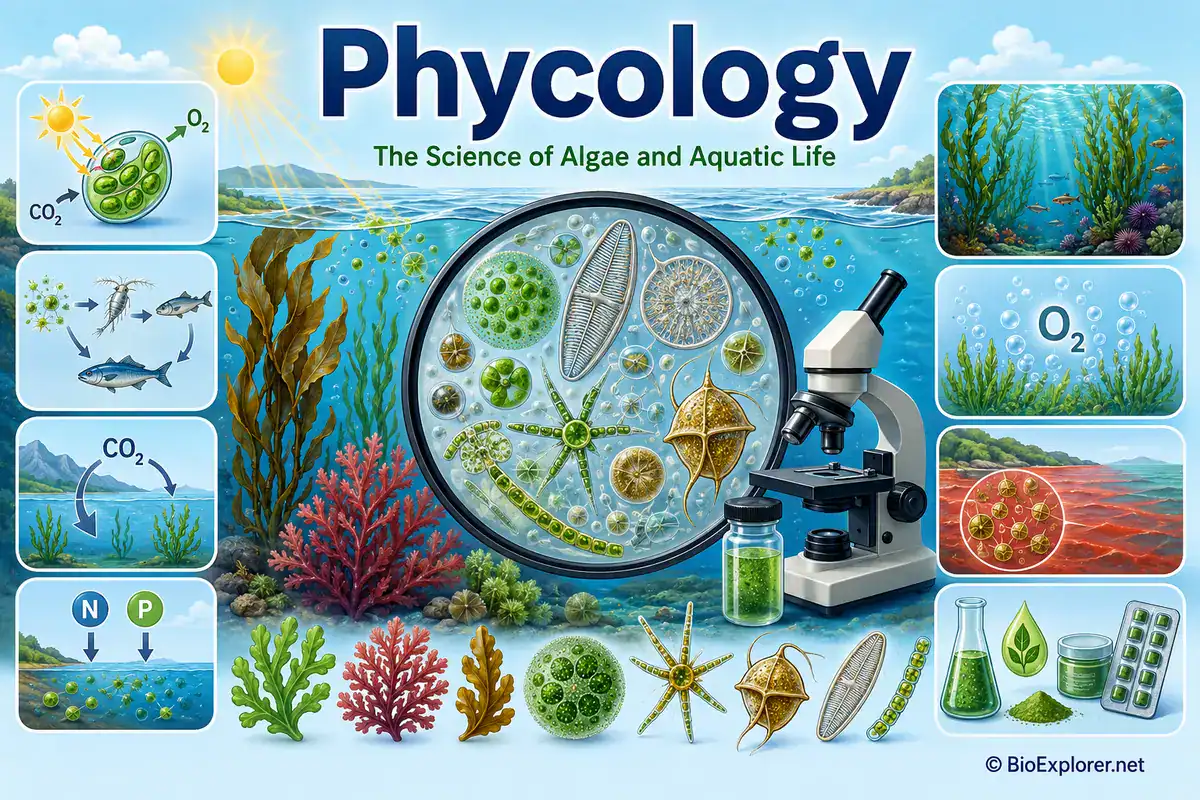
Phycology is also called algology. A phycologist studies how algae are identified, how they grow, how they photosynthesize, how they reproduce, how they shape aquatic food webs, how they respond to nutrients and light, and how some species form harmful algal blooms.
This field connects closely with botany, marine biology, ecology, microbiology, cell biology, and biotechnology. Algae matter because they produce food, release oxygen through photosynthesis, support aquatic ecosystems, form seaweed forests, influence carbon cycling, and provide useful materials for food, medicine, research, and industry.
Phycology Guide:
- Algae Are Not One Simple Group
- Major Algae and Algae-Like Groups
- Where Algae Live
- The Invisible Algae That Run Aquatic Food Webs
- Seaweeds Are Algae, Not True Plants
- Cyanobacteria: Why the Wording Matters
- Harmful Algal Blooms Without the Panic
- What Do Phycologists Study?
- Tools and Methods Used in Phycology
- Why Phycology Matters
- Phycology Careers
- Related BioExplorer Resources
- Recommended Phycology Resources
- Phycology FAQs
Algae Are Not One Simple Group
The first thing to know about phycology is that algae are not one clean taxonomic branch of life. The word algae is a practical term for many different photosynthetic organisms and lineages. Some algae are tiny single-celled organisms. Others are large seaweeds that can form underwater forests. Some are closely related to plants, while others belong to very different branches of eukaryotic life.
Most algae photosynthesize, but they do not all have the same pigments, cell structures, life cycles, or evolutionary histories. Many algae live in water, but some live on damp soil, rocks, tree bark, snow, ice, or inside other organisms. Some algae are free-floating plankton. Others attach to surfaces. Some are important food sources. Some produce toxins under certain conditions.
There is also a wording issue: cyanobacteria are often called blue-green algae in older or practical water-quality language, but they are bacteria, not eukaryotic algae. They are still commonly discussed with algae in phycology, limnology, microbiology, and harmful bloom work because they photosynthesize and can form blooms.
Major Algae and Algae-Like Groups
Phycologists study many kinds of algae and algae-like organisms. The groups below are not a single evolutionary ladder. They are a practical map of the organisms readers often meet when learning phycology.
| Group | What It Includes | Why It Matters |
|---|---|---|
| Green Algae | Mostly freshwater and marine algae with chlorophylls similar to land plants. | Important in evolution, freshwater ecology, symbiosis, and laboratory research. |
| Red Algae | Mostly marine algae, including many seaweeds and coralline algae. | Important in reef systems, food products, agar, carrageenan, and marine habitats. |
| Brown Algae | Large marine algae such as kelps, rockweeds, and Sargassum. | Build underwater habitats, support coastal food webs, and provide alginates. |
| Diatoms | Single-celled algae with glass-like silica cell walls. | Major phytoplankton, important oxygen producers, and useful environmental indicators. |
| Dinoflagellates | Mostly planktonic organisms; many photosynthesize, while others are mixotrophic or heterotrophic. | Important in marine food webs, coral symbiosis, bioluminescence, and some harmful algal blooms. |
| Phytoplankton | Microscopic drifting photosynthetic organisms in water. | Form the base of many aquatic food webs and influence oxygen and carbon cycling. |
| Cyanobacteria | Photosynthetic bacteria often called blue-green algae in practical settings. | Important in oxygen history, nitrogen fixation, water quality, and harmful cyanobacterial blooms. |
Where Algae Live
Algae are most familiar in oceans, lakes, ponds, and rivers, but phycologists find them in many more places. They can live in open water, on submerged rocks, on sediments, on sea ice, in damp soil, on tree bark, inside corals, in lichens, and in symbiosis with animals, fungi, or other organisms.
The conditions around an alga affect how it grows. Light, nutrients, temperature, salinity, water movement, grazing, competition, and pollution can all change which species are present. In a clear mountain lake, a phycologist may study plankton and water chemistry. On a rocky shore, the focus may be seaweed zonation, wave exposure, and tidal stress. In a coastal bloom, the question may be whether nutrients, temperature, and circulation have favored a fast-growing species.
The Invisible Algae That Run Aquatic Food Webs
Many of the most important algae are too small to see without a microscope. Phytoplankton are drifting microscopic photosynthetic organisms that live in sunlit water. They are eaten by zooplankton and other small animals, which are then eaten by fish and larger organisms. In this way, microscopic algae support much of the life in oceans, lakes, and other aquatic systems.
Phytoplankton and other marine photosynthesizers also produce a large share of Earth’s oxygen through photosynthesis. A careful way to state this is that ocean photosynthesizers are responsible for roughly half of global oxygen production, although oxygen in the atmosphere also depends on respiration, decomposition, burial of organic carbon, and long-term Earth system processes.
This is one reason phycology matters beyond algae identification. Studying algae helps scientists understand food webs, oxygen production, carbon cycling, water quality, climate processes, fisheries, and ecosystem change.
Seaweeds Are Algae, Not True Plants
Large marine algae are often called seaweeds. They can look plant-like, but they are not true vascular plants. Seaweeds do not have true roots, stems, leaves, flowers, seeds, or vascular tissue in the same way land plants do. Instead, many have structures such as holdfasts, stipes, and blades that help them attach, support themselves, and capture light.
Kelp forests are built by large brown algae. They provide shelter, food, and nursery habitat for many marine organisms. Other seaweeds are important as food, fertilizers, thickeners, stabilizers, research materials, and sources of compounds such as agar, carrageenan, and alginates.
Cyanobacteria: Why the Wording Matters
Cyanobacteria deserve special care in a phycology article. They are photosynthetic bacteria, not algae in the strict eukaryotic sense. However, they are frequently included in algae-related discussions because they live in similar habitats, perform photosynthesis, may form visible blooms, and can affect water quality.
Some cyanobacteria can fix nitrogen, which means they can convert atmospheric nitrogen into forms that living systems can use. Some can also produce toxins under certain bloom conditions.
For readers, the safest wording is: cyanobacteria are not true algae, but they are often studied alongside algae in ecology, microbiology, limnology, and harmful bloom monitoring.
Harmful Algal Blooms Without the Panic
Algae are essential to life in water, but some blooms can become harmful. A harmful algal bloom happens when algae or cyanobacteria grow in ways that damage ecosystems, wildlife, water quality, fisheries, recreation, drinking water, or human and animal health.
Not every algal bloom is toxic. Some blooms are mainly a sign of high productivity. Others can reduce oxygen when large amounts of biomass decay. Some species can produce toxins that affect fish, shellfish, marine mammals, birds, pets, livestock, or people. Blooms may be influenced by nutrients, temperature, sunlight, water movement, salinity, and ecological conditions.
Phycologists help identify bloom species, track bloom development, test for toxins, study environmental causes, and improve monitoring programs. This is one of the most practical modern uses of phycology.
What Do Phycologists Study?
Phycology is not only the naming of algae. It includes fieldwork, microscopy, culturing, molecular biology, ecology, physiology, chemistry, remote sensing, and applied research.
| Study Area | What Phycologists Ask | Example |
|---|---|---|
| Identification and Taxonomy | Which algae are present and how are they classified? | Using microscopy and DNA evidence to identify diatoms or seaweeds. |
| Photosynthesis and Pigments | How do algae capture light and convert it into chemical energy? | Studying chlorophylls, carotenoids, and accessory pigments. |
| Growth and Nutrients | What conditions help algae grow or limit growth? | Testing how nitrogen, phosphorus, iron, light, or temperature affect growth. |
| Life Cycles | How do algae reproduce and change form through life stages? | Studying alternation of generations in seaweeds. |
| Algae Ecology | How do algae interact with other organisms and environments? | Studying phytoplankton, grazers, kelp forests, coral symbionts, or freshwater mats. |
| Harmful Blooms | Which species bloom and what risks do they create? | Monitoring cyanobacteria, dinoflagellates, toxins, and oxygen depletion. |
| Molecular Phycology | What do genomes and genes reveal about algae? | Using DNA barcoding, genomics, and transcriptomics to study diversity and function. |
| Applied Phycology | How can algae be used responsibly? | Researching food, aquaculture, biofuels, wastewater treatment, pigments, and biomaterials. |
Tools and Methods Used in Phycology
Phycologists use different tools depending on whether they are studying a lake bloom, a kelp forest, a seaweed farm, a laboratory culture, or microscopic plankton in the open ocean.
- Microscopy: Used to examine cell shape, chloroplasts, silica walls, flagella, colonies, and reproductive structures.
- Field sampling: Used to collect water, plankton, seaweeds, sediments, or algal mats from natural habitats.
- Algal culturing: Used to grow algae under controlled light, nutrient, temperature, and salinity conditions.
- Pigment analysis: Used to study chlorophylls, carotenoids, and other pigments that help identify groups and photosynthetic activity.
- DNA barcoding and sequencing: Used to identify species, study relationships, and detect hard-to-identify organisms.
- Remote sensing: Used to detect chlorophyll, phytoplankton patterns, and some bloom conditions from satellites or aircraft.
- Toxin testing: Used to monitor harmful algal blooms and protect water supplies, seafood safety, animals, and people.
- Ecological modeling: Used to understand bloom risk, nutrient effects, food webs, and environmental change.
Why Phycology Matters
Phycology matters because algae affect water, air, food, climate, industry, and health. Algae are not just pond scum or seaweed on the beach. They are primary producers, habitat builders, chemical factories, environmental indicators, and sometimes water-quality hazards.
| Area | Role of Algae | Why It Matters |
|---|---|---|
| Aquatic Food Webs | Phytoplankton and attached algae produce food for many aquatic organisms. | They support zooplankton, fish, shellfish, and larger animals. |
| Oxygen Production | Algae and other ocean photosynthesizers release oxygen during photosynthesis. | They contribute greatly to global oxygen production. |
| Carbon Cycling | Algae take up carbon dioxide and move carbon through food webs and sediments. | They influence aquatic carbon flow and climate-related research. |
| Habitats | Large seaweeds such as kelps form underwater forests. | They provide shelter, nursery areas, and feeding grounds. |
| Food and Ingredients | Seaweeds and microalgae are used as foods and food additives. | They provide nutrients, agar, carrageenan, alginates, and other useful compounds. |
| Water Quality | Algal communities respond to nutrients, pollution, light, and temperature. | They can indicate ecosystem change or water-quality problems. |
| Harmful Blooms | Some algae and cyanobacteria can form blooms that produce toxins or reduce oxygen. | Monitoring helps protect people, animals, fisheries, and drinking water. |
| Biotechnology | Algae can produce pigments, oils, proteins, polysaccharides, and bioactive compounds. | They are studied for bioproducts, aquaculture, wastewater treatment, and sustainable materials. |
Phycology Careers
Phycology careers appear in universities, museums, marine laboratories, water-quality agencies, environmental consulting, aquaculture, biotechnology, conservation, public health, and government monitoring programs. Some roles focus on Taxonomy and ecology, while others focus on blooms, climate, products, genetics, or applied algae cultivation.
- Phycologist: Studies algae, seaweeds, phytoplankton, and algae-like organisms.
- Marine botanist: Studies marine algae, seaweeds, kelp forests, and coastal plant-like life.
- Plankton ecologist: Studies phytoplankton, zooplankton, food webs, and aquatic productivity.
- Water-quality scientist: Monitors algae, cyanobacteria, nutrients, toxins, and bloom risks.
- Harmful algal bloom specialist: Identifies bloom species and studies toxins, causes, impacts, and monitoring methods.
- Algal biotechnologist: Works with algae for food, feed, pigments, biofuels, biomaterials, or wastewater treatment.
- Seaweed aquaculture specialist: Studies cultivation, harvesting, sustainability, disease, and product quality.
- Environmental consultant: Uses algae and water data to assess lakes, rivers, reservoirs, wetlands, and coastal systems.
Related BioExplorer Resources
Use these related BioExplorer pages to connect phycology with broader biology topics:
- Botany
- Marine Biology
- Ecology
- Microbiology
- Cell Biology
- Biotechnology
- Types of Plants
- Domain Eukarya
- Domain Bacteria
- Cellular Organization
- Cellular Respiration
Recommended Phycology Resources
These external resources are useful for learning about algae, seaweeds, phytoplankton, cyanobacteria, harmful algal blooms, algal taxonomy, and ocean productivity.
- Britannica: Phycology A concise reference definition of phycology as the study of algae.
- AlgaeBase A major database for algae names, taxonomy, distribution, and classification.
- UCMP: Introduction to Cyanobacteria A useful explanation of cyanobacteria and why blue-green algae is an imprecise term.
- NOAA Ocean Service: How Much Oxygen Comes From the Ocean? A clear source for careful oxygen-production wording.
- Smithsonian Ocean: Every Breath You Take, Thank the Ocean An accessible overview of marine photosynthesizers and oxygen production.
- NOAA Harmful Algal Bloom Fact Sheet A practical introduction to harmful algal blooms and their impacts.
- EPA: Harmful Algae, Cyanobacteria, and Cyanotoxins A strong public-health resource for freshwater harmful blooms and cyanotoxins.
- NASA Ocean Color A resource for satellite observations of ocean color, chlorophyll, and phytoplankton patterns.
- Culture Collection of Algae and Protozoa A major biological resource center for algal and protozoan cultures.
- UTEX Culture Collection of Algae A culture collection supporting research and education involving algae.
- Phycological Society of America A professional society focused on phycology and algae research.
- Journal of Phycology A peer-reviewed journal covering research on algae and related organisms.
Phycology FAQs
Phycology is the scientific study of algae, including microscopic algae, seaweeds, phytoplankton, diatoms, green algae, red algae, brown algae, and algae-like photosynthetic organisms.
A phycologist studies algae identification, taxonomy, photosynthesis, pigments, growth, life cycles, ecology, harmful algal blooms, seaweeds, phytoplankton, cyanobacteria, and applied uses of algae.
Yes. Phycology and algology both refer to the scientific study of algae. Phycology is the more commonly used term in many academic and biological contexts.
Some algae are related to plants, especially green algae, but algae as a whole are not all plants. The word algae includes many different photosynthetic organisms from different evolutionary lineages.
Cyanobacteria are photosynthetic bacteria, not true eukaryotic algae. They are often called blue-green algae in practical water-quality language and are commonly studied alongside algae.
Algae are important because they support aquatic food webs, release oxygen through photosynthesis, influence carbon cycling, form habitats, indicate water quality, and provide foods, ingredients, and useful biological compounds.
Harmful algal blooms occur when algae or cyanobacteria grow in ways that harm ecosystems, water quality, animals, fisheries, recreation, drinking water, or human health.
Phycology careers include phycologist, marine botanist, plankton ecologist, water-quality scientist, harmful algal bloom specialist, algal biotechnologist, seaweed aquaculture specialist, and environmental consultant.
Cite this page
Bio Explorer. (2026, July 2). Phycology: The Study of Algae. https://www.bioexplorer.net/divisions_of_biology/phycology/